This is an independent blog. Please note that I am nowhere near fluent, and that these are not translations, but merely works in progress. Please do comment if you come across misreads or anything else you think is important.
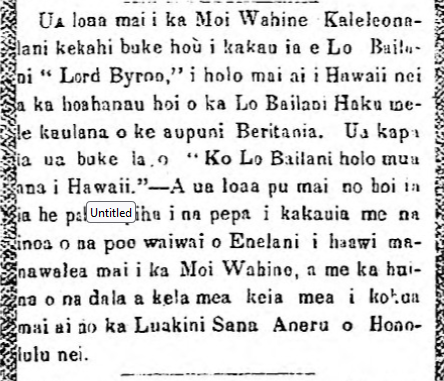
Queen Kaleleonalani has received a new book written by Lo Bailani “Lord Byron,” who sailed here to Hawaii nei, the cousin of the famous poet Lord Byron of Britain. The book is called, “Lord Byron’s first trip to Hawaii.” [Lord Byron’s 1825 Trip to Pearl River]–And she also received a box full of paper inscribed with the names of the wealthy ones of England given freely to the Queen, along with the sum of money each one has pledged to the Church of St. Andrew of Honolulu.
(Au Okoa, 11/26/1868, p. 2)
Ke Au Okoa, Buke IV, Helu 32, Aoao 2. Novemaba 26, 1868.
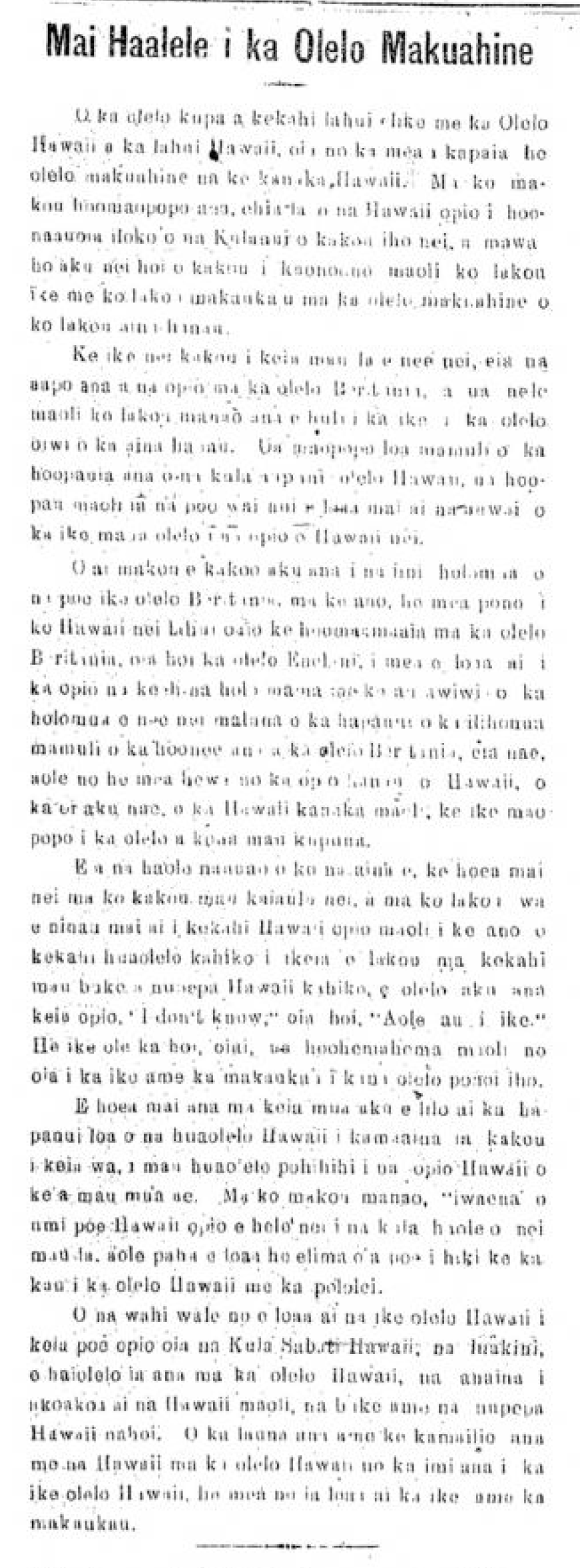
The native language of a people like the Hawaiian language to the Hawaiian people is called a mother tongue of the Hawaiians. In our understanding, how many Hawaiian youths could there be who are educated in our colleges or apart from us, and who are rich in their knowledge and preparedness in the mother tongue of their homeland.
We see in these days going by, the youth are acquiring English, and they have no intention of pursuing the native language of their land of birth. It is clear that because the Hawaiian language government schools were discontinued, the large sources of water [poowai] that fed the canals [auwai] of knowledge of that language to the youth of Hawaii were cut off.
While we support the desire to progress in speakers of English, being that it is beneficial for Hawaii’s people to become accustomed to the British language, that being English, so that the youth have a running start with the swift current of progress sweeping over the majority of the surface of the earth because of the push of English, and yet it would not be a bad thing for the young ones born here or even more so for Hawaiians to understand the language of their kupuna.
There are educated haole from other lands appearing in our neighborhoods and when they ask some native Hawaiian children about some old word they see in old Hawaiian books or old Hawaiian newspapers, they respond, “I donʻt know,” that being ”Aole au i ike.” They do not know for they are deficient in their knowledge and proficiency in their very own language.
There will come a a time when a majority of the Hawaiian words we are familiar with today will become words that are unclear to the Hawaiian youth of the future. We believe that among ten Hawaiian children attending a haole school today, there are probably not five of them that can write Hawaiian correctly.
The only places where these young ones can obtain Hawaiian language is at Hawaiian Sunday Schools, churches where Hawaiian is spoken, assemblies where Hawaiians gather, and Hawaiian books and newspapers. Associating with and talking with Hawaiians in Hawaiian in order to learn Hawaiian is the way to gain knowledge and proficiency.
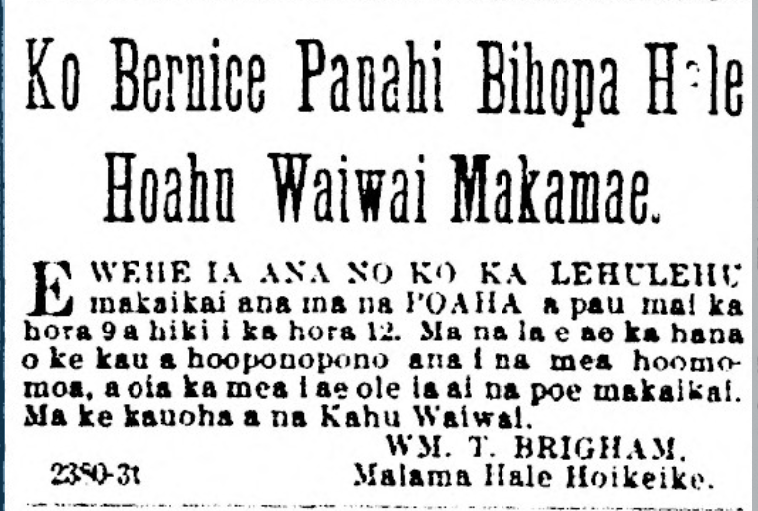
Ko Bernice Pauahi Bihopa Hale Hoahu Waiwai Makamae
To be opened to visitors every Thursday from 9 to 12 o’clock. On the other days placing and arranging of the collections [na mea hoomomoa], and therefore visitors are not allowed. By order of the Trustees.
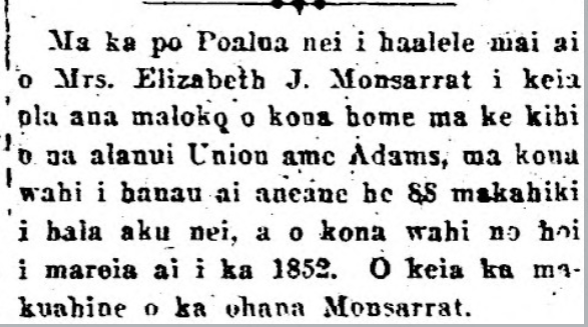
In the night of this past Tuesday, Mrs. Elizabeth J. Monsarrat left this life at her home on the corner of Union and Adams streets, the place she was born almost 88 years ago, and the place where she was married in 1852. She is the mother of the Monsarrat family.
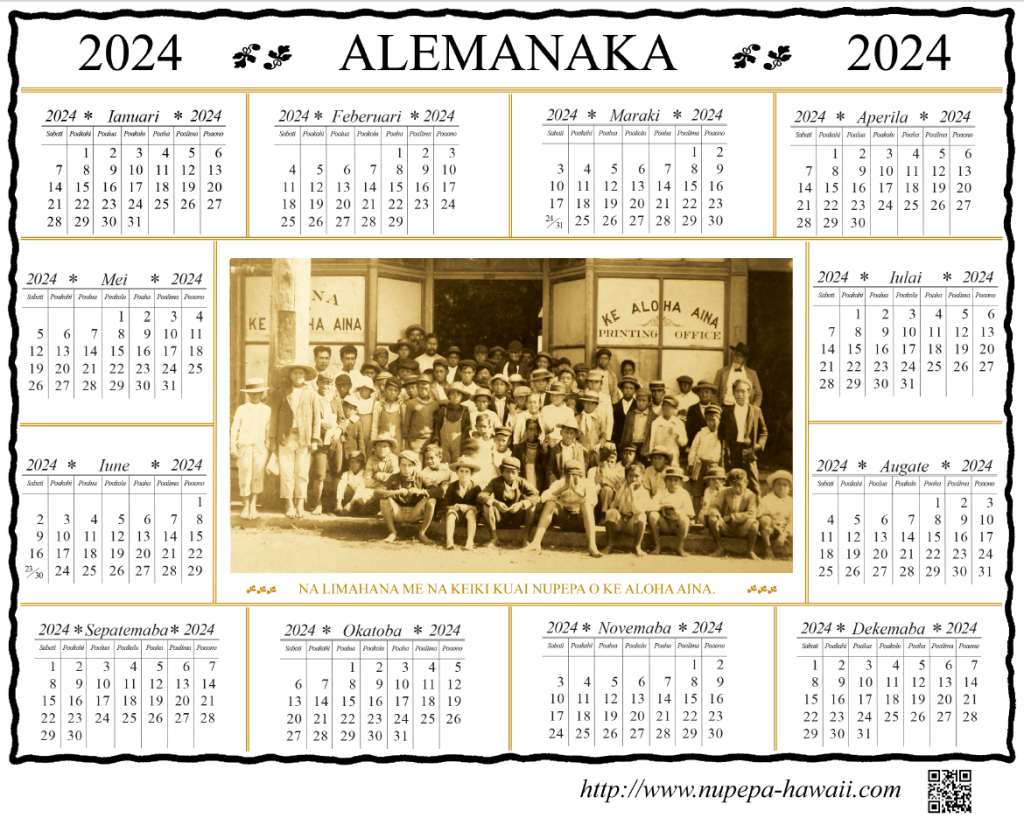
For a pdf file of this calendar fashioned after the 1906 Aloha Aina calendar to print out for your wall, just click on the image below! [I think the days are correct now!]
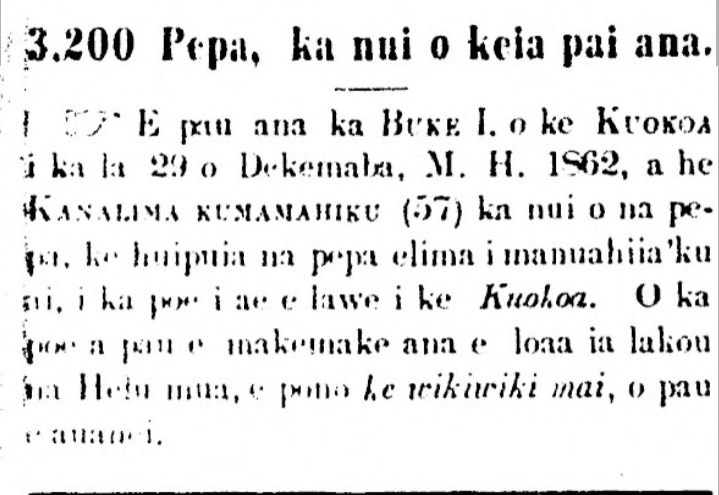
The first Volume of the Kuokoa will end on the 29th of December, 1862, and the number of issues will be fifty-seven (57), this includes the five given for free to those who agreed to take the Kuokoa. For all those who want the first issues, they need to be quick or they will be gone.
(Kuokoa, 1/11/1862, p. 2)
Ka Nupepa Kuokoa, Buke I, Helu 7, Aoao 2. Ianuari 11, 1862.
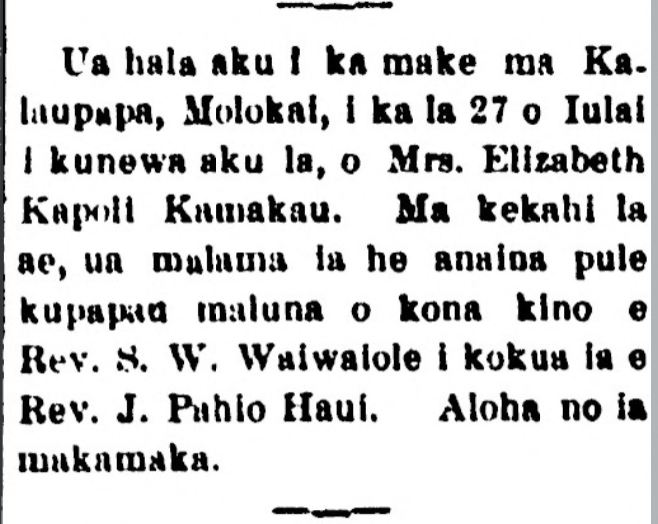
Passed on at Kalaupapa, Molokai, on the past 27th of July, was Mrs. Elizabeth Kapoli Kamakau. Some days later, a prayer gathering was held over the body by Rev. S. W. Waiwaiole, assisted by Rev. J. Pahio Haui. Aloha for that friend.
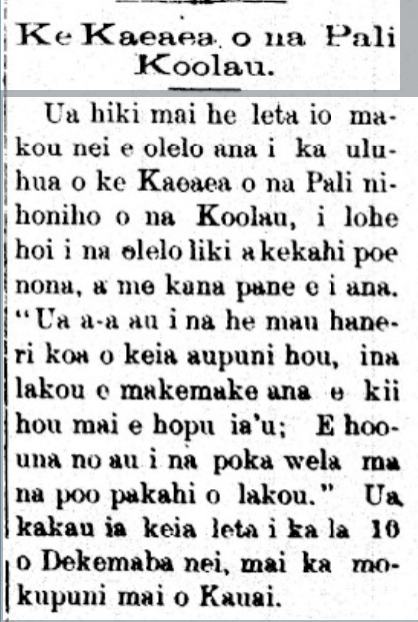
A letter has reached us, speaking of the displeasure of the Hero of the jagged Koolau cliffs hearing the boasts by some about him, and his response being, “I will challenge them even if there be hundreds of soldiers of the new government, if they want to try to capture me again. I will send fiery bullets through each of their heads.” The letter was written on the 10th of December from the island of Kauai.
(Leo o ka Lahui, 12/14/1893, p. 2)
Ka Leo o ka Lahui, Buke II, Helu 834, Aoao 2. Dekemaba 14, 1893.
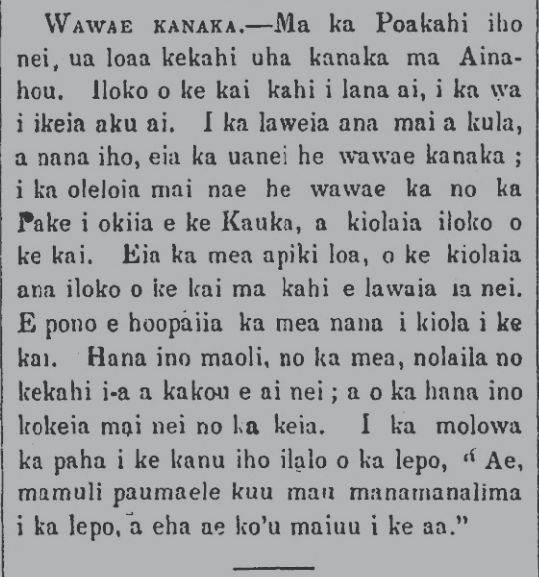
HUMAN LEG.–This past Monday, found was a human leg at Ainahou. It was floating in the ocean when it was noticed. When it was brought to shore, and examined, lo and behold, it was a human leg; it was said to be the leg of the Chinese person that was amputated by the Doctor and thrown into the sea. The bad thing about it is that it was thrown into the ocean where fishing is done. The person who threw it into the ocean should be punished. It is terrible, because some of the fish we eat comes from there; and it will decompose quickly. Perhaps they were too lazy to bury it. “Yes, my fingers will become filthy with dirt, and my nails will become sore from the exertion.”
(Kuokoa, 4/13/1865, p. 2)
Ka Nupepa Kuokoa, Buke IV, Helu 15, Aoao 2. Aperila 13, 1865.

 nupepa