Containers of new birds.—Upon the trading ship of the Chinese that stopped here, there were containers of new birds. The thing these birds do is to eat creeping things of the earth, they being caterpillars [peelua], worms [koe], and so forth. Continue reading
On the decline of native birds, 1871.
Locals of the Tuahine Rain are no more.
O Ke Au Okoa:—Aloha to you:
I am sending you a small gift atop your outstretched foundation, should your captain and Editor be so kind, and it will be for you to take it to the shores of these islands so that my newspaper-reading companions may see it, it being the letters placed above: “Some Locals of the Tuahine Rain¹ are no more,” and it has been ten or more years which they have not been seen.
And my friends are probably puzzled about these locals that have gone missing, and you, our old-timers, are all likely saying, not them, here they are, and some people have passed away, but we knew of their passing; but the departure of these kamaaina which I speak of was not witnessed. And this is it, the kamaaina birds of our uplands: the Iwi, the O-u…
View original post 711 more words
Bird catching, 1866.
[Found under: “SMALL NEWS OF HAWAII NEI.”]
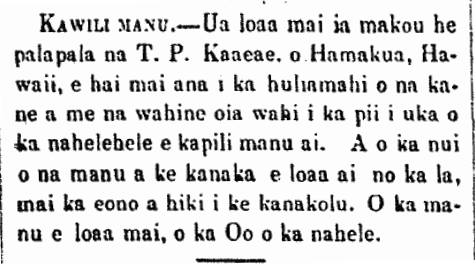
Bird snaring.—We received a letter by T. P. Kaaeae of Hamakua, Hawaii, saying that the men and women of that area are joined together in great numbers in climbing into the forests to snare birds [kapili manu; kawili manu]. And the number of birds caught by a person in a day is from six to thirty. The bird being caught is the Oo of the forests.
(Kuokoa, 3/17/1866, p. 2)
Foreign birds set free by the Honorable Lilia Kamakaeha, 1870.
[Found under: “NU HOU KULOKO: Oahu.”]
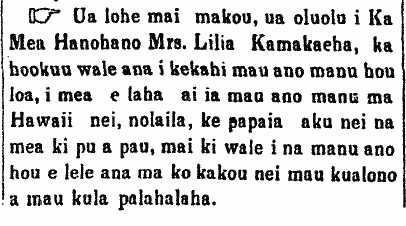
We hear that the Honorable Mrs. Lilia Kamakaeha was pleased at the releasing of some new kinds of birds so that they spread here in Hawaii nei. Therefore, all hunters are prohibited from shooting these new birds flying in our mountainsides and plains.
(Kuokoa, 10/1/1870, p. 2)
Ka Nupepa Kuokoa, Buke IX, Helu 40, Aoao 2. Okatoba 1, 1870.
Absence of singing-birds among our trees? 1865.
Canaries.—There is nothing which strangers so quickly notice as the absence of singing-birds among our trees and in our gardens. We have to rely on imported birds, and among these the canary is the finest songster. Continue reading
On rice birds in Punaluu, 1873.
[Found under: “Na Hiohiona o Koolauloa.”]
Pertaining to Punaluu.—This is rice farming lands for Chulan & Co. There is much rice in this land; there is much rice as well amongst the Hawaiians in Waiono, Makana, Puheemiki, Kapano, and Papaakoko; Continue reading
We all know what happened to that old lady who swallowed a fly, 1896.
THAT IS THE GREATEST OF CALAMITIES.
Because of the great many calamities faced by the sugar industry in Hawaii, therefore some people think best thing is for us to import another animal larger than the Mongoose to kill off the Mongoose.
That is a great misconception, but this would cause yet even more calamities. Continue reading
Two wallabies become five in a few years, 1920.
LOST WALLABIES REAPPEAR
Three years ago R. H. Trent lost two wallabies, which escaped from his private menagerie on Alewa Heights. Now he has five. Continue reading
“[They] may propagate and produce eventually a breed of Hawaiian wallabies.” 1916.
RICHARD H. TRENT’S WALLABIES FLEE FROM THEIR CAGES
Strange Australian Pets of Real Estate Man Escape Into Mountains
Richard H. Trent, Honolulu’s animal impresario, issues a call to all citizens of Oahu today to join in a mammoth, personally conducted wallaby hunt, the first of its kind ever held in the Hawaiian archipelago. Continue reading
Wallabies still missing, 1916.
TWO WALLABYS TAKE TO THE HILLS, STILL MISSING
If you meet a wallaby on your way home tonight take him by the hand and lead him to the offices of the Trent Trust Company. Richard H. Trent is looking for a pair of them he lost Saturday night and will give $25 for their return. Continue reading