DAY TO CELEBRATE LEI IN HILO
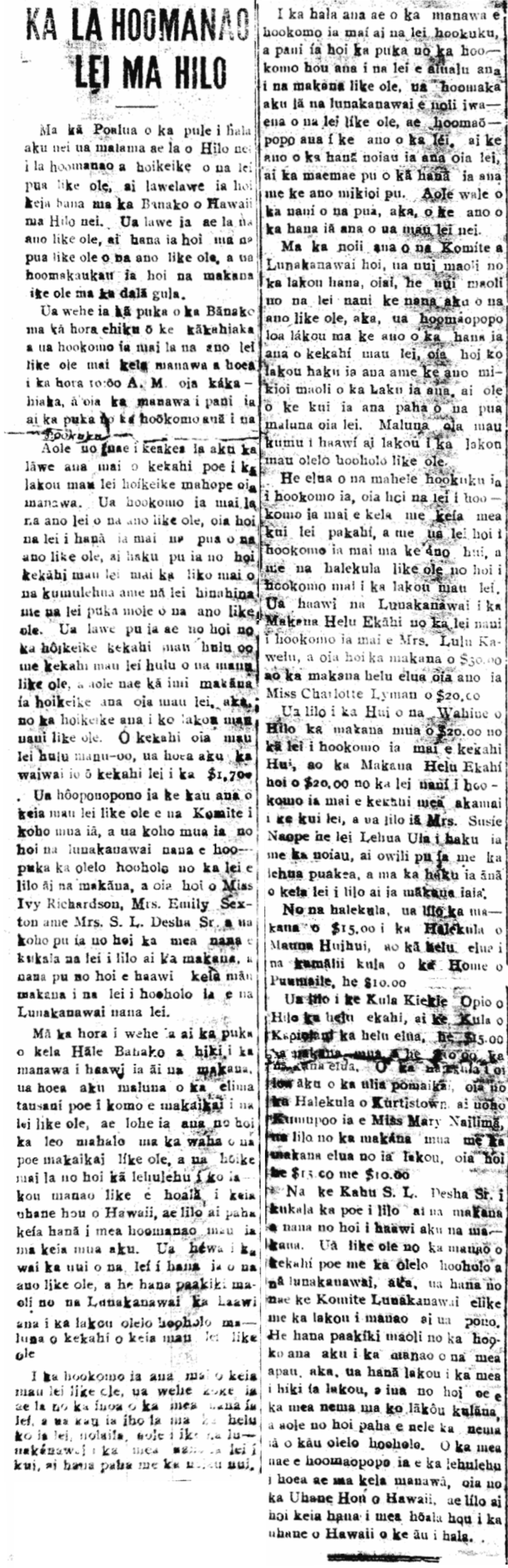
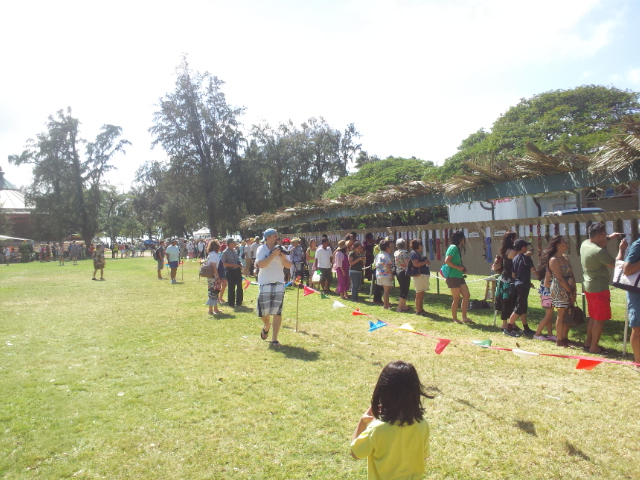
On Tuesday last week, Hilo held a celebration and display of flower lei of all sorts, and this was done at the Bank of Hawaii in Hilo. All types of lei were brought down and they were made will all kinds of flowers of all types, and prizes of all kinds were prepared of gold coins [dala gula].
The doors of the Bank were opened at seven in the morning, and lei of all types were brought in from then on until 10:00 A. M. of that morning, and then the doors were closed to bring in the judges.
However the bringing in of lei to put on display by others after that was not barred. Entered were all types of lei of all sorts; for instance, lei made of various flowers, and some lei were woven with the buds of the lehua, and lei hinahina, and lei pukamole of all sorts. Also brought for display were some oo bird feathers, and feather lei of various birds, but they were not there for judging, they were just there to show the many beautiful kinds. Some of those lei of oo bird feathers are valued at $1,700 for one.
The placing of the various lei were organized by the Committee chosen earlier, and also chosen before were the judges who would decide which lei won the prizes, and they were Miss Ivy Richardson, Mrs. Emily Sexton, and Mrs. S. L. Desha, Sr. Also selected was the one who would announce the winning lei and he would also hand out the prizes decided upon by the lei judges.
From the time when the Bank was opened until the time when the awards were given, there was approximately five-thousand visitors who entered to look at the many lei, and voices of appreciation were heard from the mouths of many attendees, and the crowd expressed their joint feelings to rouse this new Hawaiian spirit, and that this event will be commemorated always from now on. There were countless [hewa i ka wai] lei that were crafted of all sorts, and it was truly a difficult task for the Judges to give their decision on some of these lei.
When the many lei were brought in, the name of the maker was immediately announced, and a number was given to the lei, so therefore the judges did not know who strung the lei, or crafted them with great skill.
When the period for the competition lei to be entered was over and the doors were closed to the entry of lei competing for the various prizes, the judges began to examine each lei, paying attention to make up of the lei, and how it was crafted, and how cleanly it was made and how neat they were as well. [They were judged] not on just how pretty the flowers were, but on how the lei were made.
In the examination by the Judging Committee, their job was tremendous, being that there were just so many beautiful-looking lei of all sorts, but some were distinguished by how they were made, in that they were woven with true craftsmanship, or by how the flowers were sewn into the lei. By those qualities did they hand down each of their judgements.
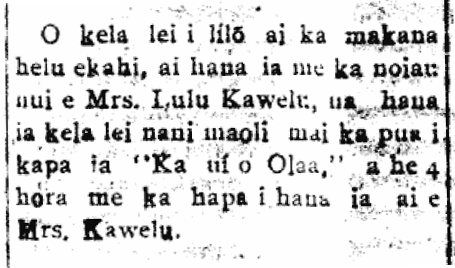
There were two competition divisions that were entered, those being lei entered by individual lei makers, and lei entered by a group, and many different schools entered their lei. The Judges awarded the First Place Prize to the beautiful lei entered by Mrs. Lulu Kawelu, and that was a prize of $30.00 and the second place prize went to Miss Charlotte Lyman, $20.00.
To the Women’s Association of Hilo went the first prize of $20.00, for the lei entered by a group; and the First Place Prize of $20.00 for the beautiful lei entered by a skilled maker of lei—to Mrs. Susie Naope with a lei of Red Lehua skillfully woven and wound with white lehua, and by weaving this lei, that prize went to her.
As for the schools, the prize of $15.00 went to the Mauna Huihui School, and the second place to the school children of Puumaile Home, a prize of $10.00.
To Hilo Junior High School went the first place, and to Kapiolani School the second place; $15.00 was the first prize and $10.00 was the second prize. The school that was the luckiest was the Kurtistown School, whose principal is Miss Mary Nailima—to them went the first prize and second prize, $15.00 and $10.00.
Kahu S. L. Desha, Sr. announced the winners of the prizes and it was he who presented the prizes. Some people had all sorts of ideas regarding the decisions of the judges, but the Judging Committee did as they thought was right. It is difficult indeed to please everyone, but they did what they could, and should you, O Fault Finders, be in their place, there mostly surely would be those faulting your decisions. The thing sensed by the crowd there at that time was the new Hawaiian spirit; and this event will become something that reawakens the spirit of Hawaii of times past.
(Hoku o Hawaii, 5/8/1928, p. 2)
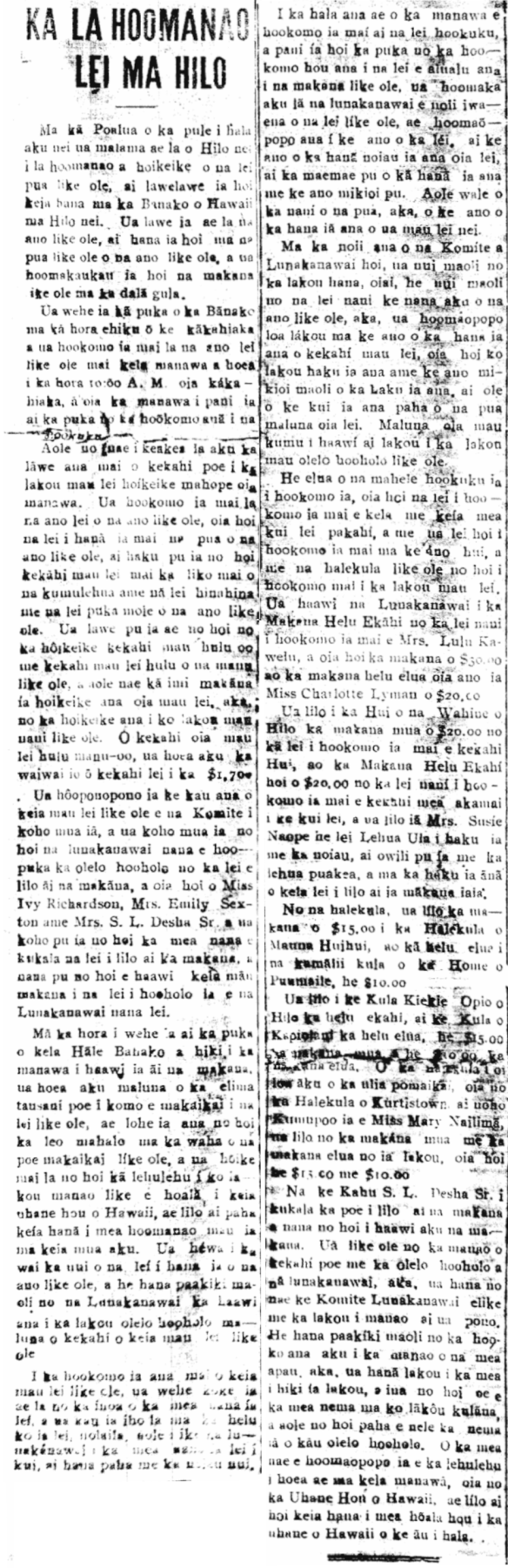
Ka Hoku o Hawaii, Buke XXI, Helu 48, Aoao 2. Mei 8, 1928.

 nupepa