This is an independent blog. Please note that I am nowhere near fluent, and that these are not translations, but merely works in progress. Please do comment if you come across misreads or anything else you think is important.
Just another place that posts random articles from the Hawaiian Newspapers! It would be awesome if this should become a space where open discussions happen on all topics written about in those papers!! And please note that these are definitely not polished translations, but are just drafts!!!
[This blog is not affiliated with any organization and receives no funding. Statements made here should in now way be seen as a reflection on other organizations or people. All errors in interpretation are my own.]
A new newspaper called, Ka Leialii o Hawaii was raised from the grave of the Nupepa Elele which died from lack of greenery needed to survive. A writer of that Leialii says because of the very little salary of the boys of the Pacific Commercial Advertiser Press [Halepai Kalepa] that they are hungry. This is not true because the PCA Press is paying its Hawaiian typesetters high wages from eight to twenty-five dollars a week. The Leialii cannot pay such high wages. Therefore what this writer speaks of is a big lie!
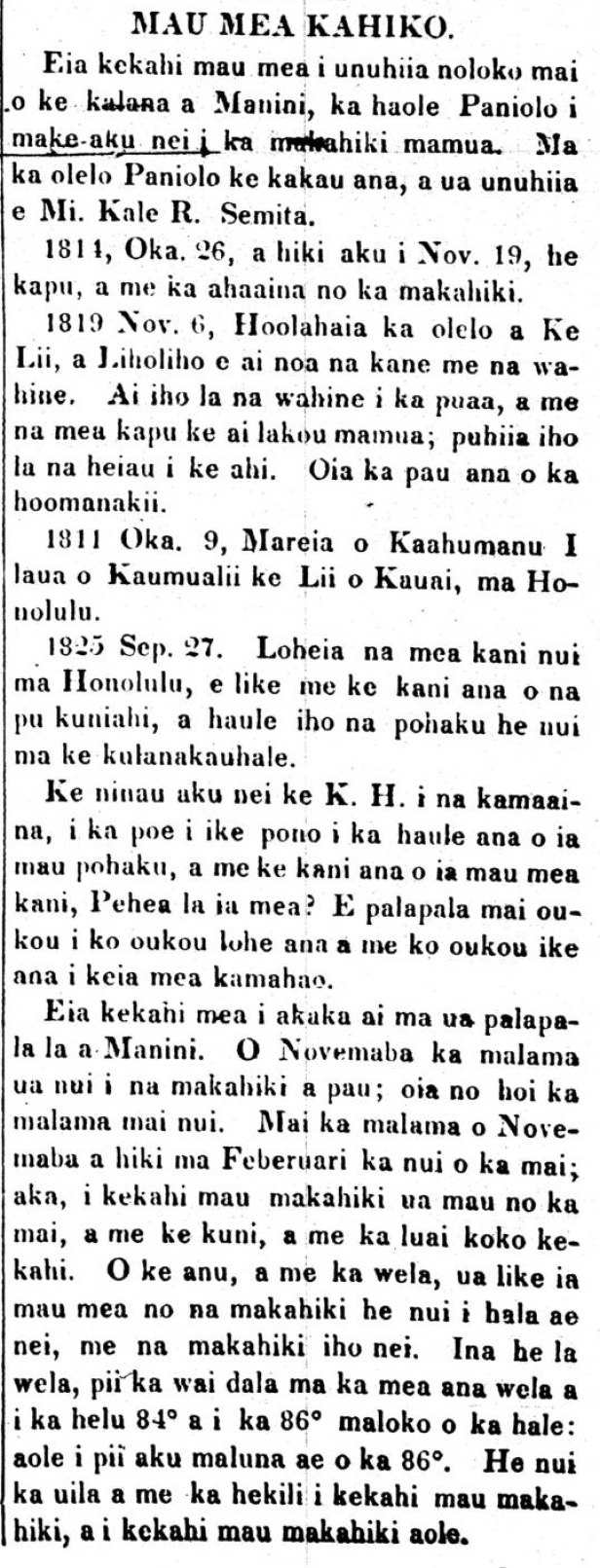
Here are some things translated from the writings of Francisco de Paula Marin [Manini], the Spanish haole who died the previous year. The writing was done in Spanish, and they were translated by Mr. Charles R. Smith [Mi. Kale R. Semita].
1814, Oct. 26, until Nov. 19, there was a kapu, and a feast for the Makahiki.
1819, Nov. 6, The word of the King, Liholiho, that the men and women would eat freely. The women ate pig, and other foods that were kapu to them previously; the heiau were burned down. It was the end of idolatry [hoomanakii].
1811, Oct. 9, Kaahumanu I was married to Kaumualii, the King of Kauai, at Honolulu.
1825, Sep. 27. There was a great noise heard in Honolulu, like the sound of canons; there were a lot of rocks which rained down upon the town.
Ke Kumu Hawaii newspaper asks the kamaaina, the ones who witnessed the falling of these rocks, and the sound of it [falling]. What was this like? Write to us how it sounded to you and how this amazing thing appeared to you.
Here is another thing that was clear through those writings of Manini. November is the month that there is much rain every year, and that is the month when there is much sickness. From the month of November to February there is much sickness; but some years, the sicknesses go on, along with fever, and also vomiting blood. Cold and heat, they are the same as many years before, as well as recent years. If it is a hot day, the mercury rises in the thermometer to 84° to 86° indoors; it does not go above 86°. There is much lightning and thunder some years, and in others there is none.
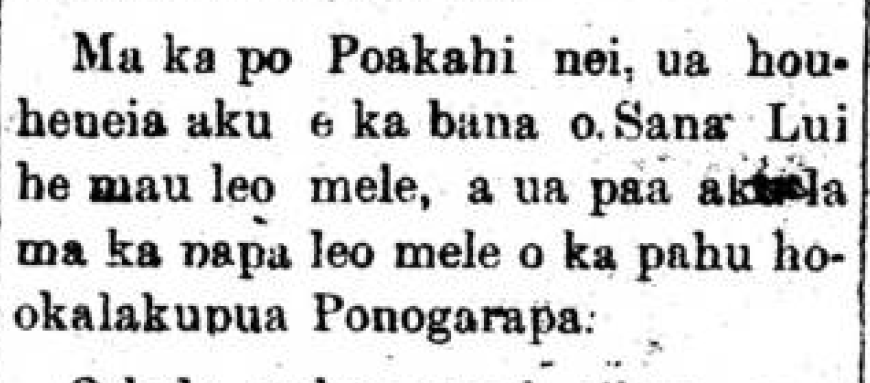
On Monday of this week, the Alii, the Queen went to where the amazing talking gourd, the ponogarapa was being shown to listen to the speaking of the Hawaiian Consul in New York with his own voice to the Queen from this talking gourd in English, thus:
I ka Moiwahine Liliuokalani o Ko Hawaii Pae Aina:–E oluolu e lawe aku i ko’u mau hoomaikai ma o ka hookomoia ana aku o ka ponogarapa a Edisona iloko o ke aupuni o Hawaii. E oluolu e hoomau ia ko ka Moiwahine ola maikai, a o kou lahui hoi me na manao maikai i ko makou lahui.
Owau iho no o kau kauwa hoolohe, Elliah H. Allen, Kanikela Nui o Hawaii.
To Her Majesty Liliuokalani of the Hawaiian Islands:–Please to accept my congratulations on the introduction of Edison’s phonograph into the Kingdom of Hawaii. Please Your Majesty to continue to enjoy excellent health, and your people the good will of our nation.
I have the honor to be your most obedient servant, Elliah H. Allen, Consul-General of Hawaii.
On that very same day, the Queen spoke into that talking gourd, thus:
Owau keia o Liliuokalani:–
O keia la 16 o Novemaba, M. H. 1891 ka la hanau o ka Moi Kalakaua. Ua haawi mai o Mr. Stoeckle i kona lokomaikai piha e ae ia’u a me ka’u mau hoahele e ae, a me na Keikialii Kawananakoa a me Kalanianaole, a me na lede a me na keonimana e ae e hoolohe i na mea maikai e puka mai ana mai keia ponogarapa (phonograph) mai. He la keia e hoopoina ole ia ai iloko o na puuwai o na Hawaii ponoia a pau. He la keia e hoopiha ana i na puuwai o na mea a pau i ke aloha no ko lakou Moi Kalakaua i hala. Aole e pau ana ko makou hoomanao ana i na mea i lohe ia mai keia ponogarapa mai. Ua oi aku ka nani o keia mea maikai mamua o ka makou i lohe ai mamua,–ka moakaka o na olelo oloko a me na manao maikai i hoopuka ia e Hon. Mr. Allen o Nu Ioka. Pela i hoike ia ai ka maikai o keia mekini. Aloha oukou.
I am Liliuokalani:–
Today, the 16th day of November, A. D. 1891, is the birthday anniversary of King Kalakaua. Mr. Stoekle has kindly extended a most courteous invitation to myself and my companions; also the Princes Kawananakoa and Kalanianaole, and several ladies and gentlemen, to listen to the delightful things coming from this phonograph. Every true Hawaiian can never forget the memory of this day. This is a day that will produce in the hearts of all a deep aloha for Kalakaua, their late beloved sovereign. We shall long remember what we have heard from this phonograph today. This wonderful instrument excels in clearness to what we have heard before. The words and the kindly expressions of Hon. Mr. Allen of New York are produced with perfect distinctness. Such are the delightful qualities possessed by this machine. Aloha oukou.
I came from the countryside, and stayed a for a bit in Honolulu. I witnessed some things that are not right:
Pigs should not travel in droves on the streets of town.
People should not raise so many dogs. You hardly can walk on the streets without being bitten. It is almost impossible to sleep at night because of the chattering dogs. The town is close to facing a famine because much of the food goes to the dogs.
This is another thing I witnessed that was not right, the leaving of dead animals on the streets. It is better to bury them. [If not] maybe and epidemic will develop.
And another thing, springs should not be left open where people walk.
Kawaiahao Church and the cemetery should not be left so it becomes a place where pigs live. Where are you O Friends of those buried there? It would seem that you would get together and rebuild the wall that has fallen and is left gaping.
(Hae Hawaii, 9/3/1856, p. 107)
Ka Hae Hawaii, Buke 1, Helu 27, Aoao 107. Sepetemaba 3, 1856.
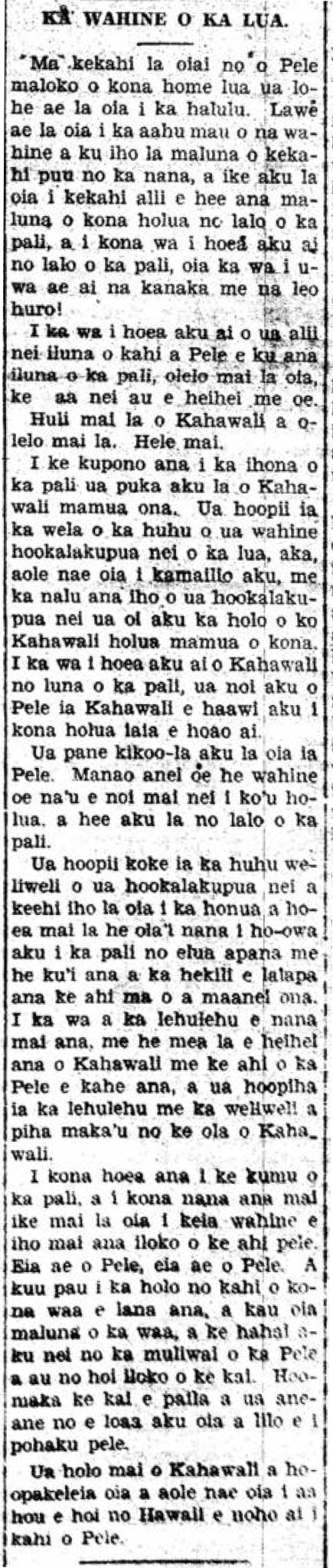
One day when Pele was in her home in the pit, she heard a rumbling. She took the regular attire of women and stood atop of a hill to look, and she saw a chief gliding upon his holua sled, down a cliff, and when he arrived at the bottom of the cliff, that was when the people cheered.
When the chief arrived up where Pele stood, on top of the cliff, she told him, “I will take the challenge to sled with you.”
Kahawali turned and replied, “Let’s go.”
When the incline of the cliff was right, Kahawali came out in front of her. The heat of anger of that woman of the pit rose, but she did not speak. That wondrous one imagined that Kahawali’s holua was faster than hers. When Kahawali reached the top of the cliff, Pele asked him to give his holua to her to try out.
He spoke sassily to Pele. “You think that you are a woman that can ask me for my holua and go gliding down the cliff?”
The frightening anger of that wondrous one quickly escalated and she stomped and there appeared an earthquake that cleaved the cliff in two, while thunder clapped and fire blazed on this side of him and that. When the crowd was watching, it appeared as if Kahawali was racing with the flowing fires of the lava, and they were filled with fright, and were filled with fear for the life of Kahawali.
When he reached the base of the cliff, and he looked and saw this woman coming down within lava. Here comes Pele, here comes Pele. And he ran with all his might to where his canoe was floating, and he got in, and he was chased by the river of lava and he sailed out to sea. The water began to boil and he was nearly caught and turned into volcanic rock.
Kahawali sailed on and he was saved, but he did not dare to return to Hawaii and stay near Pele.
(Alakai o Hawaii, 1/16/1930, p. 3)
Ke Alakai o Hawaii, Buke 2, Helu 38, Aoao 3. Ianuari 16, 1930.
REMINISCENCE OF MY DEAR HUSBAND WHO HAS GONE AFAR.
WILLIAM K. HOLOUA
To you Mr. Solomon Hanohano, the Editor of the Kuokoa Newspaper; Aloha oe:–Please insert the words above into the body of our people should there be spare room, and it will take it so that the family and friends of my dear husband who has gone afar, from the rising sun at Kumukahi to the setting sun at Lehua.
I am a malihini before you, but aloha has urged me to step unfamiliarly onto your wondrous deck.
On Thursday morning, August 24, 1922, at 10:25, my dear husband William Kanuu Holoua grew weary of this life, at our adoptive home, 440 North King St., and left his cold body for me and our only child who grieve in this world.
Auwe, my never ending aloha for my dear husband, my companion in all places. He was born at Naalehu, Kau, Hawaii, in the month of January 22, 1877, from the loins of his mother Kinolau Hilinai and Daniel Holoua Aa, his father, and he spent 45 years, 7 months, and 2 days in this world of hardships, when he passed on.
We were joined in the covenant of marriage on April 25, 1895, at Keauhou, Kau, Hawaii, by Father Kelekino, we were married for 27 years and four months, and it was death that separated us for all times; our marriage was blessed with two sons; our eldest son died, and remaining is one of my sons, Joseph Kanuu Holoua.
When he was with good mental faculties, he was an open-hearted man, welcoming, and hospitable to all that visited our home. He was important to his friends, from the prominent to the lowly, he cared for his wife, and his entire family living in our presence.
He did all sorts of work to make a living. He joined the police force in the district of Kau, Hawaii, in the month of February 1, 1914, and from police to jailor, and from that position to lieutenant, and because he had a sickness which made his thinking go strange, he left his work in the month of August 1, 1921, and it was from then that the sickness began small until it grew large.
Because of this difficulty, we left the land with our child on April 2, 1922, and wandered to this unfamiliar land in search of a cure, but there was no victory over this sickness which he had, and it turns out that he returns to his land of birth as a corpse, aloha for our sailing the ocean together, and he goes alone leaving me in this unfamiliar land. Auwe for my dear companion.
His body was taken to Borthwick Mortuary to be embalmed, and on Thursday, the 31st of August, 1922, his body was revealed to see his features, and the day following was the last time we saw his features for the very last time.
With grieving heart, i recall that unforgettable night. Auwe my dear companion, my husband!
We give our full appreciation to everyone who came to mourn with us, along with your gifts of flower bouquets and paper lei; we are greatly indebted to you all, and to our aikane goes our great thanks; Mr. and Mrs. A-i, our parents in this unfamiliar land were more than parents to a child and blood to blood, it is to them that we owe the most. On the following first of September 1922, we boarded the Maunaloa to take home his body to Kau.
When we stopped at Honuapo, the pier was filled with intimates, friends, and the police force in full uniform. It was overcome with emotion, it was as if my dear husband was standing with them. The police force carried his coffin and placed it on the car, and stood at the start where the procession began to march from the pier to our home, makai side of his coffin, at Kaunamano Homestead, Naalehu, Kau, Hawaii, under the direction of George K. Kawaha.
While the grave was being dug, his prayer gathering was being held at the residence of J. L. K. Kawaha, and at the grave was where his final memorial was concluded.
We give our thanks to the people who gathered on that day, and the sailors of the Maunaloa for their help to dig the grave of my dear husband who has gone afar, and to George K. Kawaha goes boundless appreciation, as well as for previously helping us. Blessed be the name of the Lord, He who giveth and He who taketh away. Amen!
With the Editor of the Kuokoa go our final regards, and also the boys of your press,
With sadness, MRS. LIHAU K. HOLOUA, JOSEPH H. K. HOLOUA.
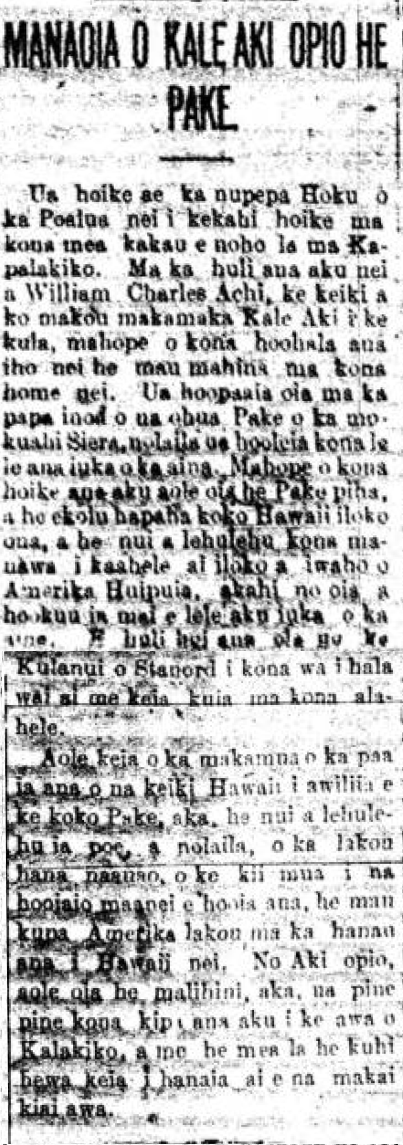
This Tuesday’s Star published a report from a correspondent living in San Francisco. When William Charles Achi, the son of our friend Kale Aki, was returning to school after spending some months at home, his name was on the list of Chinese passengers on the steamer Sierra, so he was not allowed to debark. After he stated he was not full Chinese and that he was three-fourths Hawaiian, and that he traveled in and out of the United States many times, and this was the first time he was released to go ashore. He was returning to Stanford University when he met with this obstacle on his trip.
This wasn’t the first time that a Hawaiian with mixed Chinese blood was detained, but there were many of those people, Therefore the wise thing for them to do would be to get in advance proof that they are American citizens by being born in Hawaii nei. Achi Jr. is not a stranger, but he has frequently visited the port of San Francisco, and it is as if this was an error carried out by the port security officers.
Also, did you see the quilt the Achis gifted to the family W. C. Achi Jr. was staying with in Chicago posted by Bishop Museum the other day? Click here to check it out.]
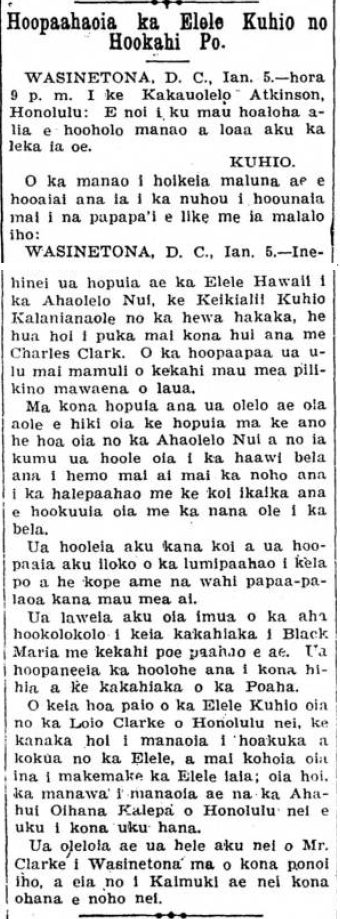
WASHINGTON, D. C., Jan. 5.–9 p. m. To Secretary Atkinson, Honolulu: Ask of my friends to wait before coming to a conclusion until you receive a letter.
KUHIO.
The thought shown above clarifies the news sent to the presses like that below:
WASHINGTON, D. C., Jan. 5.–Yesterday, Hawaiian Delegate to Congress, Prince Kuhio Kalanianaole was arrested for the offence of fighting, resulting from when he met with Charles Clarke. The fight grew from some personal matters between the two.
On being arrested, he said that he cannot be arrested being a member of Congress, and for that reason he refused to give bail to be released from staying in jail as he strongly demanded to be released without consideration of the bail.
His demands were not heeded and he was detained in a jail room that night and his food was coffee and some toast.
He was brought before the court this morning in the Black Maria with some other prisoners. The hearing of his case was postponed until Thursday morning.
This opponent of Delegate Kuhio is Attorney Clarke of Honolulu, the man who is was thought of as adviser and assistant for the Delegate, and he almost was selected, had the Delegate liked him; it was then that the Honolulu Traders Association will pay his wages.
It is said Mr. Clarke went to Washington by his own means, and here in Kaimuki lives his family.