Unknown's avatar

About nupepa

Just another place that posts random articles from the Hawaiian Newspapers! It would be awesome if this should become a space where open discussions happen on all topics written about in those papers!! And please note that these are definitely not polished translations, but are just drafts!!! [This blog is not affiliated with any organization and receives no funding. Statements made here should in now way be seen as a reflection on other organizations or people. All errors in interpretation are my own.]

Salt from Halekou, Kaneohe, 1890.

SALT FOR SALE.

Here at Halekou, Kaneohe, Koolaupoko, is very nice salt for sale to anyone who wants to buy. Consultation is pleasant, and prices are reasonable, whether it be for a bag, or two, or more, or a ton. I can be found at Halekou, Kaneohe, Koolaupoko, or if not me, my wife.

CHARLES I. HIRAM.

(Ko Hawaii Paeaina, 2/8/1890, p. 3)
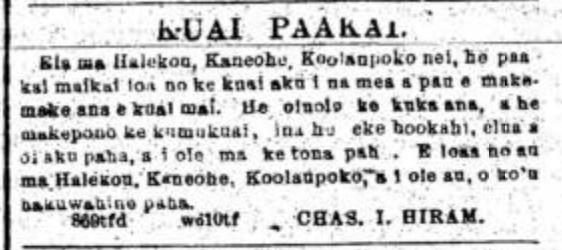
Ko Hawaii Paeaina, Buke XIII, Helu 6, Aoao 3. Feberuari 8, 1890.

Salt from Kealia, Maui, 1856.

PERTAINING TO SALT AT KEALIA IN MAUI.

I want to tell you about the abundance of salt at Kealia here in Maui.

This year, the salt here in Kealia is very good; and there is a lot.

There has not been a year like this one where there has been so much salt, and so fine; and it appears these days when looking at the salt like there are 4,000 tents in Kealia.

Continue reading

Portuguese holiday, 1897.

[Found under: “NU HOU HAWAII”]

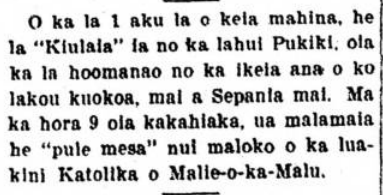
The first of this month [December] was a “Kiulaia” [Holiday] for the Portuguese, that being the day commemorating the recognition of their independence from Spain. From 9 o’clock in the morning, a great mass was held in the Catholic church Malieokamalu.[Maliaokamalu / Our Lady of Peace].

[Kiulaia seems to be interchangeable with Kulaia, but for some reason, Kiulaia is often found in quotes as seen in this article.]

(Kuokoa, 12/3/1897, p. 3)

Ka Nupepa Kuokoa, Buke XXXVI, Helu 49, Aoao 3. Dekemaba 3, 1897.

Frogs, 1903.

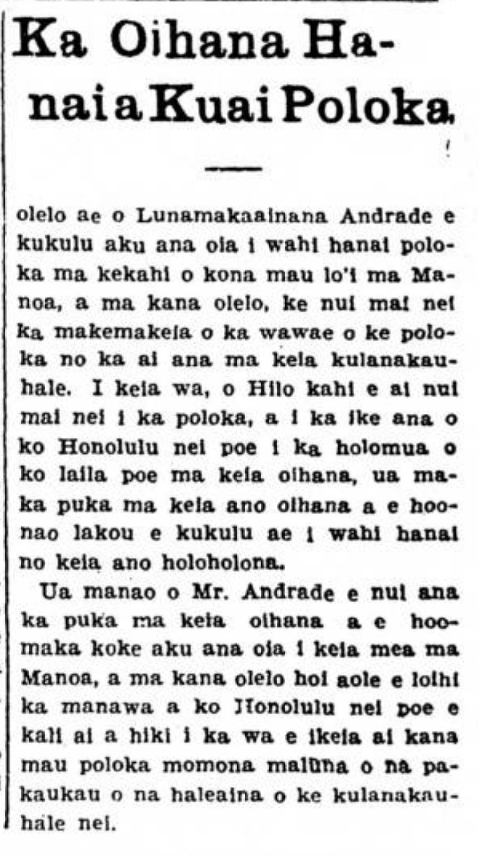
The Business of Raising and Selling Frogs.

Representative Andrade said he will build a frog breeding grounds in some of his taro patches at Manoa, And according to him, the requests for frog legs for eating in this town is increasing. Currently, Hilo is where frog is eaten a lot, and when Honolulu people see the progress of those in this business, they will think of building a place to raise those animals.

Mr. Andrade believes that profits from this business will grow and he will start this venture in Manoa, and according to him, it will not be long for Honolulu people to wait before they will see his juicy frog on tables at restaurants in town.

(Kuokoa, 7/17/1903, p. 5)

Ka Nupepa Kuokoa, Buke XLI, Helu 29, Aoao 5. Iulai 17, 1903.

Did Kamehameha IV Have Bears? Oh my! 1857,

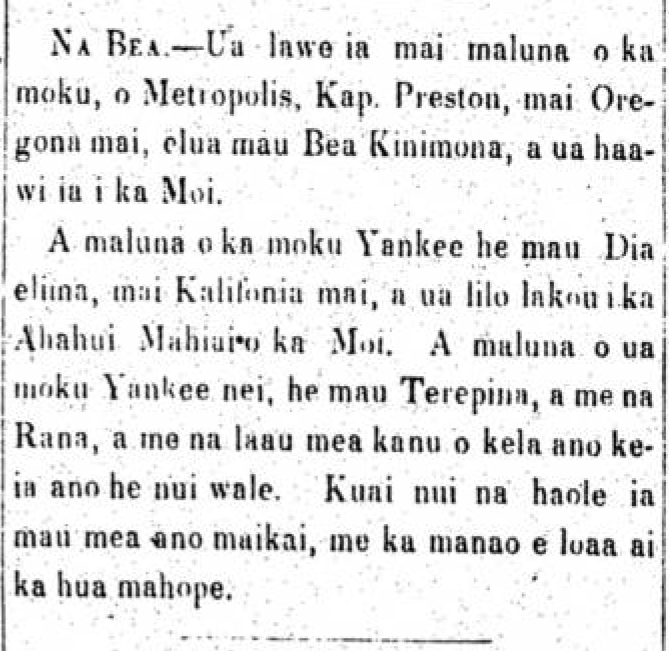
Aboard the ship the Yankee were five Deer, from California, and they went to the Royal Hawaiian Agriculture Society, of the King. And aboard that ship the Yankee, were some Terrapin and Frogs, and many types of plants. Haole buy those fine things with the thought they would have fruit in the future.

Bears.–Brought aboard the ship the Metropolis, Capt. Preston, from Oregon, were two Cinnamon Bears, and they were given to the King.

(Hae Hawaii, 12/2/1857, p. 142)

Ka Hae Hawaii, Buke 2, Ano Hou—Helu 2, Aoao 2. Dekemaba 2, 1857.

Hillebrand brings in frogs, 1857.

Something New.

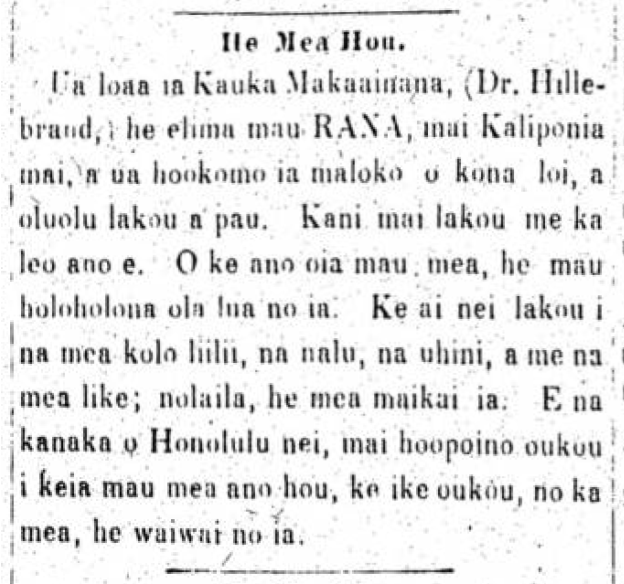
Kauka Makaainana (Dr. Hillebrand) has five FROGS [RANA] from California and he has put them in his taro patch. They are doing fine. They make strange noises. Their nature is that they are animals that have two lives. They eat small bugs: flies, grasshoppers, and other things like that. Therefore they are good. O People of Honolulu, do not harm these new things if you see them, because they are valuable.

(Hae Hawaii, 9/30/1857, p. 106)

Ka Hae Hawaii, Buke 2, Ano Hou—Helu 27, Aoao 106. Sepetemaba 30, 1857.

Altercation at the Chinese Times, 1896.

[Found under: “NU HOU HAWAII”]

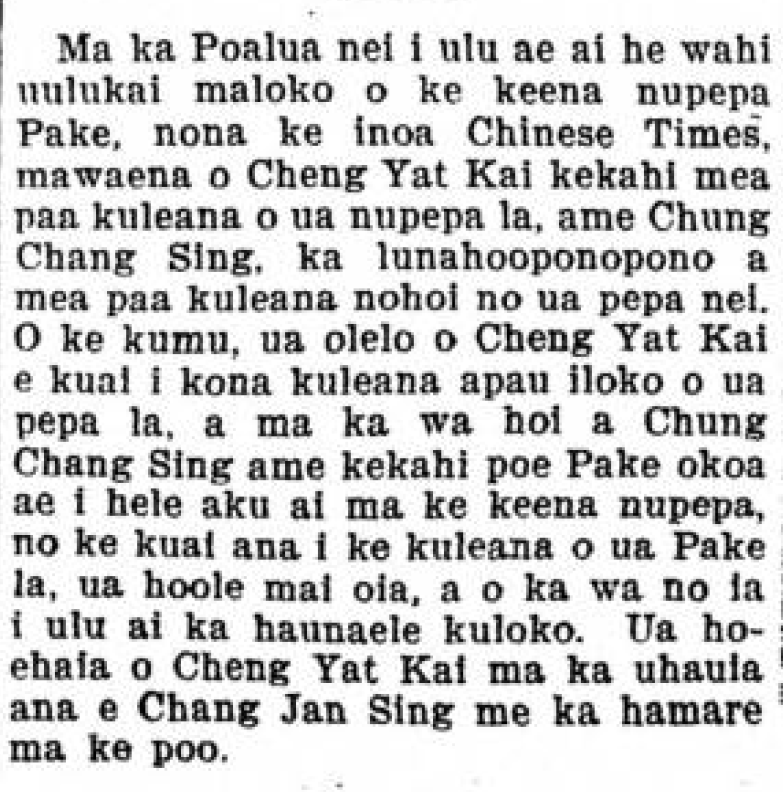
This past Tuesday, an altercation [uulukai] arose in the Chinese newspaper office by the name of Chinese Times [Wah Ha Bo] [華夏報], between Cheng Yat Kai, one of those who holds ownership in that newspaper, and Chung Chang Sing, the editor and also an owner in the paper. The cause was Cheng Yat Kai saying that he would sell all of his interests in the paper, and when Chung Chang Sing and some other Chinese got to the newspaper office to purchase the interests of that Chinese, he refused, and that was when the internal riot began. Cheng Yat Kai was injured by Chang Jan Sing hitting him in the head with a hammer.

(Kuokoa, 8/21/1896, p. 3)

Ka Nupepa Kuokoa, Buke XXXV, Helu 34, Aoao 3. Augate 21, 1896.

A new Portuguese newspaper, 1885.

O Luso Hawaiiano.

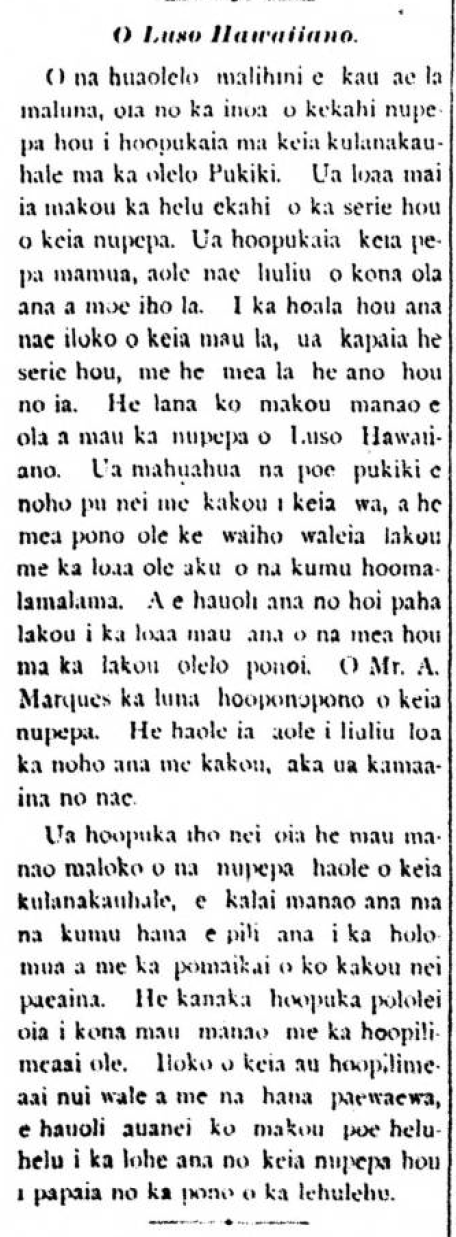
The unfamiliar words placed above is the name of a new newspaper published in town in the Portuguese language. We got a hold of the first issue of the new serie of this newspaper. This paper was published earlier, but it was not long lived before it went to sleep. After being revived these days, it was called a new serie, like it is a new ano [new series]. We hope this newspaper O Luso Hawaiiano will live forever. The number of Portuguese living with us lately has increased, and it would not be good to just have them be without means to gain knowledge. And they will probably be happy to regularly acquire news in their own language. Mr. A. Marques is the editor of this newspaper. He is a haole that has not lived long amongst us, but his is a kamaaina nonetheless.

He has had editorials printed in haole newspapers of this town, speaking of subjects pertaining to the progress and prosperity of our archipelago. He is a man who speaks his mind without being ingratiating [hoopilimeaai]. In this age of much ingratiation and prejudice, our readers will be happy to hear of this new newspaper established for the good of the people.

[Hamilton Library put up online the Portuguese language newspapers from Hawaii. CLick here to be taken to O Luso Hawaiiano.]

(Kuokoa, 8/22/1885, p. 2)

Ka Nupepa Kuokoa, Buke XXIV, Helu 34, Aoao 2. Augate 22, 1885.

Hawaiian boys in Port Gamble–A different point of view, 1877.

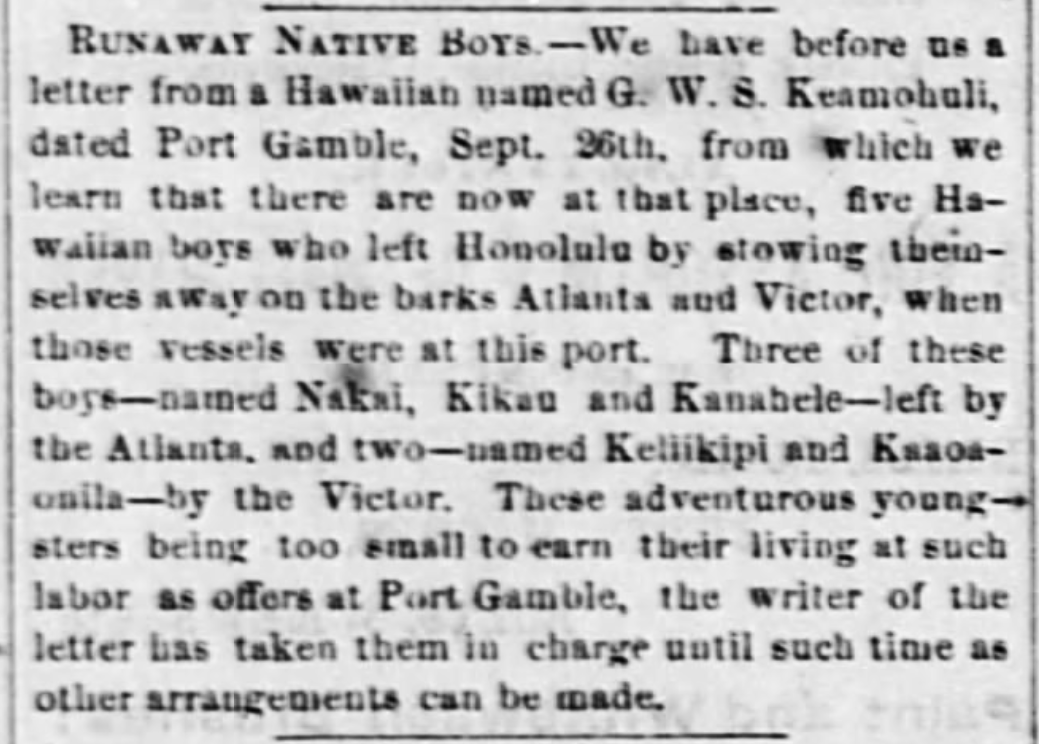
Runaway Native Boys.–We have before us a letter from a Hawaiian named G. W. S. Keamohuli, dated Port Gamble, Sept. 26th, from which we learn that there are now at that place, five Hawaiian boys who left Honolulu by stowing themselves away on the barks Atlanta and Victor, when those vessels were at this port. Three of these boys–named Nakai, Kikau and Kanahele–left by the Atlanta, and two–named Keliikipi and Kaaoaouila–by the Victor. These adventurous youngsters being too small to earn their living at such labor as offers at Port Gamble, the writer of the letter has taken them in charge until such time as other arrangements can be made.

(Hawaiian Gazette, 11/7/1877, p. 3)

Hawaiian Gazette, Volume XIII, Number 45, Page 3. November 7, 1877.