Books in Hawaiian like those written by Jack London, 1923.

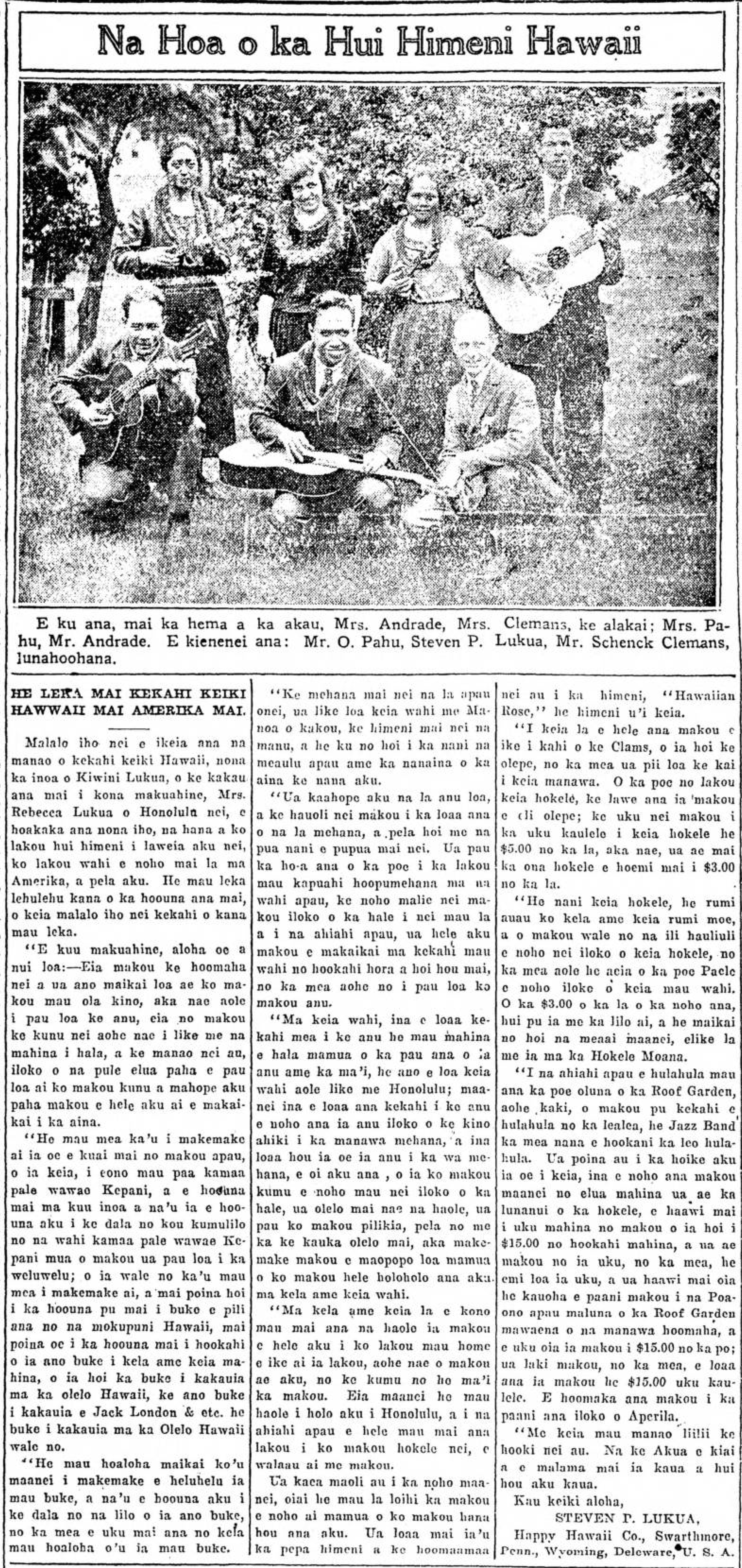
Members of the Hawaiian Singing Group

Standing from left to right, Mrs. Andrade; Mrs. Clemens, leader; Mrs. Pahu; Mr. Andrade. Squatting: Mr. O. Pahu; Steven P. Lukua; Mr. Schenck Clemens, manager.

A LETTER FROM A HAWAIIAN BOY FROM AMERICA.

Below you will see the thoughts of a Hawaiian boy by the name of Kiwini Lukua [Steven Lukua], writing to his mother Mrs. Rebecca Lukua of Honolulu nei, describing what his singing group is doing, where they are living in America, and so forth. He has sent many letters, and this below is one of his letters.

“Dear mother, much aloha to you:–Here we are on break, and we are doing better, but our cold are not completely cured; we are still coughing, but not like the previous months. I think within two weeks our colds will probably be over, and maybe we will go sightseeing.

“I have some things I want you to buy for all of us, that is this, six pairs of Japanese sandals [kamaa pale wawae], and send in under my name and I will send you the money for the expenses. Our old Japanese sandals are all shredded up. That is all I want, and do not forget to send send a book related to Hawaii; do not forget to send a book of that type every month, that being a book in Hawaiian like those written by Jack London, etc.; a book written only in Hawaiian.

“I have good friends here who I want to read those books, and I will send you money to cover the cost of those books, because my friends will pay for those books.

“The days here are getting warmer. This place is much like our Manoa. The birds are singing and all the plants and the landscapes are beautiful to see.

The frigid days have gone by and we are happy that we have warm days, and the blooming flowers. Everywhere people are no longer lighting their fireplaces. These days we are staying at home quietly, and each evening, we went exploring for an hour and returned, because our colds are not completely over.

“Here, if someone gets a cold, several months will go by before that cold and sickness is over. This place is strange and not like Honolulu. Here if someone catches a cold, that cold will live in the body until the warm period. And if you catch a cold once again during the warm period, it will be worse. That is the reason we are staying in the house. But the haole tell us that our troubles are over, and so too was what the doctor said. But we wanted to be very sure before going traveling about here and there.

“Everyday, that haole invite us to go to their homes to see them, but we do not accept because we are sick. Here there are haole who went to Honolulu, and each evening, they always come to our hotel to talk with us.

“I am truly tired of living here, because we have many days before we work again. I have the sheet music and am practicing singing, “Hawaiian Rose.” This is a beautiful song.

“Today we are going to see the place with clams, that being olepe, because it is high tide now. The owners of this hotel are taking us to dig for clams; we are paying this hotel an extra charge of $5 for the day. But the hotel owner is reducing it to $3.00 for the day.

“This hotel is nice; there is a bathroom in each room, and we are the only dark-skinned ones in this hotel, because Blacks are not allowed to stay here. The cost to stay here per day is $3.00, added to the cost for meals. And the meals here fine, just like the Moana Hotel.

“Each evening the people dance on top of the Roof Garden without charge. We dance as well because it is fun. The music for the dancing is played by a Jazz Band. I forgot to tell you this, if we live here for two months the manager of the hotel has agreed to give us a monthly rate, that being $15.00 for a month, and we agreed on that rate, because it is very cheap, and he put in a request that we play every Saturday on the Roof Garden during the breaks, and he will pay us $15.00 per night; we are lucky, because we will receive an extra payment of $15.00. We will begin playing in April.

“With these little thoughts, I will conclude. May God guide and watch over us until we meet again.

Your loving son,
STEVEN P. LUKUA,
Happy Hawaii Co., Swarthmore, Penn., Wyoming, Delaware, U. S. A.

(Kuokoa, 5/24/1923, p. 3)
Ka Nupepa Kuokoa, Buke LXII, Helu 21, Aoao 3. Mei 24, 1923.

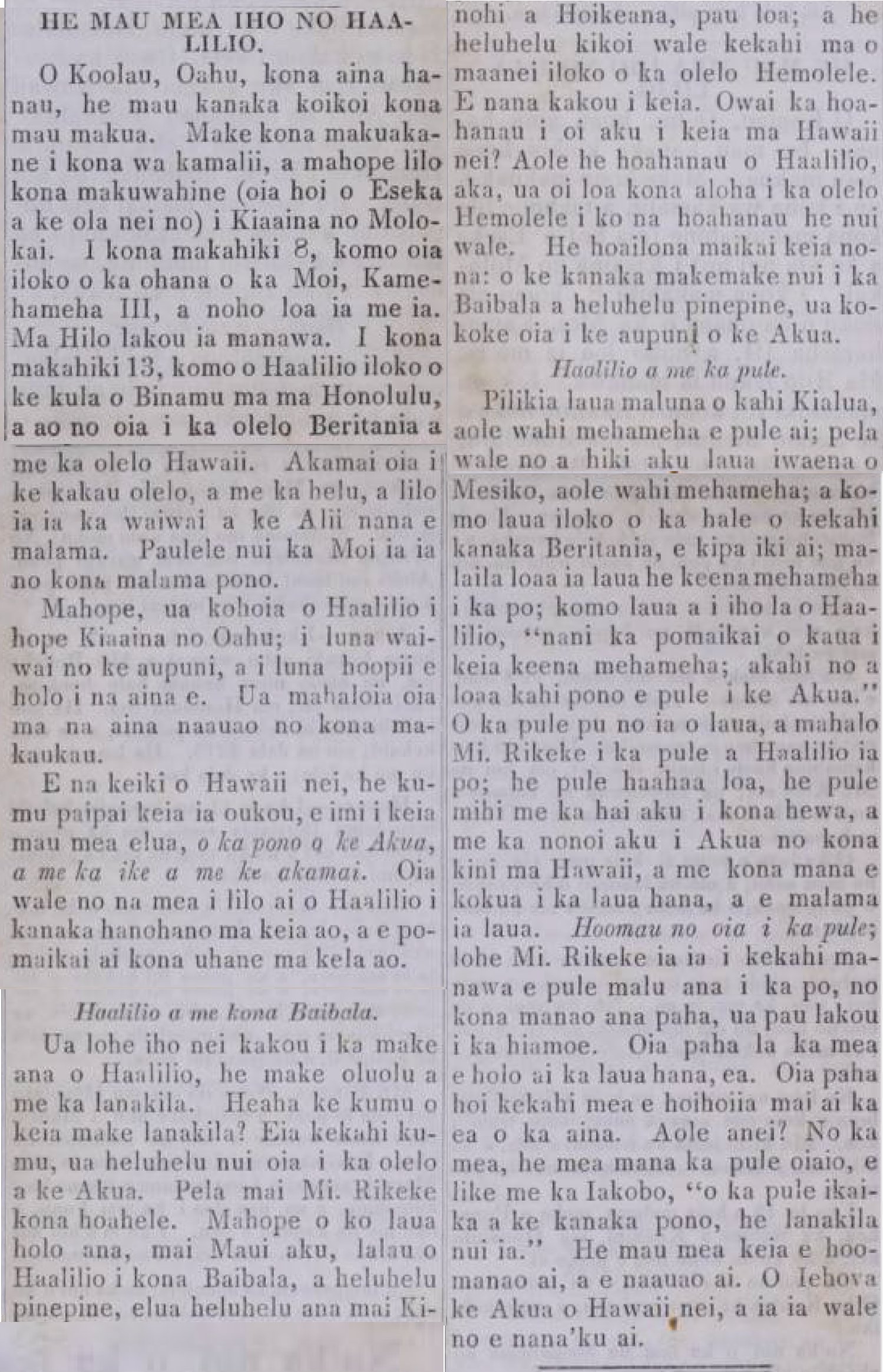
Biography of Timoteo Haalilio, 1845.

Some Things Pertaining to Haalilio.

His land of birth was Koolau, Oahu; and his parents were important people. His father died when he was a child, and thereafter his mother (that is Eseka who is living) became Governor of Molokai. When he was 8 years old, he joined the family of the King, Kamehameha III, and lived permanently with them. They were in Hilo at that time. When he was 13 years old, Haalilio entered the school of Bingham folks in Honolulu, and he learned English and Hawaiian languages. He was skilled at composition and mathematics, and he became the keeper of the King’s wealth. The King had confidence that he would care for it well.

Thereafter, Haalilio was chosen as Governor of Oahu; as minister of finances for the government, and envoy to travel to foreign lands. He was respected in the enlightened lands for his competence.

O youth of Hawaii nei, this is encouragement for you. Seek out these two things, the righteousness of God, and knowledge and wisdom. It was just those things that made Haalilio an honored man in this world, and his soul will be blessed in the other world.

Haalilio and his Bible.

We heard of the death of Haalilio, and that it was a contented and victorious death. Why was it a victorious death? Here is one reason: he read much of the word of God. That according to his traveling companion, Mr. Richards. After they left Maui, Haalilio took his Bible and read of it frequently. He read twice from Genesis to Revelation in entirety; and he read randomly here and there or the Holy Words. Let us consider this. Who is the brethren in Hawaii nei that goes beyond this? Haalilio is not a brethren, but his aloha for the holy word is greater than the many of the brethren. This is a good sign for him: a man who has great desire for the Bible and who reads it frequently, he is near to the kingdom of God.

Haalilio and prayer.

The two of them had a difficult time aboard the double-masted ship; there was no secluded place to prayer. This continued until they reached Mexico, there was no secluded place. Then they entered the house of a British man to visit. There they were allowed a quiet room at night. They entered and Haalilio said, “We are so blessed to have this quiet room; it is the first time we have a proper place to pray to God.” They prayed together and Mr. Richards admired the prayer of Haalilio that night. It was a very humble prayer; it was a prayer of repentance, and he spoke of his sins, and asked God for his relatives in Hawaii, and his power to help the two of them in their duties and to watch over them.dhis prayer; Mr. Richards heard him once secretly praying at night, perhaps because he thought they were all asleep. That is perhaps why their work progressed, yes. That is probably one of the reasons the sovereignty of the land returned. Isn’t it so? For true prayer is powerful, like what Jacob said, “The effectual fervent prayer of a righteous man availeth much.” These are things to remember and to learn from. Jehovah is the God of Hawaii nei, and it is only to him we should pay attention.

(Elele Hawaii, 4/25/1845, pp. 13-14)

Ka Elele, Buke 1, Pepa 2, Aoao 13 & 14. Aperila 25, 1845.

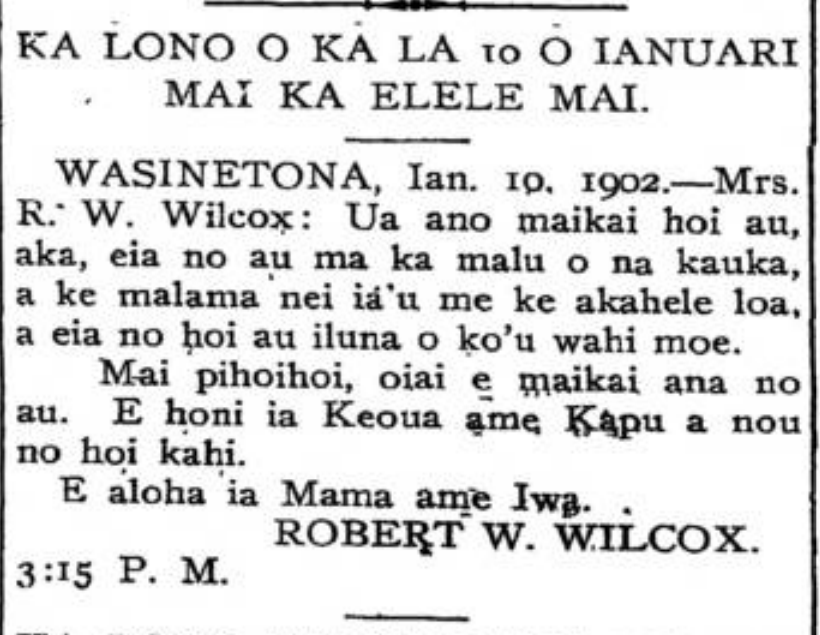
Robert Wilcox recovering, 1902.

NEWS OF THE 10th of JANUARY FROM THE DELEGATE.

Washington, D. C., Jan., 10, 1902.–Mrs. R. W. WIlcox, Honolulu, Hawaii: I am doing okay.. I am still in the hands of the physician who is doing his very best; I am still in bed.

Do not be alarmed as it will be all right. Kiss to Keoua and Kapu and also to yourself. Aloha to Mama and Iwa.

ROBERT W. WILCOX.
3:15 P. M

(Home Rula Repubalika, 1/22/1902, p. 2)

Home Rula Repubalika, Buke I, Helu 12, Aoao 6. Ianuari 22, 1902.

More on Shoji Masayoshi portrait, 1881.

[Found under: MISCELLANEOUS.]

We read that Mr. Shoji Masayoshi, a distinguished painter in oil, is at work on a likeness of the King of Hawaii, as His Majesty appeared in Japanese dress, when he was present at an entertainment given in his honour in the Momiji-kwan. It is added that the artist intends to make a gift of his work to the Hawaiian Government.

(Japan Daily Mail, 5/14/1881, p. 554)

Japan Weekly Mail, Volume V, Number 19, Page 554. May 14, 1881.

The Cyclorama of Kilauea at the Chicago World’s Fair, 1893.

Hawaiian Boys at Chicago.

There are eight Hawaiian singing youths at the Cyclorama of Kilauea the Crater of Pele at Chicago, and it would appear as if they are on their way home with Moeheau [Mooheau] aboard the steamship Monowai, or perhaps aboard the Australia. Mr. Whitney saw and met with them in Chicago a few weeks ago. All of them were in good health, and they sang like the call of lovebirds. And everyone who entered to see the exhibit of the cyclorama of Kilauea crater were very amazed.

Continue reading

O HAWAII NO KA OI, 1895.

HAWAII IS THE BEST.

Shared from a letter from Boston, United States, as follows:

The dignity of a religious assembly was raised because of some dark-skinned Hawaiians whose names are, East Kahulu [East Kahulualii], J. M. Bright, J. Edward, and Mr. Jones, being that they praised the name of the Lord from the choir loft of that sacred house of God.

When the singing of the hymns was done, the preacher of the church introduced the one who would open the sermon, that being Mr. East Kahulualii, one of the full dark-skinned Hawaiian boys, all the while there were thousands of people in that church.

Continue reading

Hawaiian boys in Port Gamble–A different point of view, 1877.

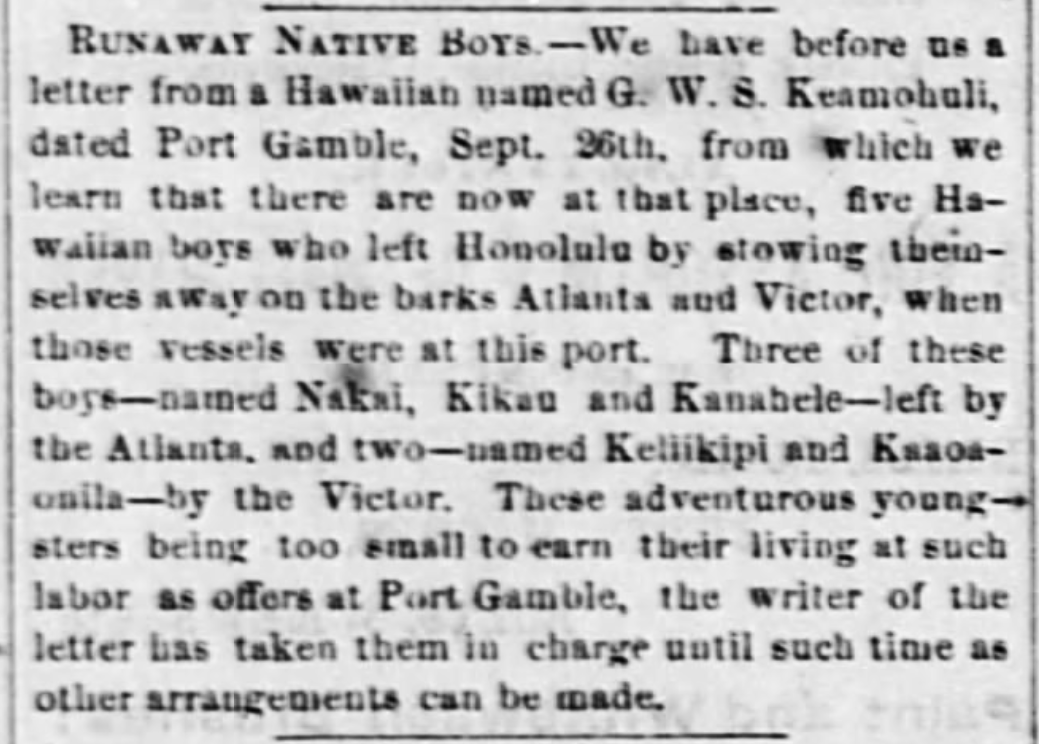
Runaway Native Boys.–We have before us a letter from a Hawaiian named G. W. S. Keamohuli, dated Port Gamble, Sept. 26th, from which we learn that there are now at that place, five Hawaiian boys who left Honolulu by stowing themselves away on the barks Atlanta and Victor, when those vessels were at this port. Three of these boys–named Nakai, Kikau and Kanahele–left by the Atlanta, and two–named Keliikipi and Kaaoaouila–by the Victor. These adventurous youngsters being too small to earn their living at such labor as offers at Port Gamble, the writer of the letter has taken them in charge until such time as other arrangements can be made.

(Hawaiian Gazette, 11/7/1877, p. 3)

Hawaiian Gazette, Volume XIII, Number 45, Page 3. November 7, 1877.

Abduction!? 1877.

Boys were kidnapped.

O Kuokoa Newspaper, Aloha oe:–

I send off my bundle to you, having the right time to do so. For I see that you are one of the shooting stars of the nation of Hawaii, flying from where the sun rises to where the sun sets, shooting all the way here to North America.

The words placed above is what grows in my conscience. Might you be patient and accept the contents of my bundle. For I have seen you and how you have patience to accept what is sent to you. Its contents are here below:–

Five Hawaiian boys were abducted by the lumber transporting ships Atlanta and Victor. Three boys on the Atlanta; these are their names, Nakai, Kikau, and Kanahele. And aboard the Victor, two boys; these are their names, Keliikipi and Kaaoaouila. That is my baggage that I entrust to you, and it is for you to call out loudly to the parents of these boys, as they may be left feeling aloha for their children abducted by the Captains of these ships who break the law of the Nation of Hawaii and King Kalakaua. When these boys arrived here at Port Gamble, the Captains abandoned them. We believe that if there were no Hawaiians here, the boys’ health would have been danger, and they would have had no place to rest their heads.

The place they were hid was in a skiff that had its opening turned over atop the Forward House* of the sailors in the bow. That is where they hid when the ship carrying lumber left Honolulu, that is what they told us. These children are very little, perhaps ten or so years old; not fit to work at the lumber mills here in Puget Sound.

To the Parents–O Parents, watch your children closely, and do not let them wander about the docks, or go aboard the ships, and enjoy feasting on barrel meats, lest they be abducted by the ship Captains like these children. You have heard that Kalakaua’s is a “Lahui increasing nation” and there is a Hawaiian government law that forbids Hawaiians from going abroad unless their contract is approved by the governor of the island on which they live; only with the governor’s approval can they leave; also the Governor must command the ship Captain to care for and return the man or men that he takes away. And if the Captain or Captains do not return the man or men that they take away, then they will be fined $300 for each man. That is the law for the Captains who secretly take away Hawaiians.

To the Governors.–O Governors, do your job conscientiously, and so too your subordinates, be vigilant of your duties, search the trading ships of all types which leave Honolulu, for there are many Hawaiians who leave Honolulu and live abroad for long periods without it being known that they left, and they have been living here in these foreign lands for many years.

But here is my question pertaining to that. Who is at fault? The ship Captain perhaps? The children perhaps? In my opinion, it is the ship captain’s fault, if I am not mistaken. That is according to what the children told us when we questioned them, and they said that they were brought because of the desire of the captain that they come here. If that is true, it would be best if the captains return the boys to Honolulu when the ships go once again, or it would be better if they were tried so that it is made clear if the captains are at fault or if it is the children. As for the names of these ships, I do not know them [Atlanta and Victor??], but the agents of this company and some haole of Honolulu should know, should it be thought to ask about the two.

I have nothing more to talk about at this time, but I ask for your kindness, if I am wrong about this, excuse me, and if I am correct before you and them as well, then place it in your bureau of love, and it will be for you to spread it before the public so that our many friends will know, they who live from Kumukahi where the sun rises to Lehua where the sun sets.

To you goes my warm aloha, and to the type-setting boys of the Press goes my expression of aloha, and to your Editor goes my loving right-handed handshake.

G. W. E. Kawaiulaomaleka,
Puget Sound, Kitsap County, Sep. 28, 1877.

*Lana House. Not sure where this phrase comes from. I could not find it used in any other article. It was suggested by http://www.maritimehawaii.com that this likely refers to the Forward House.

(Kuokoa, 11/10/1877, p. 3)

Ka Nupepa Kuokoa, Buke XVI, Helu 45, Aoao 3. Novemaba 10, 1877.

Hawaiian woman returns from Europe after many years away, 1862.

[Found under: “NA MEA HOU O HAWAII NEI.”]

Hawaiian Woman in Europe.–Early morning on this past Thursday, Kahula (woman) returned from Germany, on the foreign Laura & Louise. She lived many years away from her home lands; she left perhaps in 1857. She said she went to America, Britain, Germany, and her life was comfortable, living with her employers, that being L. H. Anthon, Esq. (Luika), that foreign language speaking haole who lived in Hawaii before.

(Kuokoa, 10/25/1862, p. 2)

Ka Nupepa Kuokoa, Buke I, Helu 48, Aoao 2. Okatoba 25, 1862.

Joseph Puni writes to the father of Diamond Kekona, 1916.

LETTER FROM BRITAIN.

Opera House,
Dudley, England,
Nov. 4, 1916.

To my true friend, Dick Kekona,

Aloha oe:–Perhaps you are surprised receiving this letter. I have tried all means to release your beloved son Diamond from the British armed forces. I appeared before the American Consul in the countryside here in England, telling them that Diamond is an American. They responded that they will put my request before the head consul in London. On the 17th of September, I went to the Consulate in London, they told me that the consul could not order the British government to release Diamond because he is 25 years old; only those below 20 years old, if they are American citizens. These past days, I decided to have your daughter-in-law (Amy Kekona) to come to see me, and get together with her to think of a way to release her husband; for these good reasons, I ask that you send me his birth certificate, or to go to the governor of Hawaii to write to the Hawaiian Delegate Mr. J. K. Kalanianaole in Washington D. C., to go to the State Department in Washington and have the American Ambassador in London investigate the circumstances of his enlisting in the armed forces, and you verify that your first-born son is a true Hawaiian. He had a document in the city of Paris, France, from the office of the American General, written on the 13th of February, 1914, attesting to the fact that he is a Hawaiian. If he finds these documents, he will be victorious. Do not neglect this, for I am still regretful not having his acting. He has much knowledge in this area, and his showing this to the world would bring fame to the Hawaiian Lahui. I will organize everything here and send it to London. With our sleuthing, I believe everything will progress; may God watch over and keep safe the life of your child until we meet again, amen.

With aloha to your family and the Hawaiian Nation.

JOSEPH PUNI.

Write me at your daughter-in-law’s, c/o 143 Baxter Ave., Kidderminister, England.

(Aloha Aina, 1/19/1917, p. 3)

Ke Aloha Aina, Buke XXII, Helu 3, Aoao 3. Ianuari 19, 1917.