Football Teams of Kamehameha and St. Louis at the Game on This Past Saturday
(Kuokoa, 11/25/1926, p. 2)
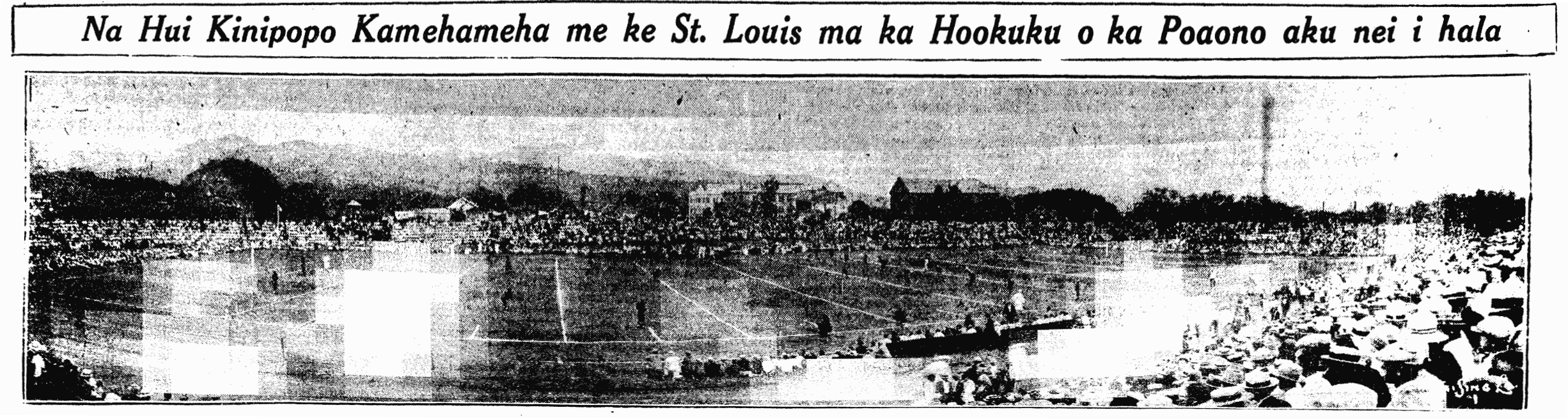
Ka Nupepa Kuokoa, Buke LXV, Helu 47, Aoao 2. Novemaba 25, 1926.
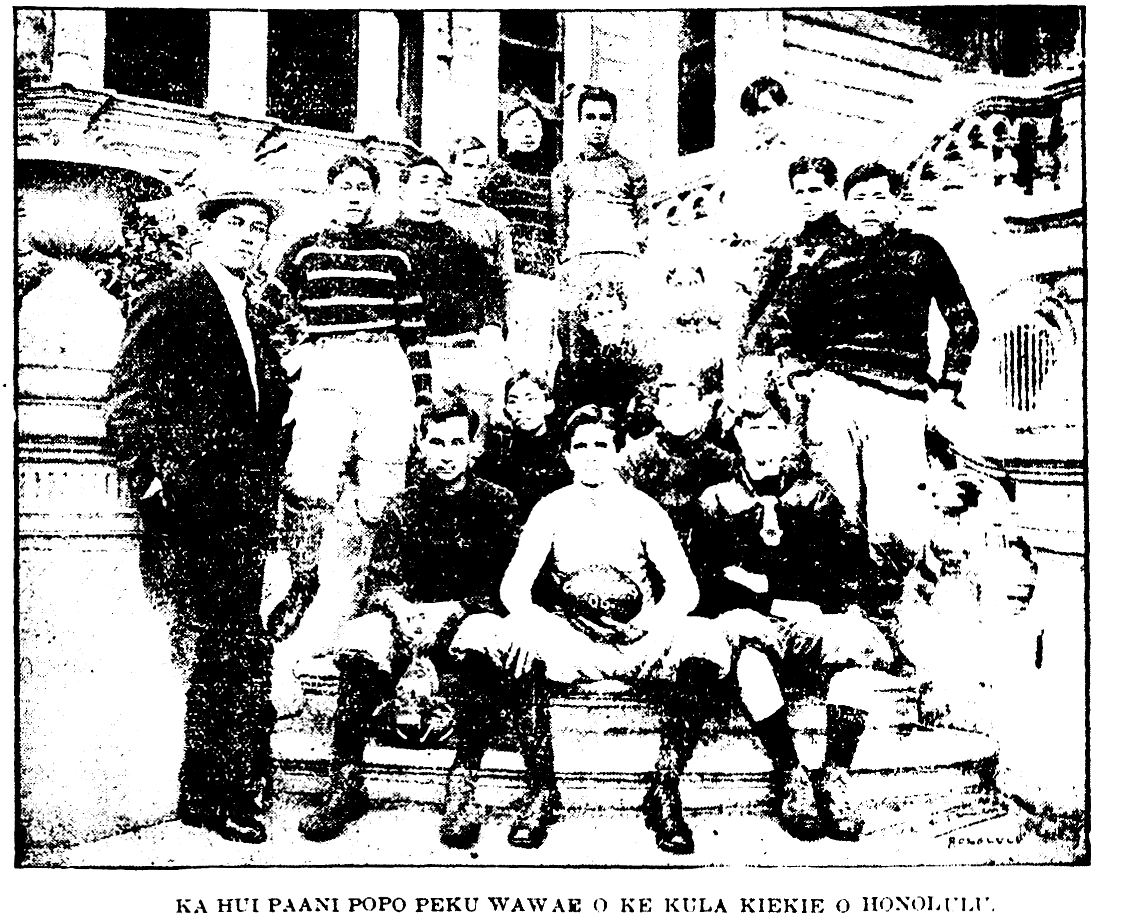
Football Teams of Kamehameha and St. Louis at the Game on This Past Saturday
(Kuokoa, 11/25/1926, p. 2)
Ka Nupepa Kuokoa, Buke LXV, Helu 47, Aoao 2. Novemaba 25, 1926.
THIS IS A PICTURE OF THE FOOTBALL GAME BETWEEN THE BOYS OF KAMEHAMEHA AND PUNAHOU ON THIS PAST SATURDAY; IT WAS ONE OF THE MOST INTENSE GAMES SEEN; THE BOYS OF PUNAHOU RAN OFF WITH THE WIN FOR THEIR SIDE, AND THE CHAMPIONSHIP FOR THAT SPORT WENT TO PUNAHOU THIS YEAR.
(Kuokoa, 11/21/1919, p. 1)
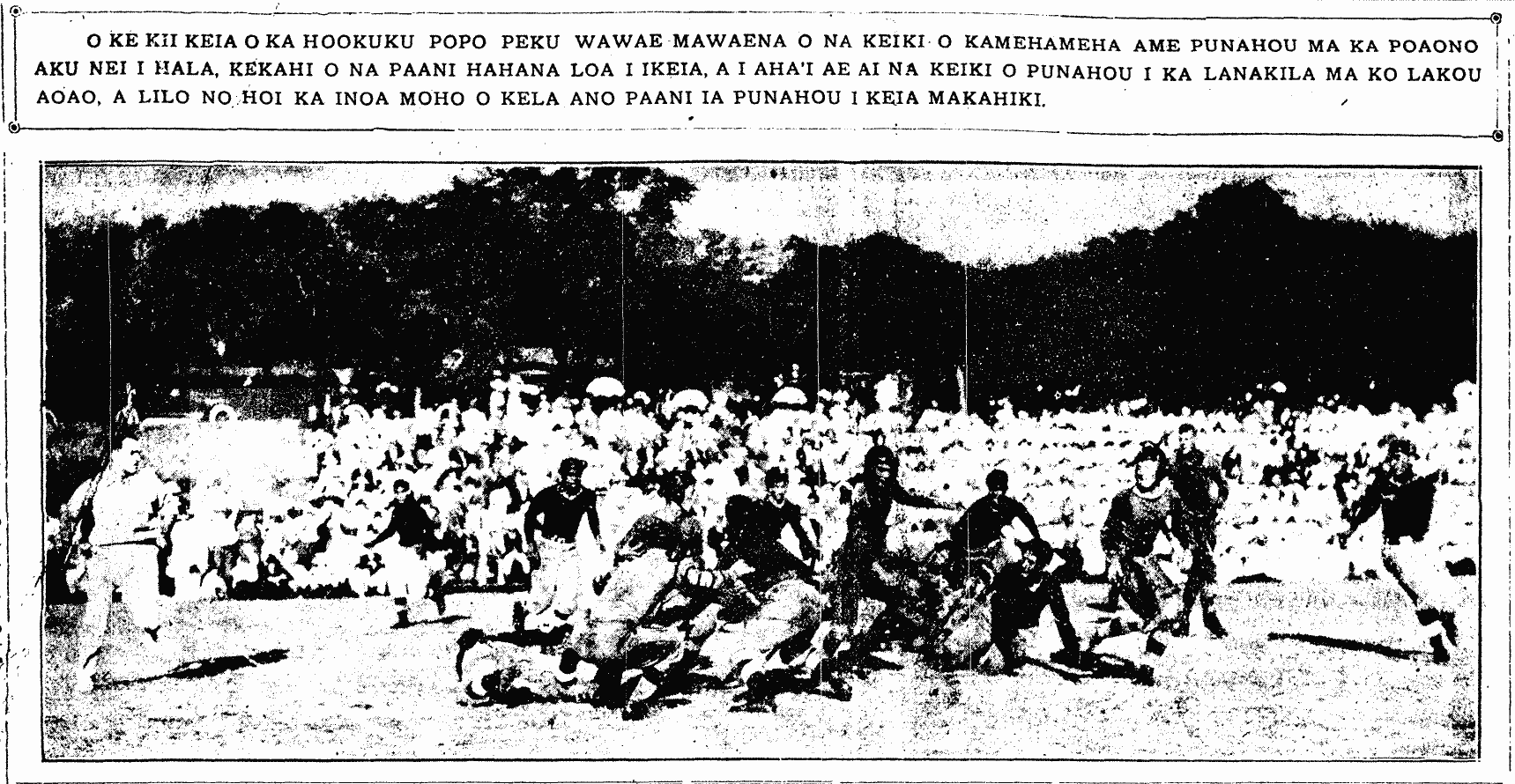
Ka Nupepa Kuokoa, Buke LVII, Helu 47, Aoao 1. Novemaba 21, 1919.
[The “O” on their uniforms hearken back to the days when Punahou was called Oahu College.]
(Kuokoa, 1/4/1907, p. 7)
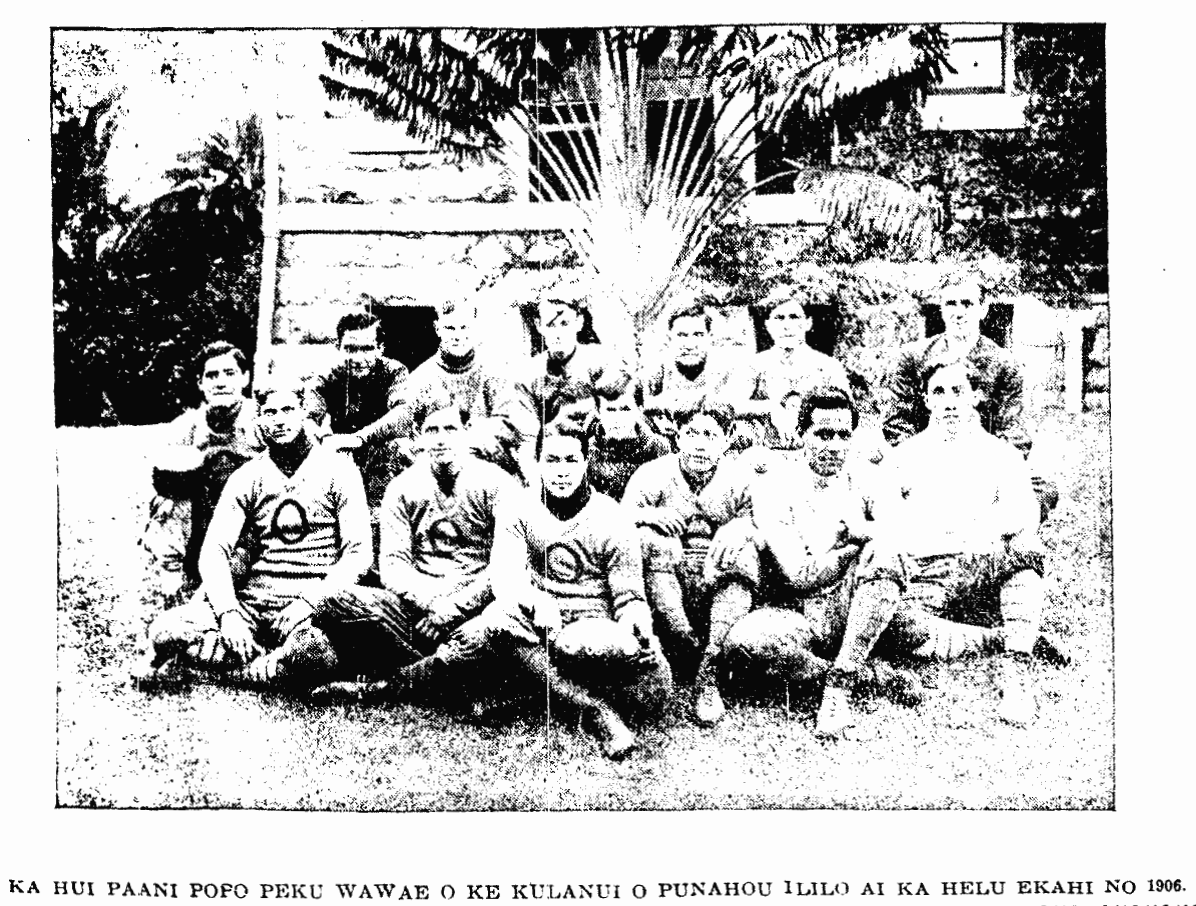
Ka Nupepa Kuokoa, Buke XLVI, Helu 1, Aoao 7. Ianuari 4, 1907.
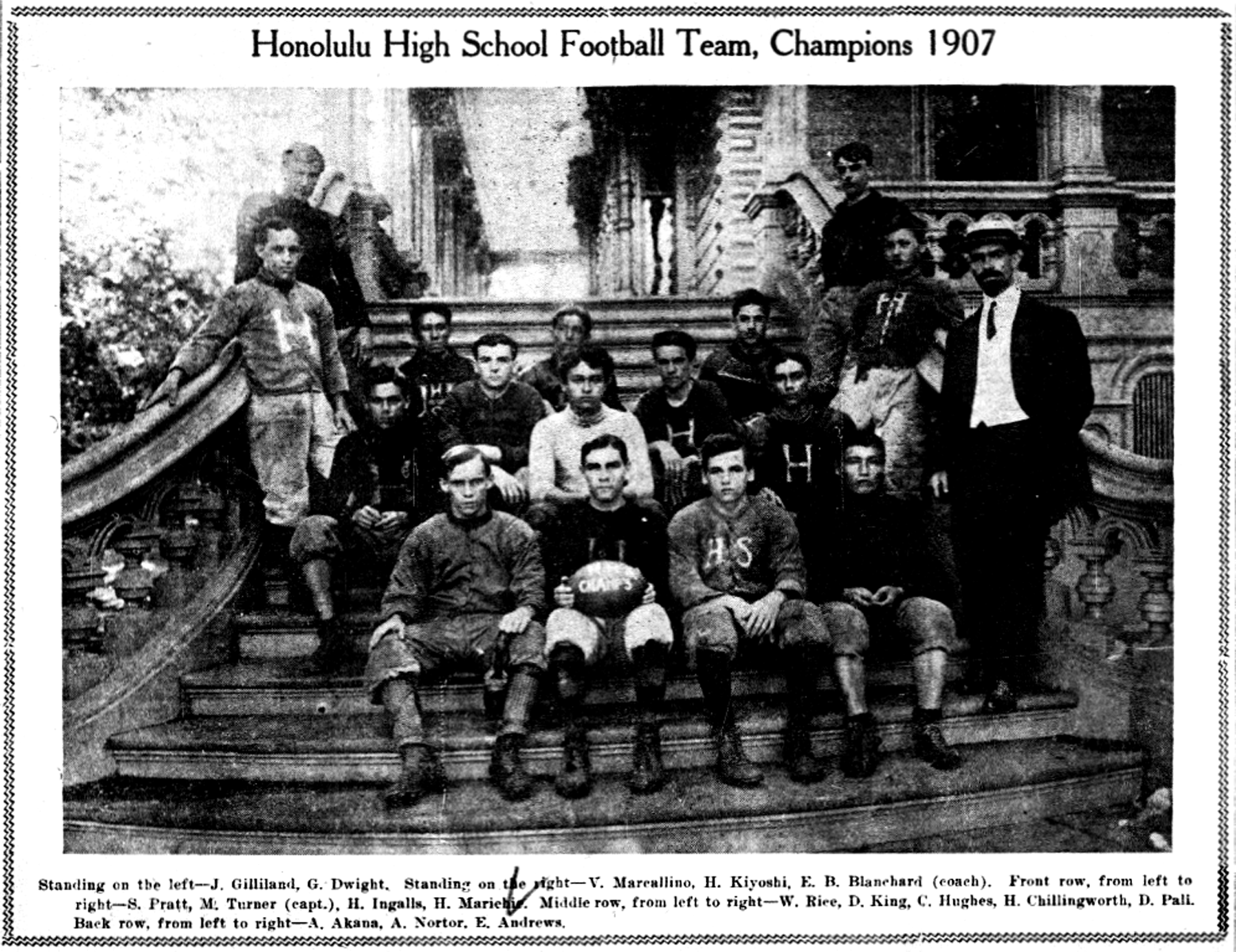
(Kuokoa, 1/4/1907, p. 7)
Ka Nupepa Kuokoa, Buke XLVI, Helu 1, Aoao 7. Ianuari 4, 1907.
Standing on the left—J. Gilliland, G. Dwight. Standing on the right—V. Marcallino, H. Kiyoshi, E. B. Blanchard (coach). Front row, from left to right—S. Pratt, M. Turner (capt.), H. Ingalls, H. Marichie. Middle row, from left to right—W. Rice, D. King, C. Hughes, H. Chillingworth, D. Pali. Back row, fro left to right—A. Akana, A. Nortor, E. Andrews.
[The Honolulu High School would go on to become what we know today as McKinley High School.]
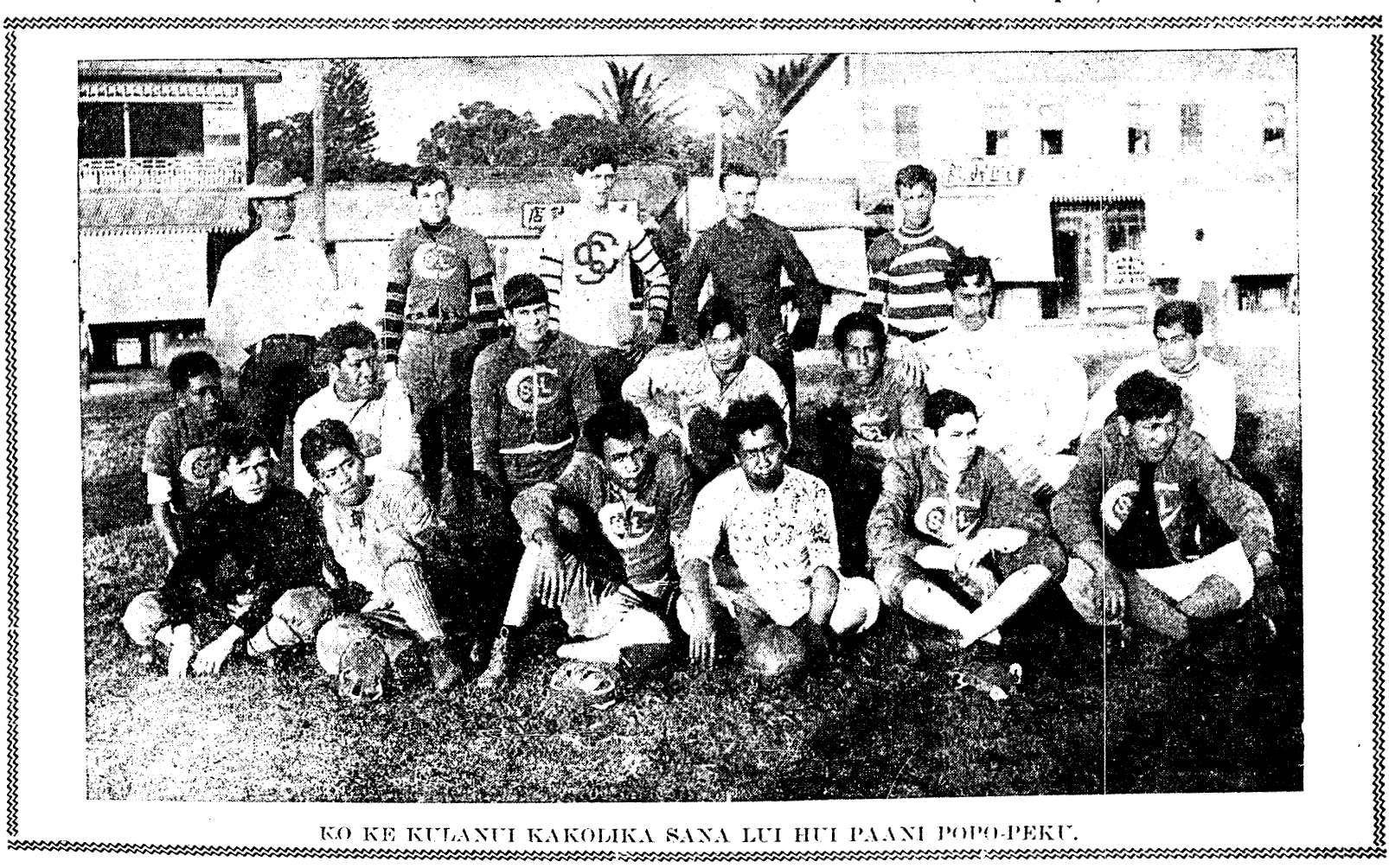
(Sunday Advertiser, 12/8/1907, p. 7)
Sunday Advertiser, Volume V, Number 258, Page 7. December 8, 1907.
[Here is a very random football image from 110 years ago of Saint Louis High School’s football team. This picture is for some reason much clearer than the usual digitized newspaper image.]
(Kuokoa, 10/5/1905, p. 4)
Ka Nupepa Kuokoa, Buke XLIII, Helu 42, Aoao 4. Okatoba 5, 1905.
Candidate for the Home Rule Party in District Five.
(Kuokoa, 11/4/1910, p. 5)

Ka Nupepa Kuokoa, Buke XLVI, Helu 44, Aoao 5. Novemaba 4, 1910.
The picture above is one of three Hawaiian boys who are doing performances at the Theater on Vineyard and River streets on the night of this Wednesday and Thursday. These boys can walk on glass that is shattered into tiny pieces without cutting their feet; they can put a person to sleep; and do many other amazing feats of power like those that are seen being done by the haole in this town.
These are boys from Honolulu nei, and it was here that they learned acting and feats of power, and the audience will be astounded to see the readiness and the true expertise of these Hawaiians at their profession.
These boys travelled around Hawaii Island with their performances, and they believe they will go around the different theaters of this town and some other islands outside of Oahu nei.
The names of these boys from the left: William Hema, Sam Kahoe and Pilipo Kahoe.
(Kuokoa, 10/3/1919, p. 3)

Ka Nupepa Kuokoa, Buke LVII, Helu 40, Aoao 3. Okatoba 3, 1919.
The readers of the Kuokoa will probably not be unable to recognize the features of the building pictured above; it is the church of Kawaiahao. It is an old building and one that is greatly beloved by a portion of our people, this mother church of ours. Its predecessor on these grounds was a church of pili grass; and the stone building was completed in 1842, constructed by the loving hands of the alii and makaainana of times gone by. It was Kekuanaoa and Bingham [Binamu] Sr. who selected the area where it was to be built and supervised its construction, however Bingham returned to America before the completion of this building.
There were many renowned events which were done in Kawaiahao such that it is as if the building was the place to carry out grand and fine deeds of the past, of the nation and the people. It was in this building that a number of the Legislative Sessions of the nation were opened, if this writer is not mistaken. It was in this building that Kamehameha V opened the Constitutional Convention [Ahaolelo Hooponopono Kumukanawai] on the 7th of July, 1864. Continue reading
“And so it happened that on the 16th day of January, 1893, between four and five o’clock in the afternoon, a detachment of marines from the United States Steamer Boston, with two pieces of artillery, landed at Honolulu. The men, upwards of 160 in all, were supplied with double cartridge belts filled with ammunition and with haversacks and canteens, and were accompanied by a hospital corps with stretchers and medical supplies. This military demonstration upon the soil of Honolulu was of itself an act of war. . .”
By nightfall of the next day, the Kingdom of Hawaiʻi had been illegally overthrown.
Hawaiʻi’s people today live in the resulting repercussions of that infamous day. For some, reflection on those historical events still conjures up the ʻeha (pain, hurt) of being wronged.
There may never be an adequate outlet to express the ʻeha, nevertheless, this story commemorates the 122nd anniversary of the illegal overthrow and honors some of the great expressions of aloha ʻāina (patriotism) coming from Hawaiʻi’s aliʻi (monarchs) and lāhui (people).→Continue reading.

Queen Liliʻuokalani, Hawaiʻi’s last reigning monarch, was imprisoned after her kingdom was illegally overthrown on January 17, 1893.
 nupepa