Lanatila! 1893.

Beautiful flag story, 1893.

HAWAIIAN FLAG.

On Thursday afternoon of this last week, Hon. C. W. Ashford raised a Hawaiian Flag hand sewn by some Hawaiian Ladies, whose length was 21 feet and width was perhaps 10 feet.

Before the raising of this flag upon a new Flag Pole built ___ feet tall, his children were called, whose ages are between ___ and ___, to name this Flag Pole and the Flag; when they were asked: What is the name of this Flag Pole and this Flag? They answered together, “Lanatila [Victory];” it was then that the beautiful Flag of Hawaii rose and fluttered in the beloved soft gentle breeze of the motherland; that Flag waves continuously upon this Flag Pole everyday. These are true Hawaiians who have done this first, it is in the uplands of Kalihi past Kamehameha School.

(Leo o ka Lahui, 5/1/1893, p. 3)

HAE HAWAII.

Ka Leo o ka Lahui, Buke II, Helu 695, Aoao 3. Mei 1, 1893.

Abraham Kaulukou to study law at Yale, 1902.

Abraham Gilbert Kaulukou, son of John Lot Kaulukou, goes to study law at Yale 15 years earlier.

nupepa's avatarnupepa

LEAVING TO STUDY LAW IN AMERICA.

ABERAHAMA KAULUKOU HEADED FOR YALE UNIVERSITY—ASSISTED BY THE ALUMNI OF YALE.

In the coming September, Aberehama Kaulukou, the son of the Hon. John L. Kaulukou will go to enter into the school of law at Yale. This is help from the Yale alumni of this town. These former students thought a great deal to do something for their school, and after prior investigation, they unanimously chose to send this intelligent Hawaiian youth of the land.

View original post 178 more words

John Lot Kaulukou, what an exciting life, 1917.

JUDGE JOHN L. KAULUKOU PASSES ON.

After a sickness of a few weeks ago, Judge John L. Kaulukou grew weary of this life, in the hospital at Kealakekua, on this past Saturday, and Judge Kaulukou was laid to rest for all times at his land of birth.

He was in the hospital for an entire month [??? ka noho ana o aku o kona kino lepo maka ilina,] because of a pain in his leg, under the medical care of Dr. H. L. Ross, the government doctor there; and the knowledge of the doctor could not save his life, until he left this world on that day indicated above.

The Judge left behind his widow, Mrs. Susie Kaulukou, and three sons, Abraham G. Kaulukou, the secretary of Kauai County; Lot Kalani Kaulukou, known also as Lot Sebastian, famed for dancing and living in lands afar; and John L. Kaulukou Jr; along with a large family and many friends, grieving with regret for him.

His Birth

Judge John L. Kaulukou was born at Keauhou, North Kona, Hawaii, on the 1st of June, in the year 1841, therefore, he lived for sixty-seven years and a day, before he left this life of hardships. His father was a Spaniard [Paniolo] and his wife was a Hawaiian, therefore he is also called a hapa Paniolo.

In the younger days of Judge Kaulukou’s life, he was orphaned by his parents leaving this life early, so the responsibility transferred upon his grandfather to educate him; the first step taken to raise him until he became an important giant of the land in the days of the monarchy of Hawaii nei. Continue reading

Irony, 1893.

It is always a good thing to read an article in its entirety before coming to any conclusions about it. It might be difficult to see, but what the Daily Bulletin is saying here is sarcastic.
The annexationist paper, Nupepa Puka La Kuokoa, printed 1,200 copies thinking because of their cheap subscription rates they would get Hawaiians to buy the copies up, and yet they only got rid of 80 copies. And at the time even the haole annexationists could understand Hawaiian. How many of those 80 do you think were bought by them?

It is good to read, and to think.

nupepa's avatarnupepa

[Found under: “LOCAL AND GENERAL NEWS.”]

The new Hawaiian daily paper, “La Kuokoa,” started the other day printed about 1200 copies. Out of this number only 80 copies were circulated. Such is the native Hawaiian’s love for annexation.

View original post 102 more words

The time will come, 1893.

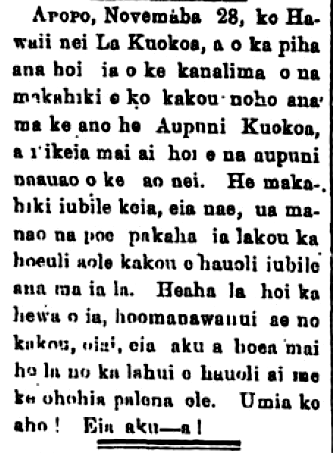
Tomorrow, November 28, is the Independence Day of Hawaii nei, and it will be the fiftieth year of our living as an Independent Nation, and being recognized by the enlightened nations of the world. This is the jubilee year; however, the plunderers believe that they hold the steering paddle and that we will not have a joyful jubilee on that day. What of that; let us be patient, for there will come a day that the lahui will be joyful and be pleased to no end. Hold your breaths! It will come!

(Lei Momi, 11/27/1893, p. 4)

LeiMomi_11_27_1893_4.png

Ka Lei Momi, Buke I, Helu 17, Aoao 4. Novemaba 27, 1893.

Heroes, 1966.

These four boys rescued two youths from drowning in California a week ago. They are from left, Robert L. Kuhaulua, George K. Kupihe, Melvin D. Kalahiki and Robert K. Brown.—Photo by Pan American.

Isle job corpsmen save two from drowning on W. Coast

The rescue of two Santa Rosa, California, youths from drowning at Salmon Creek Beach a week ago today was told by four returning job corpsmen yesterday.

The corpsmen, who returned with 11 others from California on a Pan American plane, were Robert L. Kuhaulua, George K. Kupihe, Melvin D. Kalahiki and Robert K. Brown. Continue reading

Terrorism even here? 1926.

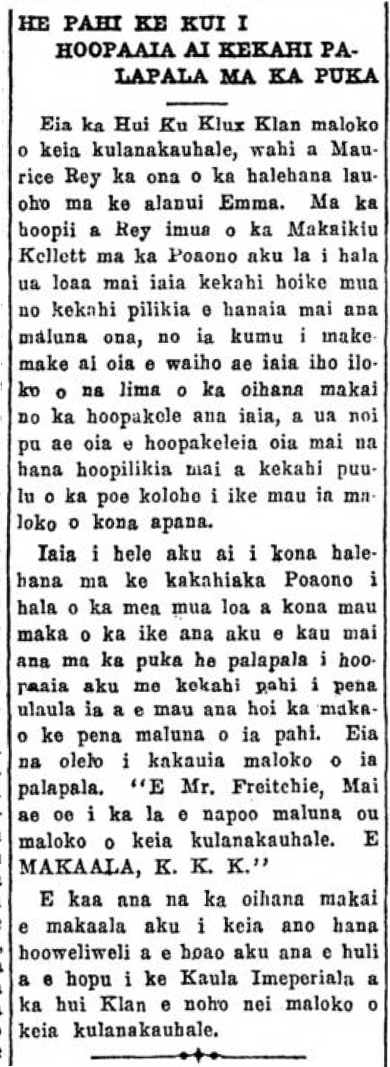
KNIFE USED AS NAIL TO AFFIX NOTE ON DOOR

The Ku Klux Klan Association is here in this town according to Maurice Rey, the owner of a hair salon on Emma Street. According to the claim of Rey before Detective Kellett, this past Saturday, he found a warning of troubles that would be carried out upon him, and for that reason he wanted to be put under the protection of the police force, and he also asked that he be protected from wrongdoings by a group of degenerates seen often in his area.

When he went to his place of work in the morning of this past Saturday, the first thing his eyes saw was a note on the door affixed by a knife painted red, the paint still fresh on the knife. These are the words written on the note. “Mr. Freitchie, Do not let the sun set upon you in this town. BEWARE, K. K. K.”

The police department is in charge of being vigilant against this type of terroristic activity, and they will try to search out and arrest the Imperial Wizard of the Klan living here in this town.

[Stand up against cowardly acts of bullying and terrorism.]

(Kuokoa, 11/18/1926, p. 2)

Kuokoa_11_18_1926_1.png

Ka Nupepa Kuokoa, Buke LXV, Helu 46, Aoao 2. Novemaba 18, 1926.

The newspapers may not always report “the truth,” but they are a priceless source for historical information, 1864, Today, and Tomorrow.

The newspapers are someplace we should be looking at for other ways to look at Hawaiian history.

Newspapers, unlike books were relatively easy to come by (whether it was by subscription, or by sharing with a neighbor).

Most people could not afford to publish books, but many people had the means to purchase pen and paper and envelope and stamp, so that they could send in their thoughts to be printed. And many in fact did. They wanted the truth as they knew it to be known by all. And because newspapers were printed regularly, it was easy to immediately comment on errors appearing in the pages of the paper. There are often heated debates over everything and anything from genealogy, to mele, to why you should not lend money to that man or woman who left a marriage bed. These debates not only took place in a single newspaper title, but often ran in totally different newspapers and sometimes even in both Hawaiian and English publications.

The information given by S. W. B. Kaulainamoku appearing in the previous post for instance is contested a month later by P. S. Pakele. He says, “…it is for you all to see which one is true, with my thought that perhaps the one who published earlier is right, and perhaps not; the same with this, perhaps it is right, and perhaps not; my confidence is with you all.”

Many generations of Hawaiians contributed information to the newspapers, because they knew that the information they submitted was not only for them at the time but more importantly for Hawaiians of today and tomorrow.

How bad leaders and their advisers were dealt with in Kaʻū, 1890.

INCIDENTS IN HAWAIIAN HISTORY.

Before Kamehameha the First had reduced the island of Hawaii to his subjection the various districts were ruled over by petty kings or high chiefs. Anecdotes of three of these aliis who successively ruled over the large district of Kau, are still current among the natives. They are not mythical, but actual events.

Koihala the alii of Kau was about making a voyage from Kona to Kau in his fleet of canoes. He sent word to his people of Kau to meet him with supplies of food on a certain day at Kapua.

The people cooked hogs, dogs and potatoes and prepared poi, water in calabashes and other supplies in sufficient quantities for the chief and his retainers, and started afoot with their burdens to meet him. On arriving at Kapua the fleet came along but did not stop. The alii called to the people ashore to go back to the next landing towards South Point. They resumed their burdens and retraced their steps to this place, the king proceeding by sea. At this place they were told to go on still further to another landing. This was repeated several times and they were finally told to climb the steep pali and meet the king at Kaalualu around and east of South Point. The people were tired, foot sore and hungry from their wearisome travel over the lava and determined upon a different reception to their alii from what he expected. They said “we will teach these chiefs a lesson not to wear us out with their capricious whims. We are hungry and we will eat the food and give him another article of diet instead.” So they sat down and ate up the food and filled the ti-leaf containers with stones and proceeded to near the coast and sat on a slight hill to await the coming of the chief and his party. He landed and proceeded up the ascent to receive his hookupu (tribute of food). When near, the people stood up and, taking the stones from the containers, threw them at the king and his retainers saying, “Here is your pig,” “Here is your dog,” “Here are your potatoes,” etc., and Koihala was killed. The stone, a short way on the road from Kaalualu to Waiohinu is still pointed out as the exact spot where Koihala—the exacting tyrant—met his death. Continue reading