How bad leaders and their advisers were dealt with in Kaʻū, 1890.

INCIDENTS IN HAWAIIAN HISTORY.

Before Kamehameha the First had reduced the island of Hawaii to his subjection the various districts were ruled over by petty kings or high chiefs. Anecdotes of three of these aliis who successively ruled over the large district of Kau, are still current among the natives. They are not mythical, but actual events.

Koihala the alii of Kau was about making a voyage from Kona to Kau in his fleet of canoes. He sent word to his people of Kau to meet him with supplies of food on a certain day at Kapua.

The people cooked hogs, dogs and potatoes and prepared poi, water in calabashes and other supplies in sufficient quantities for the chief and his retainers, and started afoot with their burdens to meet him. On arriving at Kapua the fleet came along but did not stop. The alii called to the people ashore to go back to the next landing towards South Point. They resumed their burdens and retraced their steps to this place, the king proceeding by sea. At this place they were told to go on still further to another landing. This was repeated several times and they were finally told to climb the steep pali and meet the king at Kaalualu around and east of South Point. The people were tired, foot sore and hungry from their wearisome travel over the lava and determined upon a different reception to their alii from what he expected. They said “we will teach these chiefs a lesson not to wear us out with their capricious whims. We are hungry and we will eat the food and give him another article of diet instead.” So they sat down and ate up the food and filled the ti-leaf containers with stones and proceeded to near the coast and sat on a slight hill to await the coming of the chief and his party. He landed and proceeded up the ascent to receive his hookupu (tribute of food). When near, the people stood up and, taking the stones from the containers, threw them at the king and his retainers saying, “Here is your pig,” “Here is your dog,” “Here are your potatoes,” etc., and Koihala was killed. The stone, a short way on the road from Kaalualu to Waiohinu is still pointed out as the exact spot where Koihala—the exacting tyrant—met his death. Continue reading

More Hokulea past, 1975.

Keaulana: ‘It was beautiful.’

First cruise proves craft a humdinger

By BUNKY BAKUTIS
Advertiser Staff Writer

After the dust had settled from the day’s ceremony and the crew relaxed around beer coolers and luau food, Buffalo Keaulana, one of the two steersmen for the sailing canoe’s maiden voyage, summed up the brief cruise: “It was beautiful.

“It (the canoe) turned real easy. And when the paddling was right and the canoe was moving, it was a breeze to handle,” said Keaulana, who has been practicing sailing a smaller version of the double-hulled canoe this past year in preparation for the Tahiti trip.

SOME OF THE PADDLERS for yesterday’s ceremonial cruise into Kaneohe Bay also sung the craft’s praises. Continue reading

Another mele for Kilauea Lighthouse, 1919.

In the Helen Roberts audio collection at the Bishop Museum, it seems that there is an actual recording of Wahinekeouli Pa performing this mele! [Haw 1.5a, track ] Wow.

nupepa's avatarnupepa

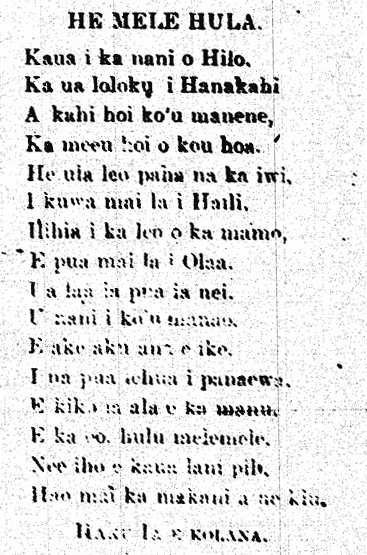
HE MELE NO KA HALE KUKUI O KILAUEA.

HALE IPUKUKUI O KILAUEA, KAUAI.

Nani wale ka uwila i Kilauea,
E anapa mai la i ka paia lani;
Hoike mai ana i kona nani,
He malamalama oi kelakela;
Helu ekahi a o Hawaii nei.
Ma ka lihi kai o ka Pakipika;
Ua ana pono ia kona enekini,
No kanaha mile kona mamao;
Kaomi lima ia iho ke pihi,
E niniu ia no umi kekona;
Hihiu na hana a ka Puakea,
He oi pakela a ke akamai;
I hana noeau ia e Palani,
Me na waihooluu like ole;
He kinohinohi ke ike aku,
Ka anapa a ka onohi kaimana,
Ua hanaia a ku i ka nani,
Molina wai gula anapanapa;
Ka papa dala ke kahua ia,
Ka hulali a ka wai hoohinuhinu;
Ua kohu lihilihi anuenue,
Ka alohi, ka anapa ke ike aku,
Haina ia mai ana ka puana,
Hale kukui nani…

View original post 27 more words

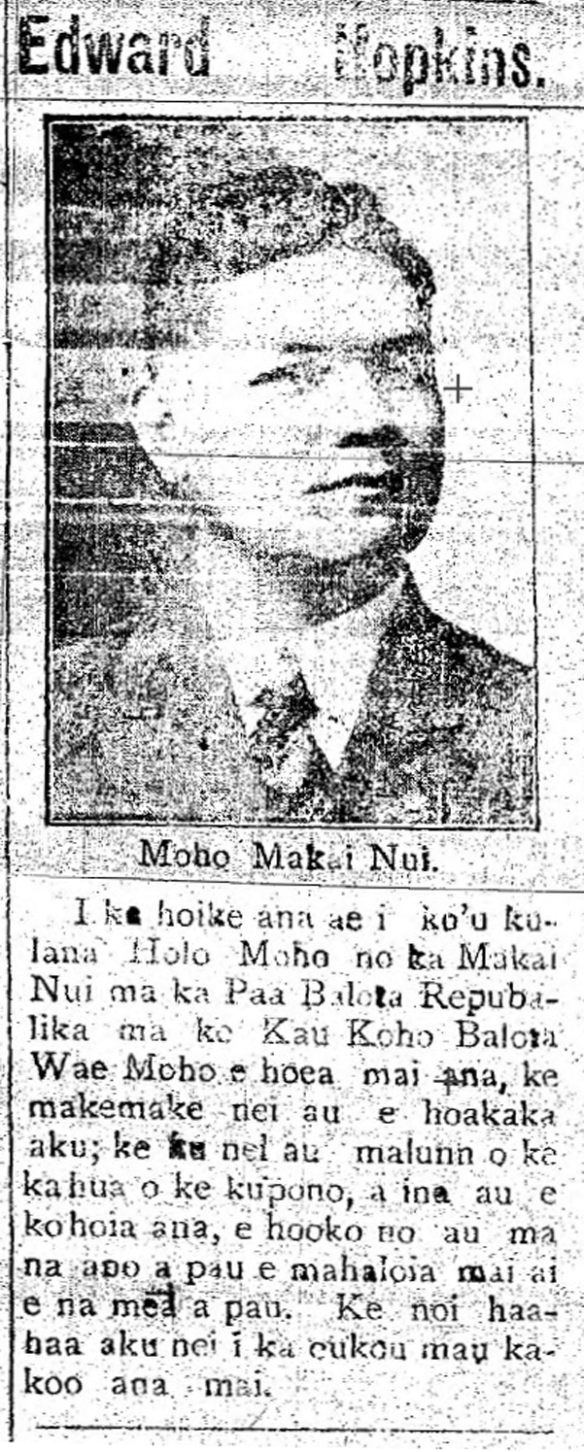
Edward Hopkins runs for Sheriff, 1917.

Edward Hopkins.

Candidate for Sheriff.

As I announce my candidacy for Sheriff on the Republican Ballot in the upcoming Election Season, I would like to make clear that I stand on the platform of good, and should I be elected, I will carry out all things so that everyone will be pleased. I ask humbly for your support.

(Puuhonua o na Hawaii, 5/25/1917, p. 4)

PONH_5_25_1917_4.png

Ka Puuhonua o na Hawaii, Buke IV, Helu 21, Aoao 4. Mei 25, 1917.

A mele composed by Mary Jane Montano for the fourth anniversary of the Outdoor Circle, 1916.

HONOLULU, OUR FAIRY LAND

A feature of yesterday’s birthday luncheon of the Outdoor Circle was the reading of a Hawaiian poem, written by Mrs. Mary Jane Kulani F. Montana [Montano], author of the verses of “The Old Plantation,” and dedicated to the Circle. The original verses and an English translation were read by Mrs. Webb. These were:

HONOLULU AINA KUPUA.

I.

I ka puu wau o Manoa,
I ka wai ola a Kanaloa,
E kilohi i ka nani punono
O Honolulu Aina Kupua.
Ua nani mai ka uka a ke kai
He mele aloha i ana ka puuwai,
Me he ala e i mai ana,
Honolulu Aina Kupua.

II.

Ua kini a lau na pua,
Kumoana la i kanahele,
Kanahele ohai pua ala,
I kanu ia e na lima aulii.
Aloha i ke oho o ka niu,
I ka holu nape i ke ehu kai,
Me he ala e i aku ana,
Honolulu Aina Kupua. Continue reading

Liliu’s National Anthem reaches New York, after a fashion, 1875.

Their National Hymn.

The words and music of the Hawaiian national anthem are both the composition of Mrs. Lila K. Dominis, the sister of King Kalakaua. The first part of the hymn we transcribe for the edification of our readers:

HE MELE LAHIU HAWAII.

Ka Makua Mana Loa,
Malin wai ia wakou,
E haliu aku rei.
We wa hian haahan,
E wan ka waluhia
O rei Pae Alna,
Wal Hawaiia Nuhan,
Mololo o Kou Malu. Continue reading

More on mele, 1860.

Through mele, one can understand the way of life of the people of very long ago, and the stories of the land as well!

Don’t forget to answer this short survey from the Bishop Museum Library and Archives. And if you are in a language class, in a hula class, in a history class. Why do you look at mele? Why don’t you look at mele? Send this survey around.

[Click the link below:]

https://docs.google.com/forms/d/e/1FAIpQLSdL2lT4hbMOyYOk0NwYtGPeIgOHj5k6ShE1N8Ub9EmrnzRWqA/viewform?usp=sf_link

nupepa's avatarnupepa

Pertaining to Mele

Perhaps the mele of old are almost all lost; those who know them are but few. This is something to be regretful of for in those mele, one can understand the way of life of the people of very long ago, and the stories of the land as well. The means for these mele to continue and not to be lost is by printing them in books and newspapers perhaps; in that way, the new generations can read them and contemplate over it and see the misconceptions of their kupuna and to not follow in their misguided ways. We wish to print the old mele and new mele, as long as they are good, and we ask of those who have mele and the composers of mele to send them to us and we will print them. Write the letters very clearly, and insert punctuation where they…

View original post 412 more words