“Kuu Moi,” a patriotic mele by Clarence E. Edwords, 1896.

Kuu Moi.

Oh Lydia, Heaven born child of the sun!
Liliuokalani, aloha, kuu Moi!
True sovereign of the sun kissed isles of the sea,
Let it not be said that they race is now run.
How shall the intruders for their crimes atone?
For the vile indignities cast upon thee?
Oh, what, indeed, should the fit punishment be
For those who so basely robbed thee of thy throne?
Even now with stones they children are fed;
Aye, but it were better that they should be dead
Than pledged allegiance to the foreign born band,
Or take subsistence from their accursed hand.
Akua mana loa forbid it be said
That thy people deserted their native land.

Clarence E. Edwords.

[Does anyone know the story of Clarence E. Edwords?? There are some nice references to what is happens with the patriots of the Royal Hawaiian Band choosing to eat stones before pledging allegiance to the Provisional Government. Ellen Predergast composes “Mele Ai Pohaku,” and Clarence E. Edwords composes “Kuu Moi.”]

(Makaainana, 7/13/1896, p. 1)

Kuu Moi.

Ka Makaainana, Buke VI—-Ano Hou, Helu 2, Aoao 1. Iulai 13, 1896.

Maui story of Eleio, the kahu of Kakaalaneo, the alii, by W. N. Pualewa, 1863.

THE STORY

—OF—

ELEIO.

SECTION 1.

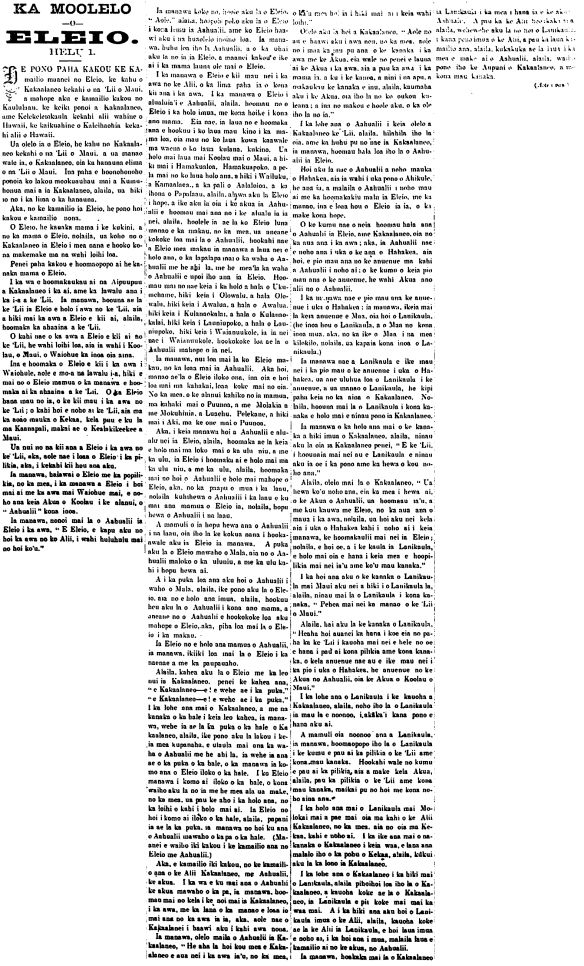
WE PERHAPS SHOULD SPEAK here of Eleio, the caretaker of Kakaalaneo, an Alii of Maui, and thereafter, let’s speak of Kaululaau, the actual child of Kakaalaneo and a chiefess of Hawaii, Kelekeleiokaula, the daughter of Kaleihaohia, a chief of Hawaii.

It is said that Eleio was a kahu of Kakaalaneo, an Alii of Maui, and it is thought that Kakaalaneo was the fifth generation of Maui Chiefs. If their genealogy was laid out properly from Kumuhonua to Kakaalaneo, then it would actually come to five generations.

But in speaking about Eleio, we must speak about him.

Eleio was a fast runner, and because of Eleio’s speed, Kakaalaneo chose Eleio to fulfill his needs in very far places.

This is how we will see how fast Eleio was.

When the Steward of Kakaalaneo was preparing the poi and the ti-leaf wrapped fish of the Alii, at that time, the Alii sent Eleio to go get awa for Him; and the feast of the Alii would begin with the arrival of the awa fetched by Eleio.

But the location of the awa that Eleio was to fetch for the Alii was at a place very far, and that place was in the Koolau side of Maui, at a place named Waiohue.

 If Eleio went to get the awa at Waiohule when the ti-leaf wrapped fish was not cooked, he would return before the meal of the Alii began. This is something Eleio did all the time, fetching the awa for the Chief; the place the Chief lived was mauka of Kekaa, that hill standing at Kaanapali, makai side of Kealakikeekee a Maui.

[This is the beginning of the story of Eleio, it begins in the Kuokoa from 9/5/1863, and concludes on 11/21/1863. This story was written down by W. N. Pualewa (who seems to have died at Kalawao on 12/26/1873).

The closing by Pualewa of his telling of the story is interesting:

And there is this, at this point, we will end our Story of Eleio and Kaululaau; because, we have come to the place where there is great entanglements, and not because the Story is completed, but because of the complexity of putting into order, for there are five sections left of this Moolelo, and within those five parts, divided are the branches of the alii, the genealogy of the kahuna, and the ancestors of the kanaka, and because of this difficulty, I am ending Kaululaau at this Section, and it is for someone that is versed in the Moolelo who should fill this empty space of the paper. With thanks. W. N. Pualewa.]

(Kuokoa, 9/5/1863, p. 1)
KA MOOLELO O ELEIO.

Ka Nupepa Kuokoa, Buke II, Helu 36, Aoao 1. Sepatemaba 5, 1863.

Our Stories Are Sacred, On Knowing Who We Are 

Owning History is Powerful! Something to think about.

hehiale's avatarKE KAUPU HEHI ALE

A flying peacock at the Nehru Memorial Museum and Library, Delhi, courtesy of the author


Our Stories Are Sacred, On Knowing Who We Are

by Anjoli Roy

     “Of course people ask me about India.” Chhaya Pishi makes a face reserved for stupid people. “Eating with my hands. Arranged marriage. Whatever. This is New York, though, thank God. Not some backward place without Indians.” She passes a long shelf of brittle pasta.
     Chandrani considers that at least her aunt knows what to say when people do ask. She’s usually guessing. Or trying to make things up so she didn’t sound so dumb. And white.
     When Chandrani’s third-grade teacher asked her which tribe she came from, she blurted out Cherokee. Her teacher looked relieved, like she’d finally dug out something sharp from her skin. She told Chandrani what strong people she came from. At dinner that night, when Chandrani told her father…

View original post 1,624 more words

Another patriotic mele by Eleanor Prendergast, 1893.

KE ALOHA AINA.

1st.  Kahiko ka ohu i Nuuanu
I ka hoku a ka lau Kawelu
Ua lupea ia e ka moani
Hoope aala oia uka.

Hui:  He halia he aloha keia
No kuu aina hanau
A’u e hiipoi mau nei
No ka lanakila o Hawaii.

2nd.  Ua nani ka pua o ka Ilima
I pilia mai me ka Maile
I wehi hoohie no ke kino
Kahiko mau no Hawaii.

3rd.  Kamahao ka ike’na i ka nani
I ka wai Lehua a na manu
Manu inu wai pua Ohelo
Iiwipolena o ke Kuahiwi.

Miss Kekoaohiwaikalani.

Puahaulani Hale.

Honolulu, Mar. 25, 1893.

(Leo o ka Lahui, 4/24/1893, p. 1)

KE ALOHA AINA.

Ka Leo o ka Lahui, Buke II, Helu 690, Aoao 1. Aperila 24, 1893.

Translation of H. Rider Haggard’s, “Morning Star,” 1910.

THE HEART-STIRRING TALE

—:OF:—

THE MORNING STAR

—AND—

RAMSES HER BELOVED SWEETHEART

“The Heir of Pharoah
The Favorite of Amen-Rah
The Proud Beauty of Egypt
The Darling of Her People.”

An Old Story from Egypt.
(Translated for the Hoku o Hawaii.)

Introduction.

We are printing this famous story of the Kingdom of Egypt. And it was near the time when Moses was living in Egypt. It is a story of speaking of the religion of that ancient people, and a story of their Chiefly kapu intertwined with their Godly kapu.

We published before our readers some years ago stories of our own Alii of ancient times of our land, and Tales of Hawaii which are nearly not remembered by the  current people of these times, and through this story which we are sharing with our readers, they will see some things about that ancient people of the land in the east. It is toilsome to translate these stories for the benefit of the people who enjoy reading stories in the Hoku. And from the Hoku, we lovingly urge its readers to please remember the life of this Hoku of ours. Printing a newspaper is very costly, and its existence and progress is reliant upon its readers.

We hope that some of the subscribers of the Hoku who are delinquent in their payments to the life of the Hoku will be moved with aloha, and they will make their payment towards the life of this patient servant.

Forgive us for these words that are not related to our story, however, “Ears do not get filled up with words.” And it is our responsibility to call out with aloha to our readers who have not paid their subscription, for the good of the newspaper to print educational stories and wise discussions of this new age.

[That was the introduction by the Hoku o Hawaii newspaper to their translation of the story, “The Morning Star” by H. Rider Haggard, which was printed just earlier that year in 1910. It ran in the weekly Hoku from March 17, 1910 to February 1, 1912.

It would be a cool thing if immersion students were introduced to old translations like these. They could see what kind of vocabulary and turns of phrase that were common during the period. I realize that trying to get through a novel in this format is tiresome and tedious, and I am considering reformatting a story (in the original orthography so that students can get more practice at reading material as they were presented in the newspapers) so that it reads continuously as a book. However, I am not sure if immersion teachers or students out there think that it would be beneficial. Perhaps it is already being done.]

(Hoku o Hawaii, 3/17/1910, p. 1)

HE MOOLELO HOONIUA PUUWAI NO KA HOKU KAKAHIAKA

Ka Hoku o Hawaii, Buke IV, Helu 46, Aoao 1. Maraki 17, 1910.

Message in a mat, 1874.

[Found under: “Nu Hou Kuloko.”]

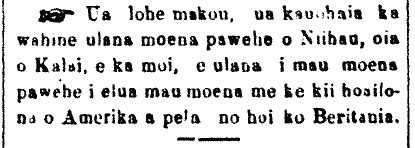
We have heard that the woman who wove the pawehe mat of Niihau, that being Kalai, was asked by the king to weave a moena pawehe, two of them, with the symbol [kii hoailona] of America and so too of Britain.

(Kuokoa, 5/2/1874, p. 2)

Ua lohe makou, ua kauohaia...

Ka Nupepa Kuokoa, Buke XIII, Helu 18, Aoao 2. Mei 2, 1874.

Princess Regent Liliuonamoku, 1881.

The Journey of the Princess Regent.

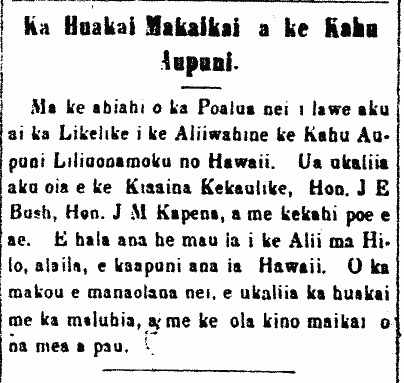
In the evening of this past Tuesday, the Likelike took the Chiefess, the Regent Liliuonamoku to Hawaii. She was attended by Governor Kekaulike, Hon. J. E. Bush, Hon. J. M. Kapena, and some others. The Chiefess will spend some days in Hilo, and then she will make a circuit of Hawaii. Our hope is that her journey will be accompanied by safety, and the good health of all.

(Kuokoa, 8/6/1881, p. 2)

Ka Huakai Makaikai a ke Kahu Aupuni.

Ka Nupepa Kuokoa, Buke XX, Helu 32, Aoao 2. Augate 6, 1881.

Champion follows the Iwalani, 1894.

The Champion [Kamepion] Leaves.

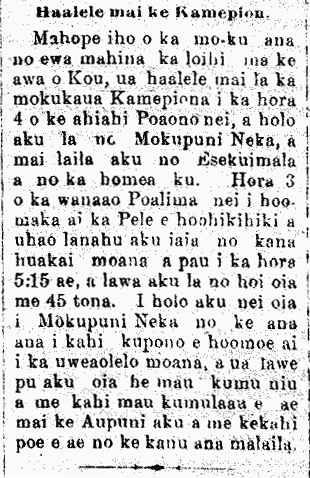
After remaining in the port of Kou for nine months, the warship Champion left at 4 in the late afternoon this past Saturday, and headed to Necker Island [Mokupuni Neka], and from there on to Esquimalt [Esekuimala] and then on home. At 3 o’clock in the dawn of the following Friday, the Pele began to fetch and scoop up coal for its long ocean voyage, and was through at 5:15, and it was filled with 45 tons. It left for Necker Island to map the proper route to lay the ocean telegraph cable [uweaolelo moana], and he took with them some coconut trees  and some other trees from the Government with some others to plant there.

(Makaainana, 8/27/1894, p. 1)

Haalele mai ke Kamepion.

Ka Makaainana, Buke II—-Ano Hou, Helu 9, Aoao 1. Augate 27, 1894.