FRANK PAHIA WAS CALLED BACK.
FRANK PAHIA.
At 4 o’clock on Thursday afternoon past, the messenger of death visited the home of Frank Pahia, an important Hawaiian, who carried out the work of the people for half a century, and [the messenger of death] took his life breath and left his cold body, the dust returning to dust at the cemetery of the Hawaiian church in Kaneohe, after he was sick for a short time.
He was born in Kukuipahu, Kohala, Hawaii, on the 1st of January, 1847, and at his rest, he was 76 years old and a few days over. He became a widower six years ago, and he left behind three children, Mrs. William Henry, the widow of the first Sheriff of the Territory; William Henry; Henry Pahia, a surveyor; and John I. Pahia, a watchman for the lighthouse.
Frank Pahia was highly educated at the schools of Kohala, here in Honolulu, and finally at the college of Lahainaluna, the school famous in that time as the Light not extinguished by the Kauaula wind.
Frank Pahia held many government jobs outside of his regular vocation of surveyor; he was the deputy sheriff of Hawaii at Hilo, and when he returned to Oahu nei, the was deputy sheriff for 16 years for here in the district of Koolaupoko. He was one of the members of the legislature in the time of the Monarchy for two seasons.
Heeia is where he lived the last days of his life. In 1916, his partner left him and he lived alone until his death.
While he held all sorts of positions, he carried out his duties with impartially and righteously; there was seen at all any blemishes in his work in all the positions he held.
He was kind and had an open heart, and he was a redeemer for the people of this land, and a parental figure for the district in which he lived.
(Kuokoa, 1/11/1923, p. 3)
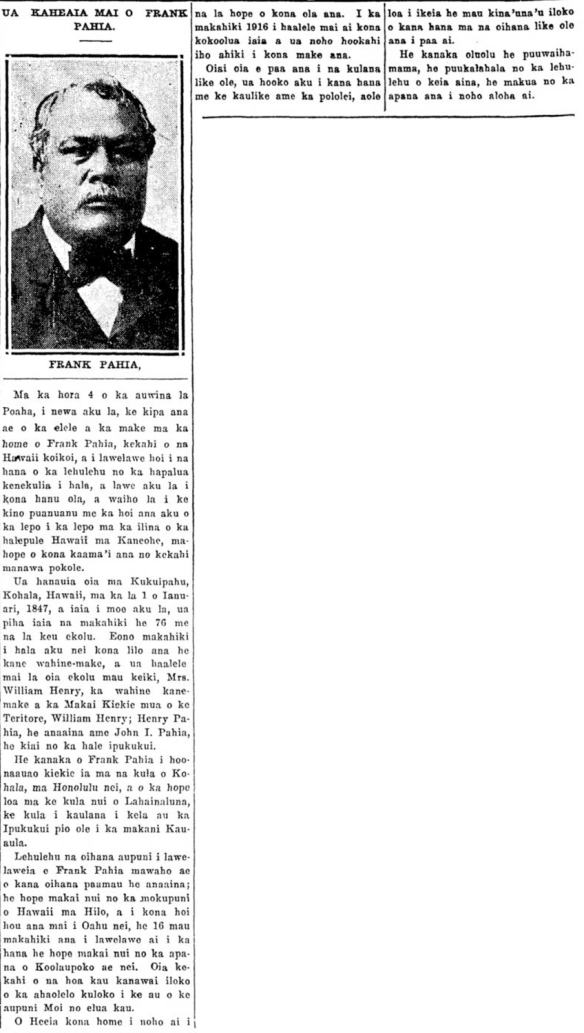
Ka Nupepa Kuokoa, Buke XLII, Helu 2, Aoao 3. Ianuari 11, 1923.
 nupepa