More on the death of Keanu, 1902.

KEANU DIES ON THE SEA SHORE

Shortly after 8 o’clock yesterday morning the body of Keanu, a high chiefess and reputed daughter of Kamehameha V, was found upon the beach at Waikiki, opposite the premises of the late Queen Dowager Kapiolani, now occupied by Princes David and Cupid. The woman had probably been dead about an hour when discovered, and her death is believed to have been due to apoplexy. She was well when she left the Dowager’s premises early in the morning. She wen across the roadway to the bathing beach, donned a muumuu and entered the water for a swim. Just how soon she was overcome is not known, but it is evident that she was upon the beach when the attack came. The fact which led to the belief of apoplexy was that the face was much discolored. There is nothing pointing to foul play and it is not believed that she was drowned.

A jury was empanelled yesterday morning and the body viewed at the morgue. An inquest was to have been held last night at the police station but was postponed until this afternoon.

Keanu was a woman of imposing appearance and always commanded the attention and respect of Hawaiians wherever she went. She had the manner and dignity of a chiefess of the royal blood and was looked upon by the natives generally as one to whom homage was due. She was a great friend of the late Princess Ruth and in later years was much with the late Queen Dowager. She has been residing on the premises at Pualeilani for several years and was protected by the two Princes, as well as by the Dowager before them. For some time past she had not been right in her mind. Several years ago her husband went away into the mountains and nothing more was heard of him. She leaves several children.

At the breakfast and reception given by Queen Liliuokalani last year Keanu was among those who called and her appearance was much commented on at that time, for, believing herself fully entitled to respect and homage, she swept majestically along amongst the throng as if she were a reigning queen.

(Hawaiian Gazette, 7/1/1902, p. 4)
KEANU DIES ON SEA SHORE

Hawaiian Gazette, Volume XXXVII, Number 50, Page 4. July 1, 1902.
Keanu, daughter of Kamehameha V and Keelikolani, passes, 1902.

That Royal Descendant of the Land has Passed.

KEANU DIES ON THE SHORE OF WAIKIKI.

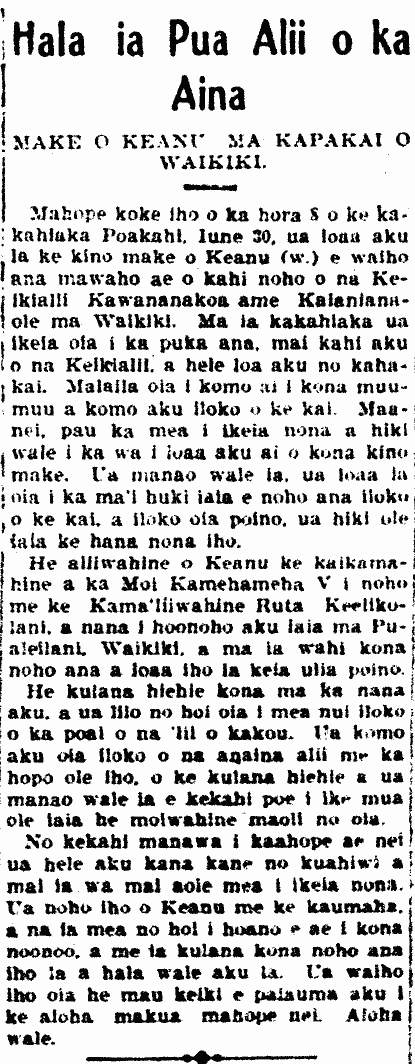
Right after 8 o’clock in the morning of Monday, June 30, the dead body of Keanu (f.) was found out near the residence of the Princes Kawananakoa and Kalanianaole at Waikiki. On that morning she was seen coming out of the Princes’ place, and went all the way to the ocean. There she put on her muumuu and went into the ocean. From here, that was all that was known of her until her body was found. It is believed that she had a stroke [ma’i huki] while in the water, and while being so afflicted, she could not help herself.

Keanu was a chiefess, the daughter of Kamehameha V and Princess Ruth Keelikolani [Ruta], and it was he who housed her at Pualeilani, Waikiki, and it was there that she lived until this unfortunate accident.

She had a regal stature, and she became an important presence in our chiefly circles. She fearlessly appeared at royal audiences with elegance, and some who had not seen her before thought she was an actual queen.

Some time ago, her husband went into the mountains, and since then nothing was known of him. Keanu lived in sadness, and it was this that made her lose her senses. She left behind children who grieve in their love for her. How pitiful.

[Anyone have more information on Keanu?]

(Kuokoa, 7/4/1902, p. 1)

Hala ia Pua Alii o ka Aina

Ka Nupepa Kuokoa, Buke XL, Helu 27, Aoao 1. Iulai 4, 1902.

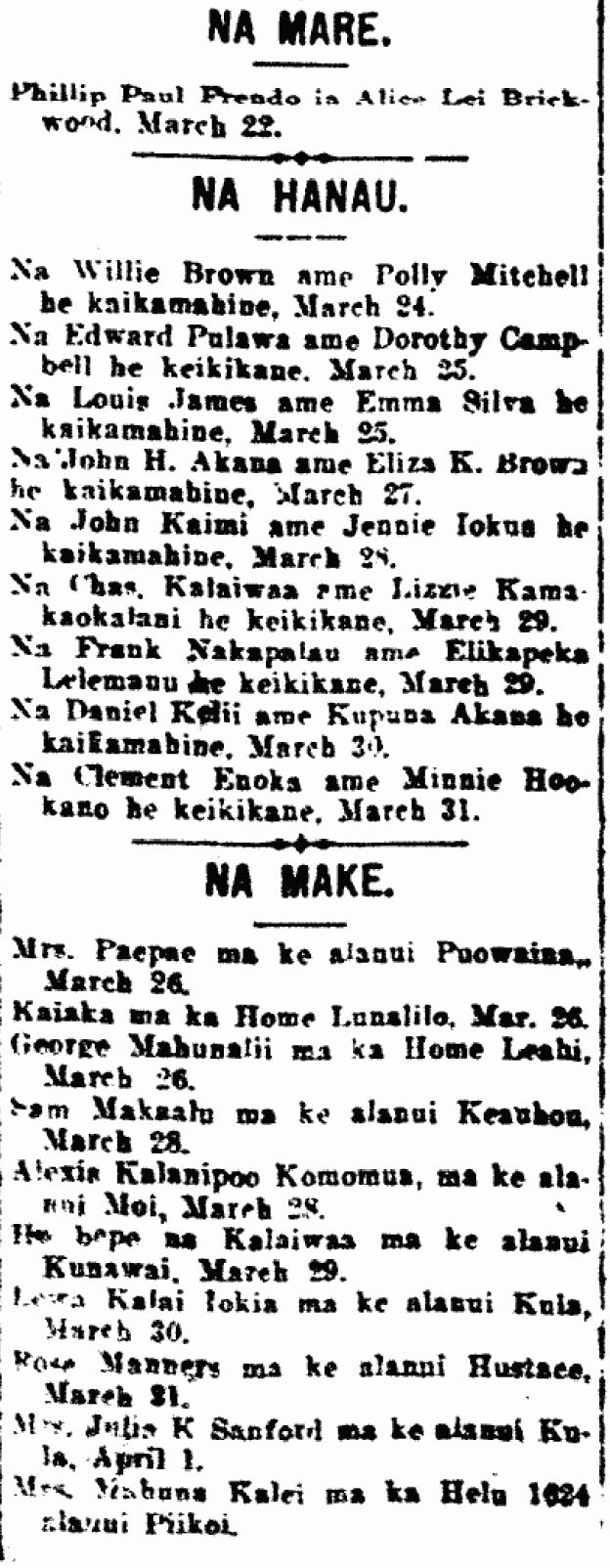
Vital Statistics, 1913.

MARRIAGES.

Phillip Paul Frendo to Alice Lei Brickwood, March 22.

BIRTHS.

To Willie Brown and Polly Mitchell, a daughter, March 24.
To Edward Pulawa and Dorothy Campbell, a son, March 25.
To Louis James and Emma Silva, a daughter, March 25.
To John H. Akana and Eliza K. Brown, a daughter, March 27.
To John Kaimi and Jennie Iokua, a daughter, March 28.
To Charles Kalaiwaa and Lizzie Kamakaokalani, a son, March 29.
To Frank Nakapalau and Elikapeka Lelemanu, a son, March 29.
To Daniel Kelii and Kupuna Akana, a daughter, March 30.
To Clement Enoka and Minnie Hookano, a son, March 31.

DEATHS.

Mrs. Paepae, on Punchbowl Street, March 26.
Kaiaka, at Lunalilo Home, Mar. 26.
George Mahunalii, at Leahi Home, March 26.
Sam Makaalu, on Keauhou Street, March 28.
Alexis Kalanipoo Komomua, on King Street, March 28.
A baby of Kalaiwaa, on Kunawai Street, March 29.
Lewa Kalai Iokia, on School Street, March 30.
Rose Manners, on Hustace Street, March 31.
Mrs. Julia K. Sanford, on School Street, April 1.
Mrs. Mahuna Kalei, at 1624 Piikoi Street.

(Kuokoa, 4/4/1913, p. 8)

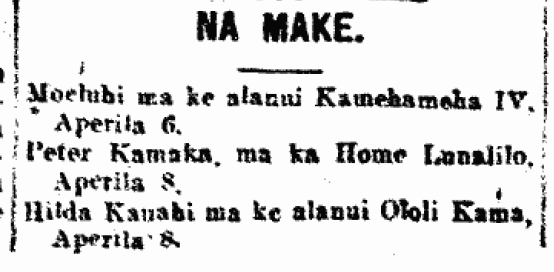
NA MARE. / NA HANAU. / NA MAKE.

Ka Nupepa Kuokoa, Buke LI, Helu 13, Aoao 8. Aperila 4, 1913.

Ninipo Hoonipo Song in Australia, 1927.

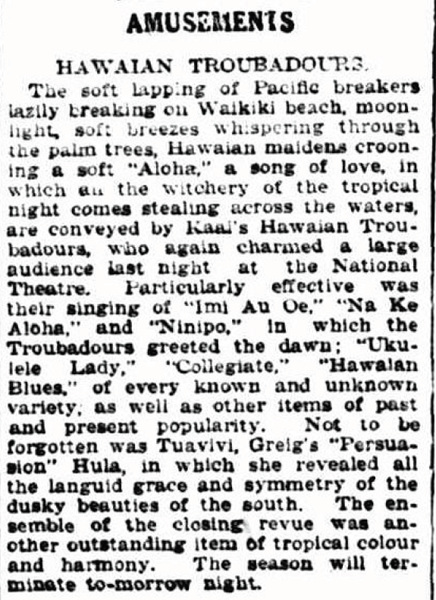
AMUSEMENTS

THE HAWAIIAN TROUBADOURS. The soft lapping of Pacific breakers lazily breaking on Waikiki beach, moon light, soft breezes whispering through the palm trees, Hawaian maidens crooning a soft “Aloha,” a song of love, in which all the witchery of the tropical night comes stealing across the waters, are conveyed by Kaai’s Hawaian Troubadours, who again charmed a large audience last night at the National Theatre. Particularly effective was their singing of “Imi Au Oe,”¹ “Na Ke Aloha,” and “Ninipo,” In which the Troubadours greeted the dawn; “Ukulele Lady,” “Collegiate,” “Hawaian Blues.” of every known and unknown variety; as well as other items of past and present popularity. Not to be forgotten was Tuavivi, Greig’s “Persuasion” Hula, in which she revealed all the languid grace and symmetry of the dusky beauties of the south. The ensemble of the closing revue was another outstanding item of tropical colour and harmony. The season will terminate to-morrow night.

[Earlier, i posted Liliuokalani’s “Ninipo Hoonipo Song”, and strangely enough, i ran across this reference to it being sung all the way in Australia in 1928!]

¹”Imi Au Ia Oe”

(Examiner, 4/22/1927, p. 6)

AMUSEMENTS.

The Examiner, Volume LXXXV, Number 95, Page 6. April 22, 1927.

“Kaai’s Hawaiians” on TROVE, 1928.

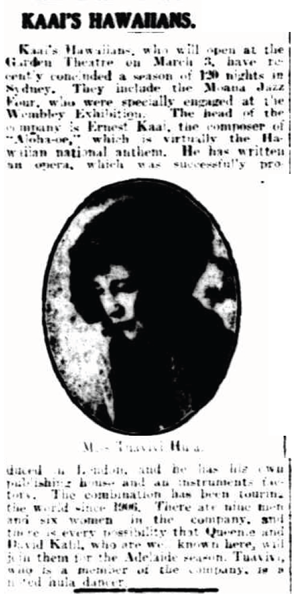
KAAI’S HAWAIIANS.

Kaaiʻs Hawaiians, who will open at the Garden Theatre on March 3, have recently concluded a season of 120 nights in Sydney. They include the Moana Jazz Four, who were specially engaged at the Wembley Exhibition. The head of the company is Ernest Kaai, the composer of   “Aloha oe,” which is virtally the Hawaiiian national anthem. He has written and opera, which was successfully pro…

Miss Tuavivi Greig

…duced in London, and he has his own publishing house and an intsruments factory. The combination has been touring the world since 1906. There are nine men   and six women in the company, and there is every possibility that Queenie and   David Kaili, who are we know here, will join them for the Adelaide season. Tuavivi,   who is a member of the company, is a noted hula dancer.

[This comes from an Adelaide, South Australia newspaper, found on the National Library of Australia webside, TROVE. It seems unclear newspaper images is not something limited to Hawaii nei. However, at least the text on that site is correctable.]

(Advertiser, 2/23/1923, p. 11)

KAAI'S HAWAIIANS.

The Advertiser, Volume LXX, Number 21645, Page 11. February 23, 1928.

Portuguese laborers, 1911.

MORE LABORERS TO BE OBTAINED.

On this Saturday, A. J. Campbell will leave Honolulu once again to go to get more laborers for the sugarcane plantations; it is believed that this mission to obtain laborers will be easier than the earlier ones.

Portuguese laborers are wanted most to come to Hawaii nei because of the belief that they are the best laborers, and being that there are many Portuguese now working in the sugar plantations, and that they wrote letters to their families behind, it has made them excited to come to Hawaii nei, and thus it is believed that his journey to fetch laborers will go smoothly.

When the board of immigration [oihana hoopae limahana] was asked if they were thinking about Chinese laborers, they denied this because the authorities in Washington are strongly against the importation of those people into the land; they are only in favor of European stock.

The entire expenses of Mr. Campbell’s travels will be paid by the board of labor [papa limahana], along with his salary of ten-thousand dollars a year.

[Here is a related publication available online:

FIRST REPORT OF THE BOARD OF IMMIGRATION TO THE GOVERNOR OF THE TERRITORY OF HAWAII.” Honolulu : Bulletin Pub. Co., Ltd., 1907-1911.]

(Kuokoa, 7/14/1911, p. 7)

E KII HOU ANA I MAU LIMAHANA.

Ka Nupepa Kuokoa, Buke XLVII, Helu 28, Aoao 7. Iulai 14, 1911.