More Hawaiians in the military, 1917.

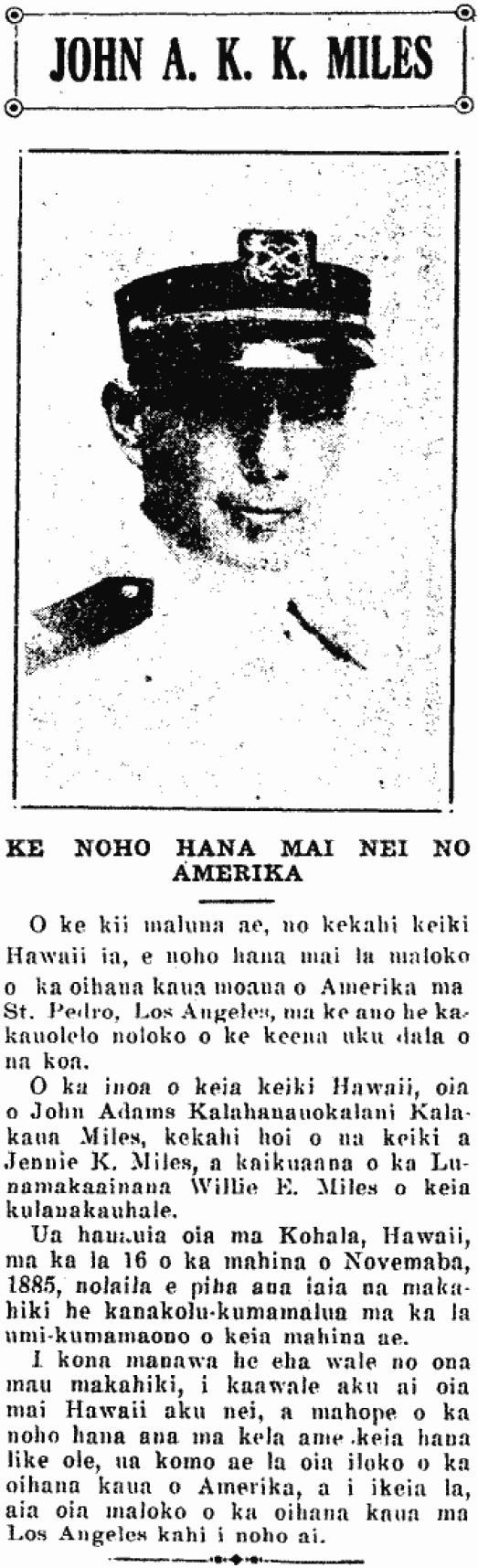
JOHN A. K. K. MILES

WORKING IN THE SERVICE OF AMERICA

The picture above is of a Hawaiian boy who is working in the navy of America at St. Pedro, Los Angeles, as a secretary in the department of the payroll of the military.

The name of this Hawaiian youth is John Adams Kalahanauokalani Kalakaua¹ Miles, a child of Jennie K. Miles and the older brother of Legislator Willie E. Miles of this city.

He was born in Kohala, Hawaii, on the 16th of November, 1885, and therefore he will make 32 on the 16th of next month.

When he was but four years old, he was taken from Hawaii nei, and after working at various jobs, he joined the military of America. And today, we see that he is in the service in Los Angeles, where he resides.

¹One way names were given traditionally was after important events, whether happy or sad. This is a nice and clear example of a commemorative name. John A. K. K. Miles was born on November 16, 1885, on the birthday of King Kalakaua. He was therefore named literally “The birthday of the royal one Kalakaua”.

(Kuokoa, 10/19/1917, p. 4)
JOHN A. K. K. MILES

Ka Nupepa Kuokoa, Buke LV, Helu 42, Aoao 4. Okatoba 19, 1917.

Hawaiian dies at war, 1917.

ALLY PAMA KUA

HAWAIIAN BOY IS TORPEDOED AND DIES.

The picture [above] is of a Hawaiian sailor, named Ally Pama Kua, who just died at sea when the steamship Kansas was sunk by a torpedo from a German submarine. This, according to a telegraph sent to this town from New York, on the 11th of this month.

The Kansas was torpedoed while it was carrying a full load to France from New York. When the steamship was sunk, A. P. Kua drowned, along with him was a American haole, and two others. As for the captain and the rest of the sailors, they all were all saved.

Because of this sad news received in town, it caused the family of Mr. Kua to be heartbroken. However, there is one thing that made it better, and that was the knowledge that the death of this Hawaiian boy was because he sacrificed his life for his country.

Ally Pama Kua was twenty-seven years old when he met with this tragedy at sea. He is the child of Fritz Wilhelm Kua of the corner of Makiki Street and Beritania Avenue. Aside from his father, he has three sisters and two cousins who are left behind grieving for him.

Ally Pama Kua was employed for a long time as a sailor aboard the steamship Kansas, from when it was sailing Hawaiian waters. And when it became a ship transporting food and other goods for France, he continued working aboard it, all the way until he met with his death on the ocean.

The last word that his family here heard from him was when they received his letter from Philadelphia written last February, and within the letter, he spoke of his marriage to a French woman.

(Kuokoa, 7/20/1917, p. 2)

ALLY PAMA KUA

Ka Nupepa Kuokoa, Buke LV, Helu 29, Aoao 2. Iulai 20, 1917.

Hawaiians away at war, 1917.

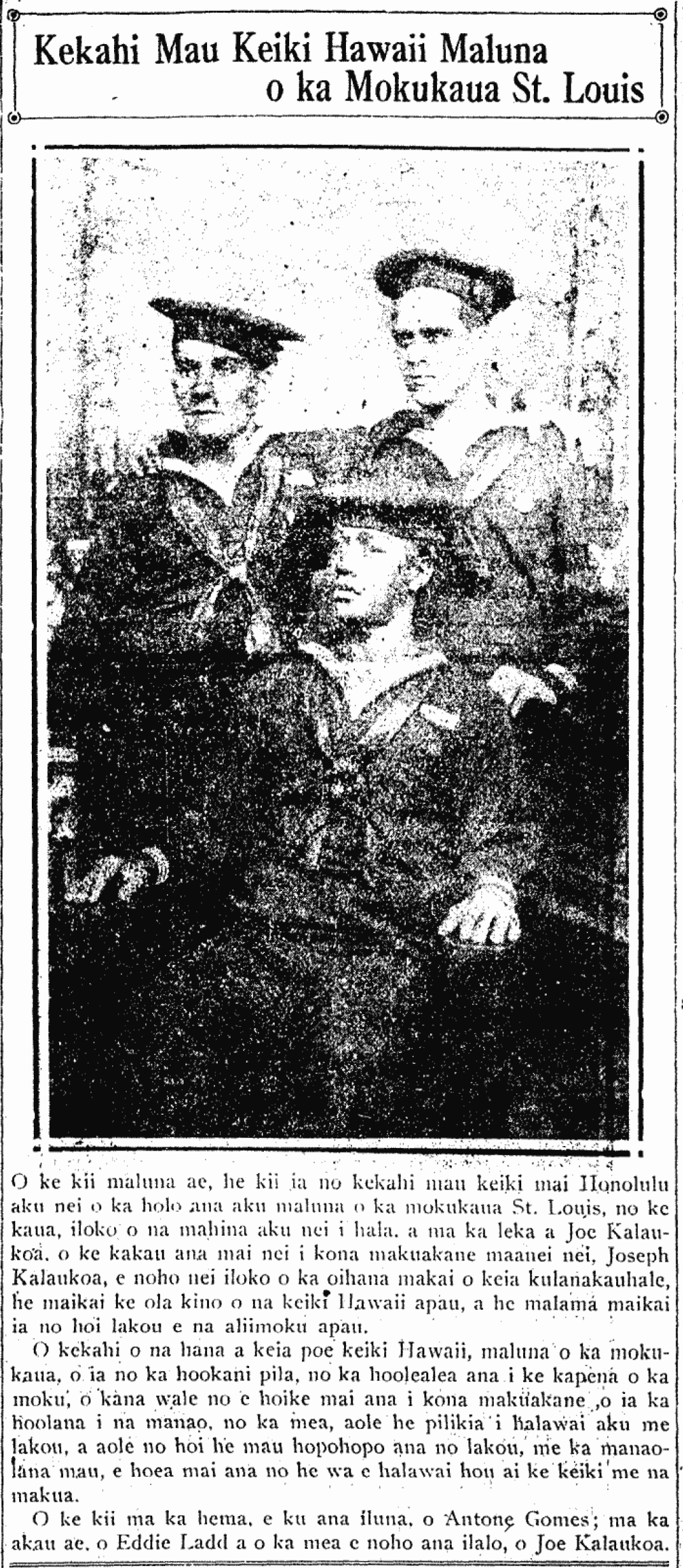
Some Hawaiian Boys Aboard the Warship St. Louis

The picture above is of some boys, who left from Honolulu on the warship St. Louis in the past months for the war. And according to the letter written by Joe Kalaukoa to his father Joseph Kalaukoa, who is in the police force of this city, all of the Hawaiian youths are doing well and are all being well taken care of by the officers.

One of the activities of these Hawaiian boys aboard the warship is playing music to entertain the ship’s captain; everything he wrote to his father was uplifting, because there has been no difficulties faced, and he has no fear for them and is forevermore hopeful that there will come a time that the child will again see his parents.

In the picture, standing to the left is Antone Gomes; to the right is Eddie Ladd, and the one seated is Joe Kalaukoa.

(Kuokoa, 7/13/1917, p. 2)

Kekahi Mau Keiki Hawaii Maluna o ka Mokukaua St. Louis

Ka Nupepa Kuokoa, Buke LV, Helu 28, Aoao 2. Iulai 13, 1917.

A composition for Hawaiians boys going away to war, 1918

Mele for the Hawaiian Boys

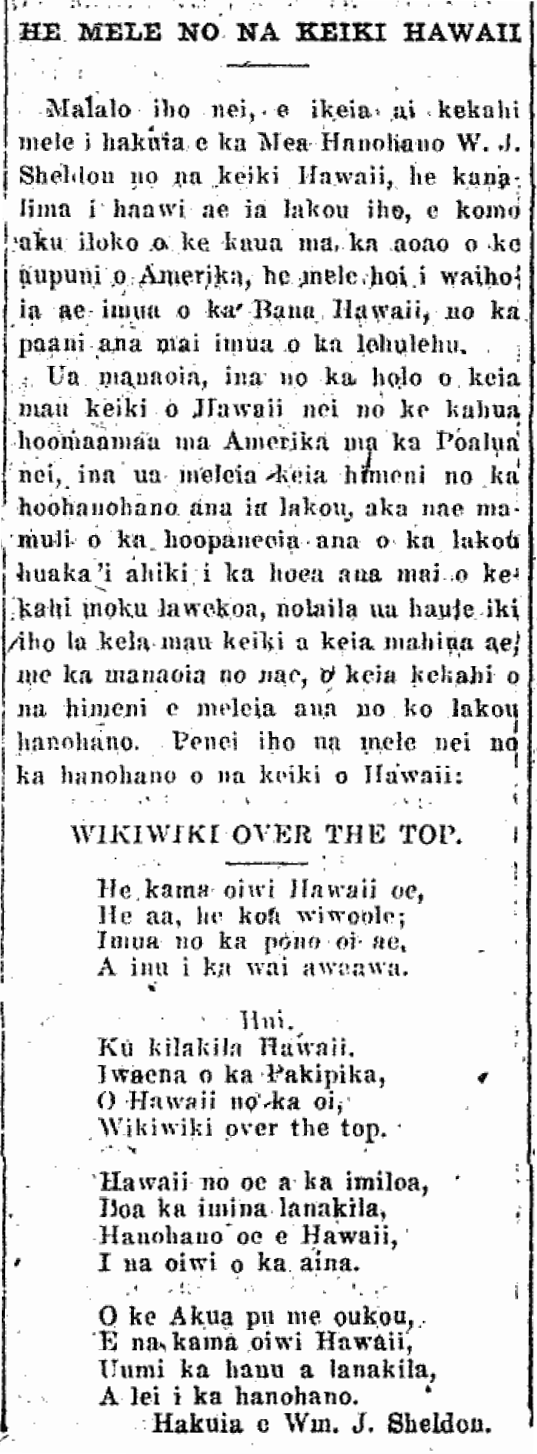
Seen below is a mele composed by the Honorable W. J. Sheldon for the fifty Hawaiian boys who gave themselves to join the war on the side of the nation of America. It is a song put before the Royal Hawaiian Band, to be played before the public.

It is believed that if these Hawaiian boys head out to the training camp in America on Tuesday, this song would have been sung for them in their honor. But as their trip is postponed until the arrival of a military ship, therefore the boys have been set back until next month. It is still believed that this will be one of the songs that will be sung to honor them. Here is this mele to glorify these Hawaiian youths:

WIKIWIKI OVER THE TOP

He kama oiwi Hawaii oe,
He aa,  he koa wiwoole;
Imua no ka pono oi ae,
A inu i ka wai awaawa.

Hui.

Ku kilakila Hawaii,
Iwaena o ka Pakipika,
O Hawaii no ka oi,
Wikiwiki over the top.

Hawaii no oe a ka imiloa,
Loa ka imina lanakila,
Hanohano oe e Hawaii,
I na oiwi o ka aina.

O ke Akua pu me oukou,
E na kama oiwi Hawaii,
Uumi ka hanu a lanakila,
A lei i ka hanohano.

Hakuia e Wm. J. Sheldon.

[Which went something like this:

QUICKLY OVER THE TOP.

You are a native son,
Daring, a fearless warrior;
Forward for the greater good,
And drink of the bitter waters.

Chorus.

Hawaii stands tall,
Amidst the Pacific,
Hawaii is the foremost,
Quickly, over the top.

You are Hawaii, of explorers,
Far reaching is your search for victory,
Proud is Hawaii,
For the oiwi of the land.

God be with you,
O Native sons of Hawaii,
Be patient until victorious,
And wear the honor like a lei.

Composed by William J. Sheldon.]

(Kuokoa, 5/17/1918, p. 3)

HE MELE NO NA KEIKI HAWAII

Ka Nupepa Kuokoa, Buke LVI, Helu 20, Aoao 3. Mei 17, 1918.

Vital Statistics, 1913.

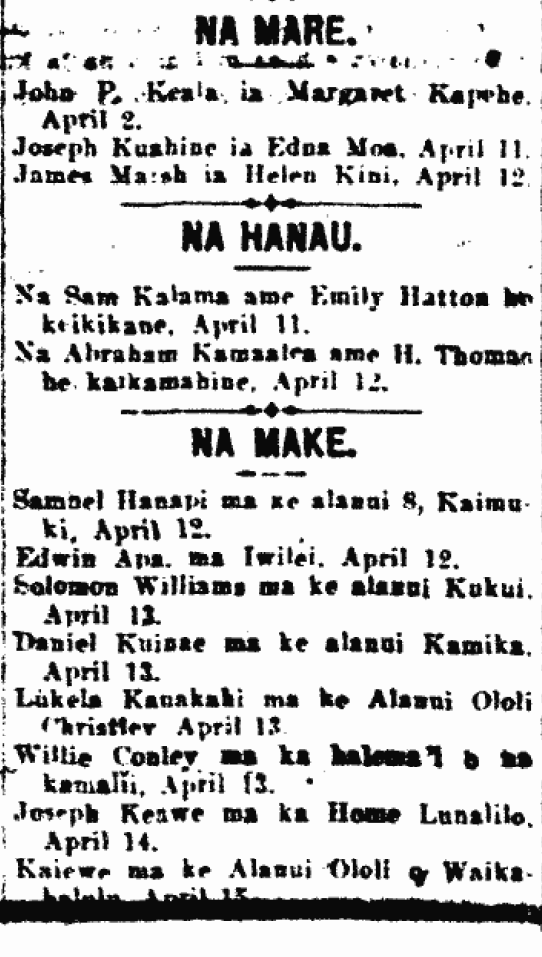
MARRIAGES.

John P. Keala to Margaret Kapehe, April 2.
Joseph Kuahine to Edna Moa, April 11.
James Marsh to Helen Kini, April 12.

BIRTHS.

To Sam Kalama and Emily Hatton, a son, April 11.
To Abraham Kamaalea and H. Thomas, a daughter, April 12.

DEATHS.

Samuel Hanapi, on 8th Avenue, Kaimuki, April 12.
Edwin Apa [? Edwin Aoa ? Edwin Ana], in Iwilei, April 12.
Solomon Williams, on Kukui Street, April 13.
Daniel Kuinae, on Smith Street, April 13.
Lukela Kauakahi, on Christiev Lane, April 13.
Willie Conley, at the children’s hospital, April 13.
Joseph Keawe, at Lunalilo Home, April 14.
Kaiewe, on Waikahalulu Lane, April 15.

(Kuokoa, 4/18/1913, p. 4)

NA MARE. / NA HANAU. / NA MAKE.

Ka Nupepa Kuokoa, Buke LI, Helu 15, Aoao 4. Aperila 18, 1913.

Old canoe, 1902.

Waa of the Olden Days

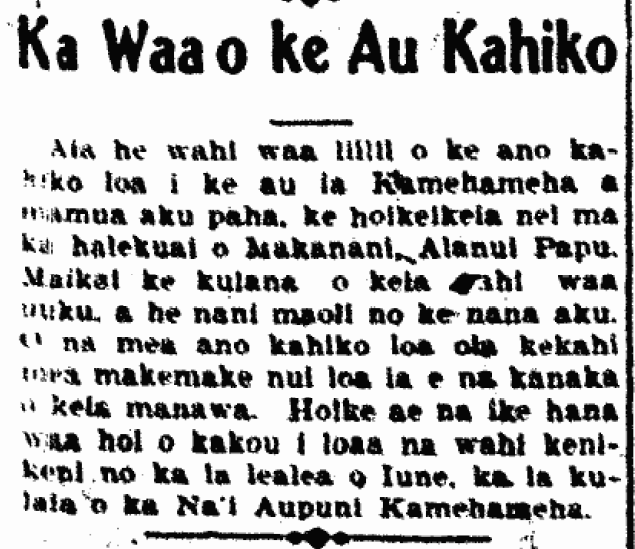
There is a tiny waa of the old sort, like those of the time of Kamehameha or perhaps before that; it is being displayed at the store of McInerny [Makanani] on Fort Street. The small waa is in good condition, and is truly beautiful to see. Antiquities are something those of today have much interest in. Canoe building will be demonstrated as a means to earn some money for that festive day of June, the holiday for Ka Na’i Aupuni, Kamehameha.

[Anyone know what became of this waa?]

(Kuokoa, 6/6/1902, p. 1)

Ka Waa o ke Au Kahiko

Ka Nupepa Kuokoa, Buke XL, Helu 23, Aoao 1. Iune 6, 1902.

Another mele composed by Mary Jane Montano, 1919.

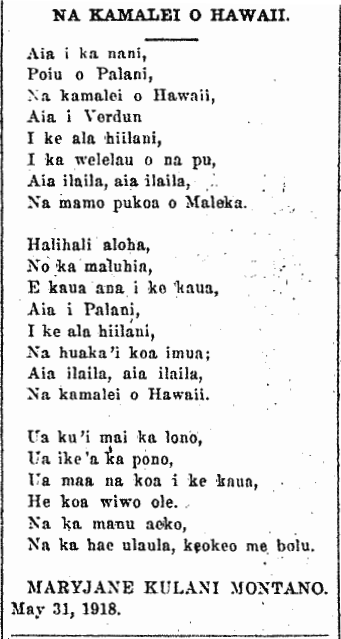
NA KAMALEI O HAWAII.

Aia i ka nani,
Poiu o Palani,
Na kamalei o Hawaii,
Aia i Verdun,
I ke ala hiilani,
I ka welelau o na pu,
Aia ilaila, aia ilaila,
Na mamo pukoa o Maleka.

Halihali aloha,
No ka maluhia,
E kaua ana i ke kaua,
Aia i Palani,
I ke ala hiilani,
Na huaka’i koa imua;
Aia ilaila, aia ilaila,
Na kamalei o Hawaii.

Ua ku’i mai ka lono,
Ua ike’a ka pono,
Ua maa na koa i ke kaua,
He koa wiwo ole.
Na ka manu aeko,
Na ka hae ulaula, keokeo me bolu.

MARYJANE KULANI MONTANO.

May 31, 1918.

[This is yet another composition by Mary Jane Montano, although not widely known today. This was composed in honor of the Hawaiian boys who were fighting in World War I, and alludes to the Battle of Verdun.

In the Hawaiian-Language Newspapers, you can find countless examples of Hawaiian boys going off to war outside of Hawaii nei, starting with America’s Civil War, and on down to the present.

The mele goes somewhat like:

THE BELOVED YOUTH OF HAWAII.

There in the beauty,
The glory of France,
Are the beloved youth of Hawaii,
There at Verdun,
On the exalted trail,
At the point of the artillery,
They are there, they are there,
The young fighters of America.

Carrying aloha,
For peace,
Fighting the fight,
There in France,
On the exalted trail,
The marching soldiers go forth,
They are there, they are there,
The beloved youth of Hawaii.

The news has spread,
The good has been seen,
The soldiers are seasoned,
Fearless warriors.
For the eagle,
For the red, white, and blue flag.

MARYJANE KULANI MONTANO.

May 31, 1918.]

(Kuokoa, 1/3/1919, p. 8)

NA KAMALEI O HAWAII

Ka Nupepa Kuokoa, Buke LVII, Helu 1, Aoao 8. Ianuari 3, 1919.

The children are your future! 1909 / timeless.

DON’T DECREASE THE PAY OF THE TEACHERS.

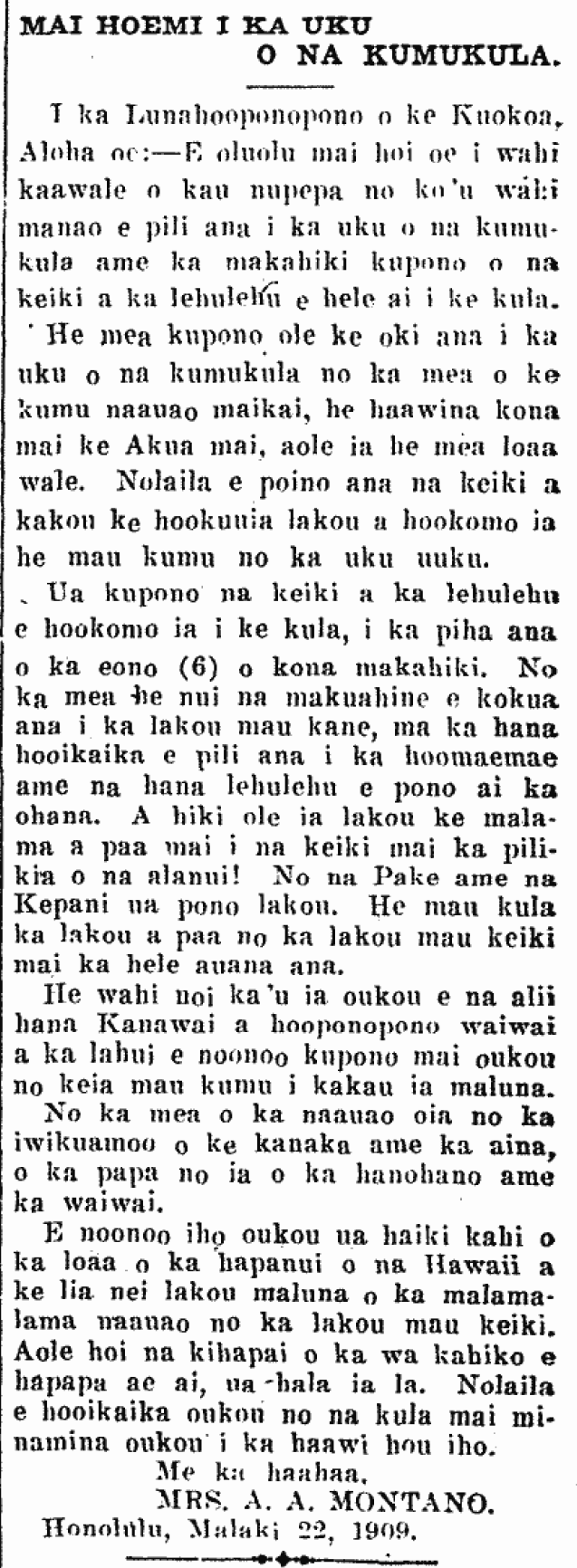
To the Editor of the Kuokoa, Aloha oe:—Please allow me some space in your newspaper for my humble thoughts dealing with the salary of teachers and the age at which children of the public should attend school.

It is wrong to cut the teachers’ pay because a well-educated teacher has a gift from God; it is not something readily gotten. And our children will be hurt should we let those teachers go and employ teachers for little pay.

The children of the people should be enrolled in school when they turn six (6) years of age. For there are many women who assist their husbands by endeavoring to take care of the many duties for the good of the family. And they are not able to care for and keep their children from the harm of the streets! As for the Chinese and the Japanese, they are fine. They have schools and their children are kept from wandering about.

I beseech all of you leaders who make Laws and who regulate public funds, do think carefully about these thoughts written above.

For knowledge is the backbone of man and his nation; it is the basis for fame and wealth.

Consider that the income of the majority of the Hawaiians is limited, and they are counting on the light of education for their children. The plantations of the old days are not to be reached out for, for those days are past. So all of you, please put effort into the schools, and don’t feel hesitant in investing more.

Sincerely,

MRS. A. A. MONTANO.

Honolulu, Malaki 22, 1909.

[Times have changed. Hopefully we learn from the past…

This letter is written by famed composer, Mary Jane Kekulani Montano.]

(Kuokoa, 3/26/1909, p. 4)

MAI HOEMI I KA UKU O NA KUMUKULA.

Ka Nupepa Kuokoa, Buke XLVI, Helu 13, Aoao 4. Maraki 26, 1909.

Buy local first—Love’s Bakery, 1909.

Support Local Businesses.

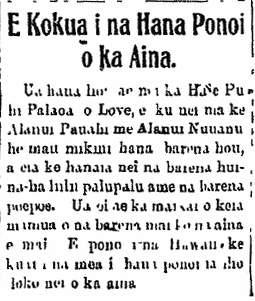
New cracker machines were installed at Love’s Bakery at Pauahi and Nuuanu Streets, and now being baked are light soda crackers [barena huina-ha liilii palupalu] and saloon pilot crackers [barena poepoe]. These are better than the crackers from outside of Hawaii. Hawaiians should purchase what is produced locally.

(Kuokoa Home Rula, 3/19/1909, p. 1)

E Kokua i na Hana Ponoi o ka Aina.

Kuokoa Home Rula, Buke VII, Helu 12, Aoao 1. Maraki 19, 1909.

Comments, Questions, and Corrections, 2013.

Aloha all.

I would like to state again that all comments, questions, and corrections are greatly welcomed, but it would be most helpful if they are appended under the corresponding posts here at http://nupepa-hawaii.com.

This would allow for an open dialogue among readers (and potential future readers?). Hopefully, one day, this page (and others like it) will take on a life of its own and I will no longer feel the need to put up anymore posts myself!

Mahalo a nui!!