Death of Edgar Henriques, 1931.

THAT KAMAAINA, EDGAR HENRIQUES, HAS LEFT THIS LIFE BEHIND

The kamaaina, Mr. Edgar Henriques, has left us, after being ill for a long time, at Queen’s Hospital at 4:30 in the afternoon of this past Sunday. He was 65 years old.

On June 14th, he returned to Queen’s Hospital. The following Wednesday he was operated upon. The doctor’s knowledge could not save his life.

His funeral was held at their home in the uplands of Nuuanu on Mamalahoa Street, the old road going to the cliff of Nuuanu, at 4 o’clock in the afternoon this past Tuesday. Continue reading

Banyan trees planted by graduating class of Kamehameha School, 1894.

Presentation of the Kamehameha School.

On the 26th of June, that being a Tuesday, there was held a ceremony to erect a monument to the students graduating from the school, before a large audience. John S. Aea was who spoke about the reason the children planted banyan [baniana] trees, and after this was over, each child who is graduating [e hemo ana] planted his tree. After this was done, the audience was invited to go beneath the shade of the trees to partake of the light refreshments prepared , and that was the close of the activities of the day. Continue reading

Our Museum, continued, 1900.

OUR MUSEUM

The Bishop Collection of Curios.

One of the Most Interesting Sights In Honolulu Pleasantly Described.

(Concluded.)

Death seems to have played an important part in the ancient regime, as the kings and chiefs had the power of life and death over their subjects. Then too, the priesthood, or kahunas, exercised what is termed the “tabu,” which prescribed certain rules and regulations for the natives, any violation of which was punishable by death; for instance a chief placed “tabu” sticks at the entrance to his hut; that meant to one and all, “Do not enter or pass within the shadow of the tabu sticks under pain of death;” if a Hawaiian subject, and even a petty chief, violated this tabu, he was instantly put to death; supplication was of no avail. The power of the kahunas in their exercise of the tabu, was so great and the superstitious awe of the common native so intense, that its effects have not died out even in this day and age. The common natives are yet prone to believe in their kahunas, and believe that they have the power to pray them to death; in olden days, if an enemy obtained any part of the body of another, a hair, a part of the finger nail, spittle, or anything of the body itself, he would give it to a kahuna and ask him to pray the other one to death; with great ceremony the kahuna would perform certain mysterious functions over the hair, say strange words, offer it before the poison god, and then announce that he was praying the native to death; this being told to the native so great his superstitious fear, he would go to his hut and in reality become sick over the thought of the dread summons made by the kahuna, and in many cases they actually died of the fright thus given them; and to this day many of the natives place more faith in their kahunas than in the “haole” or foreign physicians. If the praying did not perform the evil work, then a piece of the poison god was steeped and the fluid given the sufferer, it is said, which, acting upon his heart, killed him. On every hand in the museum are the evidences of kahunaism and death. There are stones, peculiarly shaped, (like a gourd,) with a small neck; these stones were suspended from the low door of a grass house in such a way that the person entering after the trap was set, would probably be crushed by the fall of the stone. They are made from lava rock. Continue reading

Still Our Museum Today! 1900.

OUR MUSEUM

The Bishop Collection of Curios.

One of the Most Interesting Sights In Honolulu Pleasantly Described.

HONOLULU, Feb. 8.—Above the inner entrance to the Museum of Hawaiian and Polynesian History is a tablet of polished mottled stone, in which is engraved in letters of gold the following inscription:

To the Memory of
BERNICE PAUAHI BISHOP,
FOUNDER OF THE KAMEHA-
MEHA SCHOOLS OF HO-
NOLULU.
A Bright Light Among Her Peo-
ple; Her Usefulness Survives
Her Earthly Life.

A Bernice Pauahi, she was related to the royal family of the Kamehameha dynasty, and the cousin of Queen Emma, two women who have indelibly inscribed their names upon the hearts of…

BERNICE PAUAHI BISHOP.

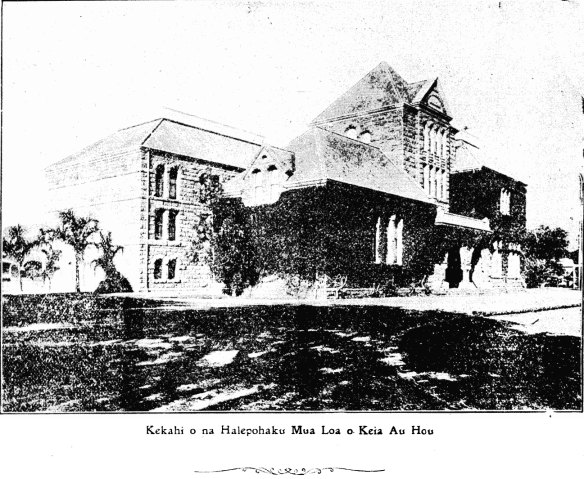
…all Hawaiians, whether by birth of association. She married the Hon. C. R. Bishop, and with her immense wealth and her kindly deeds through life, created a new life among the Hawaiians. Upon her death she left most of her wealth to endow the Kamehameha Schools, a separate school for boys and a separate one for girls. These schools are kept up entirely from the income of her estates, which have become so vast as to render it necessary to erect other buildings throughout the Islands in order to expend the revenue. In memory of his wife, the Hon. C. R. Bishop dedicated the museum in her name, laying aside a princely endowment. Collectors have scoured the Hawaiian Islands for curios of historical and intrinsic value and have succeeded by the most diligent effort and at great expense, in depositing in the museum an invaluable collection of ancient materials which would warm the cockles of the antiquarian’s heart beyond measure. Calabashes, large and small, ancient and modern, have come into the museum; some were in the possession of families, relics passed from one generation to another; others were found in the caves where in ancient times were buried kings and chiefs. Idols of grotesque shapes, dedicated to all the elements of nature, good and evil; some dedicated to Pele, the Goddess of Volcanoes; others to the poison god and to the fish god; some made of stone, others of the valuable koa and kou woods; one made of the trunk of the poison tree, its wood, upon being steeped in water, being a most powerful, yet undetectable poison which acts upon the heart, and which was used by the kahunas and chiefs. Beautiful feather cloaks of wonderful sheen and delicate texture, worn by Kamehameha the Great during his tour of conquest a century ago. Continue reading

E ola mau ka Hale Hoikeike o Bihopa! 1894.

THE BISHOP MUSEUM.

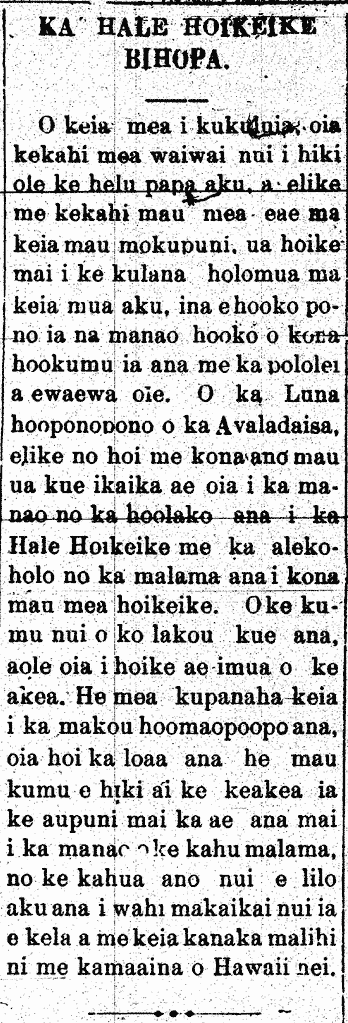
This thing being built is a great treasure that cannot be counted amongst other things of these islands; it will show our progressive state in the future if the intent for its establishment is carried out correctly and without deviation. The Editor of the Advertiser, as usual, is strongly opposed to supplying the Museum with alcohol for preserving its specimens. He did not reveal to the public the main reason for their opposition. This is something amazing in our eyes, that there are reasons that the government can be prevented from agreeing to the wishes of the curator of this great site that will become a place much visited by visitors and locals of Hawaii.

(Leo o ka Lahui, 9/21/1894, p. 2)

LOKL_9_21_1894_2.png

Ka Leo o ka Lahui, Buke II, Helu 1033, Aoao 2. Sepatemaba 21, 1894.

Long live the Bernice Pauahi Bishop Museum! 1892.

A Visit to the Museum.

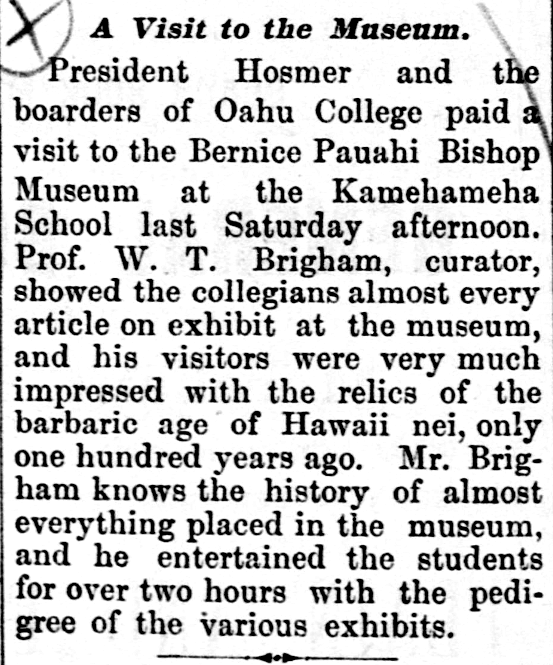
President Hosmer and the boarders of Oahu College paid a visit to the Bernice Pauahi Bishop Museum at the Kamehameha School last Saturday afternoon. Prof. W. T. Brigham, curator, showed the collegians almost every article on exhibit at the museum, and his visitors were very much impressed with the relics of the barbaric age of Hawaii nei, only one hundred years ago. Mr. Brigham knows the history of almost everything placed in the museum, and he entertained the students for over two hours with the pedigree of the various exhibits.

[I wonder if the students of Punahou are still visiting the museum today!]

(Advertiser, 10/17/1892, p. 3)

PCA_10_17_1892_3

The Pacific Commercial Advertiser, Volume XVI, Number 3203, Page 3. October 17, 1892.

What was the Bishop Museum Director thinking, 1898.

OLD CANNONS.

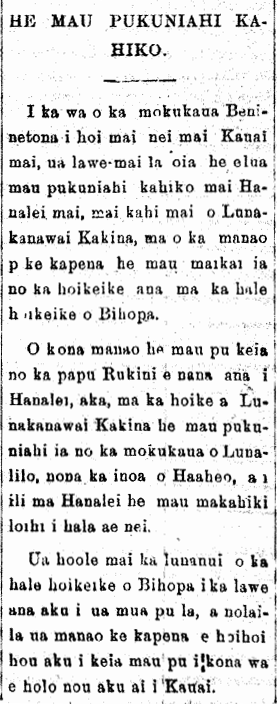
When the warship Bennington returned from Kauai, it brought two old cannons from Hanalei, from the place of Judge Thurston [Lunakanawai Kakina], with the thought of the captain that these would be fine objects for the Bishop Museum to display.

He believed that these were cannons from the Russian fort facing Hanalei, but according to Judge Thurston’s statement, they were cannons form the warship of Lunalilo named Haaheo [Haaheo o Hawaii], and it ran aground at Hanalei many years ago.

The director of the Bishop Museum refused to take the guns, and so the captain thinks he will return the guns when he returns to Kauai.

[This was the ship of Liholiho, Kamehameha II, and not Lunalilo. There was much press about it last year! Go check out the exhibit at Kauai Museum on the Haaheo, showing now!! Does anyone know what became of these cannons?]

(Aloha Aina, 12/3/1898, p. 1)

AlohaAina_12_3_1898_1.png

Ke Aloha Aina, Buke VI, Helu 49, Aoao 1. Dekemaba 3, 1898.