David Alapai and his mele inoa for Pele, 1919.

INTERESTING MATTERS PERTAINING TO THE LAVA SEASIDE OF ALIKA

When lava gushed forth upon the land of Alika, nearby the “building filled with tons of awa.” Sleeping there in that place was a man intoxicated on awa, and it was with great effort that this man drunken on awa escaped with his life. Just as that man got away did the “lava” engulf that building with its tons of awa. Right makai side of that awa storehouse the man had tied up his donkey and it is was seen that the lava had flowed off course and left behind this donkey belonging to that awa storehouse watchman. Several days later when that man was talking about his near escape from the lava, he told this funny story. “Pele does not have interest in Donkey meat, but she likes drinking awa. She waited a bit for me to get away from that building and then she drank all of our awa up, and to show her appreciation for this awa drinking party, she left behind my Donkey.” Continue reading

Volcanic activity, 1919.

Kilauea Displays Renewed Activity

According to a radiogram received by L. W. de Vis-Norton Wednesday night, a wonderful spectacle is developing at Halemaumau. The lava has risen to within 200 feet of the rim of the pit, and hundreds of fountains are in violent action. Continue reading

On string figures, 1909.

HEI OF TIMES PAST.

It’s description; a string 2 to 3 feet in length, with ends knotted together at one point; fingers are inserted and the fingers move and the figure is made; recited:

Po e kau mai ka Hoku,
Ao la helelei wale iho.

[O Night, the stars hang down,
At daylight, they all fall down.]

Done again, and that is how they forever more hang and fall across the districts of Hawaii; the kinds of hei are constantly changing; this is how it is recited.

Kueheapio ka La
Ka La komo i ke kula o Ahuena;
Komo i ka la’i o Kailua la—e—o Kona.
O Kona ia o ke kai malino, hele ana iwaho ka pulau, kani ka A’o i Waiulaula la—e—o Kau.
O Kau Kuamakani, lele iwaho ka lepo o Kaumaea la—e—o Puna.
O Puna ia o ke kai Koloa, e nui ana i ka ulu hala, ke kai o Puna i Keaau la—e—o Hilo.
O Hilo ia o ka ua kinai, kinai mao ole ka ua o Hilo—la—e o Hamakua.
O Hamakua ia o ke ala ulili, e nahu ana ka niho i ke kaula, i ka pali o Koholalele la—e—o Waipio.
O Waipio laua o Waimanu, o Kohala iki o Kohala nui, o Kohala ua Apaapaa; o Pili o Kalahikiola o na puu haele lua, o ke kanaka no ke hele ana.
Hele i ke alo o Haiku, aniani mai kahi makani, malalo mai o Awilipou, kai pii wale i ka pali, kai auau a ka mea Aloha, kona aloha ka lawalawa, oni ana i ka manawa me he ipo la.

With appreciation for the captain of the Kuokoa and aloha to the quartermaster boys.

Aloha i ka La ma Lehua e kau nei,
Ua puni o Lehua i ka hao a ka Naulu,
Kuu wahine mai ka ale huli lua la o ka moana,
Mai ke kapa ulu mai la i Kahiki,
Hiki mai ana ua makani kaili aloha nei,
E kaili no oe nau kau waiwai,
He ai pala maunu aku hoi au na ko aloha e noho nei,
I halawai pu ai kaua me ke keiki kuipua o Niolopa.

Auwe ke Aloha e!

GEORGE B. PANAEWA,

Nuuanu Valley, March 22, 1909.

[Did you check out today’s “Welo Hou” post from Bishop Museum? It talks about the mele above that accompanies the making of a traditional string figure illustrating the districts of Hawaii Island! Click here to go to the post.]

(Kuokoa, 3/26/1909, p. 6)
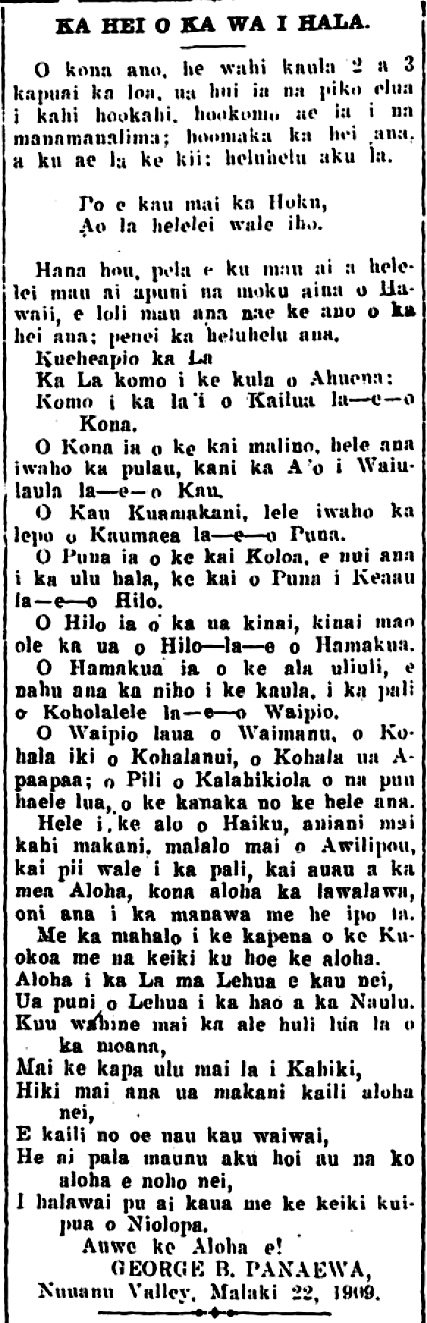
Kuokoa_3_26_1909_6

Ka Nupepa Kuokoa, Buke XLVI, Helu 13, Aoao 6. Maraki 26, 1909.
A mele hooaeae by Ku of Manoa, 1919.

HE MELE HOOAEAE.

Noho no i Puna ka nani me ka maikai,
He hale kipa ia na ke ala me ke onaona;
Onaona no ka maile me ka hala o Keaau,
Ola ai no ke kupa o Kaniahiku,
Ku mai ka ua nahunau kiekie iluna,
Hookakano no i ka la’i o Wahinekapu,
Huahuai mai na leo awahia o ka makani;
O na kauna olelo a ka Puulena i ka uka. Continue reading

Ikeia Kau na Wahine, he Kau ka makani, 1883.

[Found with: “KE ALII KIEKIE RUTH KEELIKOLANI: UA HALA! UA NALO!!”]

Ikeia Kau na Wahine, he Kau ka makani,
He umauma i pa ia e ka Moae,
E ka unulau, o Makounulau,
Ina aku no la i Unulau,
Ka wahine kaili pua o Paiahaa,
Hahai, alualu, puahala,
O Kamilo, pae kanaka e—— Continue reading

Lines of familiar mele used in stories to elicit emotion, 1895.

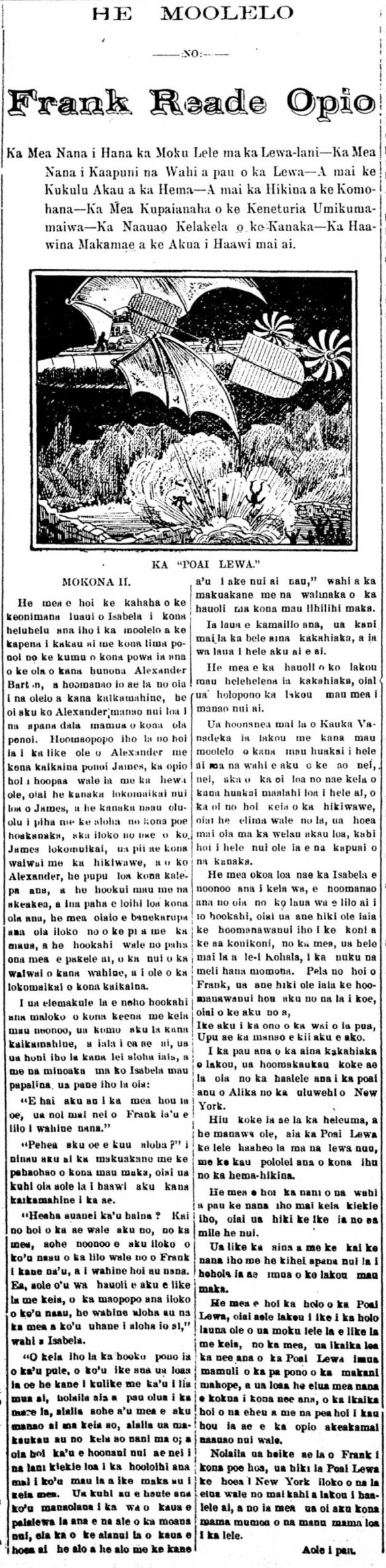
[Found in: “HE MOOLELO NO Frank Reade Opio”]

Ike aku i ka ono o ka wai o ia pua,
Upu ae ka manao e kii aku e ako.

[I know of the sweet nectar of that flower,
The desire wells up to go and pluck it.]

[The use of lines of well-known mele like from Thomas Linsey’s “Honesakala” above is a feature of Hawaiian storytelling. They elicit a feeling or mood to help the flow of the moolelo. This particular translation of  one of the Frank Reade Jr. stories ran in Hawaiian in the Kuokoa from 5/25/1895 to 11/9/1895 under the title “He Moolelo no Frank Reade Opio: Ka Mea Nana i Hana ka Moku Lele ma ka Lewa-lani…”]

(Kuokoa, 8/17/1895, p. 1)

Kuokoa_8_17_1895_1.png

Ka Nupepa Kuokoa, Buke XXXIV, Helu 33, Aoao 1. Augate 17, 1895.

Sigh, 2018.

Did you see last week Monday’s post on Welo Hou? It is funny how mele written by someone from a long time ago can stir up personal memories, both good and bad. Thomas Lindsey’s “Honesakala” is timeless. Does anyone know which Thomas Lindsey this was.

Click the sheet music below to check it out:

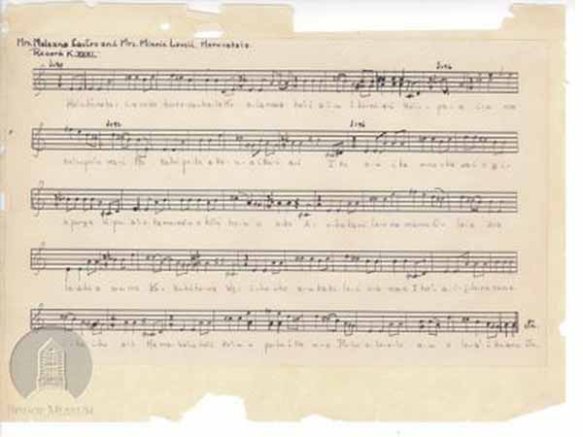
MS_SC_Roberts_2_2_Honesakala_BMWM-1-400x300.jpg

MS SC Roberts 2.2, p. 3. “Honesakala”

Welo Hou and the Helen H. Roberts Collection at the Bishop Museum, 2018.

It seems the Welo Hou blog has been up since November of 2017, with posts every Monday. If you are a mele person, or a history person, or are from Hawaii nei, you should check it out and start a dialogue! This is its opening post from last year [click anywhere below to link to the blog]:

Welo Hou: Building Connections to the Helen Roberts Mele Collection

 How has mele informed your understanding of a Hawaiian worldview?

As I ponder this question framed within the context of the above quote, my mind begins to churn with examples stemming from my own life and learning experiences. I recall my early childhood years in keiki hula class where I proudly chanted “Kūnihi ka mauna” while oblivious to the meaning of the words that were resonating from my mouth. Yet even in my naivety, I understood the function and purpose of that oli kahea. Though my mind was too young to comprehend the arbitrary words formed by my lips, I was fully aware that I had to be focused and present-minded in order to be granted permission into the hālau. This is a small example of how, even at 5 years old, mele/oli had already begun to shape my perspective to be one that reflects a Hawaiian way of thinking and behaving. “Kūnihi ka mauna” followed me into the academic arena where I eventually learned how to dissect the mele word for word, structure by structure, phrase by phrase, and sound by sound. I learned about the different places referenced in the mele and discovered the kaona behind words. I came to know the story by which the mele was inspired and I internalized the knowledge gained through the deconstruction and reconstruction of this mele. I share these thoughts with the hope that we can collectively become even more conscious of the way in which mele is able to shed light on aspects that are often considered obscure in research and Hawaiian knowledge acquisition.

                As we meet here weekly for Mele Monday, I invite you to ponder deeply on the pieces we will discuss from the Roberts’ Mele Collection over the next two years. The purpose of this blog is to cultivate a community of mele enthusiasts who would like to dialogue about the gems uncovered from within the mele we will explore over the coming weeks. Please feel free to ask questions, share manaʻo, and post comments that will contribute to the facilitation of thoughtful and respectful discourse.

                If you feel so inclined, I invite you to leave a comment expressing your thoughts on the quote and question posed above. 

E hea i ke kanaka e komo ma loko…..