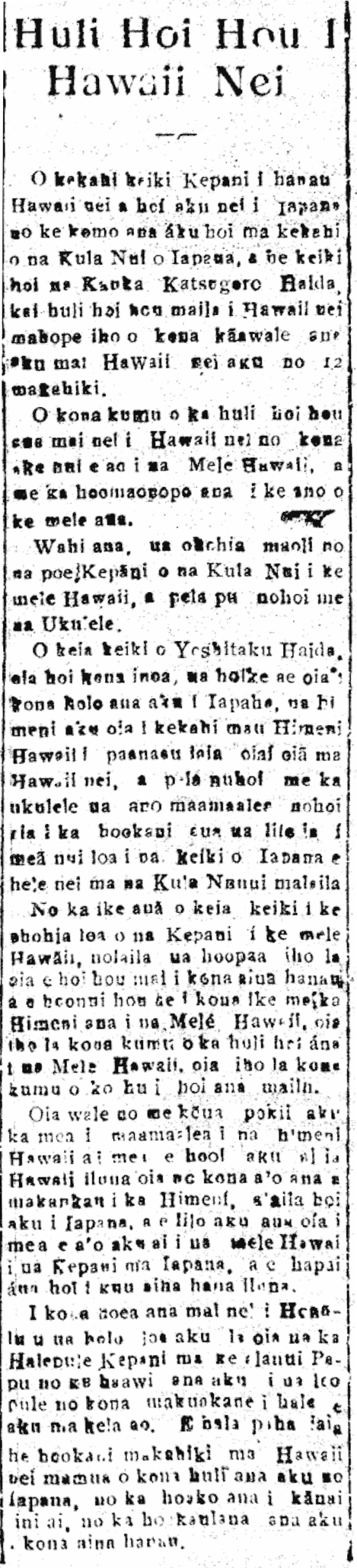
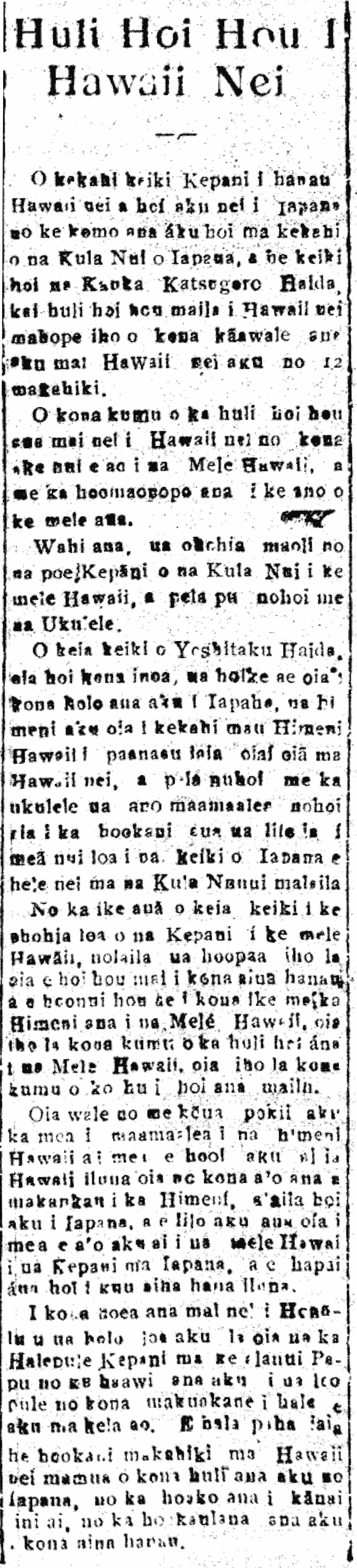
Returning Once Again to Hawaii Nei
A Japanese boy born here in Hawaii and who went back to Japan to enter into a College in Japan, and who is a child of Dr. Katsugoro Haida, came back to Hawaii after being away from Hawaii for 12 years.
The reason for his return to Hawaii was because of his desire to learn Hawaiian Mele and to learn how to sing them.
According to him, the Japanese of the Universities are enthralled by Hawaiian songs, and so too of the Ukulele.
That boy, Yoshitaku Haida [Yoshikatsu Haida, aka Haruhiko Haida, aka Yukihiko Haida] is his name, said that when he went to Japan, he sang some Hawaiian Songs that he had memorized while in Hawaii nei; so also with the ukulele, he was quite skillful in playing it; and it became something big with the Japanese youth going to that University [Keio University].
Because this boy saw the great interest the Japanese had for Hawaiian music, he decided to return to the land of his birth and increase his knowledge in Singing Hawaiian Music, and that was the reason for his coming back.
It is just he and his younger brother [Katsuhiko Haida] who are skilled at Hawaiian songs, to raise up Hawaii, and that is why he is learning Singing until he is proficient, at which point he will return to Japan where he will become a teacher of Hawaiian mele to the Japanese in Japan, and raise up the land of my [his] birth.
Upon arriving in Honolulu, he went to the Japanese Church on Fort Street to say a prayer for his father who has passed to the other world. He may be here in Hawaii for perhaps a year before turning back for Japan, to fulfill his desire to bring fame to his birth land.
(Hoku o Hawaii, 2/14/1933, p. 3)
Ka Hoku o Hawaii, Buke XXVI, Helu 37, Aoao 3. Feberuari 14, 1933.





 nupepa