Unknown's avatar

About nupepa

Just another place that posts random articles from the Hawaiian Newspapers! It would be awesome if this should become a space where open discussions happen on all topics written about in those papers!! And please note that these are definitely not polished translations, but are just drafts!!! [This blog is not affiliated with any organization and receives no funding. Statements made here should in now way be seen as a reflection on other organizations or people. All errors in interpretation are my own.]

Abduction!? 1877.

Boys were kidnapped.

O Kuokoa Newspaper, Aloha oe:–

I send off my bundle to you, having the right time to do so. For I see that you are one of the shooting stars of the nation of Hawaii, flying from where the sun rises to where the sun sets, shooting all the way here to North America.

The words placed above is what grows in my conscience. Might you be patient and accept the contents of my bundle. For I have seen you and how you have patience to accept what is sent to you. Its contents are here below:–

Five Hawaiian boys were abducted by the lumber transporting ships Atlanta and Victor. Three boys on the Atlanta; these are their names, Nakai, Kikau, and Kanahele. And aboard the Victor, two boys; these are their names, Keliikipi and Kaaoaouila. That is my baggage that I entrust to you, and it is for you to call out loudly to the parents of these boys, as they may be left feeling aloha for their children abducted by the Captains of these ships who break the law of the Nation of Hawaii and King Kalakaua. When these boys arrived here at Port Gamble, the Captains abandoned them. We believe that if there were no Hawaiians here, the boys’ health would have been danger, and they would have had no place to rest their heads.

The place they were hid was in a skiff that had its opening turned over atop the Forward House* of the sailors in the bow. That is where they hid when the ship carrying lumber left Honolulu, that is what they told us. These children are very little, perhaps ten or so years old; not fit to work at the lumber mills here in Puget Sound.

To the Parents–O Parents, watch your children closely, and do not let them wander about the docks, or go aboard the ships, and enjoy feasting on barrel meats, lest they be abducted by the ship Captains like these children. You have heard that Kalakaua’s is a “Lahui increasing nation” and there is a Hawaiian government law that forbids Hawaiians from going abroad unless their contract is approved by the governor of the island on which they live; only with the governor’s approval can they leave; also the Governor must command the ship Captain to care for and return the man or men that he takes away. And if the Captain or Captains do not return the man or men that they take away, then they will be fined $300 for each man. That is the law for the Captains who secretly take away Hawaiians.

To the Governors.–O Governors, do your job conscientiously, and so too your subordinates, be vigilant of your duties, search the trading ships of all types which leave Honolulu, for there are many Hawaiians who leave Honolulu and live abroad for long periods without it being known that they left, and they have been living here in these foreign lands for many years.

But here is my question pertaining to that. Who is at fault? The ship Captain perhaps? The children perhaps? In my opinion, it is the ship captain’s fault, if I am not mistaken. That is according to what the children told us when we questioned them, and they said that they were brought because of the desire of the captain that they come here. If that is true, it would be best if the captains return the boys to Honolulu when the ships go once again, or it would be better if they were tried so that it is made clear if the captains are at fault or if it is the children. As for the names of these ships, I do not know them [Atlanta and Victor??], but the agents of this company and some haole of Honolulu should know, should it be thought to ask about the two.

I have nothing more to talk about at this time, but I ask for your kindness, if I am wrong about this, excuse me, and if I am correct before you and them as well, then place it in your bureau of love, and it will be for you to spread it before the public so that our many friends will know, they who live from Kumukahi where the sun rises to Lehua where the sun sets.

To you goes my warm aloha, and to the type-setting boys of the Press goes my expression of aloha, and to your Editor goes my loving right-handed handshake.

G. W. E. Kawaiulaomaleka,
Puget Sound, Kitsap County, Sep. 28, 1877.

*Lana House. Not sure where this phrase comes from. I could not find it used in any other article. It was suggested by http://www.maritimehawaii.com that this likely refers to the Forward House.

(Kuokoa, 11/10/1877, p. 3)

Ka Nupepa Kuokoa, Buke XVI, Helu 45, Aoao 3. Novemaba 10, 1877.

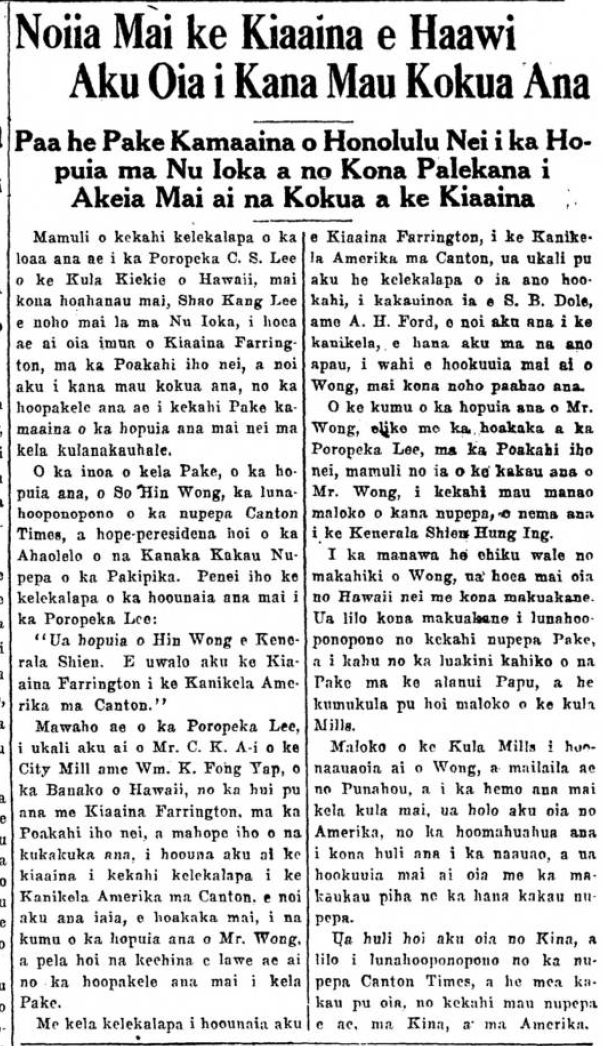
Pleas for So Hin Wong, 1923.

The Governor is Asked to Give Assistance
A Chinese Kamaaina of Honolulu is Arrested in New York, and to Save Him, Assistance of the Governor is Wanted

Because of a telegraph received by Professor C. S. Lee of the University of Hawaii, from his brother, Shao Kang Lee, living in New York, he went before Governor Farrington this past Monday and asked for his assistance to save a Chinese kamaaina who was arrested in that city.

The name of that Chinese that was arrested is So Hin Wong, the editor of the newspaper Canton Times, and vice president of the Pan Pacific Press Congress [ka Ahaolelo o na Kanaka Kakau Nupepa o ka Pakipika]. This is how the telegraph went which was sent to Professor Lee:

“Hin Wong was arrested by General Shien. Have Governor Farrington call for help from the American consulate in Canton.”

Other than Professor Lee, he was accompanied by Mr. C. K. A-i of City Mill and William K. Fong Yap of the Bank of Hawaii, to meet with Governor Farrington, on this past Monday. And after their meeting, the governor sent a telegraph to the American consul in Canton asking him to explain the reasons that Mr. Wong was arrested. And those were the steps to save that Chinese.

Along with the telegraph sent by Governor Farrington to the American Consul in Canton, another similar telegraph was sent by S. B. Dole and A. H. Ford, asking the consul to do all that he can to get Wong released from his imprisonment.

The reason that Mr. Wong was arrested, as explained by Professor Lee, last Monday, because Mr. Wong wrote editorials in his newspaper criticizing General Shien Hung Ing.

When Wong was but seven years old, he arrived here in Hawaii with his father [Shu King Wong]. His father became the editor of a Chinese newspaper [Sun Chung Kwok Bo] and pastor for the old Chinese church on Fort Street, and a teacher as well at Mills School.

Wong was educated at Mills School, and then at Punahou, and after graduating he went to America to further his education, and he graduated, prepared to be a newspaper writer.

He returned to China, and because the editor for the newspaper Canton Times, and he is also a writer for a number of other newspapers in China and America.

(Kuokoa, 2/15/1923, p. 1)

Ka Nupepa Kuokoa, Buke LXII, Helu 7, Aoao 1. Feberuari 15, 1923.

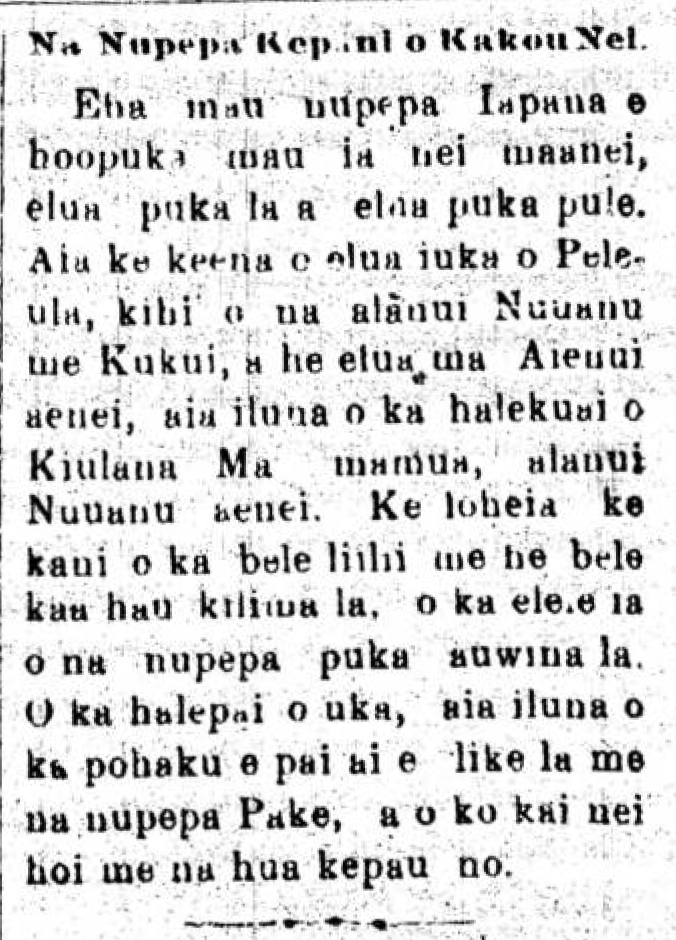
Japanese Newspapers, 1895.

Our Japanese Newspapers.

There are four Japanese newspapers being published regularly here, two dailies and two weeklies. Two of their offices are in the uplands of Peleula at the corner of Nuuanu and Kukui Streets; and two are at Aienui, above what was the shop of Chulan & Co. [Kiulana Ma], on Nuuanu Street. When we hear the little bell that sounds like the ice cream cart bell, it is the messenger of the afternoon newspaper. The press in the uplands does its printing using stone [lithograph] like the Chinese, and the lowland press uses movable type.

(Makaainana, 4/29/1895, p. 2)

Ka Makaainana, Buke III—-Ano Hou, Helu 8, Aoao 2. Aperila 29, 1895.

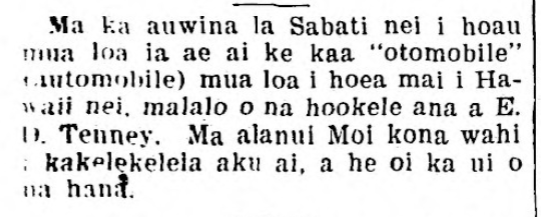
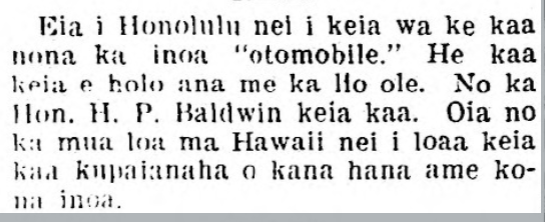
First automobile in Hawaii, 1899.

[Found under: “NU HOU HAWAII”]

Here in Honolulu currently is a vehicle called an “otomobile.” It is a vehicle that moves without a horse. This car belongs to the Hon. H. P. Baldwin. He is the very first to obtain this vehicle of amazing deeds and name.

(Kuokoa, 10/6/1899, p. 5)

Ka Nupepa Kuokoa, Buke XXXVIII, Helu 40, Aoao 5. Okatoba 6, 1899.

Ihikapukalani and Hoihoikeea, 1866.

[Found under: “NU HOU KULOKO”]

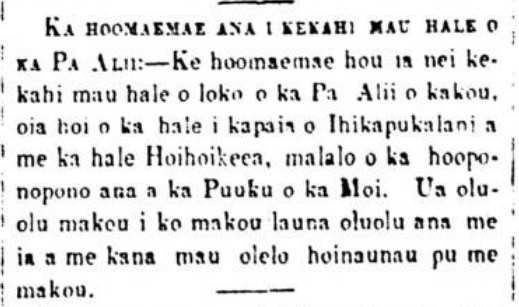
The Sprucing up of Some Buildings on the Palace Grounds:–Some of the buildings on our Palace Grounds are being refurbished again, they being the building called Ihikapukalani and the one called Hoihoikeea, under the management of the King’s Chamberlain [Kalakaua]. We were pleased to meet with him and with his interesting conversation with us.

(Kuokoa, 10/13/1866, p. 2 )

Ka Nupepa Kuokoa, Buke V, Helu 41, Aoao 2. Okatoba 3, 1866.

Where did the alii live? 1865.

News of the Royal Court.

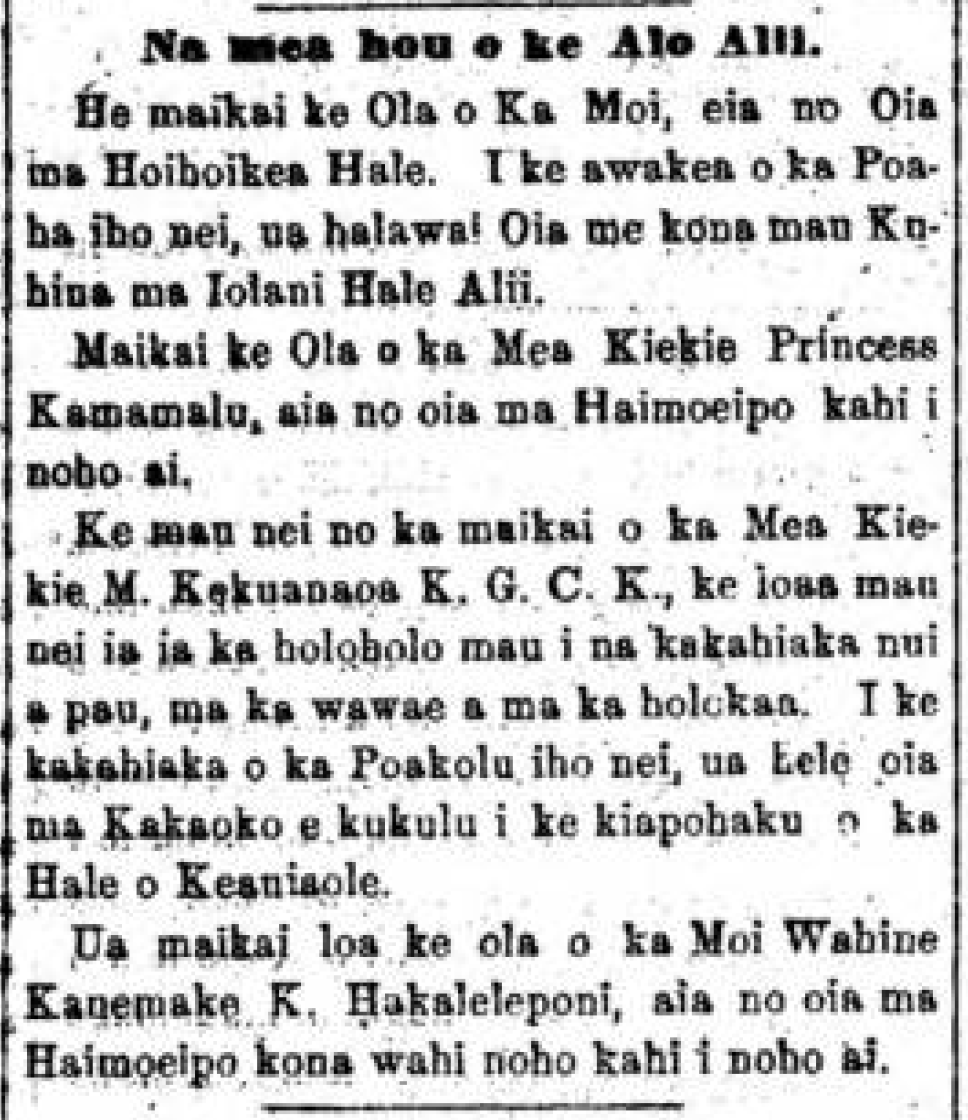
The King is in fine health, He is at Hoihoikea Hale [Hoihoikeea Hale]. In the middle of the day this past Thursday, He met with his Ministers at Iolani Palace [Iolani Hale Alii].

Her Highness Princess Kamamalu is in good health; she is living at Haimoeipo.

His Highness M. Kekuanaoa K. G. C. K. remains fine; he can be found traveling about in the early morning by foot or by carriage. This past Wednesday morning, he went to Kakaoko [variant? of Kakaako] to build the stone pillar of the House of Keauiaole.

The Dowager Queen K. Hakaleleponi is in very good health. She is living at her residence Haimoeipo.

(Au Okoa, 11/27/1865, p. 2)

Ke Au Okoa, Buke I, Helu 34, Aoao 2. Dekemaba 11, 1865.

Kaʻū famine, 1862.

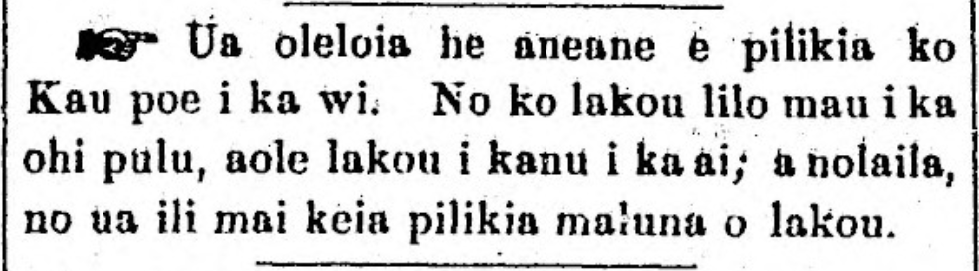
It is said that the people of Kau are soon to be in trouble because of famine. This is because they are all busy collecting pulu (the wool from tree fern), and are not planting taro; therefore they are faced with this problem.

(Hoku o ka Pakipika, 4/10/1862, p. 2)

Ka Hoku o ka Pakipika, Buke I, Helu 29, Aoao 2. Aperila 10, 1862.

J. T. Unea retires after over 20 years as newspaper agent, 1919.

Did you see the recently launched Sacred Hearts Archives website? One of their searchable collections is of images from Kalaupapa. Here for instance is a link to a portrait of John T. Unea, the newspaper agent for Kalaupapa.
https://sacredheartsarchives.pastperfectonline.com/photo/8D2012C5-C8B8-4651-A1D6-544452427616

nupepa's avatarnupepa

LEAVES HIS POST AS AGENT.

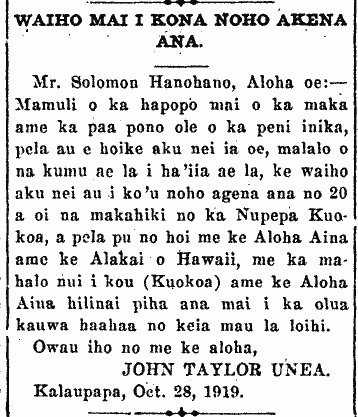
Mr. Solomon Hanohano, Aloha oe:—Due to me going partially blind, and not being able to hold properly a fountain pen [peni inika], I am therefore announcing to you, because of those reasons mentioned above, I am setting aside my position as agent for 20 years and more for the Nupepa Kuokoa, and also for the Aloha Aina and Alakai o Hawaii, with great appreciation for your (Kuokoa) and Aloha Aina‘s full trust in me, your humble servant, for these many days.

Me, with aloha,

JOHN TAYLOR UNEA.

Kalaupapa, Oct. 28, 1919.

(Kuokoa, 11/17/1919, p. 3)

WAIHO MAI I KONA NOHO AKENA ANA. Ka Nupepa Kuokoa, Buke LVII, Helu 45, Aoao 3. Novemaba 7, 1919.

View original post

Death of Abraham Panui, 1918.

ABERAHAMA PANUI HAS PASSED ON.

Our younger sibling, Abraham Panui has left on the dark path of Kane to far bank of the dark river of death, in Thursday morning, Feb. 28, 1918, 7:30 a. m, at Kahana, Kaanapali, Maui.

He has left behind his two elder siblings along with the family who are living in Honolulu, at forty years of life. Our younger brother was born in Kapaa, Kauai, of Kaua (f) and A. Panui Sr. (m), and he went to join his older sibling at Kahana, Kaanapali, Maui; Our younger brother suffered illness for a long time, and a cure was sought from the government doctors at Lahaina; but nothing was known for the affects of the illness was strong; there was coughing and cramps of the stomach, which is what shortened his life.

To the intimates and friends go our thanks for them bringing bouquets of flowers and for gathering with us in the hours of our grief; like the Holy Book states, life of man is even a vapour, that appeareth for a little time, and then vanisheth away; for dust thou art, and unto dust shalt thou return. And with these thoughts we pray to our eternal Father to watch over and protect us from above. Amen.

The two of us in sorrow,
CHARLES B. MENESE,
MRS. LOIKA MENESE.
Kahana, Kaanapali, Maui, Mar. 5, 1918.

(Kuokoa, 3/22/1918, p. 3)

Ka Nupepa Kuokoa, Buke LVI, Helu 12, Aoao 3. Maraki 22, 1918.