This is an independent blog. Please note that I am nowhere near fluent, and that these are not translations, but merely works in progress. Please do comment if you come across misreads or anything else you think is important.
Just another place that posts random articles from the Hawaiian Newspapers! It would be awesome if this should become a space where open discussions happen on all topics written about in those papers!! And please note that these are definitely not polished translations, but are just drafts!!!
[This blog is not affiliated with any organization and receives no funding. Statements made here should in now way be seen as a reflection on other organizations or people. All errors in interpretation are my own.]
[Found under: “NA WAHI PANA A KAULANA O HONOLULU, OAHU NEI, I UHIIA I KA LEPO A NALOWALE LOA HOI I KEIA AU HOU.”]
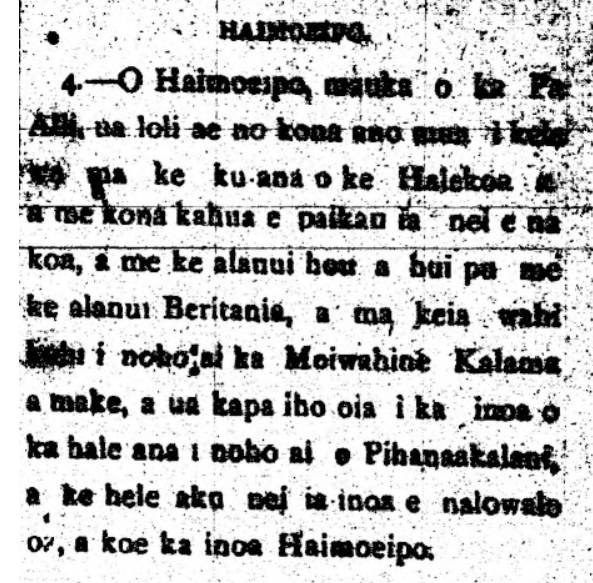
HAIMOEIPO.
4.—Haimoeipo, in the upland of the Palace Grounds, has changed in appearance these days with the building of the Barracks [Halekoa] and its grounds where the soldiers drill, and the new street that joins with Beritania Street, and this is where Queen Kalama died. She called the house which she lived, Pihanakalani, and that name is disappearing, while the name Haimoeipo remains.
(Aloha Aina, 9/26/1896, p. 5)
Ke Aloha Aina, Buke II, Helu 39, Aoao 5. Sepatemaba 26, 1896.
Mr. Editor of the Kuokoa Newspaper, aloha oe:–Please place in an open space of your paper the heading above so that the many relatives of my dear mama who live from where the sun rises at Haehae to where the sun sets at Lehua will know.
My beloved mama, Luika Kaaha left this life on the 4th of October, 1917, at 11 p. m. at Kamoiliili, and her spirit returned to He who created it, and left her earthly body for me, my dear papa, the grandchildren, and family, who lament on this side of the dark river of death. I grieve for you, my dearly beloved Mama!
My mama was born at Apauhua, Lahaina, Maui, from the loins of Mele Lukaina (f) and Kanui (m) in the year 1857, so she was alive in this faint-hearted world for 60 years when she left me and my dear father and her grandchildren who grieve for her with sadness in this world.
Her mother died while she was still young. After the death of her mother, she returned with her father, Kanui, to Kohala, Hawaii, his land of birth, and my mama lived there until the death of her father.
My dear mother first married John Kalama, and from their loins came me, and my elder sibling who died previously. And because they joined the faith of Jesus Christ of the Later Day Saints, they left the land and headed to this unfamiliar land to tell the word of God. This island was traveled by me and my dear papa who passed on, telling the gospel of Christ. In the year 1902, my dear papa, John Kalama, died and left me and my dear mama living in this foreign land.
After a year after my father’s death, my dear mama married Hiram Kaaha [Hairama Kaaha]. They lived together in marriage for 12 years, and she left this life, and the words of the Great Book came to pass, “For life of man is even a vapour, that appeareth for a little time, and then vanisheth away.” They did not produce fruit from their loins when she passed on to the fathomless pit of the earth. Blessed be Almighty God, for it is He who giveth and He who taketh away.
My dear mama was a good mother and she had an open heart; she was kind and welcoming. My dear mama was a patient mother and frugal, and she was well off in her life as man and woman. And because of her perseverance, she left me and her grandchildren well to do through her perseverance. Aloha to you, my persevering mama!
My mother’s illness began five years ago, and the illness continued until it became very severe, until the time the doctor said, your mother cannot be saved. She withstood the pains of her body until she left me, her child, her husband, and grandchildren, who mourn for her.
I give my great appreciation to the head and members of the Relief Society of the Church of Jesus Christ of the Later Day Saints. I also give my full thanks to the Rev. H. H. Parker for his blessing the body of my dear mama in Kamoiliili Church, and so too for those who carried the coffin of my dear mama; and those who gave offerings of flowers and lei to adorn my beloved mama who went on the road of no return, and everyone who accompanied her on her final journey and laid her to rest in peace in the Lord.
Therefore, I pray to God to take the grief and sadness from you, my dear papa, and his grandchildren, Amen.
Luika Piianaia, Kamoiliili, Honolulu, Oahu, October 8, 1917.
[This is Louise Piianaia, a wife of Abraham Piianaia.]
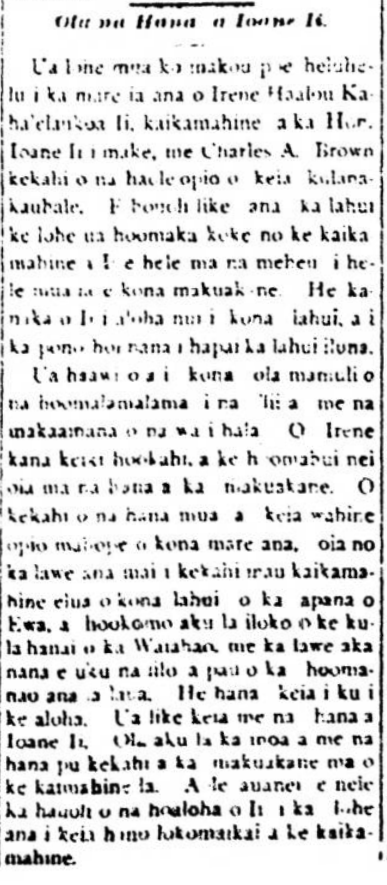
Our readers heard earlier of the marriage of Irene Haalou Kahalelaukoa Ii, daughter of the late Hon. John Ii, to Charles A. Brown, one of the young haole of this town. The lahui will all be joyous when they hear that the daughter of Ii has began at once to walk in the footsteps walked before by her father. Ii was a man who felt much aloha for his lahui, and the need for him to raise up his people.
He gave his life to educating the alii and the makaainana of the old days. Irene, his only child, is following after the deeds of her father. One of the first things this young lady did after her marriage was to take two girls of her lahui from the district of Ewa, and enrolling them in the Kawaiahao Boarding School and paying for the costs of their education. This is an act of aloha. This is like the deeds of John Ii. The name and works of the father live on through the daughter. The friends of Ii will undoubtedly be joyous when hearing of this act of goodwill by the daughter.
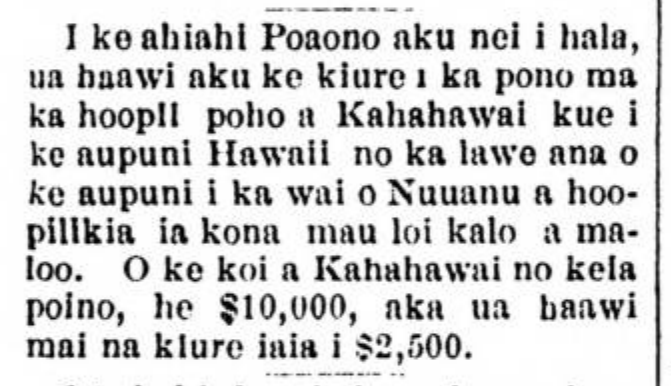
On this past Saturday evening, the jury decided in favor of Kahahawai’s suit for damages against the Hawaiian government for the government taking the water of Nuuanu and causing trouble for his irrigated taro terraces and drying them up. Kahahawai claim for the damages was $10,000, but the jury gave him $2,500.
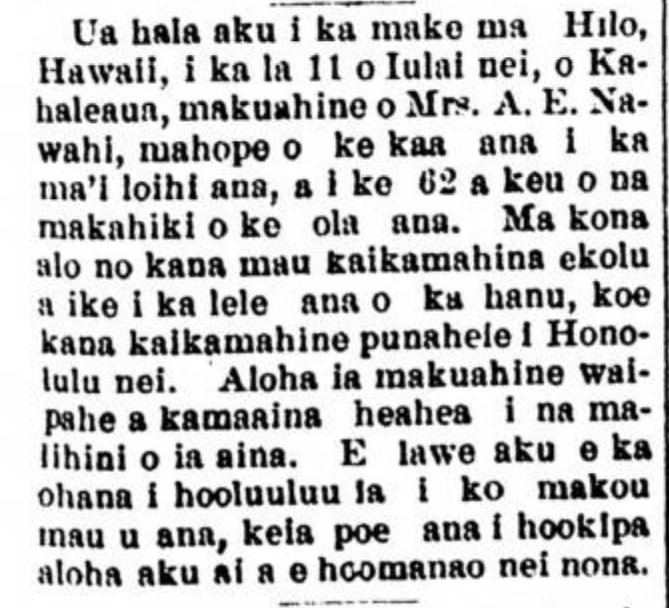
Kahaleaua has passed away at Hilo, Hawaii, after suffering a long illness and after more than 62 years of life, on the 11th of July, the mother of Mrs. A. E. Nawahi [Aima Emma Nawahi]. In front of her were her three daughters who saw her breath leave her. Not there was her favorite daughter who was here in Honolulu. Aloha to that mother who was gracious and welcoming to malihini of the land. O family in grief, please accept our sorrow, those who were lovingly welcomed by her and who now think of her.
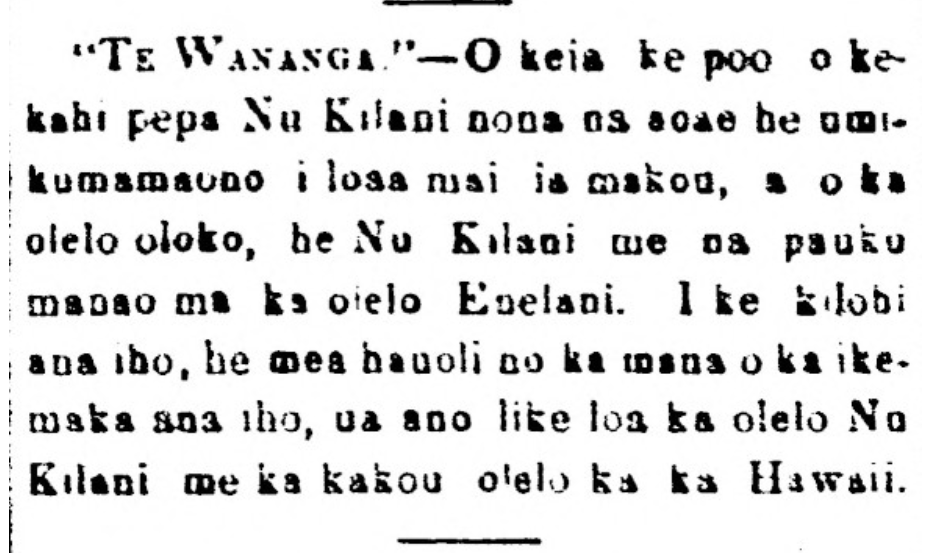
Te Wananga.–This is the title of a New Zealand newspaper of sixteen pages which we obtained. The words within are of New Zealand [Maori] with some paragraphs in English. Taking a look, it was joyful to see firsthand that the New Zealand language is very similar to our language, the Hawaiians.
Hawaiian Woman in Europe.–Early morning on this past Thursday, Kahula (woman) returned from Germany, on the foreign Laura & Louise. She lived many years away from her home lands; she left perhaps in 1857. She said she went to America, Britain, Germany, and her life was comfortable, living with her employers, that being L. H. Anthon, Esq. (Luika), that foreign language speaking haole who lived in Hawaii before.
(Kuokoa, 10/25/1862, p. 2)
Ka Nupepa Kuokoa, Buke I, Helu 48, Aoao 2. Okatoba 25, 1862.
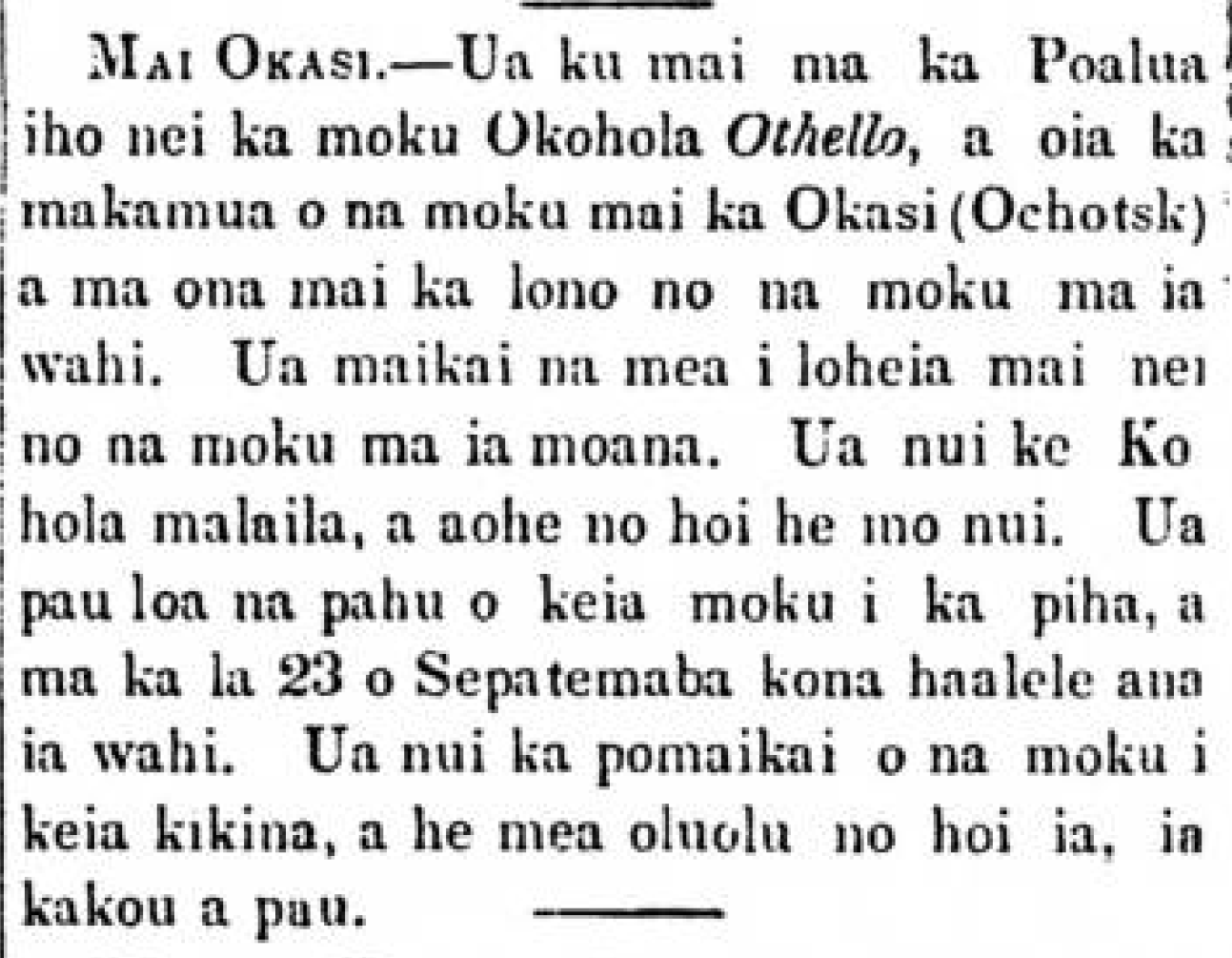
From Okasi.–This past Tuesday, the whaler Othello came to port, and that is the very first ship from Okhotsk [Okasi], and it was from it that the news about ships in that area. Fine were the things heard about the ships in that sea. There are many whales [kohola] there and there are no great storms. All the barrels on this ship were full, and on the 23rd of September it left that place. The ships this season are very blessed, and that is a good thing, for us all.
(Kuokoa,10/25/1862, p. 2)
Ka Nupepa Kuokoa, Buke I, Helu 48, Aoao 2. Okatoba 25, 1862.
Aloha oe:–Perhaps you are surprised receiving this letter. I have tried all means to release your beloved son Diamond from the British armed forces. I appeared before the American Consul in the countryside here in England, telling them that Diamond is an American. They responded that they will put my request before the head consul in London. On the 17th of September, I went to the Consulate in London, they told me that the consul could not order the British government to release Diamond because he is 25 years old; only those below 20 years old, if they are American citizens. These past days, I decided to have your daughter-in-law (Amy Kekona) to come to see me, and get together with her to think of a way to release her husband; for these good reasons, I ask that you send me his birth certificate, or to go to the governor of Hawaii to write to the Hawaiian Delegate Mr. J. K. Kalanianaole in Washington D. C., to go to the State Department in Washington and have the American Ambassador in London investigate the circumstances of his enlisting in the armed forces, and you verify that your first-born son is a true Hawaiian. He had a document in the city of Paris, France, from the office of the American General, written on the 13th of February, 1914, attesting to the fact that he is a Hawaiian. If he finds these documents, he will be victorious. Do not neglect this, for I am still regretful not having his acting. He has much knowledge in this area, and his showing this to the world would bring fame to the Hawaiian Lahui. I will organize everything here and send it to London. With our sleuthing, I believe everything will progress; may God watch over and keep safe the life of your child until we meet again, amen.
With aloha to your family and the Hawaiian Nation.
JOSEPH PUNI.
Write me at your daughter-in-law’s, c/o 143 Baxter Ave., Kidderminister, England.
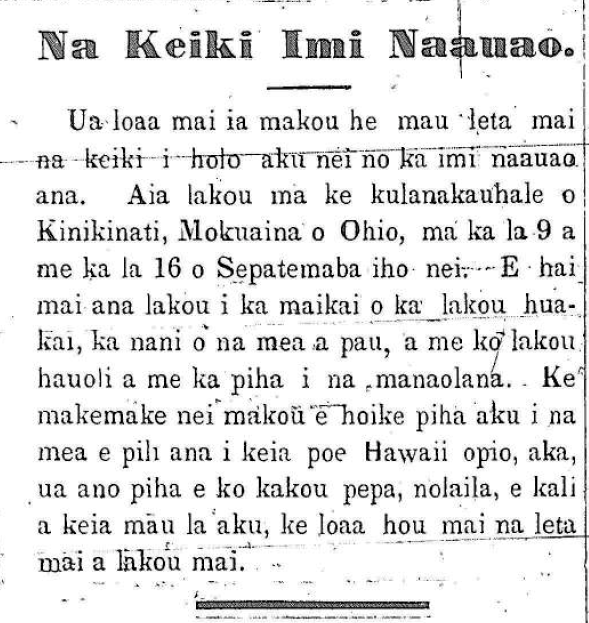
We received letters from the youths who traveled in search of knowledge. They are in the city of Cincinnati, State of Ohio, on the past 9th to the 16th of September. They tell of how their travels are going well, the beauty of everything, and their joy and that they are full of hope. We want to tell everything in full pertaining to these Hawaiian youths, but our paper is full, therefore wait for another when we receive letters from them again.
[These youths are Robert Wilcox, James Booth, and William Boyd.]
(Elele Poakolu, 10/6/1880, p. 5)
Ka Elele Poakolu, Buke I, Helu 5, Aoao 5. Okatoba 6, 1880.





 nupepa