The Blue Bird, 1862.

KA MANU ULIULI.

[Unuhiia no ke Kuokoa.]

HELU 1.

I KEKAHI MANAWA, E NOHO ANA kekahi Moi waiwai loa; a o kana wahine, ua make; a noho iho la ia me ka oluolu ole. Ewalu la o kona noho ana iloko o kekahi lumi uuku, o kana hana ka hookui i ke poo ma ka paia; aka, ua uhiia nae i ka pulu  i mea e eha ole ai ia. O na makaainana ona a pau loa, manao iho la e hele aku e ike, a e hooluolu ia ia; aole nae ona manao i ka lakou olelo. A Mahope, hele aku imua ona, he wahine i uhiia a paa i ka lole eleele, me ka uhimaka kanikau, me ka uwe ikaika loa, a kunana iho la ua Alii nei. Hookomo mai la ua Alii nei me ka oluolu, a no ka lilo loa i ke kamailio; nolaila, aole o laua olelo no ke kumu o ko laua pilikia.

[This is the beginning of another foreign kaao translated by J. W. Continue reading

Hawaiian version of “Beauty and the Beast,” 1893.

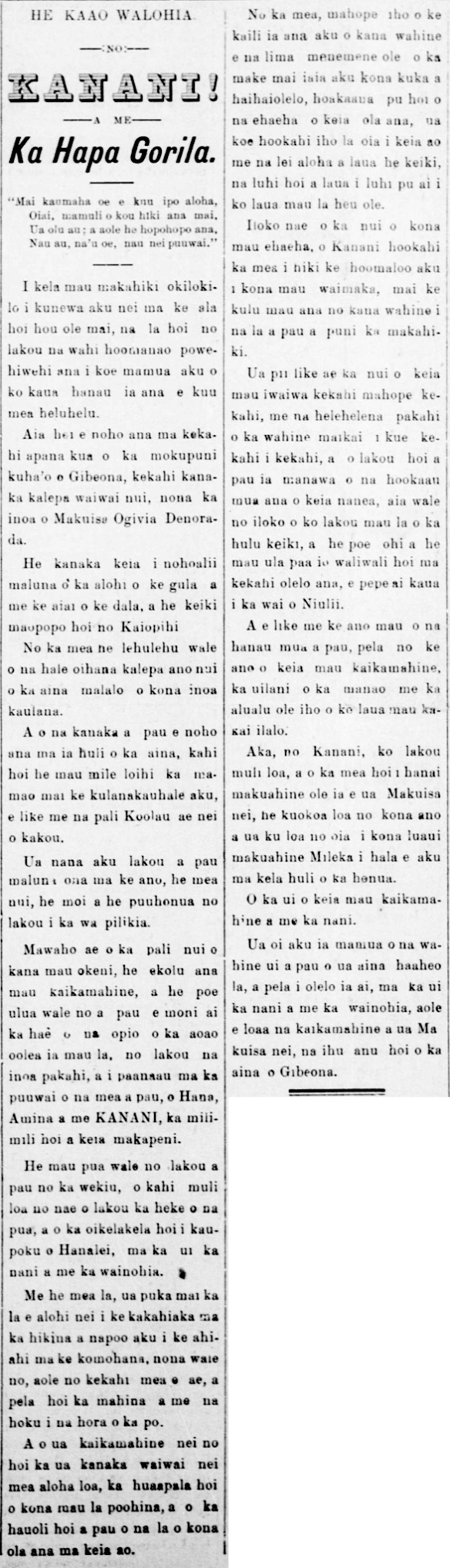
HE KAAO WALOHIA
—:NO:—
KANANI!
—:A ME:—
Ka Hapa Gorila.

“The Heart-Wrenching Tale of Beauty and the Half Gorilla” ran in Hawaii Holomua from 4/10/1893 and concluded on 5/26/1893. There is no attributed translator. I am not sure what work it was translated from.

[Much earlier in 1862, Jeanne-Marie LePrince de Beaumont’s “Beauty and the Beast” was translated as “He Kaao no Kanani! me ka Holoholona,” by J. W. Click here for my earlier post.]

(Hawaii Holomua, 4/10/1893, p. 1)

HawaiiHolomua_4_10_1893_1.png

Hawaii Holomua, Buke III, Helu 197, Aoao 1. Aperila 10, 1893.

Ohelo stories from James K. Kahele Jr., a follow up, 1930.

I just noticed that James K. Kahele Jr. states that there are stories not only saying that ohelo originated in Hawaii nei, but previous to this, he says that there are stories of it coming from afar, from Kahiki.

For the rest of the article speaking of the foreign origin stories, click here.

(Alakai o Hawaii, 8/8/1930, p. 3)

How the ohelo plant came to be, 1930.

OHELO ORIGINATED AND SPREAD FROM HAWAII NEI.

The parents of Kaoheloula were from Kauai, the father was Manuakepa and the mother was Hooleia.

The two of them begat their daughter and she was called by their name, Kaoheloua; the name of the father is very famous to the present, and it is set down in poetic composition with the words below:

Ka limu kaha kanaka o Manuakepa,
Ka pekupeku iluna ka ua o Hanalei, and so forth. Continue reading

Kamakau’s story of Lonoikamakahiki, 1871.

[Found under: “KA MOOLELO HAWAII: NA S. M. KAMAKAU.”]

Pertaining to Lonoikamakahiki: Lonoikamakahiki was the child of Keawenuiaumi, the alii of Kau and Puna, and reigned over the entirety of those sections of Hawaii. He married a chiefess, Kaikilanikohepanio, from amongst the granchildren of Laeanuikaumanamana, and from the two of them were born the sons, Keawehanauikawalu and Kaihikapumahana, and the two of them became ancestors of chiefs and commoners. When Lono ruled, he was a chief who did not listen to nor heed the advice of his kahuna and counselors [kakaolelo], so some of his counselors left to find a good master [haku]. And that is why Lanahuimihaku folks left, to find a master who would follow and listen to their advice; they searched for a haku for themselves, and they lived went to live with Kailikapuakuihewa on Oahu, believing that he was a chief who was upright and who listened to everything the kahuna and kakaolelo instructed….

[S. M. Kamakau’s telling of the story of Lonoikamakahiki ran from 1/12/1871 to 2/2/1871 in the newspaper Au Okoa. It can be found in Ruling Chiefs, pp. 47–63.]

(Au Okoa, 1/12/1871, p. 1)

AuOkoa_1_12_1871_1.png

Ke Au Okoa, Buke VI, Helu 39, Aoao 1. Ianuari 12, 1871.

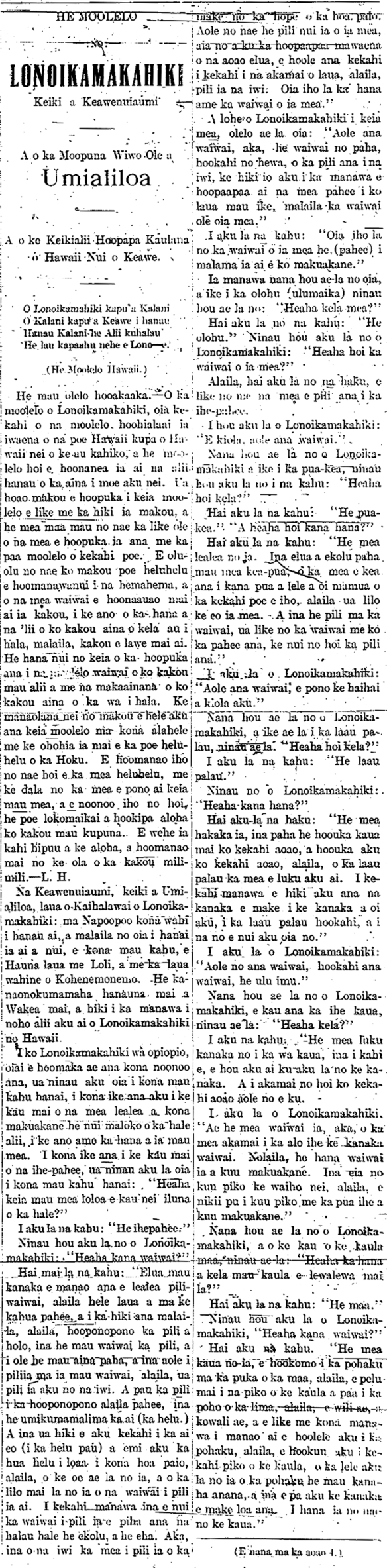
Lonoikamakahiki, unattributed, 1909.

A STORY

OF

LONOIKAMAKAHIKI

Son of Keawenuiaumi

And Fearless Grandson of

Umialiloa

And the Famous Riddling Chief of Great Hawaii of Keawe.

O Lonoikamakahiki kapu a Kalani
O Kalani kapu a Keawe i hanau
Hanau Kalani he Alii kuhalau
He lau kapaahu nehe o Lono—e.

[Lonoikamakahiki, the sacred one of Kalani
Sacred Kalani, born of Keawe
Born was Kalani, a expansive Chief
O Lono, a rustling of a heap of mats.]

(A Hawaiian Story.)

Words of clarification.—The story of Lonoikamakahiki is one of the stories delighted in by the native Hawaiians of Hawaii nei of the olden days, and it is a moolelo that was enjoyed by the alii born in this land who have passed on. We have endeavored to print this story to the greatest of our ability, but it is a common thing for there to be discrepancies from what is published with what is memorized by some people. May our readers please be patient with the mistakes, and take the valuable things that will teach us of the nature of the deeds of the alii of our land of days past. Publishing the valuable stories of our alii and makaainana of our land of the past is of great importance. We hope that this story will travel its path, delighting the readers of the Hoku. But do remember, O Readers, that money is what makes this possible, and consider that our kupuna were generous and welcoming people. Open the purse of aloha, and remember the life of our beloved.— Editor.

[This story of Lonoikamakahiki appears in Hoku o Hawaii from 7/8/1909 to 12/9/1909. Unfortunately, the first 11 buke of the Hoku, from 5/3/1906 to 5/24/1917 are not available yet online.]

(Hoku o Hawaii, 7/5/1909, p. XXX)
HokuoHawaii_7_8_1909_1.png

Ka Hoku o Hawaii, Buke IV, Helu 10, Aoao 1. Iulai 8, 1909.

Z. P. Kalokuokamaile’s Lonoikamakahiki, 1924.

ENJOYMENT TO PASS THE TIME.

THE STORY OF LONOIKAMAKAHIKI, THE EXPERT ALII WHO HAD NO EQUAL AT CONTESTS OF WIT, AND AT WAR.

CHAPTER I.

(Written by Z. P. K. Kawaikaumaiikamakaokaopua)

Lonoikamakahiki was born in the land of Napoopoo, at the base of the cliff of Manuahi, South Kona, Hawaii. Keawenuiaumi was the father, Koihalawai was the mother; and it was in Napoopoo where he was raised until adulthood; his caretakers were Hauna and his younger brother Loli.

These two men had one wife. They did not want two wahine, and they were both very nice; they did not fight or argue and there was no dissension between them over this one woman. When Lonoikamakahiki was young, he began to think.

When Lonoikamakahiki was looking at the many items of entertainment of his father placed in the royal house, and he saw the ihe pahee placed there, he looked for a long time and after a while he asked his caretakers:

“What is that long thing hanging up there in the house?” Continue reading

Story of Lonoikamakahiki as told by Wille Sepe. Kawa Jr., 1887–1888.

A STORY OF

Lonoikamakahiki

THE

High Chiefly Offspring of Kalani.

The Great Alii of Hawaii.

[WRITTEN FOR THE KUOKOA NEWSPAPER.]

(The Author should make clear that although this Lahuikanaka was accustomed to memorizing things, there nonetheless are variations between what this person and that memorized. And it is from what is memorized by this Writer, it is on that path that he will travel until this Moolelo is complete.)

I must clarify the ancestors of the alii who this moolelo is about. So that the new generations of the Hawaiian People know the kupuna and makua and older brothers and younger brothers and the sisters of their alii for whom this famous story rises.

Kiha (m) lived with Kaohikinuiokalani (f), and born between them were the chiefly children, five in total. Here are each of their names:

Liloa (m), after him there were twins, Laeanui (f), Kaumanamana (f), Kalani (m), Pinea (f).

Liloa lived with his own sister, Pinea, and born was Hakau (m), that being Hakaualiloa. It is said that Hakau was a Pi’o Chief. Continue reading

B. L. Koko tells the story of Lonoikamakahiki, 1865.

STORY OF LONOIKAMAKAHIKI

PART 1.

Kalani was the father and Haumea the mother, born was Lonoikamakahiki from Haumea and Kalani; He was taken as hanai by Hauna of Kaikilanialiiwahineopuna [?? Hauna o Kaikilanialiiwahineopuna] until he was grown; the chiefs went to bathe in the ocean, and after they had bathed, the two of them went upland to warm themselves.

While the two of them were warming themselves, Kaiklanialiiwahineopuna said to Lonoikamakahiki, “let’s play konane (the konane played with pebbles).” “Yes,” said Lonoikamakahiki, and they laid out the pebbles upon the board and the two began to play [uhau], and in that first match, he lost to his sister; the two played once again, and he lost once again to his sister; they played for the third time, and that Chief lost once more; after this third loss of Lonoikamakahiki, the Chief grew irritated for just losing…

[This is the opening of one of the stories of Lonoikamakahiki found in the Hawaiian Language Newspapers. It was written by B. L. Koko of Kaualaa, Wailupe, Oahu, and runs in Au Okoa from 9/4/1865. There is criticism of his telling and Koko ends his story on 10/23/1865. He states at his closing that what he wrote is all he knows, but those who know the story well most likely know more things. And if his kupunakane know more, that he will submit it.]

(Au Okoa, 9/4/1865, p. 4)

AuOkoa_9_4_1865_4.png

Ke Au Okoa, Buke I, Helu 20, Aoao 4. Sepatemaba 4, 1865.