Post Brown Bag: “The People of Kalaupapa as Active Participants in Their Own History.” 2012.

Much appreciation goes out to all the good people at the Center for Biographical Research at UHM! And to Anwei Skinsnes Law and Henry Law for their presentation today!! I came out of it feeling upbeat, and excited that there are people out there looking at Hawaiian-Language source material for a window into the past (outside of the University).

I encourage people to go check out the talk, questions and answers, and book signing put on by Native Books from 3 to 5 in the afternoon this Sunday.

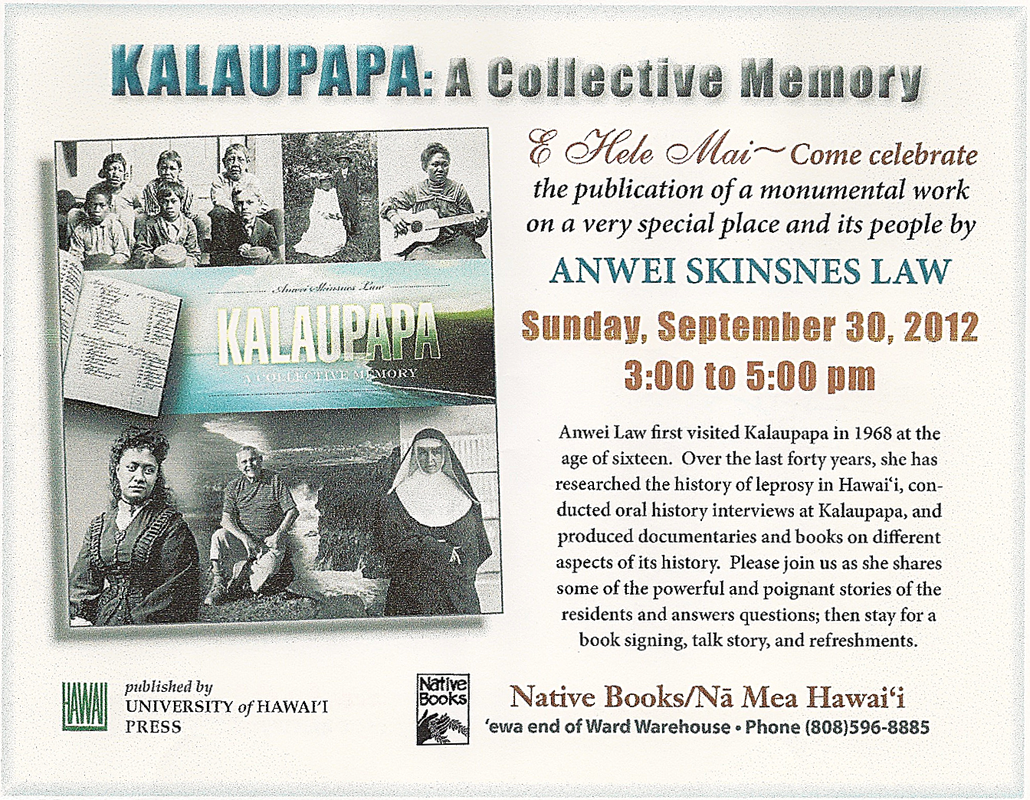
Kalaupapa: A Collective Memory

Kalaupapa: A Collective Memory

Commentary on the state of leprosy, 1879.

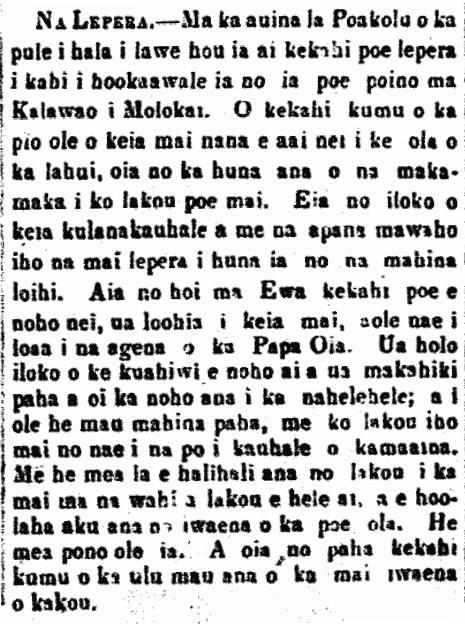
Those with Leprosy.—In the afternoon of this past Wednesday, more leprosy patients were taken to a place set apart for those unfortunate people, at Kalawao, Molokai. One reason for the lack of eradication of this disease eating away at the lives of our people, is that friends hide away their sick. Here in this town and areas right outside are those with leprosy who were hidden for many months. In Ewa there are people living, afflicted with this disease but have not been found by the agent of the Board of Health [Papa Ola]. They went into the mountains to live, and perhaps it has been over a year that they have lived in the forests; or maybe some months, descending to the houses of friends at night. It is as if they are carrying the disease where they go and are spreading it amongst the healthy people. This is not right. And that is perhaps one of the reasons that this disease keeps multiplying between us.

(Kuokoa, 7/19/1879, p. 4)

Na Lepera.

Ka Nupepa Kuokoa, Buke XVIII, Helu 29, Aoao 4. Iulai 19, 1879.

Ka Ohana O Kalaupapa to Host Educational Workshops, 2012.

I neglected to post this related information about workshops being held by Ka Ohana o Kalaupapa in conjunction with the exhibits at Iolani Palace and the Maui Arts & Cultural Center. They say: “The workshops will provide a new perspective on the history of Kalaupapa and will encourage teachers to include the history in their curriculum.” This indeed sounds like a good thing! There in fact was one just yesterday evening. Did anyone get to attend? If yes, how did it go?

There is another one scheduled for the evening of the 2nd of October. For more information, check out the link below.

Teachers Workshops

“The People of Kalaupapa as Active Participants in Their Own History,” 2012.

Tomorrow at noon, there is a Brown Bag Presentation put on by The Center for Biographical Research at University of Hawaii at Manoa. The topic is looking at the Leprosy Colony on Molokai through Hawaiian-Language Material. It sounds like an immense but priceless project! If you are interested, find the details in the link below!!

“The People of Kalaupapa as Active Participants in Their Own History.”

Patients of the leprosy settlement present gift to the Waipa Trio, 1922.

Presented by the Patients of Molokai

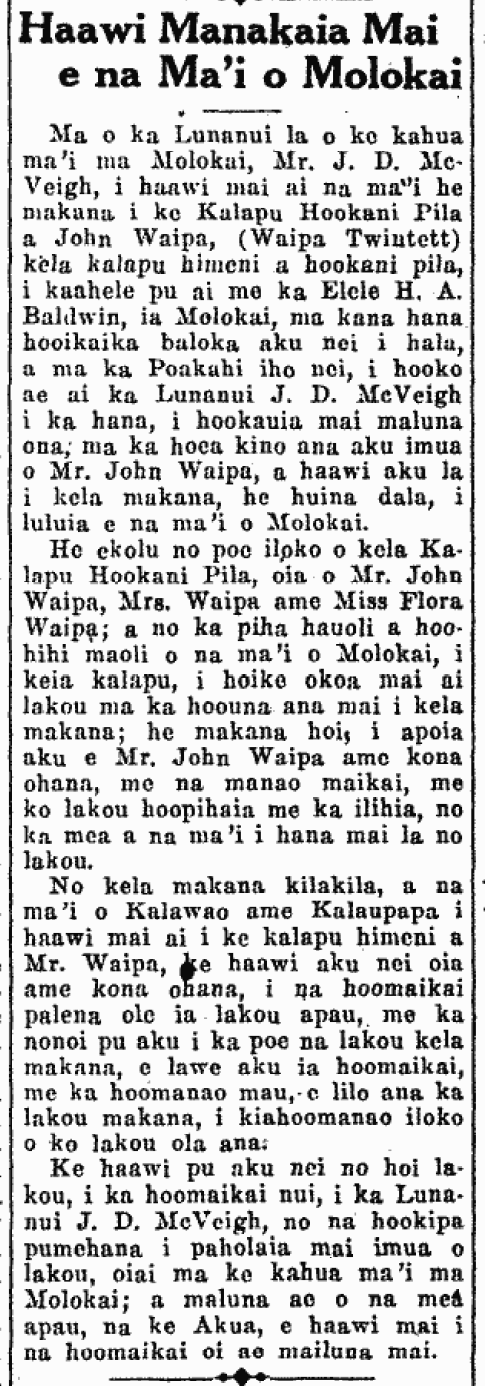
By way of the director of the leprosy settlement on Molokai, Mr. J. D. McVeigh, the patients gave a gift to the Band of John Waipa (The Waipa Twintett) [Waipa Trio]; that singing and musical group that travelled with Representative H. A. Baldwin, to Molokai, in his effort to increase voting; and on this past Monday, Director J. D. McVeigh carried out the duty given to him, by him appearing before Mr. John Waipa and presenting him with this gift, a sum of money donated by the patients of Molokai.

There are three people in that band: Mr. John Waipa, Mrs. Waipa, and Miss Flora Waipa; and because of the great joy and admiration that the patients had in the band, they showed this through the sending of this present; the gift was grasped by Mr. John Waipa and his family with pleasure, and they were filled with awe at this act done for them by the patients.

For this esteemed gift given by the patients of Kalawao and Kalaupapa to the singing group of Mr. Waipa, he and his family extend the endless appreciation to all of them, along with their request to all those who gave the gift, to accept their thanks and to always remember that their gift will be something for them to remember throughout their lives.

They also give their great appreciation to Director J. D. McVeigh for the warm hospitality extended to them while they were at the settlement on Molokai; and above all else, it is God who gives his highest blessings from above.

(Kuokoa, 4/28/1922, p. 1)

Haawi Makanaia Mai e na Ma'i o Molokai

Ka Nupepa Kuokoa, Buke LXI, Helu 17, Aoao 1. Aperila 28, 1922.

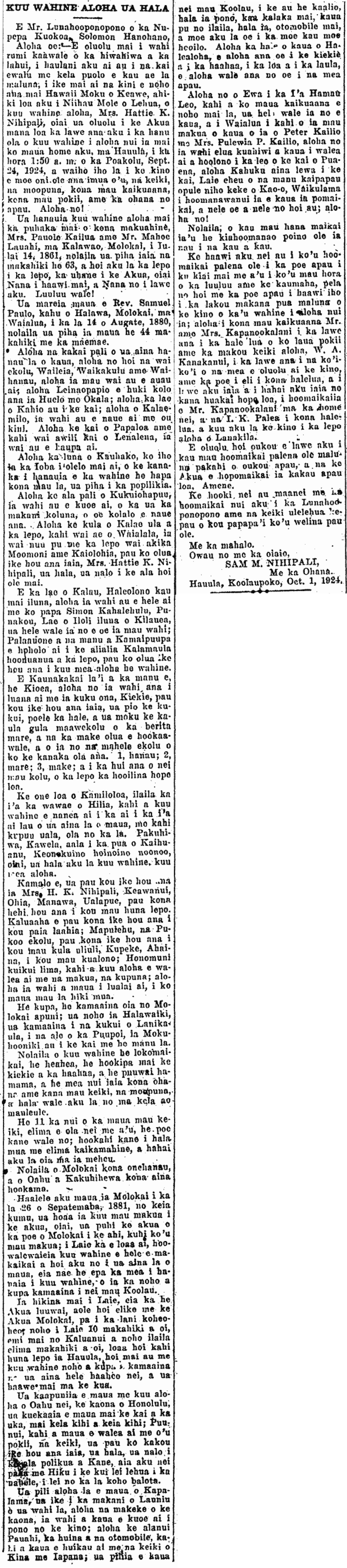
Hattie K. Nihipali passes, 1924.

My Beloved Wife Has Passed On

Mr. Editor of Ka Nupepa Kuokoa, Solomon Hanohano.

Greetings to you:—Please allow me some space within the pride of the people [Ka Nupepa Kuokoa], that I may speed across the eight seas with that parcel shown above, so the many living from Hawaii, the lands of Keawe, all the way to Niihau and the foundation of Lehua might know that my beloved wife, Mrs. Hattie K. Nihipali who was greatly loved, that her life breath has been taken, by the grace of almighty God. Her last breath was taken from our home in Hauula, at 1:50 a. m. on Wednesday, Sept. 24, 1924, and her restless sleeping body was left before me, the children and the grandchildren, her elder sisters, her younger siblings and all of the rest of the family. Aloha no!

My beloved wife was born from the loins of her parents, Mrs. Pauole Kailua and Mr. Mahoe Lauahi, at Kalawao, Molokai on July 14, 1861, therefore she was 63 years old, when dust returned to dust and her soul returned to God, as it was He that giveth and He that taketh away. How sad.

We were wed by Rev. Samuel Paulo, the kahu of Halawa, Molokai, at Waialua, on the 14th of August, 1880, and so we were married untainted for 44 years.

Aloha to the linked cliffs of our homeland; aloha to the three waters, Waileia, Waikakulu and Waihanau; aloha to the the waters where we bathed; aloha to Leinaopapio which pulls along with it, Huelo and Okala; aloha to the point of Kahio extending into the sea; aloha to Kalaemilo, where you and your family travelled about. Aloha to the sea of Papaloa and where the fresh water mixes with sea of Lenalena, the waters where you walked.

Aloha to the uplands of Kauhako, where Job’s words come true, “Man born of woman is of few days and full of trouble.”

Aloha to the cliff paths of Kukuiohapuu, where you walked; the rain and wind above, and you below moving along. Aloha to the plains of Kalae with its red dirt, and the waters of Waialala, that water filled with the acidic water of Moomoni and Kaiolohia; you will never again see Mrs. Hattie K. Nihipali; she has left, gone on the path of no return.

O point of Kalau [Kalaau], and Haleolono above; aloha to those places you went with your father [papa?] Simon Kahalehulu—Punakou, the point of Iloli above Kilauea—those places were traversed by you; Palaauone where the birds of Kamaipuupa run about on the salt beds and Kalamaula piled with dirt, you will no longer see my beloved, my wife.

O Kaunakakai, peaceful place of the kioea bird; aloha to that place where she was together with her tutu, Kiekie, you will not see her again; her light is extinguished, the house is darkened, and the gold three-ply cord or the covenant of marriage is severed, and it is death that has separted you, and those are the three divisions of a man’s life. 1, birth; 2, marriage; 3, death; and it is with the coming together of these three, dust is the final inheritance.

That vast sands of Kamiloloa is where the kicked fish of Hilia is, where my wife enjoyed eating the leaf-eating fish of that land of ours, along with some sweet potato, they were our sustenance. Pakuhiwa, Kawela, frangrant with the blossoms of Kaihuanu, Keonekuina is grieved, as my wife has gone, my beloved.

O Kamalo, you are not again to see Mrs. H. K. Nihipali; Keawanui, Ohia, Manawa, Ualapue, she will no longer step on your soil. Kaluaaha, she will no longer see your sacred walls; Mapulehu, the three Pukoo, she will not see once more your green fields; Kupeke, Ahaina, and your ridges; Honomuni of the joined hands, where my loved one relaxed with her parents and grandparents; aloha to those places where we were at ease, when we first arrived.

She is a native, a kamaaina of the entirety of Molokai; she lived in Halawaiki; she was kamaaina to the kukui of Lanikaula, to the waves of Puupoi, and to Mokuhooniki which juts into the sea like a bird.

My wife was kind-hearted, hospitable, she welcomed all from high to low, and she was open-hearted; her family was important to her as well as was her children, grandchildren—and she has gone to that faint realm.

We had 11 children, five are living with me, all boys. One boy has past as well as five girls, and she has followed in those footsteps.

Molokai is her birth land, and Oahu of Kakuhihewa is where her adopted land.

We left Molokai on the 26th of September 1881, for this reason: my parents were confused by the god, because the god of Molokai was burned in fire, and my parents thought that it would be found in Laie; and my wife was lured into going and travelling around there and then returning to our place. But my wife was tricked, and she remained and became kamaaina to these Koolau.

When she arrived in Laie, there was a god of baptism, not like the God of Molokai; touch the sky and tumble down—she stayed in Laie for about 10 years, and then down in Kaluanui for over five years. She then got some land in Hauula and I joined my beloved wife and we lived there until becoming kamaaina of that proud land, which I carried upon my back.

We travelled about Oahu, the town of Honolulu, we searched from ocean to mountain, from this corner to that. It was in Puunui that we enjoyed ourselves with my younger sibling and children. We shall no longer see her; she has left, she is gone to the dark path of Kane; perhaps she is with Hiku stringing lei of lehua in the forests, a lei for election day.

We were loved by Kapalama; we saw the Launiu winds of that place, that place were we walked for our health; aloha to Pauahi Street, the crossing of automobiles; that place where we were confused with the children of China and Japan; we were acquainted with these Koolau in the horse cart days; when those were insufficient, came the days of the truck and we were there; with the days of the automobile, you sleep the sleep of winter. Aloha to our home, Halealoha; you gave your aloha to those of high and low status, to the length and breadth, you gave your aloha to all.

Aloha to Ewa with its hushed crustacean [oyster], where our elder sibling lives; we went there; and to Waialua, the place of our makua (aunties and uncles), Peter Kailio and Mrs. Pulewia P. Kailio; aloha to those two mountains where we enjoyed ourselves and listened to the voice of the sea of Puaena; aloha to Kahuku, the land that floats on the sea, Laie borne on the wings of birds; Kaipapau with its angry opule; Kaoo and Waikulama, we were constantly blessed; but you are left without, and i am left without; how sad!

All of your kind deeds for me are an unforgettable memorial of you for all times.

I offer my appreciation to all of the people who stood with me in my hours of grief and sorrow, as well as to all the people who gave their gift of flowers atop the body of my beloved wife; aloha to her elder siblings, Mr. and Mrs. Kapanookalani for their taking of their younger sister to the cemetery, and our beloved child, W. A. Kanakanui for his taking the important things which will bring comfort to the body, as well as the people who dug her grave, and those who took her and who followed her in her last journey, blessed by Mr. Kapanookalani in this house, and I. K. Palea for the grave, and the body was put in the beloved earth at Lanakila.

Please accept my boundless appreciation for each of you, and may God bless us all. Amen.

I close here with my appreciation to the Editor, and to the children who set the type of your printing press my endless regards.

With mahalo,

Sincerely, SAM M. NIHIPALI,

and the Family.

Hauula, Koolaupoko, Oct. 1, 1924.

(Kuokoa, 10/16/1924, p. 5)

KUU WAHINE ALOHA UA HALA

Ka Nupepa Kuokoa, Buke LXIII, Helu 42, Aoao 5. Okatoba 16, 1924.

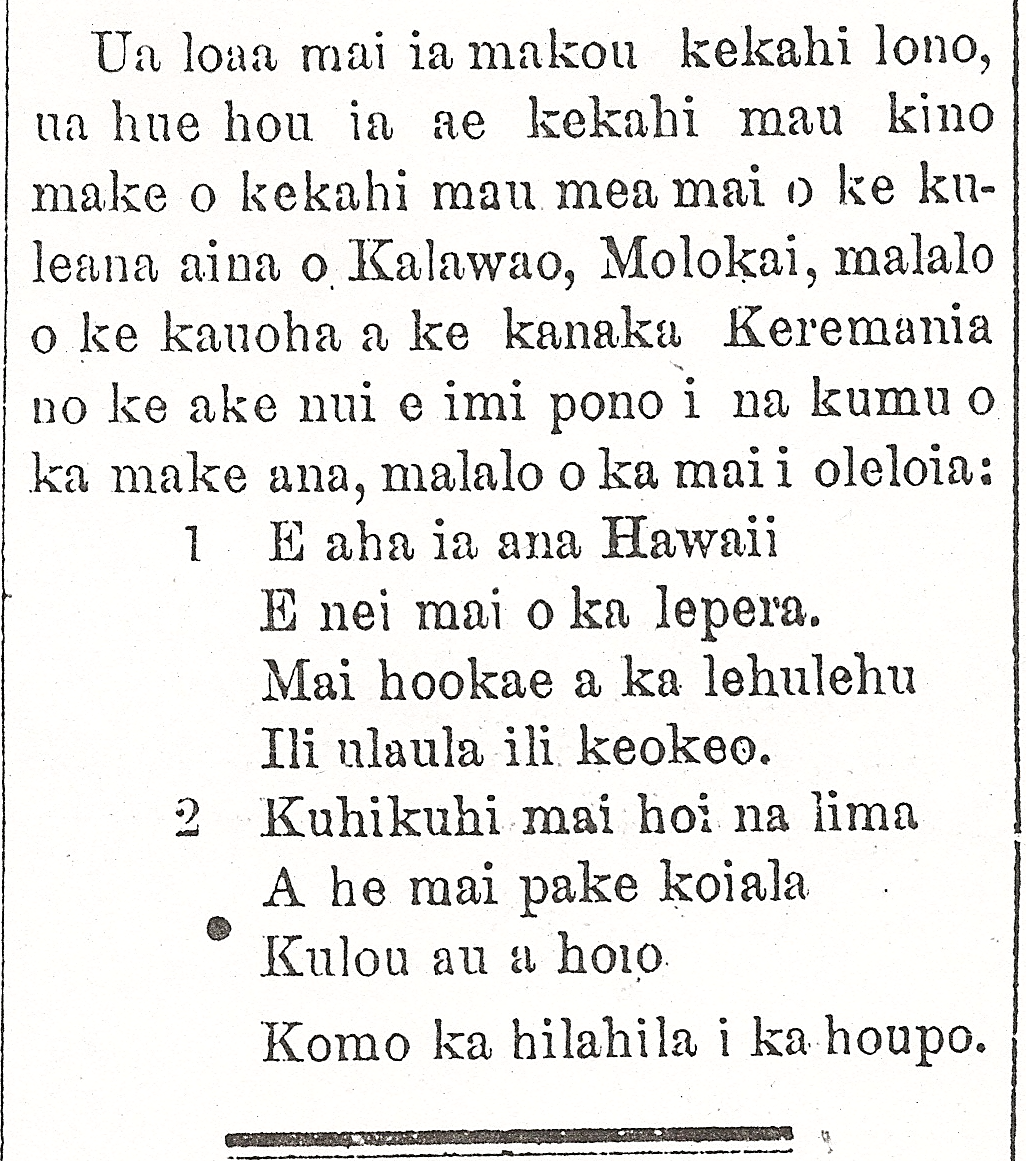
Kalawao bodies exhumed for study, 1884.

We’ve received word that more bodies were exhumed of patients in Kalawao, Molokai, under the orders of the German [Eduard Arning], because of his great desire to find the reasons for the deaths by the disease of which it is said:

1 E aha ia ana Hawaii
E nei mai o ka lepera.
Mai hookae a ka lehulehu
Ili ulaula ili keokeo.

2 Kuhikuhi mai hoi na lima
A he mai pake koiala
Kulou au a holo
Komo ka hilahila i ka houpo.

[1 What is up with Hawaii
With this disease, leprosy
Disease hated by the masses
By the dark skinned and the white skinned.

2 The hand points this way
“That one there has leprosy [mai pake]”
I look down and flee
Shame filling my heart.]

[“Ke Ola o Hawaii” is yet another newspaper that is available on microfilm that ulukau for some reason chose not to digitize. Hopefully this will be corrected soon!]

(Ola o Hawaii, 3/22/1884, p. 3)

Ua loaa mai ia makou kekahi lono...

Ke Ola o Hawaii, Buke I, Helu 11, Aoao 3. Maraki 22, 1884.

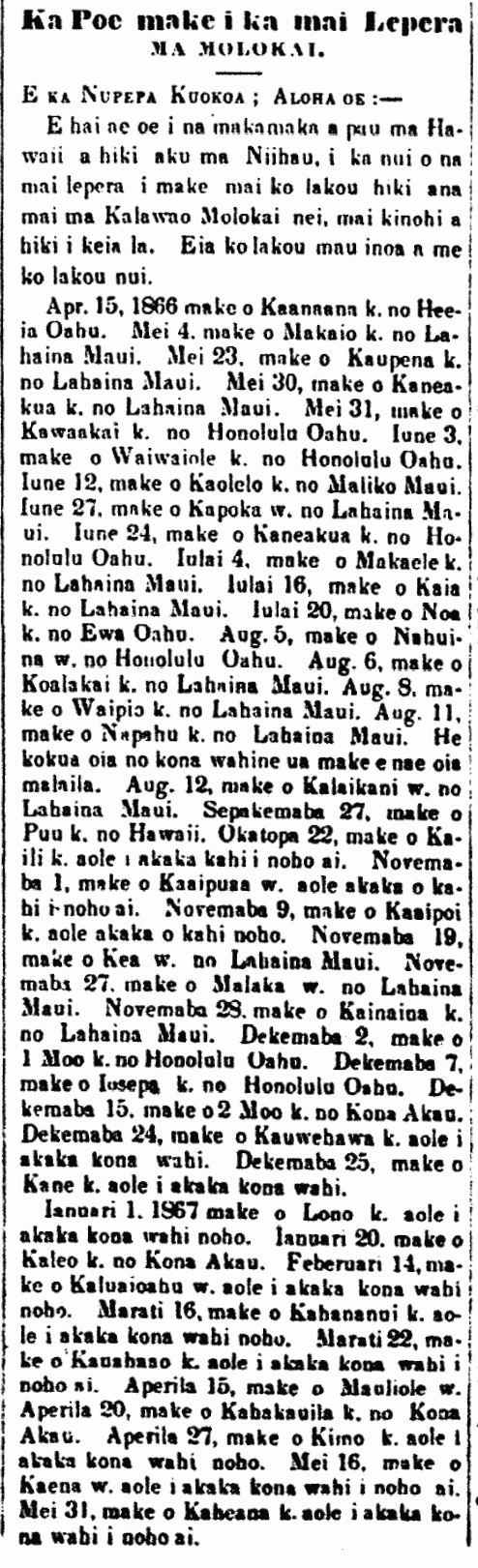
Listing of earliest deaths in Kalawao, 1868.

Those who died of Leprosy

ON MOLOKAI.

O Kuokoa Newspaper; Alohe oe:—

Tell all friends, from Hawaii to Niihau, the number of leprosy patients who died from their arrival here in Kalawao, Molokai, from the beginning until today. Here are their names and their total.

Apr. 15, 1866, Kaanaana m. died, from Heeia, Oahu. May 4, Makaio m. died, from Lahaina, Maui. May 23, Kaupena m. died, from Lahaina, Maui. May 30, Kaneakua m. died, from Lahaina, Maui. May 31, Kawaakai m. died, from Honolulu, Oahu. June 3, Waiwaiole m. died, from Honolulu, Oahu. June 12, Kaolelo m. died, from Maliko, Maui. June 27, Kapoka f. died, from Lahaina, Maui. June 24, Kaneakua m. died, from Honolulu, Oahu. July 4, Makaele m. died, from Lahaina, Maui. July 16, Kaia m. died, from Lahaina, Maui. July 20, Noa m. died, from Ewa, Oahu. Aug. 5, Nahuina f. died, from Honolulu, Oahu. Aug. 6, Koalakai m. died, from Lahaina, Maui. Aug. 8, Waipio m. died, from Lahaina, Maui. Aug. 11, Napahu m. died, from Lahaina, Maui. He was a helper [kokua] for his wife, but he died before her there. Aug. 12, Kalaikane f. died, from Lahaina, Maui. September 27, Puu m. died, from Hawaii. October 22, Kaili m. died, it is not clear where he lived. November 1, Kaaipuaa f. died, it is not clear where she lived. November 9, Kaaipoi m. died, it is not clear where he lived. November 19, Kea died, from Lahaina, Maui. November 27, Malaka f. died, from Lahaina, Maui. November 28, Kainaina m. died, from Lahaina, Maui. December 2, 1 Moo m. died, from Honolulu, Oahu. December 7, Iosepa m. died, from Honolulu, Oahu. December 15, 2 Moo m. died, from North Kona. December 24, Kauwehawa m. died, it is not clear where he lived. December 25, Kane m. died, it is not clear where he lived.

January 1, 1867, Lono m. died, it is not clear where he lived. January 20, Kaleo m. died, from North Kona. February 14, Kaluaioahu f. died, it is not clear where she lived. March 16, Kahananui m. died, it is not clear where he lived. March 22, Kauahaao m. died, it is not clear where he lived. April 15, Mauliole f. died. April 20, Kahakauila m. died, from North Kona. April 27, Kimo m. died, it is not clear where he lived. May 16, Kaena f. died, it is not clear where she lived. May 31, Kaheana m. died, it is not clear where he lived.

(Kuokoa, 2/29/1868, p. 3)

Ka Poe make i ka mai Lepera

Ka Nupepa Kuokoa, Buke VII, Helu 9, Aoao 3. Feberuari 29, 1868.

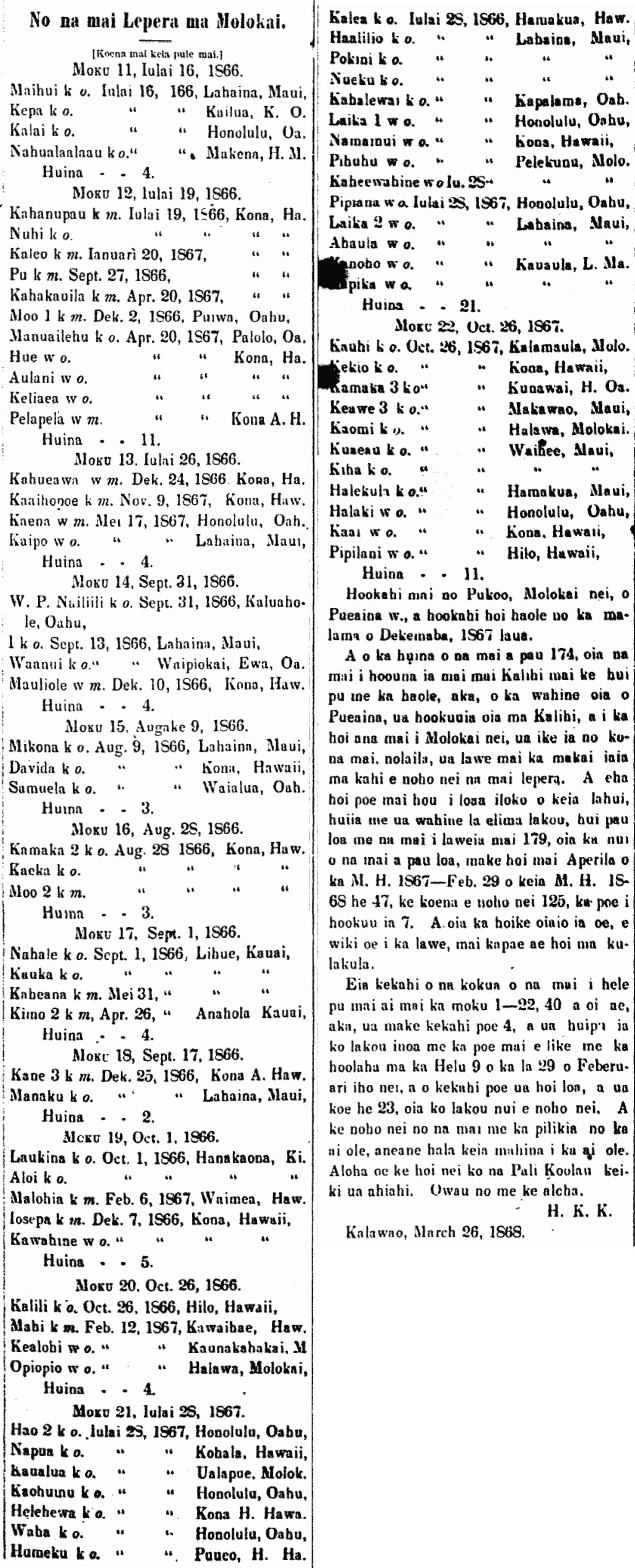
List of leprosy patients sent to Molokai, continued, 1868.

Concerning the Leprosy Patients on Molokai

(Continued from last week.)

Boat 11, July 16, 1866.
Maihui k, o. July 16, 166, Lahaina, Maui,
Kepa k, o. ” ” Kailua, K. O.
Kalai k, o. ” ” Honolulu, Oa.
Nahualaalaau k, o. ” ” Makena, H. M.
Total – – 4.
Boat 12, July 19, 1866.
Kahanupau k, m. July 19, 1866, Kona, Ha.
Nuhi k, o. ” ” ” “
Kaleo k, m. January 20, 1867, ” “
Pu k, m. Sept. 27, 1866, ” “
Kahakauila k, m. Apr. 20, 1867, ” “
Moo 1 k, m. Apr. 20, 1867, ” “
Manuailehu k, o. Apr. 20, 1867, Palolo, Oa.
Hue w, o. ” ” Kona, Ha.
Aulani w, o. ” ” ” “
Keliaea w, o. ” ” ” “
Pelapela w, m. ” ” Kona, A. H.
Total – – 11.
Boat 13, July 26, 1866.
Kahueawa w, m. Dec. 24, 1866, Kona, Ha.
Kaaihopoe k, m. Nov. 9, 1867, Kona, Haw.
Kaena w, m. May 17, 1867, Honolulu, Oah.
Kaipo w, o. ” ” Lahaina, Maui,
Total – – 4.
Boat 14, Sept. 31, 1866.
W. P. Nailiili k, o. Sept. 31, 1866, Kaluahole, Oahu,
I k, o. Sept. 13, 1866, Lahaina, Maui,
Waanui k, o. ” ” Waipiokai, Ewa, Oa.
Mauliole w, m. Dec. 10, 1866, Kona, Haw.
Total – – 4.
Boat 15, August 9, 1866.
Mikona k, o. Aug. 9, 1866, Lahaina, Maui,
Davida k, o. ” ” Kona, Hawaii,
Samuela k, o. ” ” Waialua, Oah.
Total – – 3.
Boat 16, Aug. 28, 1866.
Kamaka 2 k, o. Aug. 28, 1866, Kona, Haw.
Kaeka k, o. ” ” ” “
Moo 2 k, m. ” ” ” “
Total – – 3.
Boat 17, Sept. 1, 1866.
Nahale k, o. Sept. 1, 1866, Lihue, Kauai,
Kauka k, o. ” ” ” “
Kaheana k, m. May 31, ” ” “
Kimo 2 k, m. Apr. 26, ” Anahola, Kauai,
Total – – 4.
Boat 18, Sept. 17, 1866.
Kane 3 k, m. Dec. 25, 1866, Kona A. Haw.
Manaku k, o. ” ” Lahaina, Maui,
Total – – 2.
Boat 19, Oct. 1, 1866.
Laukina k, o. Oct. 1, 1866, Hanakaona, Ki.
Aloi k, o. ” ” ” “
Malohia k, m. Feb. 6, 1867, Waimea, Haw.
Iosepa k, m. Dec. 7, 1866, Kona, Hawaii,
Kawahine w, o. ” ” ” “
Total – – 5.
Boat 20, Oct. 26, 1866.
Kalili k, o. Oct. 26, 1866, Hilo, Hawaii,
Mahi k, m. Feb. 12, 1867, Kawaihae, Haw.
Kealohi w, o. ” ” Kaunakahakai, M.
Opiopio w, o. ” ” Halawa, Molokai,
Total – – 4.
Boat 21, July 28, 1867.
Hao 2 k, o. July 28, 1867, Honolulu, Oahu,
Napua k, o. ” ” Kohala, Hawaii,
Kaualua k, o. ” ” Ualapue, Molok.
Kaohumu k, o. ” ” Honolulu, Oahu,
Helehewa k, o. ” ” Kona, H. Hawa.
Waha k, o. ” ” Honolulu, Oahu,
Humeku k, o. ” ” Puueo, H. Ha.
Kalea k, o. July 28, 1866, Hamakua, Haw.
Haalilio k, o. ” ” Lahaina, Maui,
Pokini k, o. ” ” ” “
Nueku k, o. ” ” ” “
Kahalewai k, o. ” ” Kapalama, Oah.
Laika 1 w, o. ” ” Kona, Hawaii,
Namamui w, o. ” ” Kona, Hawaii,
Pihuhu w, o. ” ” Pelekunu, Molo.
Kaheewahine w, o. July 28, ” ” “
Pipiana w, o. July 28, 1867, Honolulu, Oahu,
Laika 2 w, o. ” ” Lahaina, Maui,
Ahaula w, o. ” ” ” “
Kanoho w, o. ” ” Kauaula, L. Ma.
??pika w, o. ” ” ” “
Total – – 21.
Boat 22, Oct. 26, 1867.
Kauhi k, o. Oct. 26, 1867, Kalamaula, Molo.
Kekio k, o. ” ” Kona, Hawaii,
Kamaka 3 k, o.  ” ” Kunawai, H. Oa.
Keawe 3 k, o. ” ” Makawao, Maui,
Kaomi k, o. ” ” Halawa, Molokai,
Kuaeau k, o. ” ” Waihee, Maui,
Kiha k, o. ” ” ” “
Halekula k, o. ” ” Hamakua, Maui,
Halaki w, o. ” ” Honolulu, Oahu,
Kaai w, o. ” ” Kona, Hawaii,
Pipilani w, o. ” ” Hilo, Hawaii,
Total – – 11.
There is one patient from Pukoo, Molokai, named Pueaina (f.), and one haole, and they are both from the month of December 1867.
The total number of patients is 174; those are the patients sent from Kalihi along with the haole; however the woman, Pueaina, she was released at Kalihi, but when she was returning to Molokai, her sickness was seen, and so she was brought by the deputy to where the patients reside. And there were four more of our people brought, and so added together with that woman, there are five of them, so all together with those patients brought in, there are 179; that is the total number of patients. The deaths from April 1867—Feb. 29 of this year, 1868, is 47; the remainder of those alive is 125; the number of them released is 7. And this is a true report to you; take this quickly, and don’t just set it aside.
One more thing; the number of helpers (kokua) who came along with the patients from ships 1–22, there are 40 or more of them, however, 4 of them have died, and their number was added with the patients as was announced in Issue 9 of the 29th of February; and some have returned home; and 23 are left, and that is the number of those that still live here. The patients are living with difficulty for lack of food; this month was almost totally spent without food. Aloha to you as this son of the Koolau Cliffs returns for it is eventide. Me, with aloha.
H. K. K.
Kalawao, March 26, 1868.
(Kuokoa, 5/16/1868, p. 4)
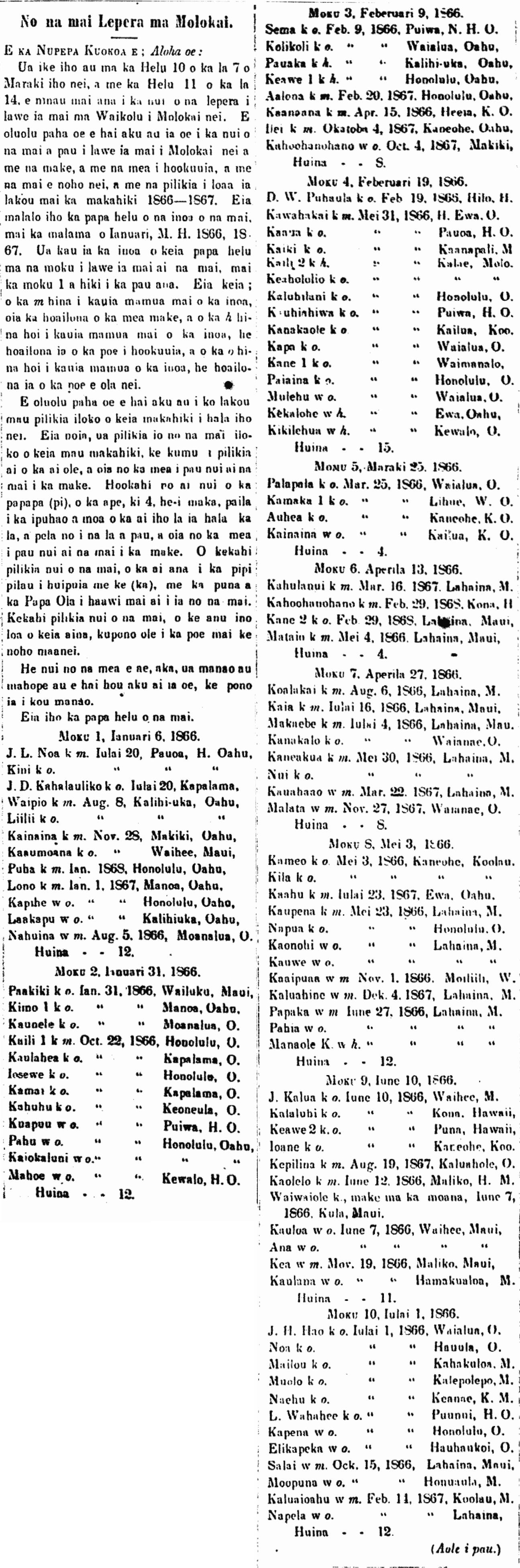
No na mai Lepera ma Molokai.

Ka Nupepa Kuokoa, Buke VII, Helu 20, Aoao 4. Mei 16, 1868.

List of leprosy patients sent to Molokai, 1868.

Concerning the Leprosy Patients on Molokai.

O Kuokoa Newspaper, Aloha oe:

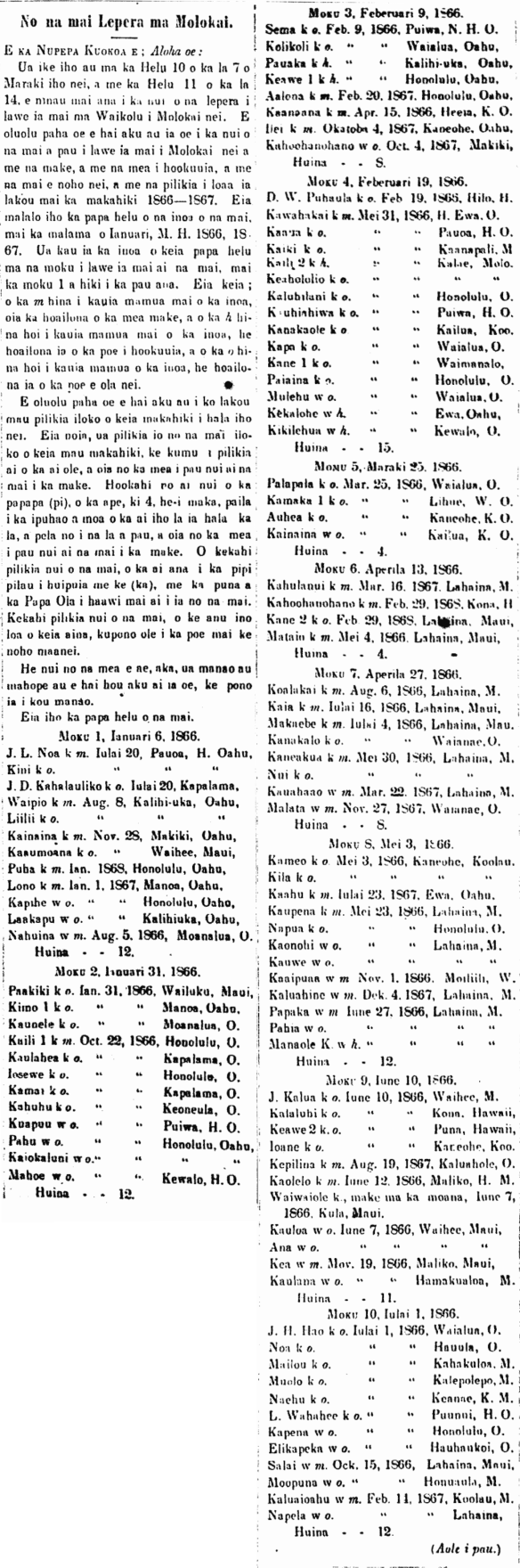
I have seen in Issue 10 of March 7 and Issue 11 of the 14th, the question as to how many leprosy patients were brought to Waikolu, here in Molokai. If it pleases you, I will tell you the total number of patients brought to Molokai, along with the deaths, and those who were released, and also those patients who are still living; and also the difficulties they faced in the years 1866–1867. Here below is a list of the patients from the month of January, 1866–1867. The list is given by the boats that brought the patients, from the first boat to the last. And also, an italic “m” placed [after] the name signifies that they are deceased [“make”], and an “h” placed [after] the name signifies they were released [“hookuuia”], and an “o” placed [after] the name means they are still living here [“ola”].
I would like to speak of their difficulties during this past year. And this is it; the patients were beset with much difficulties, and that they had no food, and that is the reason that so many patients died. There is but one abundant thing to eat: peas, ape, ti-leaf root 4, and green bananas boiled up in a pot until cooked, and that is what they eat to get by; and that goes on everyday, and that is why many of the patients die. Another big problem of the patients is the consumption of the spoiled beef mixed with tar and plaster that is sent by the board of health as food for the patients. Another big problem faced by the patients is the extreme cold; it is not beneficial for the sick to live here.
There are so many other things, but I believe that I will talk about them to you later, should you deem it proper.
Here is the lists of the patients.
Boat 1, January 6, 1866.
J. L. Noa k [kane], m. July 20 [not sure what these dates are], Pauoa, H. Oahu,
Kini k, o. ” ” “
J. D. Kahalauliko k, o. July 20, Kapalama, Oahu,
Waipio k, m. Aug. 8, Kalihi-uka, Oahu,
Liilii k, o. ” ” “
Kainaina k, m. Nov. 28, Makiki, Oahu,
Kaaumoana k, o. ” Waihee, Maui,
Puha k, m. Jan. 1868, Honolulu, Oahu,
Lono k, m. Jan. 1, 1867, Manoa, Oahu,
Kapihe w [wahine], o. ” ” Honolulu, Oahu,
Laakapu w, o. ” ” Kalihiuka, Oahu,
Nahuina w, m. Aug. 5, 1866, Moanalua, O.
Total – – 12.
Boat 2, January 31, 1866.
Paakiki k, o. Jan. 31, 1866, Wailuku, Maui,
Kimo 1 [“1” indicates that there were more than one person with the same name] k, o. ” ” Manoa, Oahu,
Kaunele k, o. ” ” Moanalua, O.
Kaili 1 k, m. Oct. 22, 1866, Honolulu, O.
Kaulahea k, o. ” ” Kapalama, O.
Iosewe k, o. ” ” Honolulu, O.
Kamai k, o. ” ” Kapalama, O.
Kahuhu k, o. ” ” Keoneula, O.
Kuapuu w, o. ” ” Puiwa, H. O.
Pahu w, o. ” ” Honolulu, Oahu,
Kaiokaluni w, o. ” ” ” “
Mahoe w, o. ” ” Kewalo, H. O.
Total – – 12.
Boat 3, February 9, 1866.
Sema k, o. Feb. 9, 1866, Puiwa, N. H. O,
Kolikoli k, o. ” ” Waialua, Oahu,
Pauaka k, h. ” ” Kalihi-uka, Oahu.
Keawe 1 k, h. ” ” Honolulu, Oahu,
Aalona k, m. Feb. 20, 1867, Honolulu, Oahu,
Kaanaana k, m. Apr. 15, 1866, Heeia, K. O.
Ilei k, m. October 4, 1867, Kaneohe, Oahu,
Kahoohanohano w, o. Oct. 4, 1867, Makiki,
Total – – 8.
Boat 4, Feberuary 19, 1866.
D. W. Puhaula k, o. Feb. 19, 1868, Hilo, H.
Kawahakai k, m. May 31, 1866, H. Ewa, O.
Kaaua k, o. ” ” Pauoa, H. O.
Kaiki k, o. ” ” Kaanapali, M.
Kaili 2 k, h. ” ” Kalae, Molo.
Keahololio k, o. ” ” ” “
Kaluhilani k, o. ” ” Honolulu, O.
Kauhiahiwa k, o. ” ” Puiwa, H. O.
Kanakaole k, o. ” ” Kailua, Koo.
Kapa k, o. ” ” Waialua, O.
Kane 1 k, o. ” ” Waimanalo,
Paiaina k, o. ” ” Honolulu, O.
Mulehu w, o. ” ” Waialua, O.
Kekalohe w, h. ” ” Ewa, Oahu,
Kikilehua w, h. ” ” Kewalo, O.
Total – – 15.
Boat 5, March 25, 1866.
Palapala k, o. Mar. 25, 1866, Waialua, O.
Kamaka 1 k, o. ” ” Lihue, W. O.
Auhea k, o. ” ” Kaneohe, K. O.
Kainaina w, o. ” ” Kailua, K. O.
Total – – 4.
Boat 6, April 13, 1866.
Kahulanui k, m. Mar. 16, 1867. Lahaina, M.
Kahoohanohano k, m. Feb. 29, 1868, Kona, H.
Kane 2 k, o. Feb. 29, 1868, Lahaina, Maui,
Mataio k, m. May 4, 1866, Lahaina, Maui,
Total – – 4.
Boat 7, April 27, 1866.
Koalakai k, m. Aug. 6, 1866, Lahaina, M.
Kaia k, m. July 16, 1866, Lahaina, Maui,
Makaebe k, m. July 4, 1866, Lahaina, Mau.
Kanakalo k, o. ” ” Waianae, O.
Kaneakua k, m. May 30, 1866, Lahaina, M.
Nui k, o. ” ” ” “
Kauahaao w, m. Mar. 22, 1867, Lahaina, M.
Malata w, m. Nov. 27, 1867, Waianae, O.
Total – – 8
Boat 8, May 3, 1866.
Kameo k, o. May 3, 1866, Kaneohe, Koolau,
Kila k, o. ” ” ” “
Kaahu k, m. July 23, 1867, Ewa, Oahu.
Kaupena k, m. May 23, 1866, Lahaina, M.
Napua k, o. ” ” Honolulu, O.
Kaonohi w, o. ” ” Lahaina, M.
Kauwe w, o. ” ” ” “
Kaaipuaa w, m. Nov. 1, 1866, Moiliili, W.
Kaluahine w, m. Dec. 4, 1867, Lahaina, M.
Papaka w, m. June 27, 1866, Lahaina, M.
Pahia w, o. ” ” ” “
Manaole K. w, h. ” ” ” “
Total – – 12.
Boat 9, June 10, 1866.
J. Kalua k, o. June 10, 1866, Waihee, M.
Kalaluhi k, o. ” ” Kona, Hawaii,
Keawe 2 k, o. ” ” Puna, Hawaii,
Ioane k, o. ” ” Kaneohe, Koo.
Kepilina k, m. Aug. 19, 1867, Kaluahole, O.
Kaolelo k, m. June 12, 1866, Maliko, H. M.
Waiwaiole k., died at sea, June 7, 1866, Kula, Maui,
Kauloa w, o. June 7, 1866, Waihee, Maui,
Ana w, o. ” ” ” “
Kea w, m. Nov. 19, 1866, Maliko, Maui,
Kaulana w, o. ” ” Hamakualoa, M.
Total – – 11.
Boat 10, July 1, 1866.
J. H. Hao k, o. July 1, 1866, Waialua, O.
Noa k, o. ” ” Hauula, O.
Mailou k, o. ” ” Kahakuloa, M.
Muolo k, o. ” ” Kalepolepo, M.
Naehu k, o. ” ” Keanae, K. M.
L. Wahahee k, o. ” ” Puunui, H. O.
Kapena w, o. ” ” Honolulu, O.
Elikapeka w, o. ” ” Hauhaukoi, O.
Salai w, m. Oct. 15, 1866, Lahaina, Maui,
Moopuna w, o. ” ” Honuaula, M.
Kaluaioahu w, m. Feb. 14, 1867, Koolau, M.
Napela w, o. ” ” Lahaina,
Total – – 12.
(Not complete.)
[Anyone have an idea what the dates in the list stand for? And also the description here is interesting when compared to what was said in this morning’s newspaper: “Translations bring to light true voices of patients,” by Dan Nakaso.]
(Kuokoa, 5/9/1868, p. 4)
No na mai Lepera ma Molokai.

Ka Nupepa Kuokoa, Buke VII, Helu 19, Aoao 4. Mei 9, 1868.