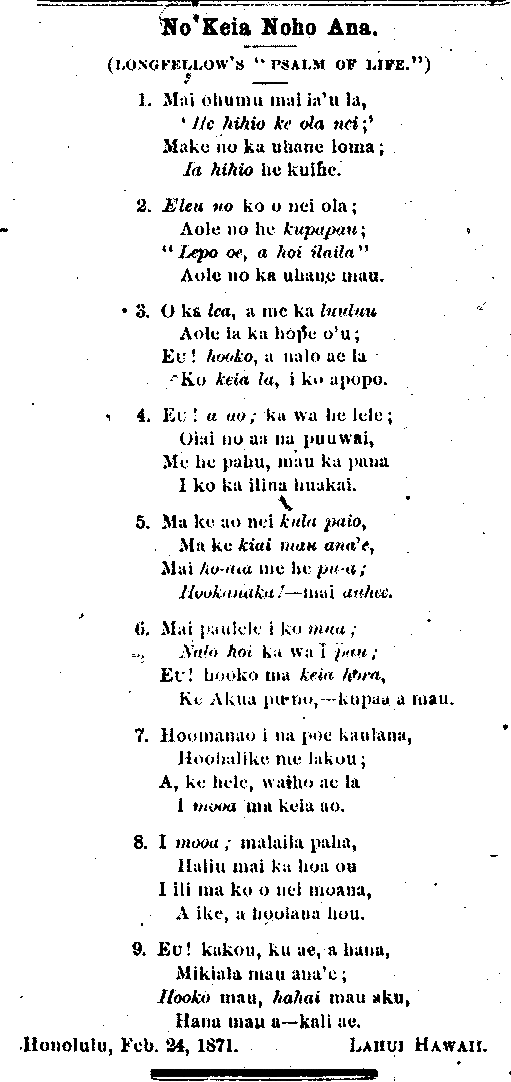
Hawaiian-language interpretation of Longfellow’s “Psalm of Life,” 1871.

No Keia Noho Ana.

(LONGFELLOW’S “PSALM OF LIFE.”)

1. Mai ohumu mai ia’u la,
‘He hihio ke ola nei;’
Make no ka uhane loma;
Ia hihio he kuihe.

2. Eleu no ko o nei ola;
Aole no he kupapau;
“Lepo oe, a hoi ilaila”
Aole no ka uhane mau.

3. O ka lea, a me ka luuluu
Aole ia ka hope o’u;
Eu! hooko, a nalo ae la
Ko keia la, i ko apopo.

4. Eu! a ao; ka wa he lele;
Oiai no aa na puuwai
Me he pahu, mau ka pana
I ko ka ilina huakai.

5. Ma ke ao nei kula paio,
Ma ke kiai mau ana’e
Mai ho-aia me he pu-a;
Hookanaka!—mai auhee.

6. Mai paulele i ko mua;
Nalo hoi ka wa i pau;
Eu! hooko ma keia hora,
Ke Akua pu no,—kupaa a mau.

7. Hoomanao i na poe kaulana,
Hoohalike me lakou;
A, ke hele, waiho ae la
I mooa ma keia ao.

8. I mooa; malaila paha,
Haliu mai ka hoa ou
I ili ma ko o nei moana,
A ike, a hoolana hou.

9. Eu! kakou, ku ae, a hana,
Mikiala mau ana’e;
Hooko mau, hahai mau aku,
Hana mau a—kali ae.

Honolulu, Feb. 24, 1871.  Lahui Hawaii.

[A PSALM OF LIFE

What the Heart of the Young Man Said to the Psalmist

Tell me not, in mournful numbers,
Life is but an empty dream!—
For the soul is dead that slumbers,
And things are not what they seem.

Life is real! Life is earnest!
And the grave is not its goal ;
Dust thou art, to dust returnest,
Was not spoken of the soul.

Not enjoyment, and not sorrow,
Is our destined end or way;
But to act, that each to-morrow
Find us farther than to-day.

Art is long, and Time is fleeting,
And our hearts, though stout and brave,
Still, like muffled drums, are beating
Funeral marches to the grave.

In the world’s broad field of battle,
In the bivouac of Life,
Be not like dumb, driven cattle!
Be a hero in the strife!

Trust no Future, howe’er pleasant!
Let the dead Past bury its dead!
Act,—act in the living Present!
Heart within, and God o’erhead!

Lives of great men all remind us
We can make our lives sublime,
And, departing, leave behind us
Footprints on the sands of time ;

Footprints, that perhaps another,
Sailing o’er life’s solemn main,
A forlorn and shipwrecked brother,
Seeing, shall take heart again.

Let us, then, be up and doing,
With a heart for any fate;
Still achieving, still pursuing,
Learn to labor and to wait.

(Lau Oliva, 3/1871, p. 1)
LauOliva_3_1871_1

Ka Lau Oliva, Buke I, Helu 3, Aoao 1. Maraki 1871.
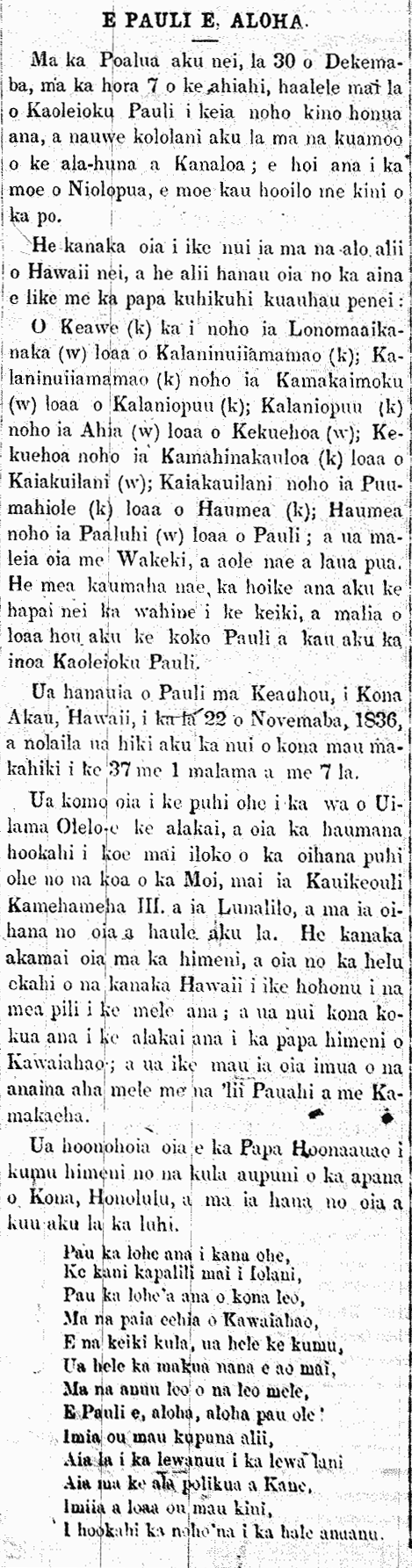
The death of Kaoleioku Pauli, 1874.

O PAULI, ALOHA

This past Tuesday, the 30th of December, at 7 o’clock in the evening, Kaoleioku Pauli left this earthly body and silently went on to the hidden pathway of Kanaloa; to return to the slumber of Niolopua, the eternal rest.

He was a man who was often seen in the royal courts of Hawaii nei, and he was a chief born of the land as shown in the genealogy chart below:

Keawe (m) dwelt with Lonomaaikanaka (f), begot was Kalaninuiiamamao (m); Kalaninuiiamamao (m) dwelt with Kamakaimoku, begot was Kalaniopuu (m); Kalaniopuu (m) dwelt with Ahia (f), begot was Kekuehoa (f); Kekuehoa dwelt with Kamahinakauloa (m), begot was Kaiakuilani (f); Kaiakauilani dwelt with Puumahiole (m), begot was Haumea (m); Haumea dwelt with Paaluhi (f), begot was Pauli; and he married Wakeki, but they have no offsrping. But it is sad that it was revealed that his wife is now pregnant with child, and perhaps the blood of Pauli will be begotten anew, and the name Kaoleioku Pauli will be given.

Pauli was born at Keauhou, in North Kona, Hawaii, on the 22nd of November 1836, and therefore he reached 37 years old and 1 month and 7 days.

He began playing the band during the time it was lead by William Merseburgh [?? Uilama Olelo-e], and he was the only student left from the band of the Kings, from Kauikeaouli Kamehameha III to Lunalilo, and while in that occupation, he fell. He was a man that was skilled at singing, and he was the greatest of Hawaiians in his deep knowledge of singing; and he greatly assisted in leading the choir of Kawaiahao; and he was always seen in front of song concerts with the alii Pauahi and Kamakaeha.

He was assigned by the Board of Education as a singing teacher for the government school for the district of Kona, Honolulu, and while in that position he let go of his burdens.

Pau ka lohe ana i kana ohe,
Ke kani kapalili mai i Iolani,
Pau ka lohe’a ana o kona leo,
Ma na paia eehia o Kawaiahao,
E na keiki kula, ua hele ke kumu,
Ua hele ka makua nana e ao mai,
Ma na anuu leo o na leo mele,
E Pauli e, aloha, aloha pau ole!
Imia ou mau kupuna alii,
Aia ia i ka lewanuu i ka lewa lani,
Aia ma ke ala polikua a Kane,
Imiia a loaa ou mau kini,
I hookahi ka noho’na i ka hale anuanu.

[No more will we hear wind instrument,
Its trilling song from Iolani,
No more will his voice be heard,
In the solemn walls of Kawaiahao,
O Schoolchildren, your teacher has gone,
Went is the father who taught,
The intervals in singing,
O Pauli, aloha, our never-ending aloha!
Seek out your chiefly ancestors,
They are in the sky up above, the sky in the heaven,
On the dark path of Kane,
Search out and find your relatives,
You will live as one in the cold house.

This is not the Pauli Kaoleioku who was the son of Kamehameha I and Kanekapolei.]

(Nuhou, 1/6/1874, p. 6)

Nuhou_1_6_1874_6

Ka Nuhou Hawaii, Buke I, Helu 10, Aoao 6. Ianuari 6, 1874.

Sweet voices, 1916.

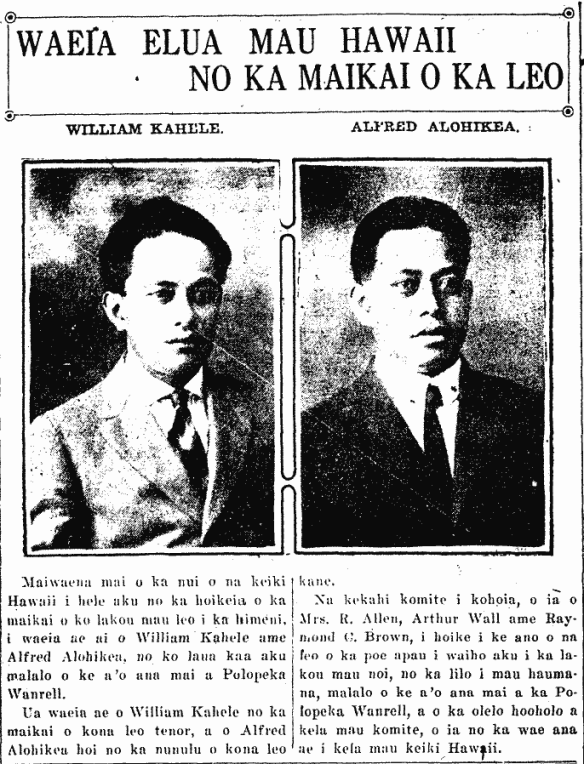
TWO HAWAIIAN SELECTED FOR THEIR FINE VOICES

WILLIAM KAHELE.  ALFRED ALOHIKEA.

From amongst many Hawaiian youths who went to show the quality of their singing voices, chosen  were William Kahele and Alfred Alohikea for them to study under Professor Wanrell.

William Kahele was selected for quality of his tenor voice, and Alfred Alohikea for his reverberating bass [leo kane].

They were picked by a committee, that being Mrs. R. Allen, Arthur Wall and Raymond C. Brown, who tested all of the voices who put in the application to become students under the tutelage of Professor Wanrell, and the decision of the committee was the choosing of those Hawaiian boys.

(Kuokoa, 10/20/1916, p. 3)

Kuokoa_10_20_1916_3

Ka Nupepa Kuokoa, Buke LIV, Helu 42, Aoao 3. Okatoba 20, 1916.

O uluwehiwehi mau ka lehua o Hilo!

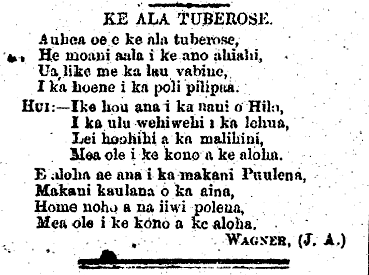
KE ALA TUBEROSE

Auhea oe e ke ala tuberose,
He moani aala i ke ano ahiahi,
Ua like me ka lau vabine,
I ka hoene i ka poli pilipaa.

Hui:—Ike hou ana i ka nani o Hilo,
I ka ulu wehiwehi i ka lehua,
Lei hoohihi a ka malihini,
Mea ole i ke kono a ke aloha.

E aloha ae ana i ka makani Puulena,
Makani kaulana o ka aina,
Home noho a na iiwi polena,
Mea ole i ke kono a ke aloha.

Wagner, (J. A.)

[This is a song credited to Joseph Kapaeau Aea that will be performed at the Kamehameha Song Contest this Friday night! There is a translation here to this mele and the others to be sung that night as well!! May the verdant lehua of Hilo live forever!!!

Does anyone know who the Wagner referred to is?]

(Nupepa Elele, 10/2/1886, p. 1)

NupepaElele_10_2_1886_1

Ka Nupepa Elele, Buke VIII, Helu 14, Aoao 1. Okatoba 2, 1886.

Alakai o Hawaii prints mele without any accreditation, 1930.

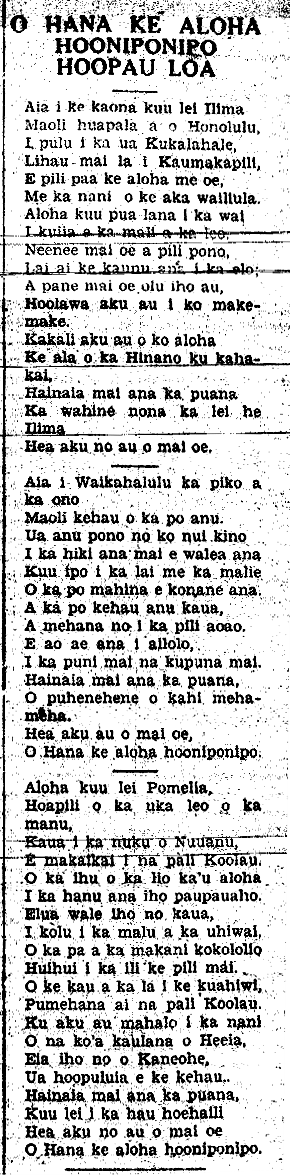
O HANA KE ALOHA HOONIPONIPO HOOPAU LOA

Aia i ke kaona kuu lei Ilima
Maoli huapala a o Honolulu,
I pulu i ka ua Kukalahale,
Lihau mai la i Kaumakapili,
E pili paa ke aloha me oe,
Me ka nani o ke aka wailiula.
Aloha kuu pua lana i ka wai
I kuiia e ka mali a ka leo,
Neenee mai oe a pili pono,
Lai ai ke kaunu ana i ka elo;
A pane mai oe olu iho au,
Hoolawa aku au i ko makemake.
Kakali aku au o ko aloha
Ke ala o ka Hinano ku kahakai,
Hainaia mai ana ka puana
Ka wahine nona ka lei he Ilima
Hea aku no au o mai oe.

———

Aia i Waikahalulu ka piko a ka ono
Maoli kehau o ka po anu
Ua anu pono no ko nui kino
I ka hiki ana mai e walea ana
Kuu ipo i ka lai me ka malie
O ka po mahina e konane ana
A ka po kehau anu kaua
A mehana no i ka pili aoao.
E ao ae ana i ailolo,
I ka puni mai na kupuna mai
Hainaia mai ana ka puana,
O puhenehene o kahi mehameha.
Hea aku au o mai oe,
O Hana ke aloha hooniponipo.

———

Aloha kuu lei Pomelia,
Hoapili o ka uka leo o ka manu,
Kaua i ka nuku o Nuuanu,
E makaikai i na pali Koolau
O ka ihu o ka lio ka’u aloha
I ka hanu ana iho paupauaho
Elua wale iho no kaua,
I kolu i ka malu a ka uhiwai
O ka pa a ka makani kokololio
Huihui i ka ili ke pili mai
O ke kau a ka la i ke kuahiwi,
Pumehana ai na pali Koolau
Ku aku au mahalo i ka nani
O na ko’a kaulana o Heeia.
Eia iho no o Kaneohe,
Ua hoopuluia e ke kehau
Hainaia mai ana ka puana,
Kuu lei i ka hau hoehaili
Hea aku no au o mai oe
O Hana ke aloha hooniponipo.

[Perhaps this printing of the three mele without any credit given is what caused the letter to the Editor from Mrs. Kaholopololei in the previous post.]

(Alakai o Hawaii 3/13/1930, p. 4)

AlakaioHawaii_3_13_1930_4.png

Ke Alakai o Hawaii, Buke 2, Helu 45, Aoao 4. Maraki 13, 1930.

Mele ownership, 1930.

LET THE TAKING OF OTHER PEOPLE’S MELE BE PUT TO AN END.

Mr. Jonah Kumalae,

Editor of Ke Alakai o Hawaii,

Aloha oe:—

I am Mrs. Kaholopololei, and I am resending to you a copy of these mele, with an explanation for the second time.

That is, do disseminate in the precious KE ALAKAI O HAWAII so that the people who love hula and who take the mele of others and bequeath it to whom they want will know.

Instruct them to stop this taking, for still living today is the one to whom the mele belong.

I and some women members of the Ahahui o na wahine Poola of the town of Honolulu, during the term when Mrs. Apoki Kauhini served as President, and Mrs. Holi Kealohahooniponipo Thornton was secretary of that Association.

Kanekoa was her husband, and Holi Thornton the other’s husband. Continue reading

Sweet Hilo mele by “Pilialoha,” 1914.

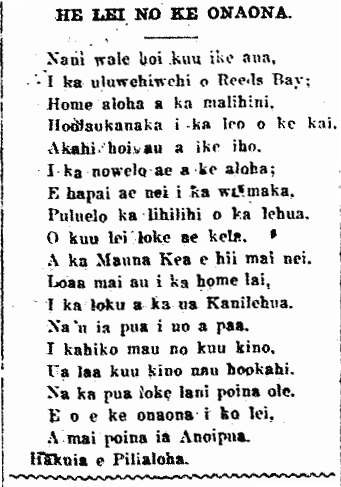
HE LEI NO KE ONAONA.

Nani wale hoi kuu ike ana,
I ka uluwehiwehi o Reeds Bay;
Home aloha a ka malihini,
Hoolaukanaka i ka leo o ke kai.
Akahi hoi au a ike iho,
I ka nowelo ae a ke aloha;
E hapai ae nei i ka waimaka,
Puluelo ka lihilihi o ka lehua.
O kuu lei loke ae kela,
A ka Mauna Kea e hii mai nei,
Loaa mai au i ka home lai,
I ka loku a ka ua Kanilehua.
Na’u ia pua i uo a paa,
I kahiko mau no kuu kino,
Ua laa kuu kino nau hookahi,
Na ka pua loke lani poina ole.
E o e ke onaona i ko lei,
A mai poina ia Anoipua.

Hakuia e Pilialoha.

(Kuokoa, 5/15/1914, p. 2)

Kuokoa_5_15_1914_2

Ka Nupepa Kuokoa, Buke LII, Helu 20, Aoao 2. Mei 15, 1914.

Kamehameha School for Boys’ 24th annual song contest, 1945.

[Found under: “News From Boys, Girls Kamehameha School”]

BOY’S SONG CONTEST

Kamehameha School for Boys will present its 24 annual song contest on March 4 at the school auditorium with the eighth and ninth graders competing in the junior division at the tenth, eleventh and twelfth grade boys in the senior division.

The eighth graders have as their choice song “Beautiful Kahana” and the ninth graders choice is “Ka Anoi.” The juniors have selected “Wai Lana” and the tenth grade boys a medley of “Kuu Lei Pikake,” “Lei Awapuhi” and “Roselani.” A medley of “Na Lei O Hawaii” and “Aloha Oe” is the seniors choice. Continue reading

A mele for Jack, the son of Tarzan, 1920.

HOOHENO NO JACK TAZANA.

Anoai ke aloha nou e Keaka,
Ka hanau kahi a Tazana:
Ka opu rose i mohala ae,
I kupu a ulu i Enelani.
Ua like a like me ka papa,
Ka lima wikani pukonakona:
Hoohihi li’aloko no Akuta,
Ike nae i ka aina malihini.
Pau ka manaolana no ka hoi mai,
E ike i ka nani a o ka makua:
Nau i olali hookahi aku,
Ia kula mehameha he kanaka ole.
Hookahi pailaka a o Akuta,
A loaa Miriama me ka enemi;
Aole i hopo iho hoi o Keaka,
Kaukani enemi ke ku mai.
Oniu ko pahi ma ka lima hema,
Olapa ka uwila i ka enemi:
Kokua Akuta me ka maalahi,
Ola ai ka nohona o ia aina.
Hu ae ke aloha no ka aina,
Me ka poli pumehana a o ka makua;
Haina ia mai ana ka puana,
Ka lima hei o ka oniu pahi.

JOHN H. MAMALA.

Ahukini Landing, Kauai.

[The Tarzan stories were extensively translated in the Hawaiian Language Newspapers!]

(Kuokoa, 2/13/1920, p. 4)

Kuokoa_2_13_1920_4

Ka Nupepa Kuokoa, Buke LVIII, Helu 7, Aoao 4. Feberuari 13, 1920.

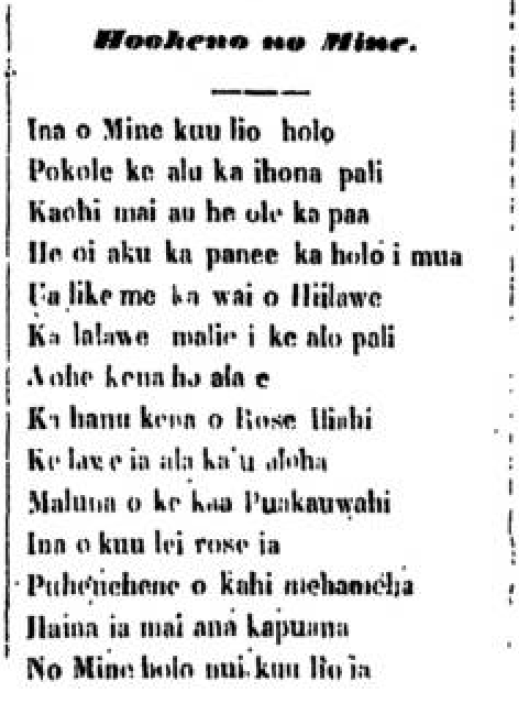
If Mine was my swift horse… 1893.

Hooheno no Mine.

Ina o Mine kuu lio holo
Pokole ke alu ka ihona pali
Kaohi mai au he ole ka paa
He oi aku ka panee ka holo i mua
Ua like me ka wai o Hiilawe
Ka lalawe malie i ke alo pali
Aohe kena he ala e
Ka hanu kena o Rose Iliahi
Ke lawe ia ala ka’u aloha
Maluna o ke kaa Puakauwahi
Ina o kuu lei rose ia
Puhenehene o kahi mehameha
Haina ia mai ana kapuana
No Mine holo nui kuu lio ia

[The line in Lena Machado’s “Holo Waapa” about Mine the fast-running horse was perhaps inspired by this mele. Does anyone know if there was a racehorse by this name?]

(Lei Momi, 7/26/1893, p. 3)

LeiMomi_7_26_1893_3

Ka Lei Momi, Buke I, Helu 29, Aoao 3. Iulai 26, 1893.