Still more on the Makee, the Malulani, and a reminder on naming, 1897.

[Found under: “ALL ALONG THE DOCKS”]

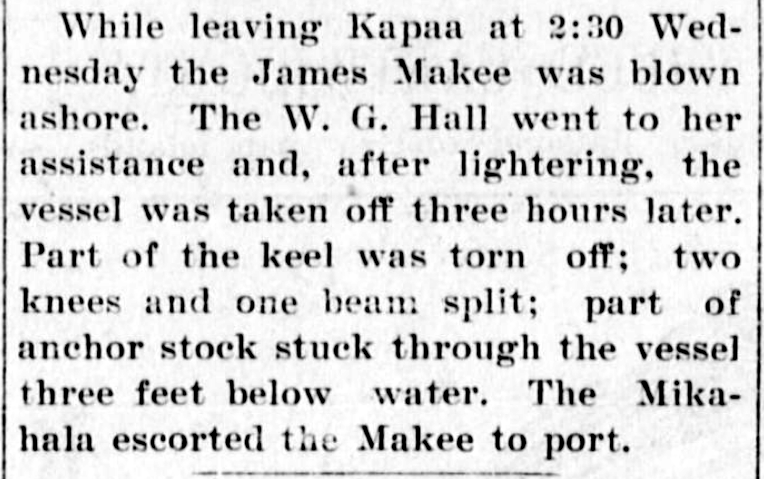
While leaving Kapaa at 2:30 Wednesday the James Makee was blown ashore. The W. G. Hall went to her assistance and, after lightering, the vessel was taken off three hours later. Part of the keel was torn off; two knees and one beam split; part of the anchor stock stuck through the vessel three feel below water. The Mikahala escorted the Makee to port.

[It is good to at least be aware that many times, Hawaiians called things (boat, for instance) a different name from what it was called in English. Here you see the W. G. Hall mentioned. It might sound more familiar to you as the Malulani.

Spelling is also varied in Hawaiian on occasion. You would expect in the Hawaiian-Language Newspapers, the James Makee to be written Kimo Maki (which it is at times), but it is also seen as Kimo Makee, James Maki, and James Makee as well! On a somewhat related note, Ena Road in Waikiki is not pronounced like “ena” as is so often heard today from the youngsters, but it is pronounced like “ina” and refers to the old-time Ing Family. So you will see in the Hawaiian-Language Newspapers, John Ena, John Ina, Keoni Ena, Keoni Ina…

I would like to see an easy online reference done for English/Hawaiian name variants done!]

(Hawaiian Star, 1/2/1897, p. 2)
While leaving Kapaa at 2:30...

The Hawaiian Star, Volume III, Number 1160, Page 2. January 2, 1897.

More on the Makee, 1897.

JAMES MAKEE AGROUND.

Accident to One of the Inter-Island Boats at Kapaa.

The James Makee met with a streak of misfortune on her last trip to Kauai. She was leaving Kapaa about 2:30 p. m. on Wednesday with 650 bags of sugar on board. The wind was blowing a perfect gale, and the Makee was blown upon the knuckle, sticking fast.

The W. G. Hall¹ came over from Koloa to the assistance of the Makee.

Capt. Peterson gave orders to have the sugar discharged. Something over 200 bags was put into the W. G. Hall and the rest was taken back to Kapaa.

The Makee had her stern lightened, and she swung around into deep water about 5 p. m. Five hours later she had all her cargo out, and she slid off with her keel very badly damaged.

The Makee left for Koloa at 8:30 a. m. on Thursday and arrived in Hanamaulu at 7:30 p. m. same day. Here she met the Mikahala and the two came to Honolulu together.

¹The W. G. Hall was also known as Malulani.

(Hawaiian Gazette, 1/5/1897, p. 5)

JAMES MAKEE AGROUND.

The Hawaiian Gazette, Volume XXXII, Number 2, Page 5. January 5, 1897.

Auhea iho nei la o Makee, A ka Malulani la e huli hele nei… 1897.

Kimo Maki Near Disaster.

Tuesday Night past, when the steamship James Makee was in Kapaa, Kauai, while the strong winds were blowing upon us and there as well, it was blown towards land while it attempted to head out to sea. It was stuck for two hours, and during this time, its cargo was unloaded, and the Malulani arrived to give assistance. Looking from the underside, it was seen that part of its keel [kila] was lost, two knees [kuli] and one beam [kua] at the stem were split, and there was a hole underneath, perhaps three feet below sea level at the base of the anchor. The Malulani accompanied it until arriving here in the morning of this past Friday. It will be placed atop the marine railway.

[I am guessing that this is the incident which inspired the famous composition still often heard today!]

(Makaainana, 1/4/1897, p. 8)

Kokoke e Poino ke Kimo Maki.

Ka Makaainana, Buke VII, Ano Hou—Helu 1. Aoao 8. Ianuari 4, 1897.

Two mele for Liliu and her garden, Uluhaimalama, 1894.

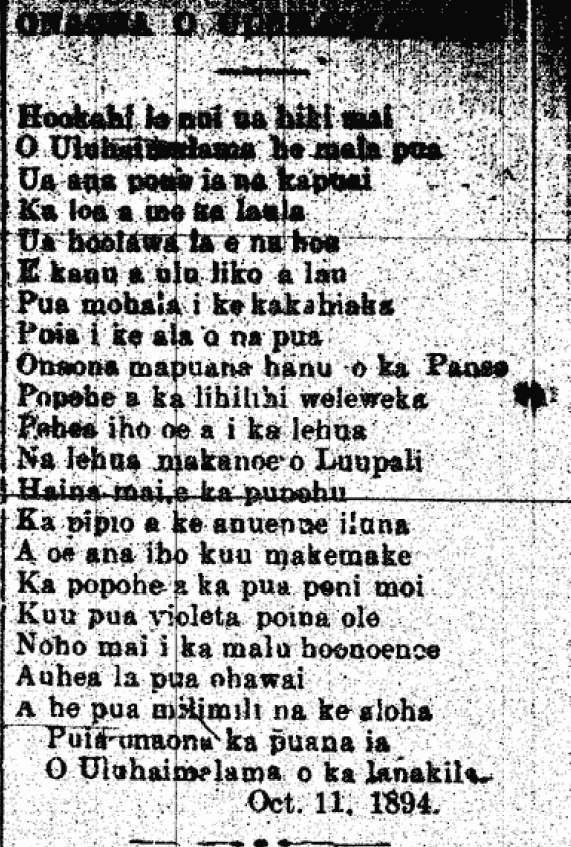
ONAONA O ULUHAIMALAMA.

Hookahi la nui ua hiki mai
O Uluhaimalama he mala pua
Ua ana pono ia na kapuai
Ka loa a me ka laula
Ua hoolawa ia e na hoa
E kanu a ulu liko a lau
Pua mohala i ke kakahiaka
Puia i ke ala o na pua
Onaona mapuana hanu o ka Panse
Popohe a ka lihilihi weleweka
Pehea iho oe a i ka lehua
Na lehua makanoe o Luupali
Haina mai e ka punohu
Ka pipio a ke anuenue iluna
A oe ana iho kuu makemake
Ka popohe a ka pua poni moi
Kuu pua violeta poina ole
Noho mai i ka malu hoonoenoe
Auhea la pua ohawai
A he pua milimili na ke aloha
Puia onaona ka puana ia
O Uluhaimalama o ka lanakila.

Oct. 11, 1894.

(Leo o ka Lahui, 10/16/1894, p. 2)

ONAONA O ULUHAIMALAMA.

Ka Leo o ka Lahui, Buke II, Helu 1050, Aoao 2. Okatoba 16, 1894.

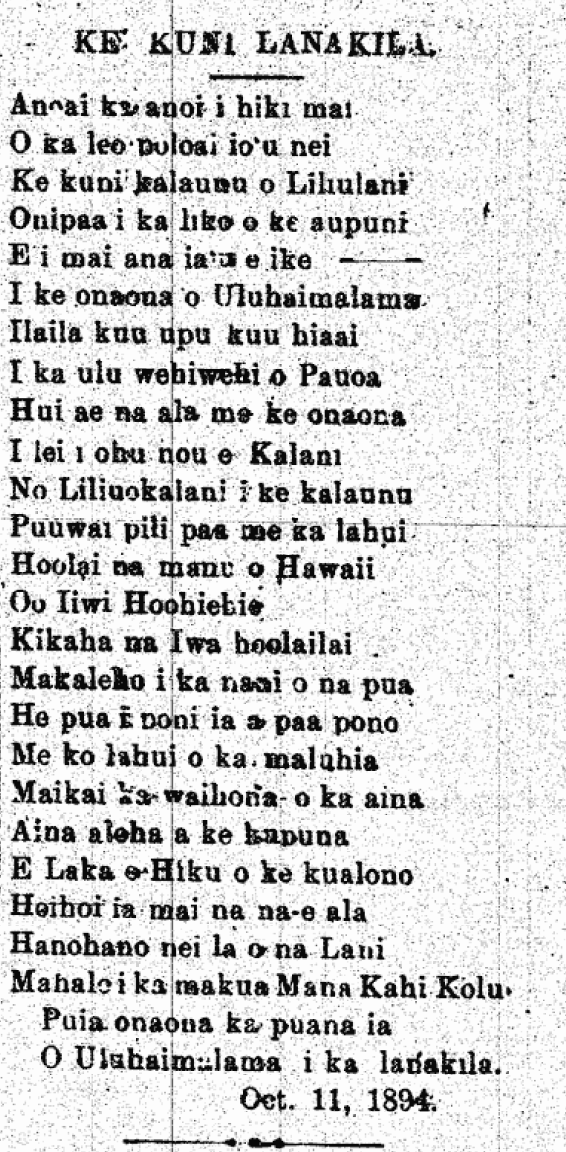
KE KUNI LANAKILA.

Anoai ka anoi i hiki mai
O ka leo poloai io’u nei
Ke kuni kalaunu o Liliulani
Onipaa i ka liko o ke aupuni
E i mai ana ia’u e ike
I ke onaona o Uluhaimalama
Ilaila kuu upu kuu hiaai
I ka ulu wehiwehi o Pauoa
Hui ae na ala me ke onaona
I lei i ohu nou e Kalani
No Liliuokalani i ke kalaunu
Puuwai pili paa me ka lahui
Hoolai na manu o Hawaii
Oo Iiwi Hoohiehie
Kikaha na Iwa hoolailai
Makaleho i ka nani o na pua
He pua i poni ia a paa pono
Me ko lahui o ka maluhia
Maikai ka waihona o ka aina
Aina aloha a ke kupuna
E Laka e Hiku o ke kualono
Hoihoi ia mai na na-e ala
Hanohano nei la o na Lani
Mahalo i ka makua Mana Kahi Kolu
Puia onaona ka puana ia
O Uluhaimalama i ka lanakila

Oct. 11, 1894.

(Leo o ka Lahui, 10/16/1894, p. 2)

KE KUNI LANAKILA.

Ka Leo o ka Lahui, Buke II, Helu 1050, Aoao 2. Okatoba 16, 1894.

English Song for the Restoration of the Kingdom, 1893.

[The Hawaiian Historical Society, on their Facebook page, posted this awesome image of the English lyrics of the “Restoration Anthem,” which it seems was sung at the luau given by Kamehameha III at Luakaha!]

Restoration Anthem.

Tune. God save the King

Hail! to our rightful king!
We joyful honor bring,
This day to thee!
Long live your Majesty!
Long reign thou dynasty!
And for posterity,
The sceptre be

Hail! to the worthy name!
Worthy his country’s fame!
Thomas, the brave!
Long shall they virtues be,
Shrined in our memory
Who came to set us free
Quick oe’r the wave!

Hail! to our Heavenly King!
To thee our thanks we bring,
Worthy of all.
Loud, we thine honors raise!
Loud, is our song of praise!
Smile on our future days,
Sovereign of all.

July 31, 1843

Sung at the great cold water luau given by H.H.M. Kamehameha III, in Nuuanu to several thousands of natives and all the Foreigners including the officers of 4 ships of war. For which Admiral Thomas thanked the ladies and gent who did him the honor.

[unclear phrase]  August 20, 1843

Song for the Restoration of the Kingdom, 1843.

MELE HOI HOU ANA.

(Leo, ‘E Ola ke Alii i ke Akua.’)

1.  E ko makou alii!
Mahalo ‘ka moi,
I keia la!
E mau kou ola nei!
E mau kou aupuni!
No na hanauna hoi,
I oni paa.

2.  Nani! ka inoa maikai!
Me kona aina nae!
Toma ke koa!
Mahalo ‘kou maikai,
Kou wikiwiki mai!
Maluna o ke kai,
E kuu ‘na pau!

3.  Hiilani i ke Lii!
Iehova ka Moi,
E hapai no;
Nui ke kupinai!
Nui ke mele nae!
I mau ka pomaikai
Ia oe no.

Honolulu, Oahu, Iulai 31, 1843.

(Nonanona, 9/5/1843, p. 44)

MELE HOI HOU ANA.

Ka Nonanona, Buke 3, Pepa 8, Aoao 44. Sepatemaba 5, 1843.

Columbia Records in Hawaii, 1911.

TO RECORD HAWAIIAN SINGING.

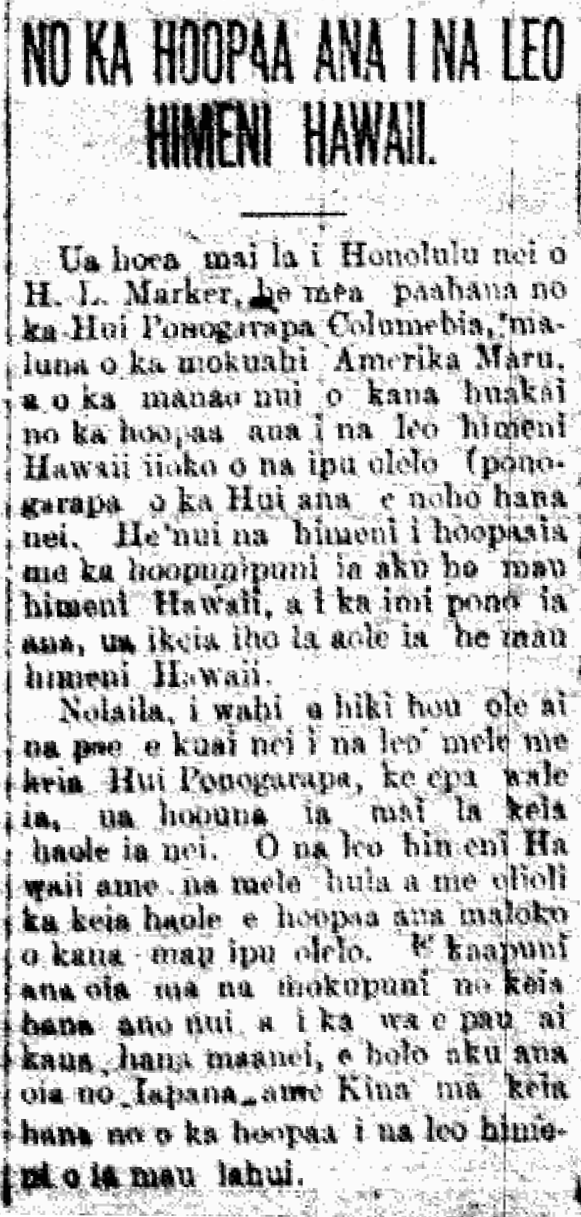
H. L. Marker, an employee of the Columbia Phonograph Company, arrived aboard the steamship Amerika Maru, and the main reason for his trip is to record Hawaiian singing in a horn [ipu leo] of the Company for which he works. There have been many a fake recording of Hawaiian songs, and after a close check, it was found that they weren’t Hawaiian songs.

Therefore, so as no more people purchasing music from this Phonograph Company will be deceived, that haole was sent here. Hawaiian songs and hula songs and chanting is what this haole will be recording in his horns. He will be travelling around the islands to accomplish this great effort, and when his work here is done, he will be going to Japan and China to do this job of recording songs of those people.

(Aloha Aina, 6/24/1911, p. 1)

NO KA HOOPAA ANA I NA LEO HIMENI HAWAII.

Ke Aloha Aina, Buke XVI, Helu 25, Aoao 1. Iune 24, 1911.

Kuu Aina Hanau E. 1871.

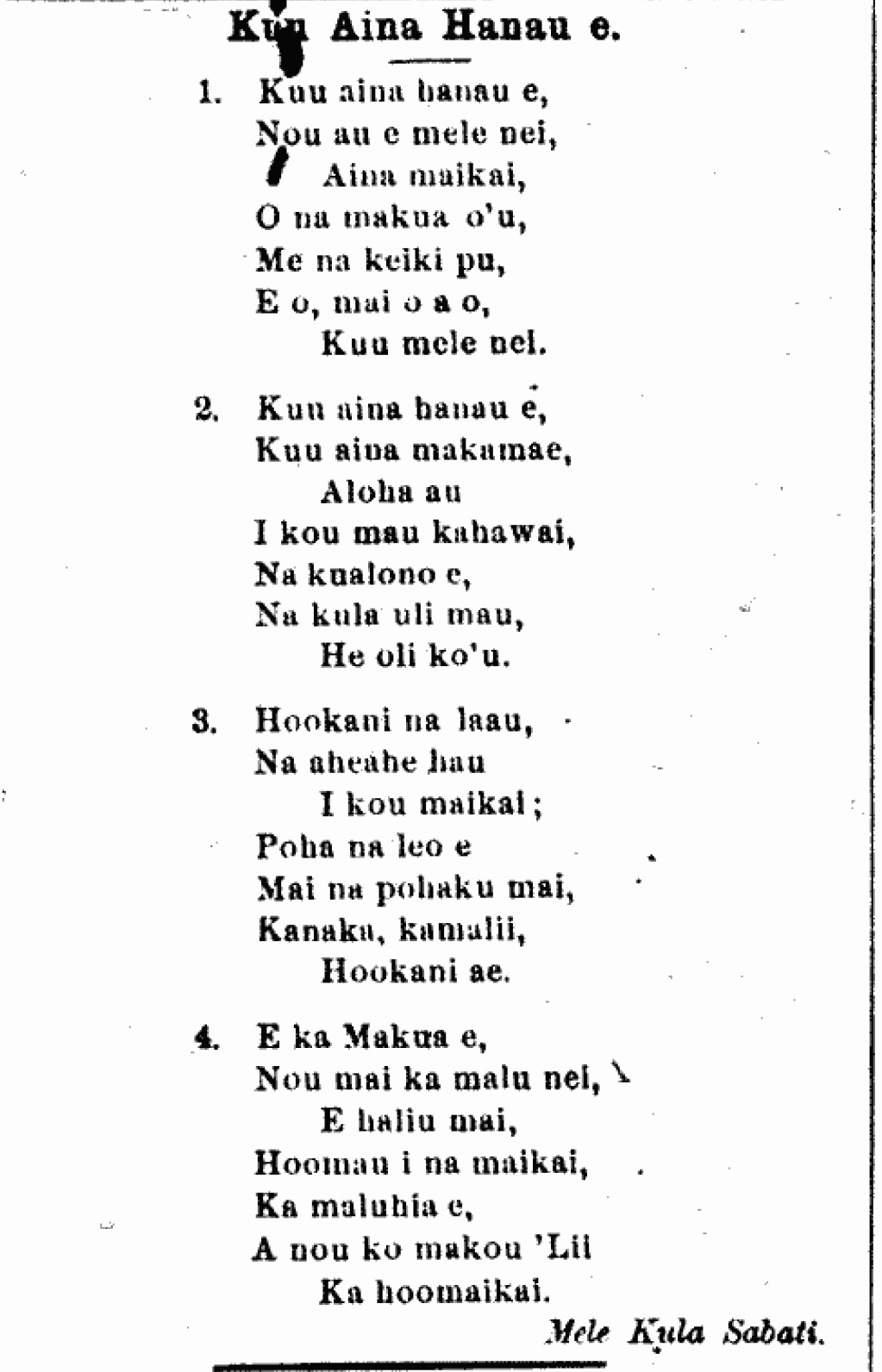
Kuu Aina Hanau e.

1. Kuu aina hanau e,
Nou au e mele nei,
Aina maikai,
O na makua o’u,
Me na keiki pu,
E o, mai o a o,
Kuu mele nei.

2. Kuu aina hanau e,
Kuu aina makamae,
Aloha au
I kou mau kahawai,
Na kualono e,
Na kula uli mau,
He oli ko’u.

3. Hookani na laau,
Na aheahe hau
I kou maikai;
Poha na leo e
Mai na pohaku mai,
Kanaka, kamalii,
Hookani ae.

4. E ka Makua e,
Nou mai ka malu nei,
E haliu mai,
Hoomau i na maikai,
Ka maluhia e,
A nou ko makou ‘Lii
Ka hoomaikai.

Mele Kula Sabati.

My Dear Land of Birth.

1. My dear land of birth,
For thee I sing,
Beautiful land,
Of my parents,
And my children,
Respond from far and wide
To my song.

2. My dear land of birth,
My cherished land,
I love
Your rivers,
The mountain ridges,
The ever-green plains,
I am jubilant.

3. The trees sound forth,
The gentle cool breezes
Of your splendor;
The voices boom
From the rocks,
Men, children,
Sounding forth.

4. O Father,
From whom comes our protection,
Look down upon us,
Let the goodness continue,
The peace,
And for you, our King
Is the praise.

Sunday School Song.

[This is the song sung at the opening of the first meeting of the Kona chapter of the Kaahumanu Society held on  March 30, 1913. It is one of the many compositions of Lorenzo Lyons. The song was sung to the tune of “My Country ‘Tis of Thee,” and it seems some of the sentiment was taken from its lyrics as well.]

(Lau Oliva, 2/1871, p. 1)

Kuu Aina Hanau e.

Ka Lau Oliva, Buke I, Helu 2, Aoao 1. Feberuari, 1871.

Lei o Kaahumanu, 1916.

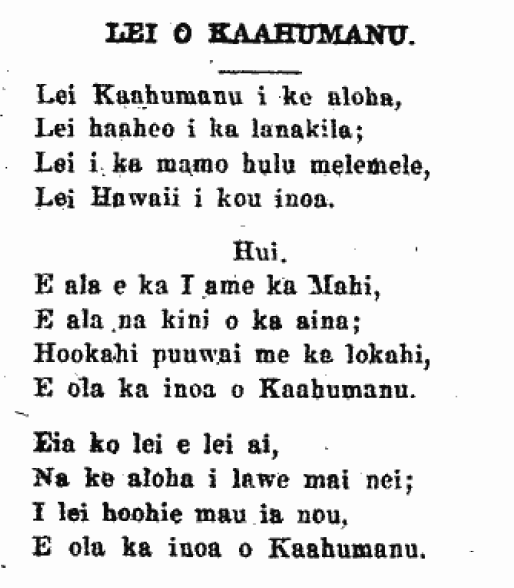
LEI O KAAHUMANU.

Lei Kaahumanu i ke aloha,
Lei haaheo i ka lanakila;
Lei i ka mamo hulu melemele,
Lei Hawaii i kou inoa.

Hui:

E ala e ka I ame ka Mahi,
E ala na kini o ka aina;
Hookahi puuwai me ka lokahi,
E ola ka inoa o Kaahumanu.

Eia ko lei e lei ai,
Na ke aloha i lawe mai nei;
I lei hoohie mau ia nou,
E ola ka inoa o Kaahumanu.

LEI OF KAAHUMANU.

Kaahumanu is adorned with a lei of aloha,
A proud lei in victory;
Adorned with the yellow-feathered mamo,
Hawaii is adorned by your name.

Chorus:

Rise, O I and Mahi,
Rise, O People of the land;
With one heart and in unity,
May the name of Kaahumanu live.

Here is the lei for you to wear,
Carried here by aloha;
It is an ever distinguished lei for you,
May the name of Kaahumanu live.

(Kuokoa, 12/29/1916, p. 2)

LEI O KAAHUMANU.

Ka Nupepa Kuokoa, Buke LIV, Helu 52, Aoao 2. Dekemaba 29, 1916.

Mele for the birthplace of alii, Kukanikolo, 1925.

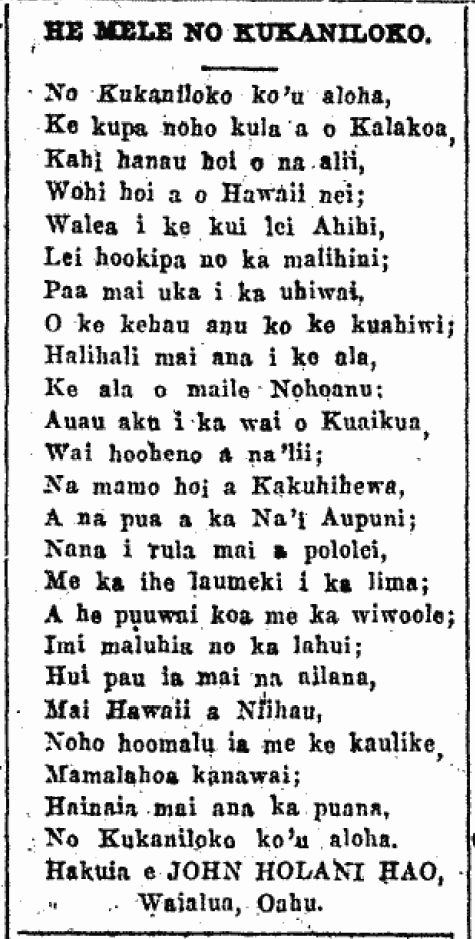
HE MELE NO KUKANILOKO.

No Kukaniloko ko’u aloha,
Ke kupa noho kula a o Kalakoa,
Kahi hanau hoi o na alii,
Wohi hoi a o Hawaii nei;
Walea i ke kui lei Ahihi,
Lei hookipa no ka malihini;
Paa mai uka i ka uhiwai,
O ke kehau anu ko ke kuahiwi;
Halihali mai ana i ke ala,
Ke ala o maile Nohoanu;
Auau aku i ka wai o Kuaikua,
Wai hooheno a na’lii;
Na mamo hoi a Kakuhihewa,
A na pua a ka Na’i Aupuni;
Nana i rula mai a pololei,
Me ka ihe laumeki i ka lima;
A he puuwai koa me ka wiwoole;
Imi maluhia no ka lahui;
Hui pau ia mai na ailana,
Mai Hawaii a Niihau,
Noho hoomalu ia me ke kaulike,
Mamalahoa kanawai;
Hainaia mai ana ka puana,
No Kukaniloko ko’u aloha.

Hakuia e JOHN HOLANI HAO,
Waialua, Oahu.

HE MELE NO KUKANILOKO.

For Kukaniloko is my aloha,
Native dwelling on the plains of Kalakoa,
Birthplace of the alii,
Wohi chiefs of Hawaii nei;
Taking pleasure in stringing lei of Ahihi,
A lei of welcome for the visitor;
The uplands are covered by fog,
The cold mist of the mountains;
Carrying along the scent,
The fragrance of maile in the cold;
Bathing in the waters of Kuaikua,
Cherished waters of the alii;
The descendants of Kakuhihewa,
And progeny of the Conqueror of the Nation;
Who ruled with righteousness,
With barbed spear in hand;
And a brave and fearless heart;
In pursuit of peace for the people;
Completely joining the islands,
From Hawaii to Niihau,
Living in peace with equality,
The law of Mamalahoa;
Let the refrain be told,
For Kukaniloko is my aloha.

Composed by JOHN HOLANI HAO,
Waialua, Oahu.

(Kuokoa, 5/28/1925, p. 7.)

HE MELE NO KUKANILOKO.

Ka Nupepa Kuokoa, Buke LXIV, Helu 22, Aoao 7. Mei 28, 1925.