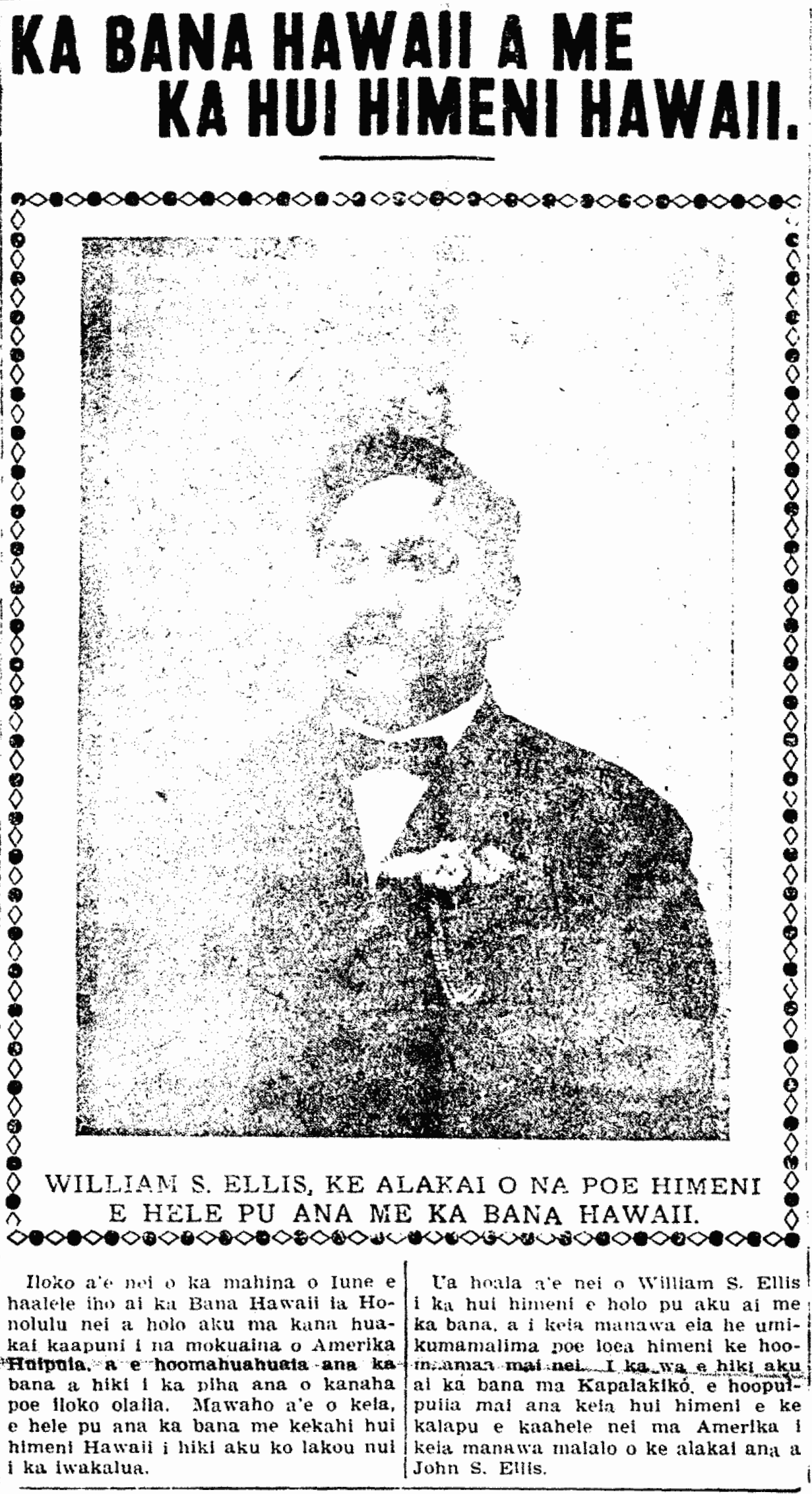
William S. Ellis, leader of the glee club accompanying the Royal Hawaiian Band on tour, 1906.

THE ROYAL HAWAIIAN BAND AND THE HAWAIIAN GLEE CLUB.

WILLIAM S. ELLIS, THE LEADER OF THE SINGERS THAT ARE TRAVELLING WITH THE ROYAL HAWAIIAN BAND.

In the month of June, the Royal Hawaiian Band is leaving Honolulu and going on their tour of the states of the United States of America, and their number will increase until it includes forty people. Other than that, the band will go with a Hawaiian glee club that is made up of twenty people.

William S. Ellis formed the glee club going along with the band, and currently there are fifteen skilled singers who are practicing. When the band arrives in San Francisco, this glee club will be increased by the club that is touring America under the leadership of John S. Ellis.

(Kuokoa, 3/9/1906, p. 1)

KA BANA HAWAII A ME KA HUI HIMENI HAWAII.

Ka Nupepa Kuokoa, Buke XLIV, Helu 10, Aoao 1. Maraki 9, 1906.

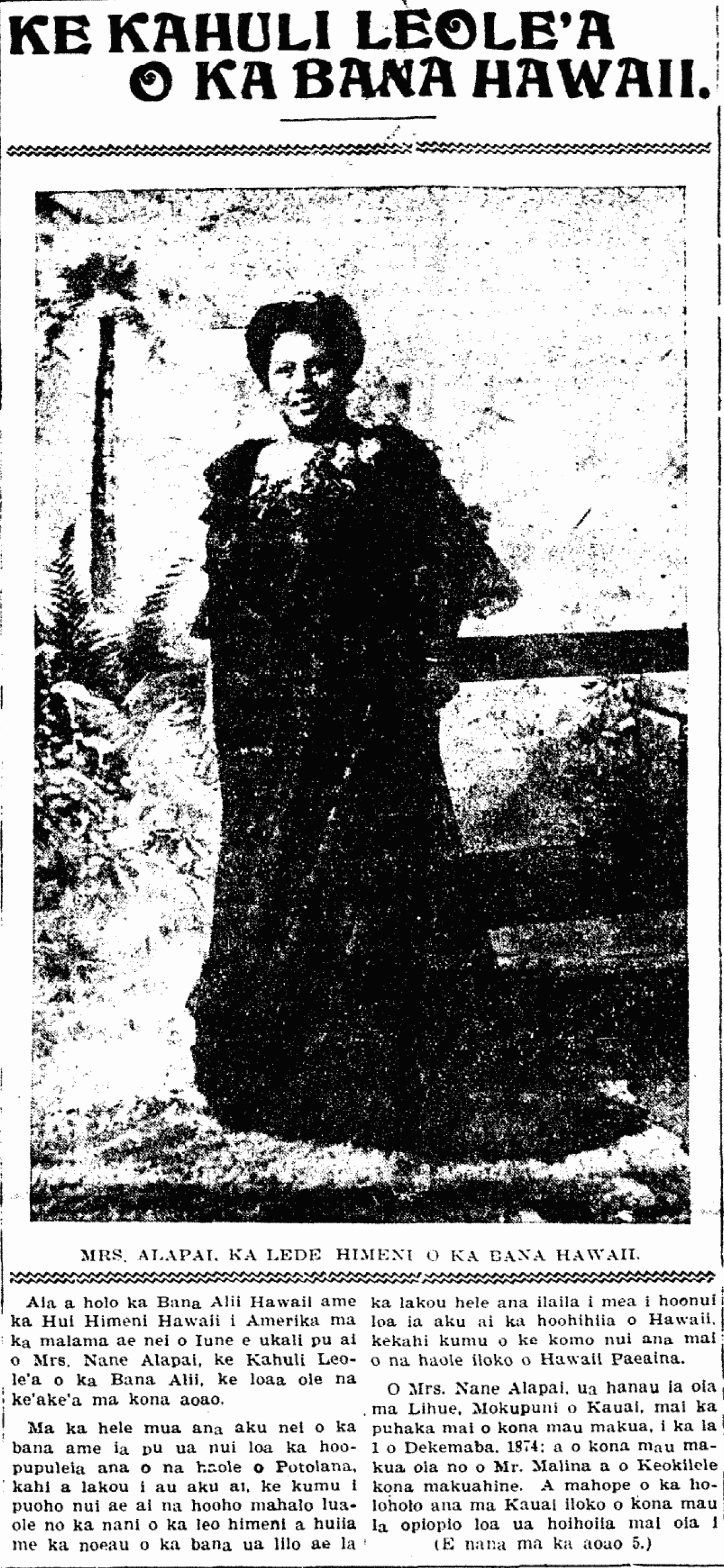
Nane Alapai, 1906.

THE HAPPY-VOICED KAHULI OF THE HAWAIIAN BAND

When the Royal Hawaiian Band and the Hawaiian Glee Club leaves for America in the next month of June, Mrs. Nane Alapai [Nani Alapai], the Beautiful-Voiced Kahuli of the Hawaiian Band will accompany them, should there be no obstructions in her way.

When the band first went with her along, the haole of Portland, where they travelled to, were driven crazy, and that is the reason that there was unequaled exclaim for the beauty of of the singing along with the skill of the band; and their travelling there caused a great interest in Hawaii, which is why there is a great influx in the number of haole coming to the Hawaiian Islands.

Mrs. Nane Alapai [Nani Alapai], was born in Lihue, on the island of Kauai, from the loins of her parents, on the 1st of December, 1874; her parents are Mr. Malina and Keokilele is her mother. And after going around Kauai during her youth, she was taken…

(Kuokoa, 3/16/1906, p. 1)

KE KAHULI LEOLE'A O KA BANA HAWAII.

Ka Nupepa Kuokoa, Buke XLIV, Helu 11, Aoao 1. Maraki 16, 1906.

to Honolulu, where she was educated at the Catholic Boarding School for Girls. She married her husband, Mr. W. J. Alapai almost eleven years ago. She has some siblings other than her; five brothers and eight sisters.

When she joined the Royal Hawaiian Band until today, she spent nine years singing before an audience, and during that whole time, her singing has brought much delight in Hawaii’s people and more so in the malihini who come to Hawaii and then go to America; they are so much more delighted; and this is very valuable to Hawaii and to her herself, and this advertises Hawaii’s beauty; the beauty of her ridges, the beauty of her mountains, and the beauty of the songs of her people; it seems there will be a lot of Hawaiian singer born as a result.

(Kuokoa, 3/16/1906, p. 5)

KE KAHULI LEOLE'A O KA BANA HAWAII.

Ka Nupepa Kuokoa, Buke XLIV, Helu 11, Aoao 5. Maraki 16, 1906.

Royal Hawaiian Band on major tour, 1906.

THE HAWAIIAN BAND HAS LEFT

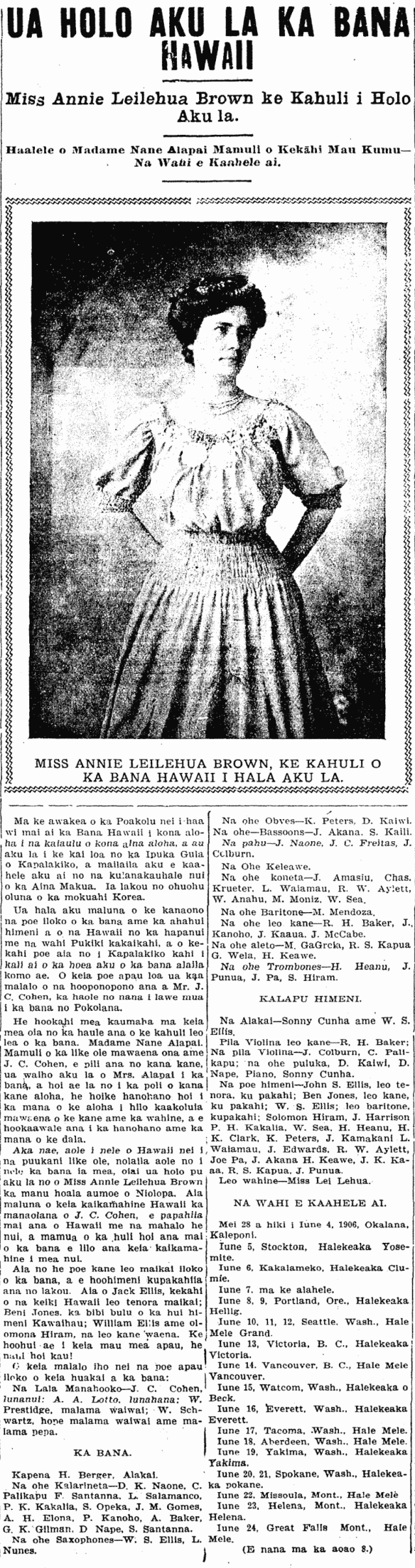
Miss Annie Leilehua Brown is the Kahuli¹ that has Left.

Madame Nane [Nani] Alapai Pulled Out Over Some Issues—The Places They Will Visit.

MISS ANNIE LEILEHUA BROWN, THE KAHULI OF THE HAWAIIAN BAND WHO HAS LEFT.

On the evening of this past Wednesday, the Royal Hawaiian Band gave their aloha to the communities of their beloved land, and travelled across the wide ocean to the Golden Gate [Ipuka Gula] of San Francisco, and from there they will travel the major cities of the Father Land. They made the deck of the Steamer Korea adorned with them.

There were sixty people on there of the band and glee club, and the majority are Hawaiian, with a few Portuguese; and some people are waiting in San Francisco to join up with the band there. All of them are under the management of Mr. J. C. Cohen, the haole who took the band earlier to Portland [Pokolana].

There is one sad thing, and that is the dropping of the sweet-voiced singer of the band, Madame Nane [Nani] Alapai. Due to a differences between her and J. C. Cohen about her husband, Mrs. Alapai has left the band, and returned to the bosom of her beloved husband; this is a noble example of the power of aloha that is triply bound betwixt a man and his wife; and she will abandon the prestige and power of money.

Hawaii however does not lack in all sorts of singers, so that band is not missing a singer being that they were accompanied by Miss Annie Leilehua Brown, the bird that enlivens the nights of Niolopa. Upon this Hawaiian girl lies the hopes of J. C. Cohen that Hawaii will be lauded with much praise, and that before the band returns home, this girl will become something big.

There are men in that band with beautiful voices, and they will be made to sing solos. There is Jack Ellis, one of Hawaii’s fine tenors; Beni Jones, the bull of the Kawaihau Glee Club; William Ellis and Solomon Hiram, the baritones. When they are all singing together, it is just so beautiful!

These below are all of the people in this tour of the band:

Executive Staff—J. C. Cohen, general manager [lunanui]; A. A. Lotto, business representative [lunahana]; W. Prestidge, master of properties [malama waiwai]; W. Schwartz, assistant master of properties [hope malama waiwai] and librarian [malama pepa].

THE BAND.

Captain H. Berger, Director.

Clarinets—D. K. Naone, C. Palikapu, F. Santanna, L. Salamanco, P. K. Kakalia, S. Opeka, J. M. Gomes, A. H. Elona, P. Kanoho, A. Baker, G. K. Gilman, D. Nape, S. Santanna.

Saxophones—W. S. Ellis, L. Nunes.

Oboes—K. Peters, D. Kaiwi.

Drums—J. Naone, J. C. Freitas, J. Colburn.

The Brass Section.

Cornets—J. Amasiu, Charles Krueter, L. Waiamau, R. W. Aylett, W. Anahu, M. Moniz, W. Sea.

Baritone Horn—M. Mendoza.

Tubas—R. H. Baker, J. Kanoho, J. Kaaua, J. McCabe.

Alto Horns—M. Garcia, R. S. Kapua, G. Wela, H. Keawe.

Trombones—H. Heanu, J. Punua, J. Pa, S. Hiram.

GLEE CLUB.

Directors—Sonny Cunha and W. S. Ellis.

Double bass—R. H. Baker; Violinists—J. Colburn, C. Palikapu; flutists, D. Kaiwi, D. Nape; Piano, Sonny Cunha.

Singers—John S. Ellis, tenor, soloist; Ben Jones, bass, soloist; W. S. Ellis, baritone, soloist; Solomon Hiram, J. Harrison, P. H. Kakalia, W. Sea, H. Heanu, H. K. Clark, K. Peters, J. Kamakani, L. Waiamau, J. Edwards, R. W. Aylett, Joe Pa, J. Akana, H. Keawe, J. K. Kaaa, R. S. Kapua, J. Punua.

Female singer—Miss Lei Lehua [Leilehua]

THE PLACES THEY WILL TRAVEL.

May 28 to June 4, 1906, Oakland, California.
June 5, Stockton, Yosemite Theater.
June 6, Sacramento, Clumie Theater.
June 7, on the road.
June 8, 9, Portland, Oregon, Hellig Theater.
June 10, 11, 12, Seattle, Washington, Grand Music House.
June 13, Victoria, British Columbia, Victoria Theater.
June 14, Vancouver, B. C., Vancouver Music House.
June 15, Watcom, Washington, Beck Theater.
June 16, Everett, Washington, Everett Theater.
June 17, Tacoma, Washington, Music House.
June 18, Aberdeen, Washington, Music House.
June 19, Yakima, Washington, Yakima Theater.
June 20, 21, Spokane, Washington, Spokane Theater.
June 22, Missoula, Montana, Music House.
June 23, Helena, Montana, Helena Theater.
June 24, Great Falls, Montana, Music House.

¹Kahuli are the famous singing land shells which are often used to describe sweet-voiced singers.

(Kuokoa, 5/25/1906, p. 1)
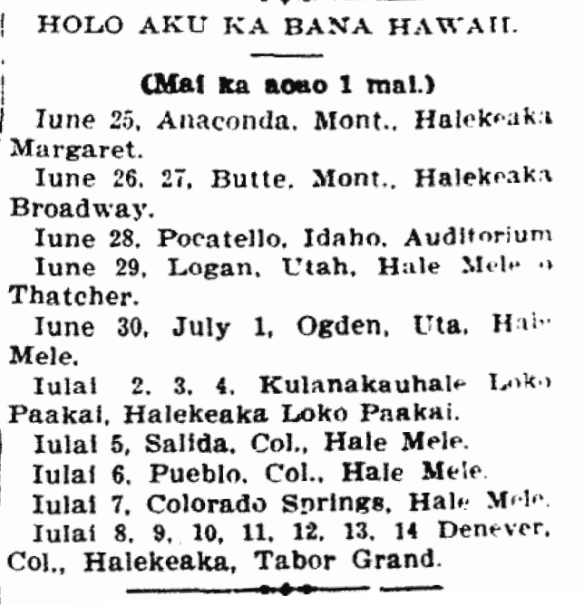
UA HOLO AKU LA KA BANA HAWAII

Ka Nupepa Kuokoa, Buke XLIV, Helu 21, Aoao 1. Mei 25, 1906.

June 25, Anaconda, Montana, Margaret Theater.
June 26, Butte, Montana, Broadway Theater.
June 28, Pocatello, Idaho, Auditorium.
June 29, Logan, Utah, Thatcher Music House.
June 30, July 1, Ogden, Utah, Music House.
July 2, 3, 4, Salt Lake City, Salt Lake Theater.
July 5, Salida, Colorado, Music House.
July 6, Pueblo, Colorado, Music House.
July 7, Colorado Springs, Music House.
July 8, 9, 10, 11, 12, 13, 14, Denver, Colorado, Tabor Grand Theater.

(Kuokoa, 5/25/1906, p. 8)
HOLO AKU KA BANA HAWAII.

Ka Nupepa Kuokoa, Buke XLIV, Helu 21, Aoao 8. Mei 25, 1906.

Kamehameha Schools Song Contest, yesterday and today, 1944 / 2014.

[Found under: “News From Boys, Girls Kamehameha School”]

By HARRIETTE HURLEY

People who enjoy Hawaiian music have expressed the desire to know the meanings of the Hawaiian songs. Translations of the two prize songs to be used in the Kamehameha School for Girls’ song contest to be held on February 13, appear below.

Mrs Mary Kawena Pukui, translator at the Bishop Museum and director of Hawaiian activities at the Kamehameha Preparatory School, has translated the songs.

The junior division prize song is Pa’au’au Waltz. Selected for the senior division prize song is Lei Awapuhi.

Translation of Lei Awapuhi

I hear the voice of a loved one say
Let me pluck and wear the flower
To string a lei for my leaf bud to wear
My love was strongly attracted
To the choicest flower that ever bloomed
Let me, darling, string it into a lei,
O let your ginger lei be mine. Continue reading

Nipper and Hawaiian Music, 1917.

Victor
“HIS MASTER’S VOICE”
REG. U.S. PAT OFF

To insure Victor quality, always look for the famous trademark, “His Master’s Voice.” It is on every Victrola and every Victor Record. It is the identifying label on all genuine Victrolas and Victor Records.

All the fascination of Hawaiian music is in these Victor Records

There is a quaint and dreamy beauty to the music of Hawaii as it comes like the whispering breeze from the mid-Pacific. It breathes the lightsome spirit of this land of sunshine. Its laguorous rhythm is typical of Hawaiian life, of the swaying trees, the beating surf, of the joys and sorrow of this interesting music-loving people.

And all the enchantment of Hawaiian music, all the charms of their quaint instruments, all the peculiar beauties of their light voices are brought to you on Victor Records. You are in fancy transported to these far-off islands.

18132 10 in. 75c
On the Beach at Waikiki—Medley Hula (with Ukulele and Guitar by Louise and Ferera) Horace Wright-Rene Dietrich
My Luau Girl (with Ukulele and Guitar by Louise and Ferera) Horace Wright-Rene Dietrich

17701 10 in. 75c
Hawaiian Waltz Medley (Guitar Duet) Lua and Kaili
Kilima Waltz (Guitar Duet) Lua and Kaili

65344 10 in. 75c
My Honolulu Hula Girl In English and Hawaiian (with Quintette) E. K. Rose
One—Two—Three—Four In English Hawaiian Quintette

65348 10 in. 75c
Aloha Oe (Farewell to Thee) (Liliuokalani) Hawaiian Quintette
Kuu Home—Native Plantation Song (with Quintette) S. M. Kaiawe

17710 10 in. 75c
Honolulu March (Guitar Duet) Pale K. Lua-David Kaili
Kohala March (Guitar Duet) Pale K. Lua-David Kaili

17767 10 in. 75c
Hilo—Hawaiian March Irene West Royal Hawaiians
Wailana Waltz Irene West Royal Hawaiians

Hear this fascinating Hawaiian music today at any Victor dealer’s. He will gladly give you a copy of the special Victor catalog of Hawaiian Records, and play any music you wish to hear. And he will demonstrate the various styles of Victor and Victrola—$10 to $400.

Victor Talking Machine Co., Camden, N. J.

Important Notice. All Victor Talking Machines are patented and are only licensed, and with right of use with Victor Records only. All Victor Records are patented and are only licensed, and with right of use on Victor Talking Machines only. Victor Records and Victor Machines are scientifically coordinated and synchronized by our special process of manufacture; and their use except with each other, is not only unauthorized, but damaging and unsatisfactory.

New Victor Records demonstrated at all dealers on the 28th of each month.

Victrola

“Victrola” is the Registered Trade-mark of the Victor Talking Machine Company designating the products of this Company only.

Warning: The use of the word Victrola upon or in the promotion or sale of any other Talking Machine or Phonograph products is misleading and illegal.

[It is interesting to note that many of these records can still be heard today (although well worn) on Youtube!]

(Bismarck Tribune, 2/20/1917, p. 2)

Victor

The Bismarck Tribune, Twenty-Seventh Year, Number 43, Page 2. February 20, 1917.

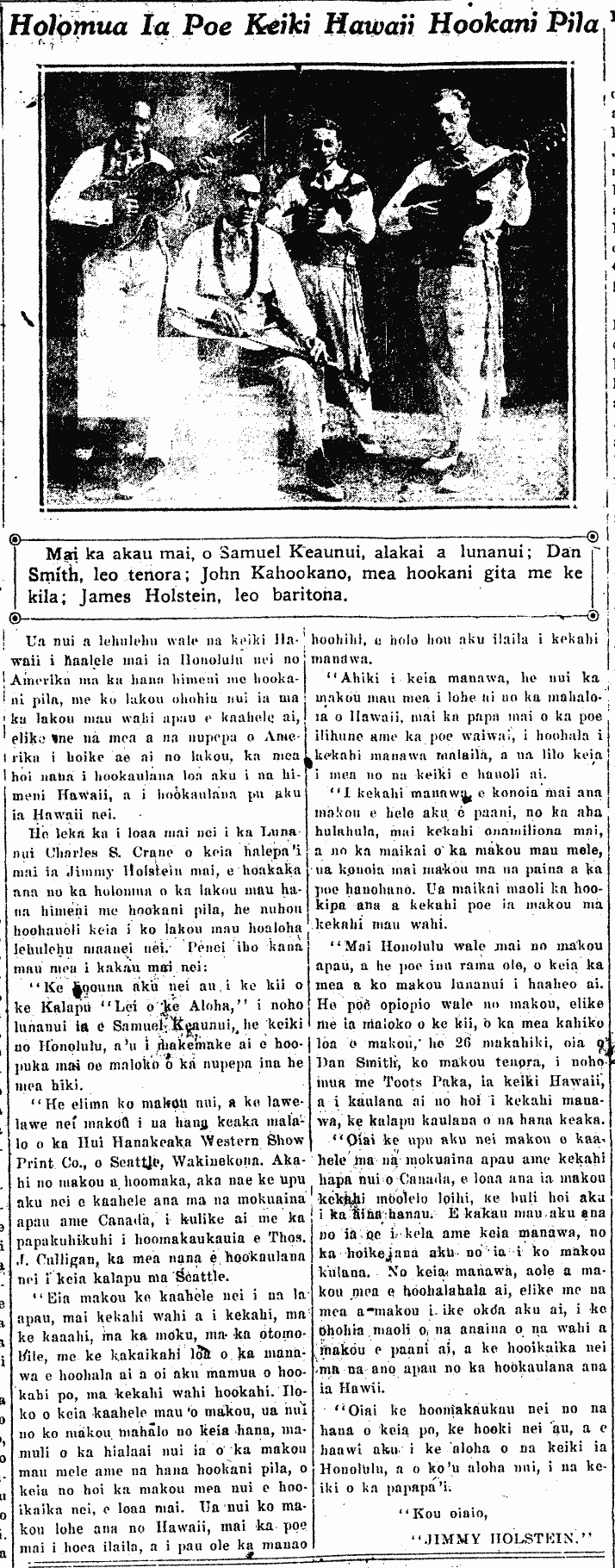
“Lei o ke Aloha” band making music abroad, 1919.

Hawaiian Musician Boys Making Progress

From the right, Samuel Keaunui, leader and manager; Dan Smith, tenor; John Kahookano, guitarist and steel guitarist; James Holstein, baritone.

There are a great and many Hawaiian youths that have left Honolulu to go to America to sing and play music, with much acclaim everywhere they have travelled, like what has been reported about them in newspapers in America, which makes Hawaiian music famous, and makes Hawaii nei famous as well.

There has been a letter received by the Editor of this press, Charles S. Crane, from Jimmy Holstein, explaining the progress made in their singing and music; this is happy news for their many friends here. Here is what he had to say:

“I am sending a picture of the Club “Lei o ke Aloha,” managed by Samuel Keaunui, a boy from Honolulu, that I want you to print in the newspaper if possible.

“We are comprised of five members, and are acting under the Acting Company, Western Show Print Co., of Seattle, Washington. We have just began, but we hope that we will travel all the states as well as Canada, as per the itinerary prepared by Thomas J. Culligan, the one making this club famous in Seattle.

“Currently we are moving from one place to another everyday, aboard trains, ships, automobiles, hardly ever spending more than a night in one place. While constantly travelling, we have much appreciation for this work because of the great delight received from our singing and music; and this is what we strive to attain. We hear much of Hawaii from those who went there and whose desire never ends to go there once again.

“Until now, we hear much of the admiration for Hawaii from the fathers of the poor and the rich, who spent some time there, and this has become something that the Hawaiian boys enjoy.

“Once we were invited to play for a ball, by a millionaire, and because of our find singing, we were invited to parties of prestigious people. The hospitality we received from various people in certain places has been great.

“We are all from Honolulu, and are not drinkers, and this is something which our leader is proud of. We are but youngsters, as seen in the picture; the oldest of us is 26, that being Dan Smith, our tenor, who was with Toots Paka before, that Hawaiian boy that was famous for some time; the club famous for acting.

“Being that we hope to travel through all the states and some of Canada, we will have a long story when we return to our land of birth. I will write to you all the time to tell you how we are doing. For now, there is nothing  we have to complain about, like what we have seen, or the true enthusiasm of the audiences wherever we’ve played at, and we are working in every way to bring fame to Hawaii.

“Since we are getting ready for tonight’s gig, I will stop here; give the boys’ aloha to Honolulu, and my great aloha to the boys of the press.

“Yours sincerely,

“JIMMY HOLSTEIN.”

(Kuokoa, 8/15/1919, p. 2)

Holomua Ia Poe Keiki Hawaii Hookani Pila

Ka Nupepa Kuokoa, Buke LVII, Helu 33, Aoao 2. Augate 15, 1919.

Diamond Kekona writes home, 1908.

A LETTER FROM FOREIGN LANDS.

This past week, Mr. D. K. Kekona received a letter from his child Dimond Kekona [Diamond Kekona], written in the city of Philadelphia, United States of America, telling of how they are doing and their progress of their work in the foreign lands.

These are Hawaiian boys who left the beloved shores of Hawaii nei and sailed to other lands in search of fortunes through singing and playing music with their various instruments. According to what he reported, their work is going well; they receive around $1,425 every week.

They are under the direction of a haole that shows movies named Mr. Lubin, and on the first night that showed the movies in the city of Philadelphia, along with their singing of Hawaiian songs, they received a huge sum of money, and on that night in their estimation, there was about ten-thousand people or more gathered there to see the performance of the Hawaiian boys which they heard about.

In their band is seven actual Hawaiian boys; each of their names are: Dimond Kekona [Diamond Kekona], Charles Kalahila, E. Davis, Frank Forest [Frank Forrest], Harry Parker, Sam and Willie Jones. There are many other Hawaiian bands in America and they travel all over the place.

Here is the gist of the letter:

To My Dear Papa,

Mr. D. K. Kekona, Aloha to you and all the family:—I have found the perfect time to write to you this letter to tell you how we are and how our work is here.

We opened a show in the city of Philadelphia before a large group of people that numbered about ten thousand. Mr. Lubin is our leader, and he shows movies with our assistance in our singing Hawaiian songs along with playing instruments. Hawaiian songs are very popular. The audience was filled with delight and were pleased until the time when the program let out for the night. The money we make is about $1,425 a week and we earn very good wages for the week. We will be touring other places with our singing.

There are just seven of us Hawaii boys. We are all doing good and are in good health. It is very cold here.

(Kuokoa, 11/20/1908, p. 4)

HE LEKA MAI NA AINA E MAI.

Ka Nupepa Kuokoa, Buke XLIII, Helu 47, Aoao 4. Novemaba 20, 1908.

Hawaiians singing on the East Coast, 1908.

A SINGING GROUP OF HAWAIIAN YOUTHS TOURING IN THE EAST

Their Singing was Received with Much Delight

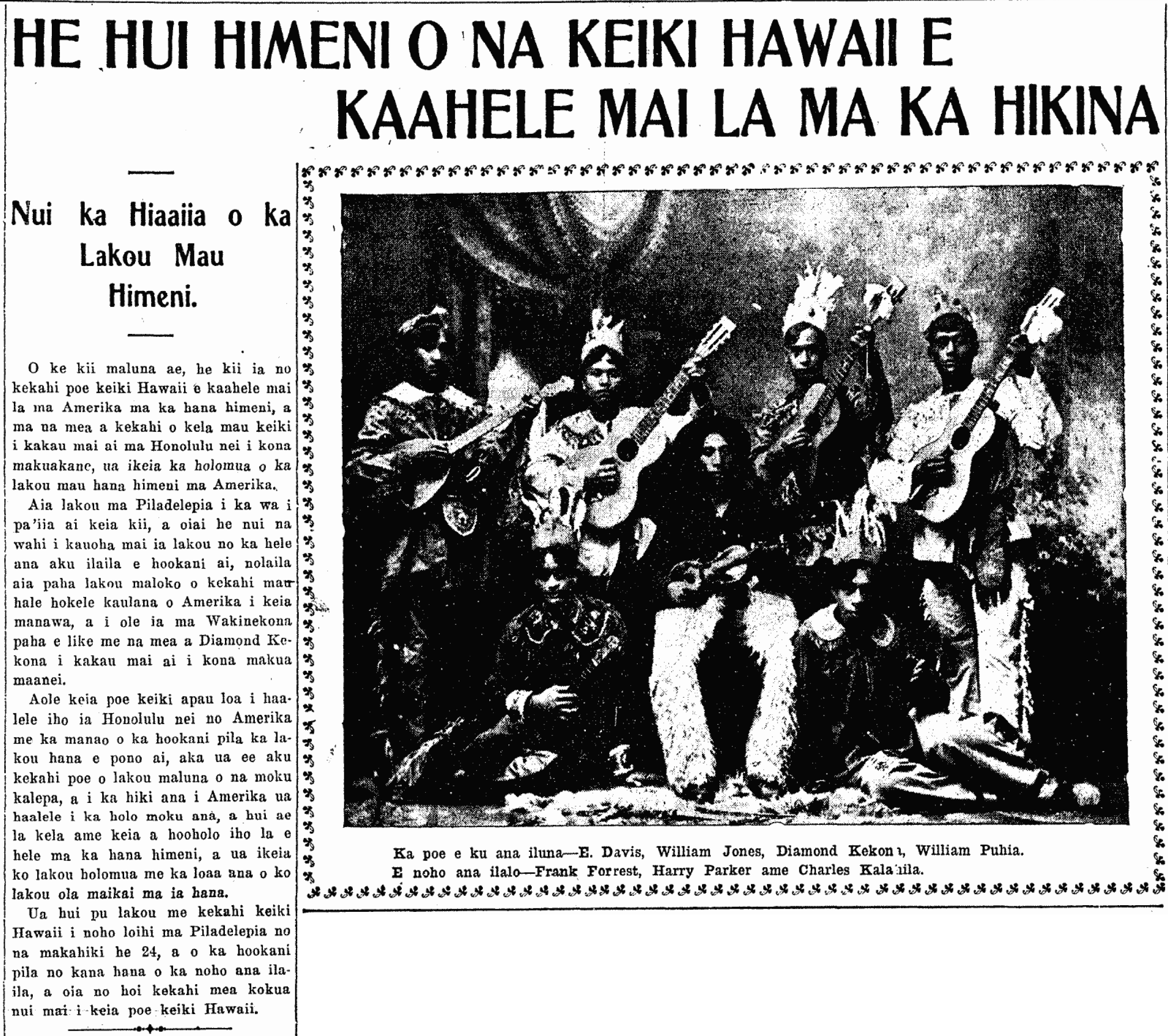
The picture above is a picture of some Hawaiian youths travelling America singing, and from what one of them wrote to Honolulu to his father, we can see they are making progress in their singing in America.

They were in Philadelphia at the time this picture was taken, and being that there are many places where they have been requested to go to perform music, they might be in some famous hotels now in America, or perhaps in Washington according to what Diamond Kekona wrote to his father here.

All of these boys did not leave Honolulu for America thinking that they would be making a living playing music, but some boarded trading ships, and upon arriving at America, they gave up sailing and met up with each other and decided to go around singing, and their progress has been witnessed along with them making a good living.

They met a young Hawaiian who was living in Philadelphia for 24 years, and he was working playing music and he was one who helped these Hawaiian boys immensely.

Those standing—E. Davis, William Jones, Diamond Kekona, William Puhia.

Seated—Frank Forrest, Harry Parker and Charles Kalahila.

(Kuokoa, 11/27/1908, p. 1)

HE HUI HIMENI O NA KEIKI HAWAII E kAAHELE MAI LA MA KA HIKINA

Ka Nupepa Kuokoa, Buke XLIII, Helu 48, Aoao 1. Novemaba 27, 1908.

J. C. K. Hopkins and his band travelling around America, 1914.

SOME HAWAIIAN BOYS TRAVELLING AMERICA SINGING AND PLAYING MUSIC

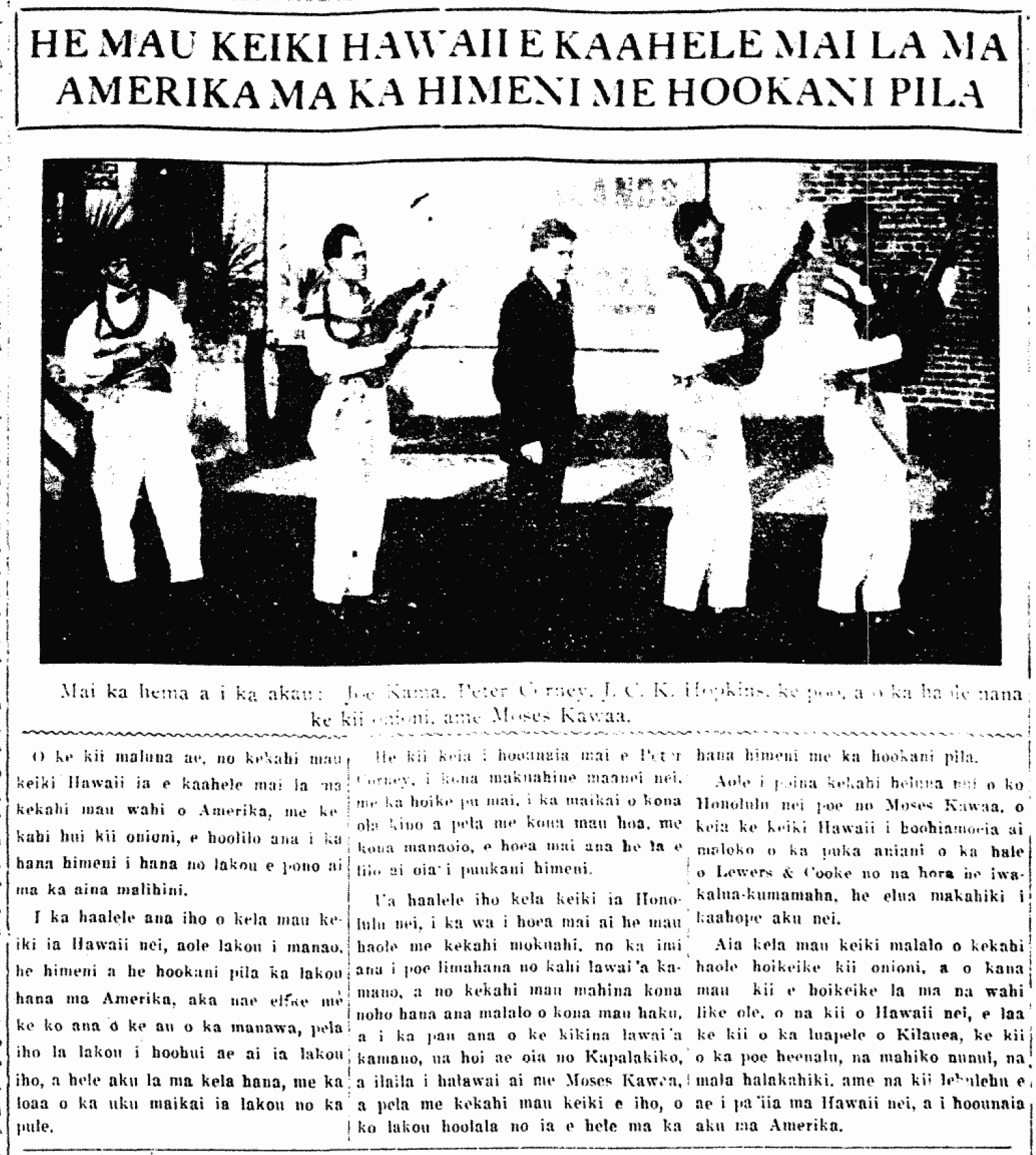
From the left to right: Joe Kama; Peter Corney; J. C. K. Hopkins, the leader; the haole to whom belongs the movies; and Moses Kawaa.

The picture above is of some Hawaiian boys travelling around some places in America, along with a movie company, using music to make a living in the unfamiliar lands.

When the Hawaiian boys left Hawaii nei, they did not imagine that they would be singing and playing music in America, but with the passing of time, they found themselves getting together with each other and started this job, getting paid well by the week.

This picture was sent by Peter Corney to his mother here and he also stated that he was in very good health as well as his friends, and that he believes that the day will come when he will become a singer.

This boy left Honolulu nei when some haole came with a steamship in search of workers for a salmon fishing outfit and he spent several months working under his supervisors, and when the salmon fishing season was over, he returned to San Francisco and there he ran into Moses Kawaa and with some other boys, and they planned to go around singing and playing music.

Many here in Honolulu have not forgotten Moses Kawaa, the Hawaiian boy who was made to sleep in the window of the Lewers & Cooke building for twenty-four hours, two years ago.

These boys work under a haole who shows movies, and the movies that he shows all over the place are of scenes of Hawaii, like shots of the crater of Kilauea, shots of surfers, the expansive sugarcane plantations, pineapple fields, and many, many scenes taken in Hawaii nei and sent to America.

(Kuokoa, 3/13/1914, p. 5)

HE MAU KEIKI HAWAII E KAAHELE MAI LA MA AMERIKA MA KA HIMENI ME HOOKANI PILA

Ka Nupepa Kuokoa, Buke LII, Helu 11, Aoao 5. Maraki 13, 1914.

Ray Kinney Band, 1940.

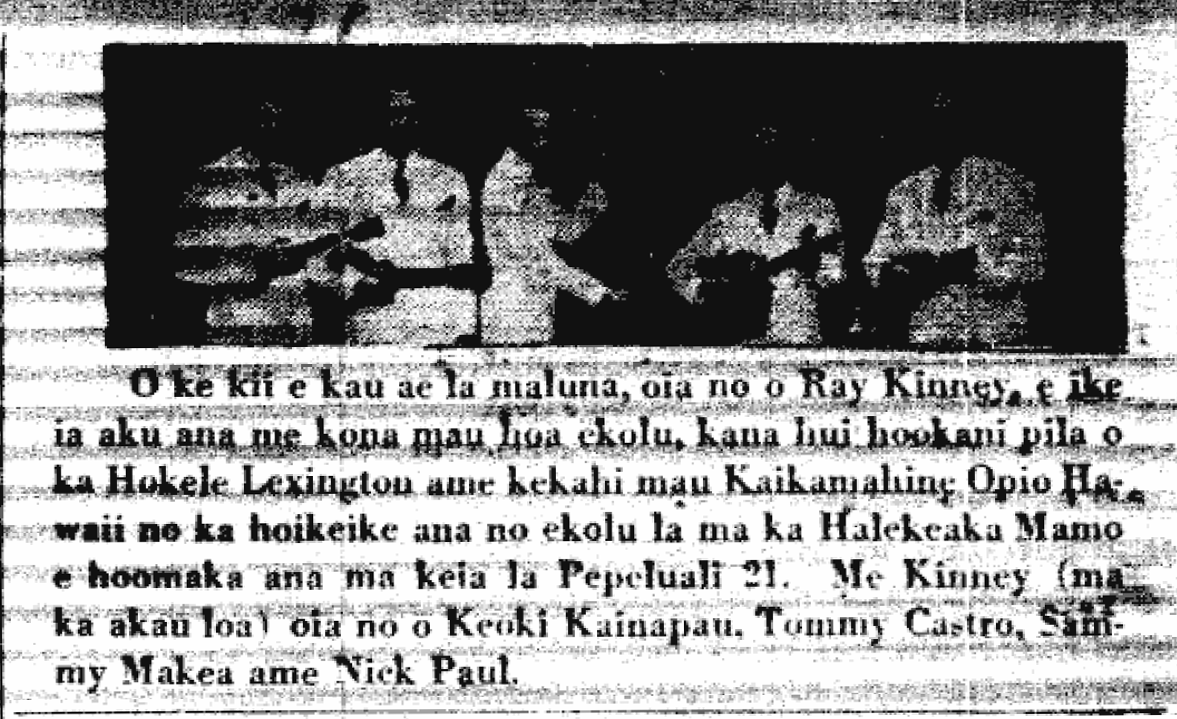
The picture above is of Ray Kinney, and he will be seen with his three friends, who are the band that plays at the Hotel Lexington [in New York], and some Hawaiian Girls; they are here to perform for three days at the Mamo Theater [Halekeaka Mamo], beginning on this day, February 21. With Kinney (on the far right), are Keoki Kainapau, Tommy Castro, Sammy Makea and Nick Paul.

(Hoku o Hawaii, 2/21/1940, p. 3)

O ke kii e kau ae la maluna...

Ka Hoku o Hawaii, Volume XXXIV, Number 43, Aoao 3. Feberuari 21, 1940.