Kū nō i ka haʻaheo! ʻO ʻoe, e Kapalaiʻula lā, mahalo au i kāu hana noiʻi noelo.
Kamehameha Song Contest Pre-Show, 2014.
Reply
Kū nō i ka haʻaheo! ʻO ʻoe, e Kapalaiʻula lā, mahalo au i kāu hana noiʻi noelo.
George Freeth of Honolulu nei is the Hawaiian youth who holds six gold medals [the sixth gold medal], an award from the Congress of America for his fearless rescuing of lives, witnessed at Venice, California, and at the seaside of the Atlantic Ocean, while he was away from home several years ago; there was an announcement aboard the Steamship Sierra last Friday. It said that the Japanese changed the name of their little town in which they live, close to Port Los Angeles, to “Freeth Town”. There was a gift given by the Japanese showing their esteem for this youth for his fearless rescue of some of their kinsmen caught in a terrible storm there some time ago. Continue reading
Liliuokalani Moves the Pebbles on the Konane Board of Hawaii.
When the Queen heard that the treaty which Her lahui greatly feared was put before the Senate, this was when She quickly sent Mr. Joseph Heleluhe to deliver Her protest to John Sherman, the Secretary of State [Kakauolelo Nui o Amerika Huipuia]; Joseph Heleluhe carried out the command of the Queen, and at 3 o’clock in the afternoon of June 17th, he delivered the protest, and this is how the document reads:
“Owau, o Liliuokalani, o Hawaii, ma o ka makemake la o ke Akua, i kohoia ai i hooilina moi ma ka la 10 o Aperila, M. H. 1877, a mamuli o ka lokomaikai o ke Akua, i Moiwahine no ko Hawaii Pae Aina, ma ka la 17 o Ianuari, M. H. 1893, ma keia ke kue aku nei Au i ke aponoia ana o kekahi kuikahi, A’u hoi i haiia mai ai, ua kakauinoaia ma Wasinetona e Haki, Kakina a me Kini, e haawi ana hoi i keia mau mokupuni i Panalaau a malalo hoi o ka mana o Amerika Huipuia. Ke kukala nei au, o ua kuikahi la he hana hewa ia i na kanaka a hapa Hawaii pu, he haihai wale ana i na pono o na ‘lii maoli e noho mana ana, he kue i ke kanawai lahui i ko’u lahui a me na hoaloha e ae, i hana kuikahi pu ai lakou, a he hoomau ana aku hoi ia i ka hana apuka i hookahuliia ai ke Aupuni kumu, a o ka hope, he hana hewa loa ia e kue ana Ia’u nei.
“O na palapala kue pili oihana i hanaia ai e A’u ma ka la 17 o Ianuari, 1893, imua o ke Aupuni Kuikawa, ua kakauinoaia e A’u a apoia mai hoi e na Aupuni elua, me ka hooia ana mai e waihoia aku ana ka hana a Amerika Huiia no ka hooponopono kuikawa ana.
“Ua hoike maoli ae Ka’u mau palapala kue a me Ka’u mau palapala e ae i ke Aupuni o Amerika Huipuia mahope koke iho oia wa, ua haawi aku Au i Kuu Mana i na koa o Amerika Huipuia, i mea e kapaeia ae ai ka hookahe koko ana.
“Ua hoike ae ka Peresidena o Amerika Huipuia, ke Kuhina Nui o ke Aupuni a me ka Elele i hookohuia e laua, ma na palapala pili Aupuni, ua hooweliweli kue kanawai ia Ko’u Aupuni e na mana ikaika, o ka Oihana Kuhina a me ko ka mokukaua o Amerika Huipuia, a ma ia manawa no hoi i lawelawe ai na noii ana. Owau no ka Moi Kumukanawai o Ko’u lahui.
“Oia olelo hooholo a ke poe kiekie i ikeia o Amerika Huipuia, ua haawi pili Aupuni ia mai la ia Ia’u a me Sanford B. Dole, a ua nonoiia aku hoi ko Dole haalele ana i ka oihana e Albert S. Willis, ka agena i ikeia a Kuhina o ke Aupuni Amerika Huiia.
“Aole i loaa ka mana i ke Komisina i hoikeia ae la, aole hoi i ke Aupuni nana i hoouna mai ia mea, ka mana mai na poe koho balota o Hawaii i hoopaaia ko lakou mau inoa, aka, ua loaa mai kona mana hookohukohu mai kekahi komite mai i kapaia, ke Komite na ka Maluhia o ka Lehulehu, i hoala ia ma ua la 17 la o Ianuari, 1893, a maloko o ua komite la he poe kupa Amerika ka hapa nui, aole hoi he Hawaii, a lala o loko o laila he Hawaii, a i komo pu hoi ma na hana hoomaikeike a hiki i kona ku ana.
“O Ko’u lahui, he aneane 40,000 ia, aole loa lakou i kuka pu ia aku e kela poe 3,000 ka heluna, ka poe hoi i olelo he kuleana ko lakou e wawahi ai i ke kuokoa o Hawaii. O Ko’u lahui ka eha-hapalima o na poe kupono ma ke kanawai no ke koho balota ana ma Hawaii, a ina e kapae ia aku na poe i laweia mai he poe limahana, elike ana no ka huina averika o na kanaka.
“Ua hoole loa ua kuikahi la i na pono lahui o Ko’u poe kanaka; a pela pu hoi me na pono waiwai pili paa o ka lakou mau alii. Mailoko ae o na eka he 4,000,000 i komo iloko o ka panalaau a ua kuikahi la e haawi nei no ka hoohui ana mai, he 1,000,000 a 915,000 eka paha, i hoomaopopo mau ia mamua aku nei aole ma kekahi ano e ae, aka, ma ke ano he waiwai ponoi no ia no ke Alii Kumukanawai, e hooponoponoia ana elike me na waiwai ponoi e ae ona.
“Ua manaoia ma ua kuikahi la, e ope’a wale ia ae ua waiwai la, oia hoi na aina i kapaia, na Aina Leialii, a o ka poe i kuleana ma ke kanawai i ua mau aina la, ma keia wa a ma ka lalani aku o ka nohoalii, aole i loaa ia lakou he kumukuai (kumuwaiwai) no ia mau aina, a o ko lakou kuleana ma ia mau aina, he kuleana ia i hoopaapaa ole ia, a ua paa ia kuleana ma ke kanawai ma ko’u inoa i keia la.
“Ua hoole ae la ua kuikahi la i na hoike ana a pau o ka noho aloha mau ana a me ka manao maikai i hana ia me Amerika Huipuia maloko o na kuikahi mua, e na Moi ma ka aoao o na kanaka Hawaii, a pela pu hoi me na kuikahi a pau i hanaia e ia poe Moi me na Aupuni makamaka e ae, a nolaila, ua kue ia ke kanawai lahui.
“Ma o ka hana ana me na poe e olelo nei i keia wa he kuleana ko lakou e panai mai ai i ua panalaau la o Hawaii, e lawe mai auanei ke Aupuni o Amerika Huipuia i ua panalaau la mai na lima mai o ka poe a ko Amerika luna poo kiekie (ka mea i koho pono ia e ka lahui o Amerika Huipuia, a i noho oihana ma ka makahiki 1893) i puana ai, he poe lakou i loaa ka mana mamuli o ka epa a e hoomalu ana hoi ia Hawaii me ke kue i ke Kumukanawai.
“Owau o Liliuokalani o Hawaii, ma keia, ke poloai aku nei au i ka Peresidena o ka lahui A’u i hookuu mai ai i Kuu waiwai a me Kuu mana Aupuni, e unuhi aku i ua kuikahi la (e haawi ana i na mokupuni i oleloia) mai ka noonoo hou ia ana aku. Ke nonoi aku nei Au i ka Aha Senate hanohano o Amerika Huipuia e hoole i ke apono ana i ua kuikahi la, a ke uwalo aku nei au i keia lahui kaulana a maikai, ka poe hoi i loaa mai ai i ko’u poe kupuna ka ike no ka hoomana Karistiano, e kakoo ae i ko lakou mau wahaolelo ma na hana ku i ka pono a me ke kaulike, e kulike ana me na rula o ko lakou poe kupuna, a i ke Akua mana loa hoi o ke ao a pau, ka Mea e hooko pololei ana, Iaia no Au e waiho aku nei i Ka’u koi ana.
“Hanaia ma Wasinetona i keia la 17 o Iune, ma ka makahiki umi-kumamawalu haneri a me kanaiwa-kumamahiku.
LILIUOKALANI.
Na Hoike:
Joseph Heleluhe.
Wakeki Heleluhe.
Julius A. Palmer.
[See the English of the Queen’s Protest in Chapter Fifty-Five of “Hawaii’s Story.” See the text of the treaty in Appendix D of the same publication.]
(Aloha Aina, 7/10/1897, p. 6)

Ke Aloha Aina, Buke III, Helu 28, Aoao 6. Iulai 10, 1897.
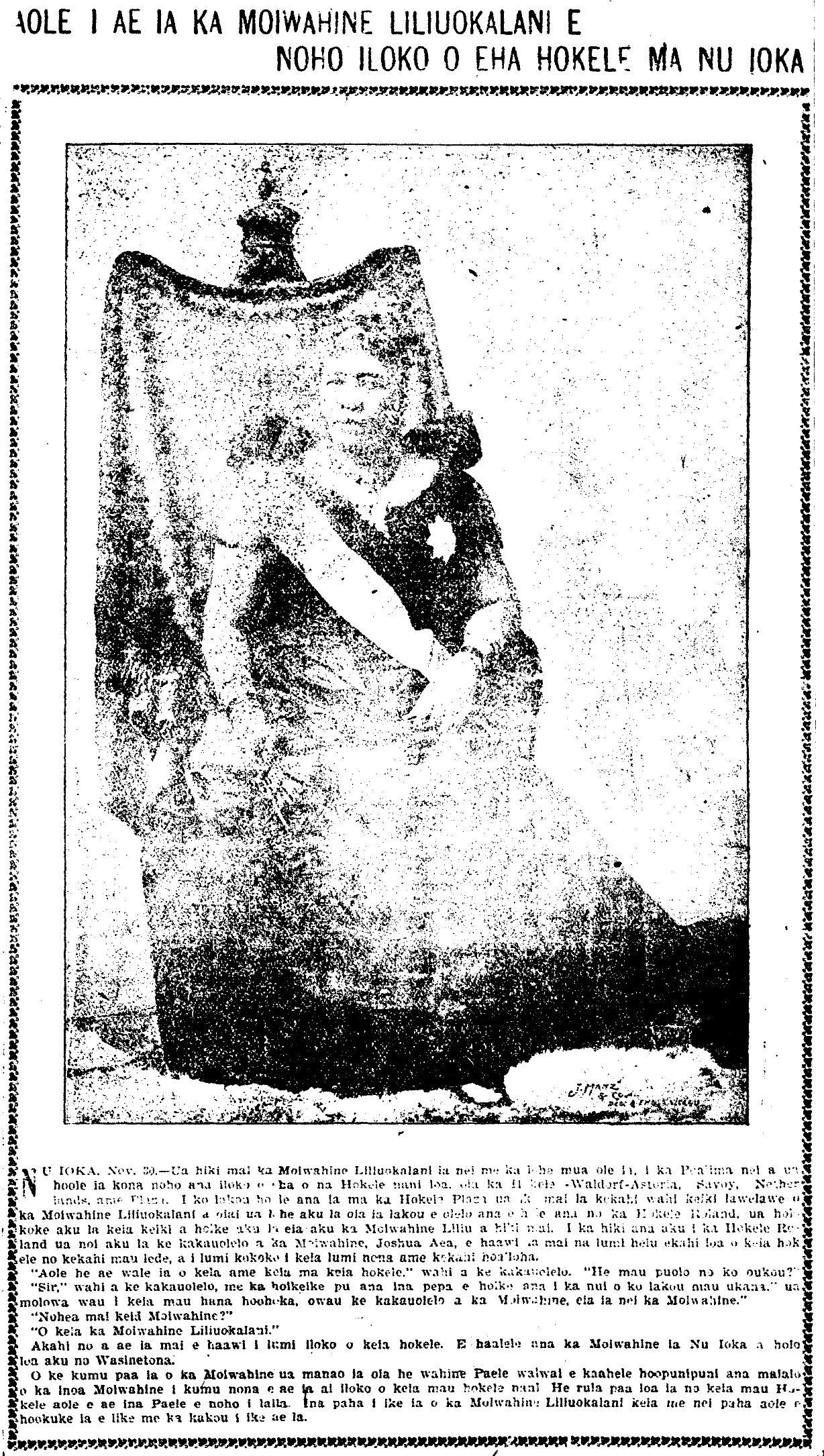
New York. Nov. 30.—Queen Liliuokalani arrived here last Friday unannounced, and she was refused stay at four posh hotels: The Waldorf-Astoria, Savoy, Netherlands, and Plaza. After being refused by the Plaza, one of the Queen’s servants saw this and and being that he heard them saying they were headed to the Hotel Roland, he went at once and announced that the Queen would be arriving. When Joshua Aea, her secretary, asked for their best room for some ladies, and for a room nearby for him and his friends.
“Not just anyone is allowed admittance here to this hotel,” said the hotel staff [“kakauolelo” seems to be a misprint]. “Do you have baggage?”
“Sir,” the secretary said while showing a list of their baggage, “I have had enough of all of these frustrations; I am the secretary of the Queen; the Queen is here.”
“Where is this Queen from?”
“This is the Queen Liliuokalani.
Only then was a room in the hotel given. The Queen will be leaving New York for Washington.
The reason the Queen was barred was that she was thought to be a rich Black [Paele] woman going around trying to pass as a Queen, so that she would be allowed to stay at these beautiful hotels. All of those hotels have a policy not to allow Blacks to stay there. Perhaps if they knew she was the Queen, perhaps she would not have been driven off as we have seen above.
(Kuokoa, 12/13/1901, p. 1)
Ka Nupepa Kuokoa, Buke XXXIX, Helu 24, Aoao 1. Dekemaba 13, 1901.
Some day later, we were asked at our Hoku publishing office, of the songs which were sung at the funeral of Mrs. Aima Nawahi on the last Sunday of this past year. The mele sung on that day were famous songs in “Leo Hoonani a me Hoku Ao Nani.”¹ They were not all shown and there were others, like “Mai Kuu Kaumaha Luuluu a Po,” and the young girls of Haili sang those songs with beautiful lyrics.
There were also hymns sung by some girls who were close to Aunty Aima, and they were sung with such sweetness. The mele sung by the Kaahumanu Society was this one. “Ma ko Iesu mau lima,” and some others as well.
The main reason that this question was asked, was because of the great admiration for the hymns composed by the devout in years gone by. There is someone writing down some old mele in a book to be distributed, and these hymns are wanted by this person writing down Hawaiian mele as something new for him. Another admired mele sung at the funeral of Mrs. Nawahi was that mele composed by Mr. Nawahi before their marriage. Here are the lines of that mele that are recalled partially, and recalled at that time.
Nana aku iluna
He star e alohi ana
Ua like me sweet rose
Me Fairy Puakoolau.
Hui
Aheahe mai ke kehau of the twilight
Pa mai ke ala onaona oia of my dear
Please wau e kiss i ke ala oia pua
And not Forgetting the sweet Lei Lehua
Hoi iho au e moe
Hiki ana o sweet rose
E naue ae kaua
I kuu home iuiu.
This is a mele that was sung all the time by the women of those days, and the lyrics are beautiful. There are many other lovely mele by Hawaiians that we remember, but when it is thought to sing it, we totally forget the words.
¹Leo Hoonani a me Hoku Ao Nani. Honolulu: Ka Papa Hawaii, 1902.
[This mele is printed earlier in Hoku o Hawaii on 1/3/1936 and the article itself is a reprint from 1/7/1936.]
(Hoku o Hawaii, 1/15/1936, p. 3)

Ka Hoku o Hawaii, Buke XXVII, Helu 29, Aoao 3. Ianuari 15, 1936.

Ka Makaainana, Buke VI—-Ano Hou, Helu 13, Aoao 1. Sepatemaba 28, 1896.
Hanaiakamalama, Ianuari 2, 2014.
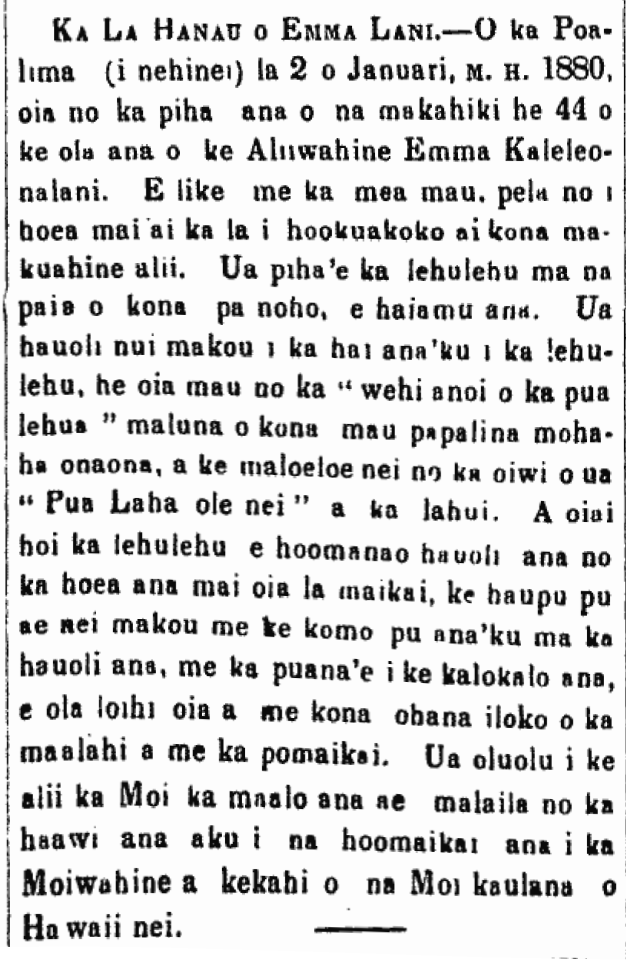
The Birthday of Emma Lani.—Friday (yesterday), the 2nd of January, 1880, was the 44th birthday of the life of Queen Emma Kaleleonalani. Just as usual, the day on which her royal mother suffered birthing pains arrived. There were throngs gathered at the walls of her estate. We are very happy to inform the public that as always the “beloved elegance of lehua blossoms” top her sweet rounded cheeks, and the figure of that “Rare Blossom” of the people is in fine shape. And as the people happily celebrate the arrival of this fine day, we also reminisce as we join in the celebration, while we utter a prayer, wishing that she and her family live long in ease and prosperity. The King kindly made his way by to give his congratulations to the Queen of one of the famous Kings of Hawaii nei.
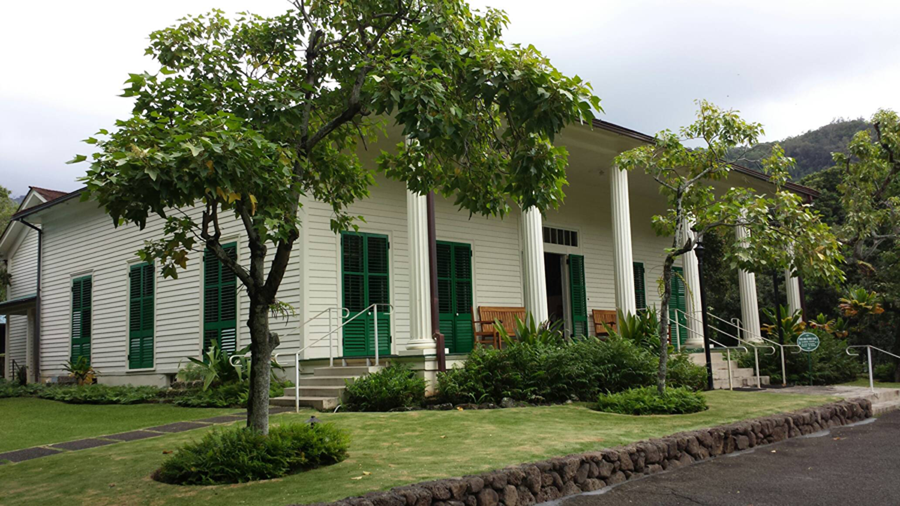
[The Daughters of Hawaii announced that today, 1/2/2014, in honor of Queen Emma’s 178th birthday, there will be a new exhibit opening, along with free admission to Hanaiakamalama, with a short program at 11 a. m. So if you are on Oahu, this sounds like a good way to spend the Queen’s birthday!]
(Kuokoa, 1/3/1880, p. 2)
Ka Nupepa Kuokoa, Buke XIX, Helu 1, Aoao 2. Ianuari 3, 1880.
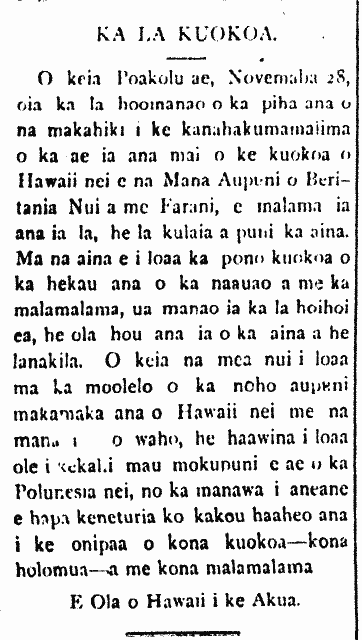
This coming Tuesday, November 28th, is the forty-fifth year celebration marking the recognition by the Heads of the Nations of Great Britain and France of Hawaiian independence; this day is set aside as a holiday all across the land. In other lands which enjoy independence through learning and enlightenment, independence day is seen as a day of rebirth for the nation and victory. These are great events found in the history of Hawaii’s friendly international relations; this is a distinction not received by any other island here in Polynesia; it has been nearly half a century that we remain proud of her unwavering independence—progress—and enlightenment.
Long Live Hawaii Under God.
[On this the 170th anniversary of La Kuokoa, what are you doing to remember the great efforts taken by those like Timoteo Haalilio and William Richards to gain independence for the Nation?]
(Kuokoa, 11/24/1888, p. 2)
Ka Nupepa Kuokoa, Buke XXVII, Helu 47, Aoao 2. Novemaba 24, 1888.
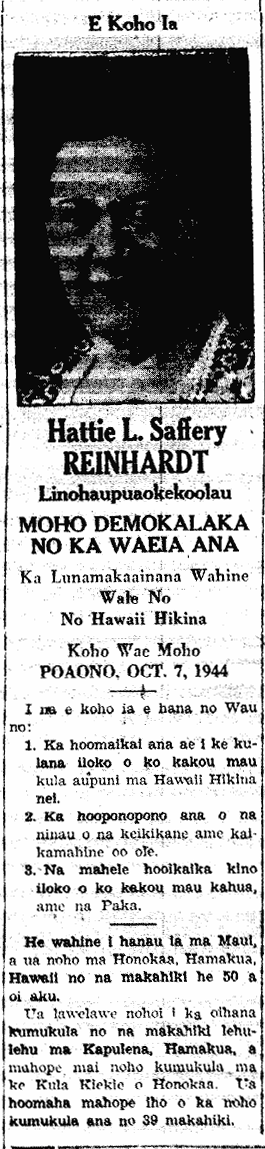
DEMOCRATIC CANDIDATE
FOR ELECTION
The Only
Woman Representative
For East Hawaii
Election
SATURDAY, OCT. 7, 1944
Should I be elected I will work for:
1. Benefit the state of our public schools here in East Hawaii.
2. Deal with the obstacles of girls and boys who have not yet reached adulthood.
3. Physical education in our Parks and grounds.
This is a woman born on Maui, and lived in Honokaa, Hamakua, Hawaii for over 50 years.
She had the occupation of school teacher for many years at Kapulena, Hamakua, and after that, she served as a teacher at Honokaa High School. She retired after teaching for 39 years.
(Hoku o Hawaii, 9/27/1944, p. 2)
Ka Hoku o Hawaii, Volume XXXIX, Number 23, Aoao 2. Sepatemaba 27, 1944.
 nupepa