David Bonaparte Haumea, 1922.

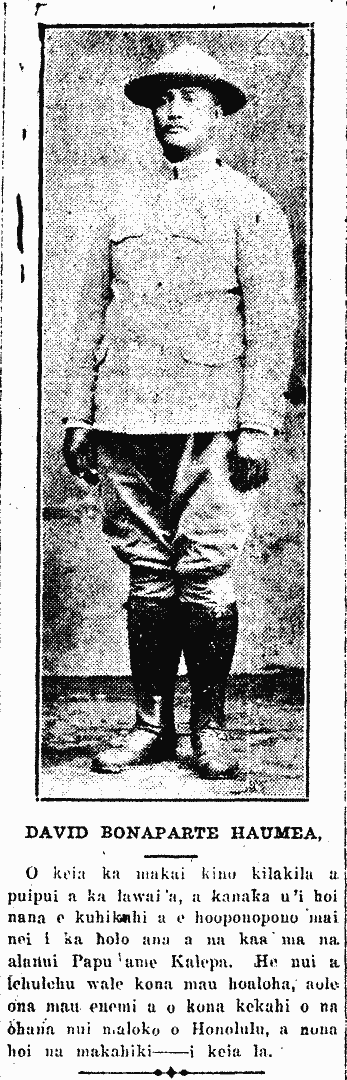
DAVID BONAPARTE HAUMEA.

This is the tall and husky officer and fisherman and handsome youth who directs and brings order to traffic at Fort and Merchant streets. He has a great many friends, and no enemies, and he has one of the biggest families in Honolulu, and is ——- years old today.

(Kuokoa, 1/27/1922, p. 6)

DAVID BONAPARTE HAUMEA.

Ka Nupepa Kuokoa, Buke LXI, Helu 4, Aoao 6. Ianuari 27, 1922.

“Makaloa ihi” hats, 1861.

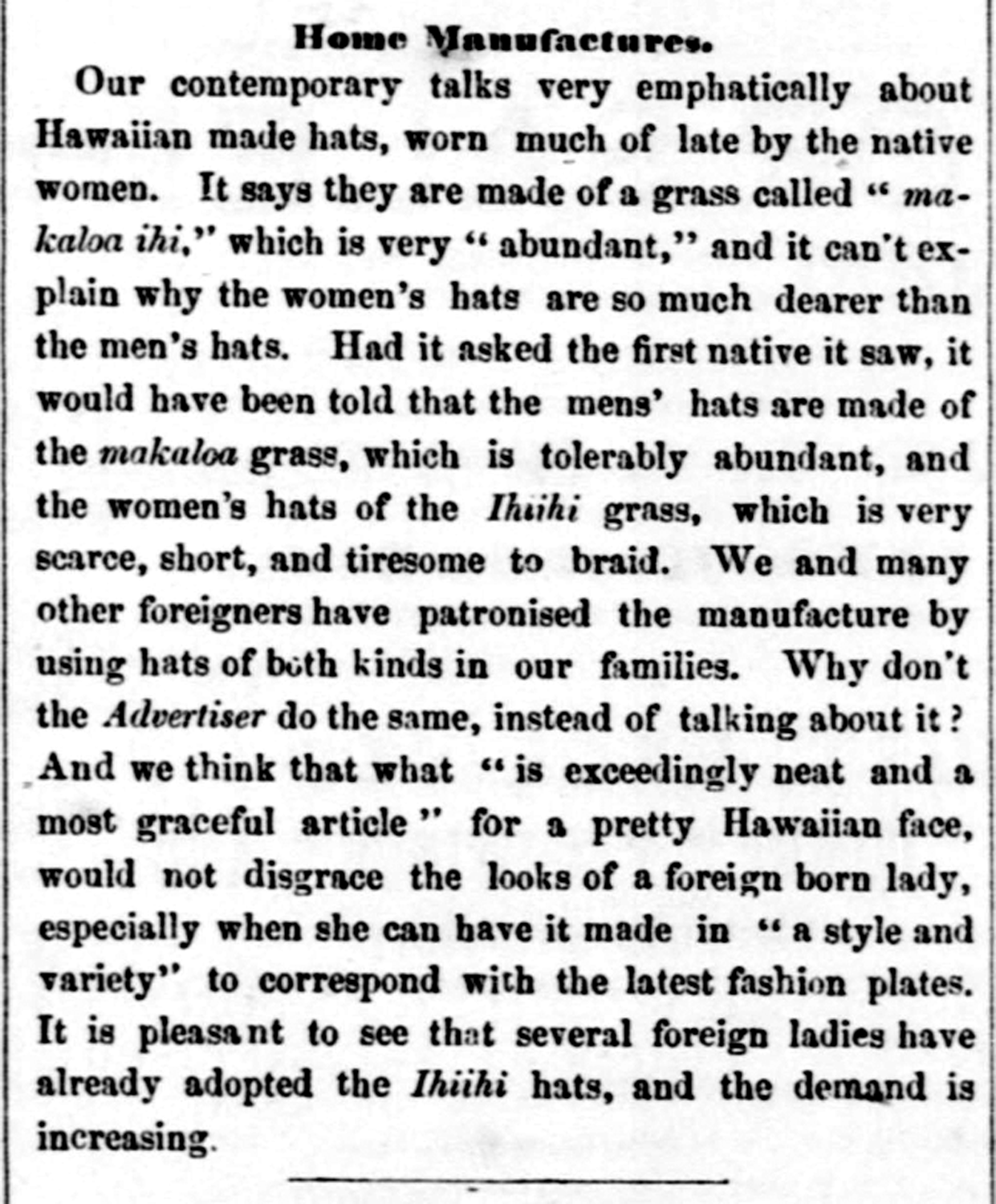
Home Manufactures.

Our contemporary [Pacific Commercial Advertiser] talks very emphatically about Hawaiian made hats, worn much of late by the native women. It says they are made of a grass called “makaloa ihi,” which is very “abundant,” and it can’t explain why the women’s hats are so much dearer than the men’s hats. Had it asked the first native it saw, it would have been told that the mens’ hats are made of the makaloa grass, which is tolerably abundant, and the women’s hats of the Ihiihi grass, which is very scarce, short, and tiresome to braid. We and many other foreigners have patronised the manufacture by using hats of both kinds in our families. Why don’t the Advertiser do the same, instead of talking about it? And we think that what “is exceedingly neat and a most graceful article” for a pretty Hawaiian face, would not disgrace the looks of a foreign born lady, especially when she can have it made in “a style and variety” to correspond with the latest fashion plates. It is pleasant to see that several foreign ladies have already adopted the Ihiihi hats, and the demand is increasing.

(Polynesian, 11/30/1861, p. 2)

Home Manufactures.

The Polynesian, Volume XVIII, Number 31, Page 2. November 30, 1861.

Almost a death everyday… 1873.

DEATHS.

Nov. 12 [1875]—At Pauoa. Honolulu Oahu, Lono (m) died.
” 13—At the same location, P kaukau [? Pakaukau] (m) died.

Nov. 1, 1873, at Kalawao, Molokai, Nunuha (m) died.
Nov. 2, at the same location, Nakaula (m) died.
4, at the same location, Haliata (f) died.
5, at the same location, Kainuwai (m) died.
6, at the same location, M nnini [? Manini] (m) died.
6, at the same location, Piipii (f) died.
7, at the same location, Kauluhiwa (f) died.
8, at the same location, Kel ikaala (m) died.
9, at the same location, Kokii (m) died.
12, at the same location, Kahinawe (m) died.
14, at the same location, Wahapaa (m) died.
14, at the same location, Naalu (f) died.
17, at the same location, Kepa (m) died.
17, at the same location, Kahoomalana (f) died.
18, at the same location, Pohakukihi (f) died.
20, at the same location, Kailiwalea (f) died.
20, at the same location, Paaniani (m) died.
23, at the same location, Kimo (m) died.
24, at the same location, Ai (f) died.
25, at the same location, Kealohi (m) died.
25, at the same location, Kanakaole (m) died.
26, at the same location, Kaaeae (m) died.
28, at the same location, Halula (m) died.
Dec. 20, at the same location, Akini (m) died.
20, at the same location, Miriama (f) died.
20, at the same location, Papa (m) died.
23, at the same location, Wiliams [? Williams] (m) died.
24, at the same location, Kaiakoili (m) died.
26, at the same location, W. N. Pualewa (m) died.
27, at the same location, Lae (m) died.
27, at the same location, Nana (f) died.
30, at the same location, Mahina (m) died.
30, at the same location, Kapapaholona (m) died.
30, at the same location, A. S. Nuuanu (m) died.
Jan. 1, 1874, at the same location, Kapaka (f) died.
1, at the same location, Kekaula (f) died.
2, at the same location, Kalili (m) died.
3, at the same location, Popoalaea (f) died.
8, at the same location, Pahukailua (m) died.
9, at the same location, Kuaiwa (f) died.
10, at the same location, Malei (m) died.
10, at the same location, H. R. Hoohila (f) died.
12, at the same location, Keliimahiai (m) died.
13, at the same location, Waha (m) died.
14, at the same location, Kapele (m) died.
15, at the same location, Kokookalani (m) died.
20, at the same location, Kaulalani (f) died.
21, at the same location, Napoka (m) died.
21, at the same location, Kapika (f) died.
22, at the same location, Naai (f) died.
24, at the same location, Kanoni (f) died.
25, at the same location, Moo (m) died.
26, at the same location, Kauapuni (m) died.
28, at the same location, Makakoa (m) died.
29, at the same location, Luala (m) died.
30, at the same location, Papue (m) died.
Feb. 6, at the same location, Maemae (m) died.
7, at the same location, Henry (m) died.
8, at the same location, Momona (f) died.
14, at the same location, Kaluakini (m) died.
14, at the same location, Kanakaole (m) died.
18, at the same location, Kamai (m) died.
18, at the same location, Bila (m) died.
19, at the same location, Beni (m) died.
28, at the same location, Kaiwi (m) died.
28, at the same location, Ainiu (f) died.

 (Lahui Hawaii, 11/25/1875, p. 4)
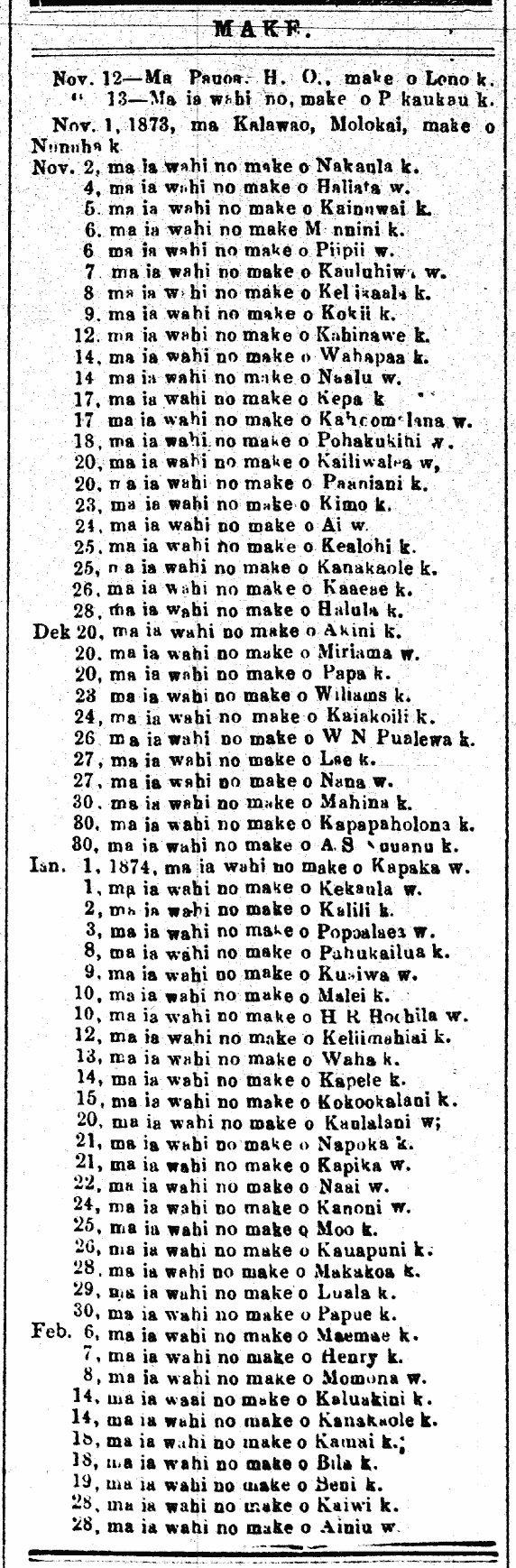
MAKE.

Ka Lahui Hawaii, Buke I, Helu 48, Aoao 4. Novemaba 25, 1875.


Maui story of Eleio, the kahu of Kakaalaneo, the alii, by W. N. Pualewa, 1863.

THE STORY

—OF—

ELEIO.

SECTION 1.

WE PERHAPS SHOULD SPEAK here of Eleio, the caretaker of Kakaalaneo, an Alii of Maui, and thereafter, let’s speak of Kaululaau, the actual child of Kakaalaneo and a chiefess of Hawaii, Kelekeleiokaula, the daughter of Kaleihaohia, a chief of Hawaii.

It is said that Eleio was a kahu of Kakaalaneo, an Alii of Maui, and it is thought that Kakaalaneo was the fifth generation of Maui Chiefs. If their genealogy was laid out properly from Kumuhonua to Kakaalaneo, then it would actually come to five generations.

But in speaking about Eleio, we must speak about him.

Eleio was a fast runner, and because of Eleio’s speed, Kakaalaneo chose Eleio to fulfill his needs in very far places.

This is how we will see how fast Eleio was.

When the Steward of Kakaalaneo was preparing the poi and the ti-leaf wrapped fish of the Alii, at that time, the Alii sent Eleio to go get awa for Him; and the feast of the Alii would begin with the arrival of the awa fetched by Eleio.

But the location of the awa that Eleio was to fetch for the Alii was at a place very far, and that place was in the Koolau side of Maui, at a place named Waiohue.

 If Eleio went to get the awa at Waiohule when the ti-leaf wrapped fish was not cooked, he would return before the meal of the Alii began. This is something Eleio did all the time, fetching the awa for the Chief; the place the Chief lived was mauka of Kekaa, that hill standing at Kaanapali, makai side of Kealakikeekee a Maui.

[This is the beginning of the story of Eleio, it begins in the Kuokoa from 9/5/1863, and concludes on 11/21/1863. This story was written down by W. N. Pualewa (who seems to have died at Kalawao on 12/26/1873).

The closing by Pualewa of his telling of the story is interesting:

And there is this, at this point, we will end our Story of Eleio and Kaululaau; because, we have come to the place where there is great entanglements, and not because the Story is completed, but because of the complexity of putting into order, for there are five sections left of this Moolelo, and within those five parts, divided are the branches of the alii, the genealogy of the kahuna, and the ancestors of the kanaka, and because of this difficulty, I am ending Kaululaau at this Section, and it is for someone that is versed in the Moolelo who should fill this empty space of the paper. With thanks. W. N. Pualewa.]

(Kuokoa, 9/5/1863, p. 1)

KA MOOLELO O ELEIO.

Ka Nupepa Kuokoa, Buke II, Helu 36, Aoao 1. Sepatemaba 5, 1863.

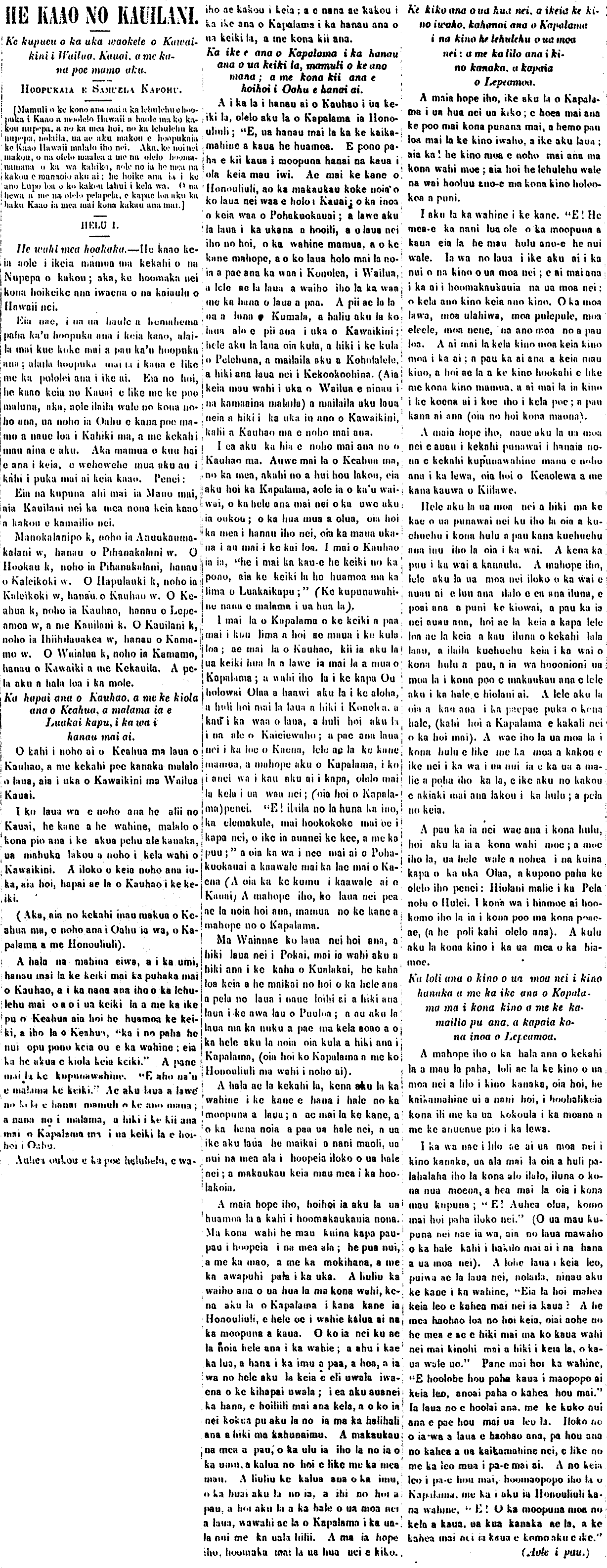
A Kauai story of Kauilani by Samuela Kapohu, 1869.

KAAO OF KAUILANI.

The wondrous one of the forests of Kawaikini in Wailua, Kauai, and his descendants thereafter.

Published by Samuela Kapohu.

{Because we were asked by the public to print Hawaiian and haole Stories in our newspaper, and being that the newspaper is for the people, therefore, we agreed to print the Hawaiian Kaao below. However, we ask pertaining to the deceitful words and the superstitious words of the olden days, those are not something for us to believe in; it shows the great ignorance of our lahui of that time. As for the sins and obscene words, they are to be deleted by the writer of the Kaao from what he writes.}

NUMBER 1.

A clarification.—This kaao has not been seen before in one of our Newspapers; but it is beginning to be shown amongst the communities of Hawaii nei.

However, if there are deletions or perhaps my telling of this kaao is unskilled, don’t object straight off, but when my telling is over, then that other person should put his out as he understands it to be true. And this is a story from Kauai, as shown in the title above, but he did not live only there, his descendants populated Oahu and moved all the way on to places of Kahiki and other lands. But before I speak about this, I will explain first where this kaao originated. Like this:

Here are the royal kupuna from Mano; Kauilani is the one who this kaao is about of which we are speaking.

Manokalanipo (m) dwelt with Anuukaumakalani (f), born was Pihanakalani (f). Hookau (m) dwelt with Pihanakalani, born was Kalekoki (f). Hapulauki (m) dwelt with Kaleikoki (f), born was Kauhao (f). Keahua (m) dwelt with Kauhao, born was Lepeamoa (f) and Kauilani (m). Kauilani (m) dwelt with Ihiihilauakea (f), born was Kamamo (f). Waialua (m) dwelt with Kamamo, born was Kawaiki and Kekauila. And so forth all the way until the ancestral root.

The pregnancy of Kauhao, and its discarding by Keahua, and it was cared for by Luakaikapu [the grandmother] when it was born.

[And so begins Samuel Kapohu’s telling of the story of Kauilani. This serial appears in the Kuokoa from 9/18/1869 and concludes on 2/12/1870.]

(Kuokoa, 9/18/1869, p. 1)

HE KAAO NO KAUILANI.

Ka Nupepa Kuokoa, Buke VIII, Helu 38, Aoao 1. Sepatemaba 18, 1969.

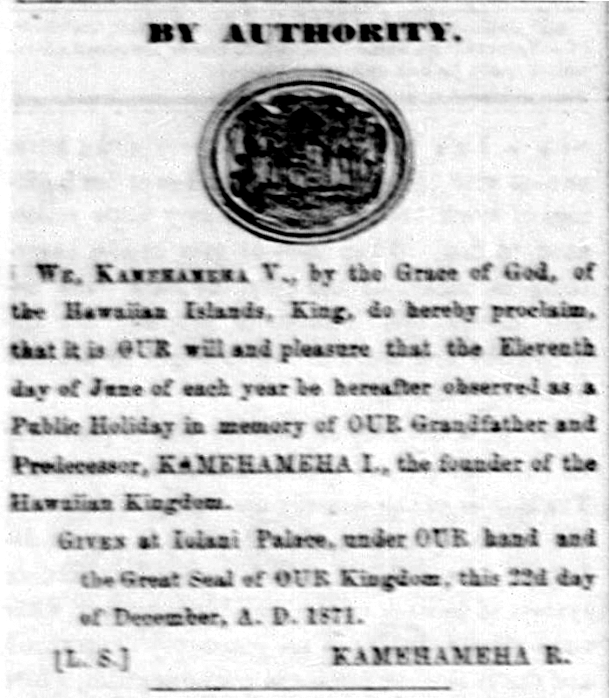
Kamehameha Day proclaimed, 1871.

BY AUTHORITY.

We, Kamehameha V., by the Grace of God, of the Hawaiian Islands, King, do hereby proclaim, that it is OUR will and pleasure that the Eleventh day of June of each year be hereafter observed as a Public Holiday in memory of OUR Grandfather and Predecessor, KAMEHAMEHA I, the founder of the Hawaiian Kingdom.

Given at Iolani Palace, under OUR hand and the Great Seal of OUR Kingdom, this 22nd day of December, A. D. 1871.

[Legal Seal] KAMEHAMEHA R.

(Hawaiian Gazette, 12/27/1871, p. 2)

BY AUTHORITY.

Hawaiian Gazette, Volume VII, Number 50, Page 2. December 27, 1871.

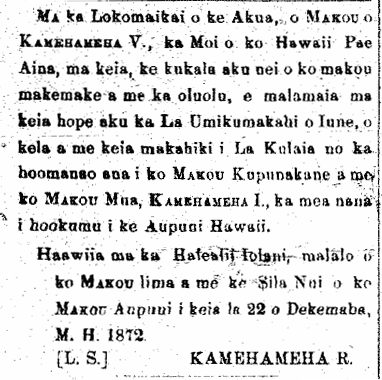
Official Proclamation of the first Kamehameha Day Holiday, 1872.

[Found under: “MA KE KAUOHA.”]

By the Blessings of God, We, Kamehameha V., the King of the Hawaiian Islands, through this, proclaim that it is our desire and pleasure that from here forth, the eleventh day of June, of every year will be a Holiday to memorialize Our Grandfather and Our Progenitor, Kamehameha I., the one who founded the Nation of Hawaii.

Given at Iolani Palace, by Our hand and Great Seal of Our Nation on this 22nd of December, 1872.

[Legal Seal] KAMEHAMEHA Rex.

(Au Okoa, 12/28/1871, p. 2)

Ma ka Lokomaikai o ke Akua...

Ke Au Okoa, Buke VII, Helu 37, Aoao 2. Dekemaba 28, 1871.

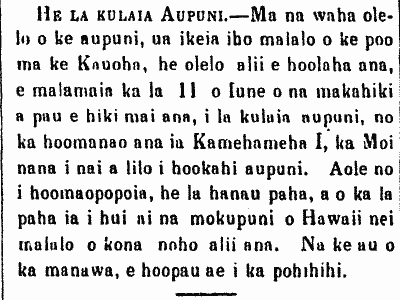
Announcing the first Kamehameha Day, 1872.

[Found under: “NU HOU KULOKO.”]

National Holiday.–According to the spokesman of the nation [Ke Au Okoa], seen under the heading, “By Order,” was proclaimed the word of the king that the 11th of June every year will be observed as a national holiday to memorialize Kamehameha I, the King who unified the kingdom into one. It is not known whether it is his birthday, or whether it is the day that the islands of Hawaii were united under his rule. Time will clear up the confusion.

(Kuokoa, 12/30/1871, p. 2)

He la kulaia Aupuni.

Ka Nupepa Kuokoa, Buke X, Helu 52, Aoao 2. Dekemaba 30, 1871.

More on the first Kamehameha Day, 1872.

On this upcoming Tuesday, the 11th of June; this is the day which pleases our benevolent King, to set aside as a memorial holiday where the Hawaiian people should rejoice in honor of the progenitor Kamehameha I, who established the Hawaiian nation and who united the archipelago beneath one King, as it is today. The festivities of the day can be seen in the announcements column and it is desired that all enjoy themselves within the proper bounds.

(Au Okoa, 6/6/1872, p. 2)

Ma keia Poalua ae e hiki mai ana...

Ke Au Okoa, Buke VIII, Helu 8, Aoao 2. Iune 6, 1872.

The first Kamehameha Day, 1872.

On this past Tuesday, in accordance with the royal proclamation, the 11th of June was celebrated as a day of remembrance of Kamehameha I, the Royal Ancestor who conquered our aina. This is a new day included in the circle of holidays, and the minds of the populace are happy about this type of day set aside to remember our cherished one of days gone by. The day dawned beautifully; there were no droplets to interfere with those who skillfully took care of the day. From early morning the doors of the shops of the town, both large and small, were shut. And when the sun came all the way out, there were not many people seen on the streets of town, and the great work places were deserted. All things meant to entertain themselves were prepared—some people made parties while others rode horses; however, it seemed as if most of the people were all at the races organized at Kulaokahua, the usual place for all types of entertainment.

The atmosphere of the race tracks that day seemed better than all previous days. Lanai and tents were set up impeccably, and those that undertook that task received much appreciation. The lanai, fields, and hills were filled with thousands who amused themselves with the events of the day. If an observer stood and watched from afar, it was as if he were seeing a picture of a race day somewhere like in Europe. The events of the day started at 10 or so, and after watching all the day’s activities, it was truly wonderful. There were no great commotions to disturb the peace among the crowd–this is something unfamiliar on special days like these.

At 10 o’clock sharp, Queen Emma arrived with her guests, and King Kapuaiwa with his entourage. At the appearance of the King, the activities of the day commenced, and all of the crowd joined in the gaieties that were set up. Below, you will find the races and those that won.

[Various horse races, winners, and prizes are listed.]

The final race, the wheelbarrow race was the most humorous. This entertainment marked the close of the festivities of the day. And everyone left with hearts filled with much glee. We are greatly pleased with one thing, and that is the decrease in the number of outbreaks of various sorts. There were no big riots thought to be related to the events of the day.

(Au Okoa, 6/13/1872, p. 2)

Ma ka Poalua iho nei...

Ke Au Okoa, Buke VIII, Helu 9, Aoao 2. Iune 13, 1872.