“King of the Cannibal Islands,” 1830 / 1872.

By 1830 at least, there was a mocking ballad called “King of the Cannibal Islands” that was popular in the United Kingdom (as seen in newspaper advertisements for various concerts). Click here for lyrics printed on a broadside in 1858. By many accounts this was written in response to Kamehameha II going to England in 1824.

As a result of another famous trip taken by a Hawaiian monarch in 1874, the lyrics are adapted in America (the original song popular there much earlier).

THE KING OF THE CANNIBAL ISLANDS.

[From the N. Y. Graphic.]

Tam? Tam! Kalakaua the great
Is booming through the Golden Gate;
The Polynesian potentate,
The King of the Cannibal Islands.

Chorus—Hunki-dori-doodle-dum,
Ministers all upon a bum;
Honolulu! How they come
With the King of the Cannibal Islands.

From sugar-coated Hawaii
He comes strange countries for to see;
And ‘Frisco greets him: “How are ye?
O King of the Cannibal Islands.
Hunki-dori, etc. Continue reading

Kilipaki and lauhala hats in Honolulu, 1903.

LAUHALA HATS SCARCE WHEN GILBERTESE LEAVE HONOLULU

Art of Hat Making is Falling Into Decadence Among the Hawaiians and Was Chief Industry Among the South Sea Islanders.

GILBERT ISLANDERS’ SETTLEMENT.

GILBERT ISLANDERS AT HOME.

With the departure of the Gilbert Islanders for their South Sea home in the British S. S. Isleworth, the art of native hat making is likely to fall into decadence. Strange as it may seem the majority of the native hats sold in Honolulu for many years past have been made by the Lewalewas who in turn were taught the art by the Hawaiians. Form the Island of Hawaii come the more expensive native hats, and the departure of the Gilbert Islanders will undoubtedly give an impetus to the art in Kona and Kohala.

In and around Honolulu there are but few Hawaiians who have the deft art at their fingers ends, and except among the older generations of natives, little about hat making is known. As with hat weaving, so with the making of mats. An old native woman at Waikiki is one of the few who can repair mats, and another in Manoa valley still manufactures mats, large and small. The present generation of Hawaiians has not added hat and mat weaving to its accomplishments.

A couple of years ago the Gilbert Islanders has a village on the naval reservation on the Waikiki side of the harbor channel. Camera fiends and brush artists found the village a picturesque attraction, where nearly all the women villagers manufactured the cheaper grade of hats which were sold here for $1 and $1.50.

The Honoluluans will miss the Gilbert Islanders from the streets on which they appeared barefooted and generally with about half a dozen of the cheap hats in their hands, going from one store to another in quest of a purchaser for the lot. When a tourist arrives in Honolulu about the first thing he or she does is to seek a curio store and invest in a native hat, and after adorning it with a flaring striped pugaree “do” the sights of the city. The hats have always an attraction for the newcomer. But few of the malihinis or even kamaainas have ever seen them made. Continue reading

Revival of the lauhala hat, 1919.

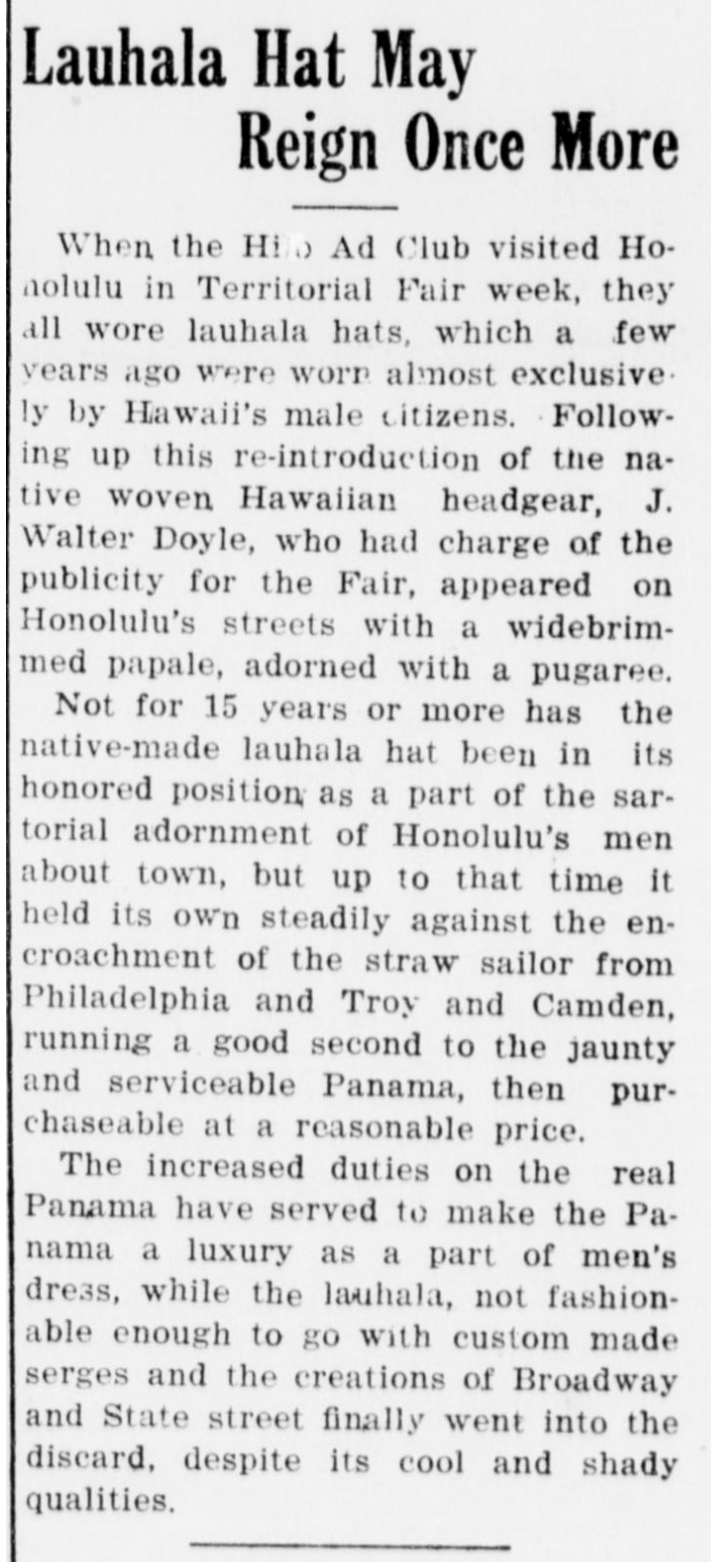
Lauhala Hat May Reign Once More

When the Hilo Ad Club visited Honolulu in Territorial Fair week, they all wore lauhala hats, which a few years ago were worn almost exclusively by Hawaii’s male citizens. Following up this re-introduction of the native woven Hawaiian headgear, J. Walter Doyle, who had charge of the publicity for the Fair, appeared on Honolulu’s streets with a widebrimmed papale, adorned with a pugaree.

Not a 15 years or more has the native-made lauhala hat been in the honored position as a part of the sartorial adornment of Honolulu’s men about town, but up to that time it held its own steadily against the encroachment of the straw sailor from Philadelphia and Troy and Camden, running a good second to the jaunty and serviceable Panama, then purchaseable at a reasonable price.

The increased duties on the real Panama have served to make the Panama a luxury as a part of men’s dress, while the lauhala, not fashionable enough to go with custom made serges and the creations of Broadway and State street finally went into the discard, despite its cool and shady qualities.

[Let’s bring it back! And who needs a pugaree when you can pair your hat with a nice lei…]

(Maui News, 7/4/1919, p. 1)

Lauhala Hat May Reign Once More

The Maui News, Twentieth Year, Number 1007, Page 1. July 4, 1919.

Papale styled after hale? 1902.

HATS AND HABITATIONS.

Theory of Relation Between Houses and Headgear Expounded by an Architect.

“Hats and Houses” was the subject of a novel 20-minute illustrated talk lately given by Edgar Allen Poe Newcomb, the architect, in the rooms of the Young Women’s Christian association, says the Honolulu Advertiser. Mr. Newcomb’s address was intended to show the relationship of the headgear of various peoples in both ancient and modern times to their habitations and public buildings. In 40 large colored illustrations, designed personally by Mr. Newcomb, the similarity was made striking. The designs were arranged in pairs, one to show the hat and manner of wearing, and the other the style of architecture based upon it.

The speaker began by saying that his talk was upon “Hats and Houses, or Headgear and Habitation,” but which should come first in order was difficult to determine, as difficult as it is to determine whether primitive man wore clothes before he chose his cave. He said that every nation under the sun has its own style of architecture, as well as certain kind of headgear peculiar to its people. Helmets, turbans, miters, bonnets, hats and wigs seem to bear a certain likeness to domes, spires, turrets, pagodas, gables and frontons, but just why this should be he was unable to say.

In some of the examples shown Mr. Newcomb called attention to the fact that the headdress bore the form of the whole building, as in the Hawaiian, Laplander and Egyptian styles; in some it resembled only the crowning point of the building, as in the Grecian, Roman, Russian and Turkish styles, and in others the form was only carried through the detail of the building, as in the Rococo style. Speaking of the ancient styles of architecture, he called attention to the grass house of the Hawaiian islands, which seemed to have been the prevailing style long before civilization placed her frigid finger on the natives and turned their attention to clothes. What the natives first took to he was unable to say, but he knew that the Hawaiian hat as worn to-day was one of the characteristic things now made and worn here. He showed an illustration of the lei-bedecked hat and also a companion picture of an old-time grass hut, the similarity of appearance being remarkable. Next was shown a picture of Egyptian wearing the peculiar headgear which is seen in the architectural features of their temples—a flat top with the sides diverging. The tall pagoda-shaped hats of the Chinese showed a remarkable likeness to the pagoda temples of the celestial empire. Continue reading

Fashion setting, 1901.

[Found in an advertisement for Hale’s Good Goods store in San Francisco]

In ready-to-wear hats

We are showing now a splendid variety of chic, nobby styles. This imitation of the Hawaiian hat, bound with silk and trimmed with silk and gold scarf, for $1.25 is a splendid illustration of the money’s worth we can give you Two or three others:…

(San Francisco Call, 3/24/1901, p. 32)

In ready-to-wear hats

The San Francisco Call, Volume LXXXIX, Number 114, Page 32, March 24, 1901.

Hawaiian influence in music and fashion, 1917.

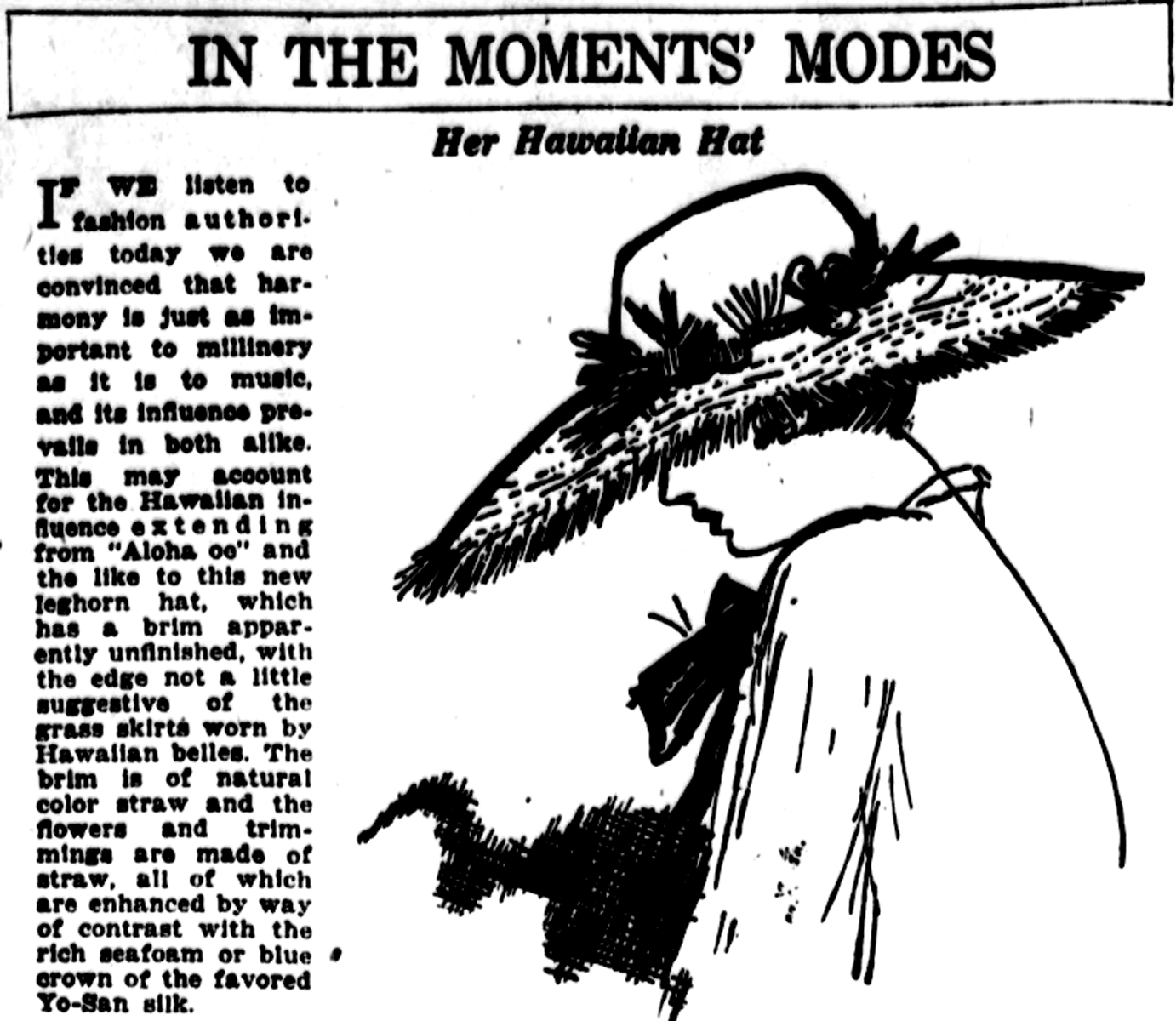
IN THE MOMENTS’ MODES

Her Hawaiian Hat

IF WE listen to fashion authorities today we are convinced that harmony is just important to millinery as it is to music, and its influence prevails in both alike. This may account for the Hawaiian influence extending from “Aloha oe” and the like to this new leghorn hat, which has a brim apparently unfinished, with the edge not a little suggestive of the grass skirts worn by Hawaiian belles. The brim is of natural color straw and the flowers and trimmings are made of straw, all of which are enhanced by way of contrast with the rich seafoam or blue crown of the favored Yo-San silk.

(Evening Ledger, 4/5/1917, p. 12)

IN THE MOMENTS' MODES

Evening Ledger, Volume III, Number 174, Page 12. April 5, 1917.

Stanford University Hawaii Club, 1905.

LEIS AT STANFORD

AN INTERESTING SOCIETY FORMED AT THE UNIVERSITY AT PALO ALTO—LEIS OF ROSES AND SCORE CARDS OF LAUHALA AT A CARD PARTY OF THOSE WHO HAVE LIVED IN THE ISLANDS.

STANFORD UNIVERSITY, April 13, 1905.—A number of Island people met on the evening of April 7, at the home of Mr. and Mrs. A. D. Larnach, and formed what was named the “Hui Hawaii” which is intended to bring together the Hawaiians about Stanford University in a social way. It was decided to have this a most informal affair and not to choose any regular officer, but simply to have it made known at one meeting who is to entertain at the next one. Anyone who has been in the Islands is to be eligible to membership. Continue reading

Papale fame to reach New York, 1906.

Hawaiian Hats for New York.

A question which has long puzzled the friends of the Hawaiian people has been how to provide, for the ones who wish to work, suitable occupations. Critics of the Hawaiian race have been free in their statements to the effect that the Hawaii is lazy and unprogressive, in utter forgetfulness of the fact that it takes more than a generation or two to outlive the old customs more especially when the vitality of a once healthy people has been sapped by the vices and evil productions of socalled civilizasion.

This attitude on the part of many whites and the importation of foreign goods has very nearly doomed to extinction many industries distinctively Hawaiian, but a determined effort is being made to revive at least some of them before they are forgotten entirely.

Perhaps among the most interesting of these is that of making Hawaiian hats and in this a fine start towards establishing a truely native industry has already been made.

The prices commanded by Panama and Filipino hats is such as to encourage those who are looking after the present attempt as there is no doubt that as good hats can be made by the Hawaiian women as any that come from the places mentioned. For these expensive hats however there is of course a limited demand and it is towards the production of grades for ordinary wear that attention has been directed.

First attempts to enlist Hawaiian women in the work were discouraging but after some time Theodore Richards and the Atherton Estate, recognizing the importance of the work, took it up in order to assist the lady who had the matter in hand.

“When Mr. Richards heard of the work he became interested and at once offered a work room at the Kauluwela lodgings, on Vineyard street,” she said this morning, “with out that we could have done nothing. There the women work on the hats and on the braids. Some of the original Hawaiian patterns for braids had disappeared entirely. Others were recalled by native women who remembered them from the early days. Others we managed to get from the other islands and one or two I designed. We have now thirty patterns in all.”
Continue reading

Far reaching influence of Hawaiian lauhala, 1911.

[Found in: M. McInerny, Ltd. advertisement]

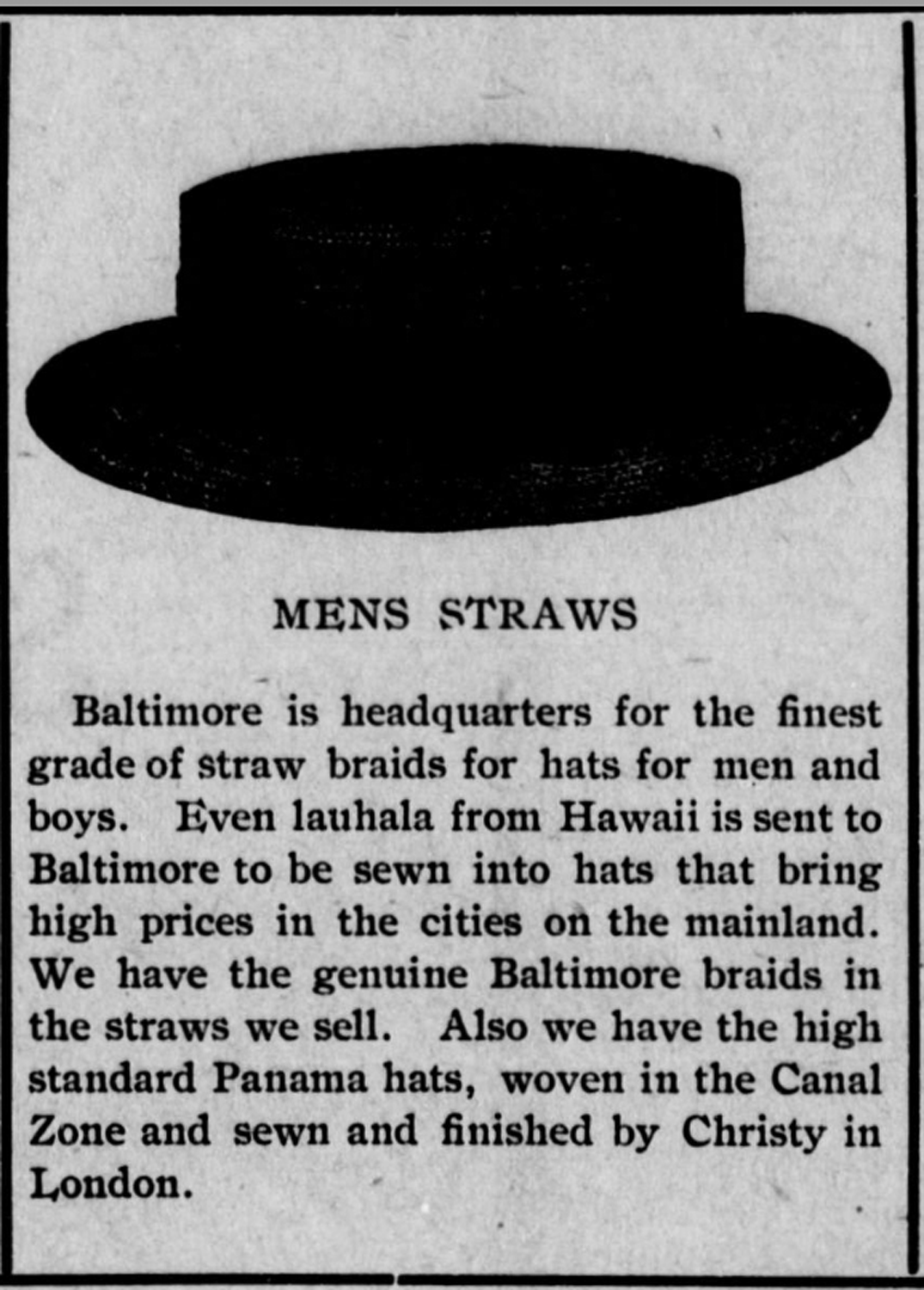
MENS STRAWS

Baltimore is headquarters for the finest grade of straw braids for hats for men and boys. Even lauhala from Hawaii is sent to Baltimore to be sewn into hats that bring high prices in the cities on the mainland. We have the genuine Baltimore braids in the straws we sell. Also we have the gigh standard Panama hats, woven in the Canal Zone and sewn and finished by Christy in London.

(Maui News, 12/2/1911, p. 7)

MENS STAWS

Maui News, Volume XVIII, Number 41, Page 7. December 2, 1911.

Carl Nakuina’s shark attack news spreads far to Utah, 1917.

SHARK IN AUTO BITES CAPTOR

HONOLULU, T. H., Aug. 30 (by mail).—Honolulu has probably the only man who was ever bitten by a shark in an automobile. If the sentence appears confused, it is nevertheless correct, for both the man and the shark were in the automobile at the time.

Carl Nakuina, an employee of a local poi factory, went to Nanakuli, on the shores of this island, last Sunday to fish. He had bigger luck than he anticipated in, for he hooked a twelve-foot shark. Continue reading