More on the Wahiawa “healing stones,” 1927.

THE SUPERNATURAL ROCKS WILL BE LEFT IN THEIR PLACE.

At the meeting of the Daughters of Hawaii last week Wednesday in the Home of Queen Emma Kaleleonalani in Nuuanu, the association decided not to move the “Healing Stones” from where the two stand in Wahiawa; they made no decision to perhaps not move them for a time between three and six months and after that time, to take up again the question of those rocks.

When ayes and nays were asked for per the request explained earlier by Mrs. Julie Judd Swanzy and added to with small changes made by Mrs. F. A. Potter, there were three members who were opposed to the changes.

The decision by the association agreed upon that day, was in accordance with the decision by the President of the Board of Health, F. E. Trotter, that there would be no action upon on the matter of the rocks and that they’d be left where they stand now without being moved. With this decision by the Daughters of Hawaii, the ones who have responsibility over the rocks, dashed was the hope and request of 400 citizens of Wahiawa made to this association in a petition to remove the rocks from Wahiawa.

Another subject considered and decided upon by the association was this: there shall be no monuments built upon heiau. At that meeting, announced were pledges of $588, and cash donations of $1712, and funds of $341.72 for the restoration of that palace in Kailua, Kona, Hawaii [Hulihee].

Because of the rumor that the enthusiasm over the healing powers of the rocks are dwindling, which was known because less people go to worship the stones and because of less donations, this is the reason for the postponement by the association on action to be taken in regard to the rocks, with their belief that perhaps in a short few months the craze of the people over worshiping them will decrease drastically.

At that meeting of the association, there were many letters read by the President, Mrs. Swanzy, in front of the members gathered there, from different people dealing with the stones.

One of these letters was a petition by 400 people of Wahiawa asking to remove these rocks from there; three of the people who signed their names to the document asked that their names not be publicized and to take out their names from the list; there was a letter against the moving of the rocks to the Bishop Museum, where the stones would just be a “Collection” there; in another letter, it was asked to move the rocks to an area near the new road in Koko Head.

Mrs. Charles Clark asked to return these stones to the grounds of Kukaniloko; her idea was opposed by the majority of the members for the reason that the ancient history of these stones have nothing to do with the history dealing with the alii born at Kukaniloko, and therefore, it is not right to move them there. The rocks were moved to Kukaniloko at the order of Galbraith, because he thought they might be broken up where they stood beneath the stream.  The association does not want to return the stones there; they have been something much cared for by the Filipinos and others, and other stones of Kukaniloko have been cracked because of candles placed upon them, and the grounds are full of rotting fruits and flowers; and seeing those things which marred the beauty of the area was why they were moved to where they stand now. Those stones will not be considered again for return to Kukaniloko.

As for the $3000 in the bank, it is from donations made by people who went to worship the stones, but the association has not agreed to take a cent of the money, but it will instead be appropriated for use for works benefiting the people of Wahiawa.

(Kuokoa, 11/24/1927, p. 4)

E WAIHOIA ANA NO NA POHAKU KUPUA MA KO LAUA WAHI.

Ka Nupepa Kuokoa, Buke LXVI, Helu 52, Aoao 4. Novemaba 24, 1927.
E o, e Kaleleonalani! Queen Emma and Kamehameha Schools, 1887.

KAMEHAMEHA SCHOOL.

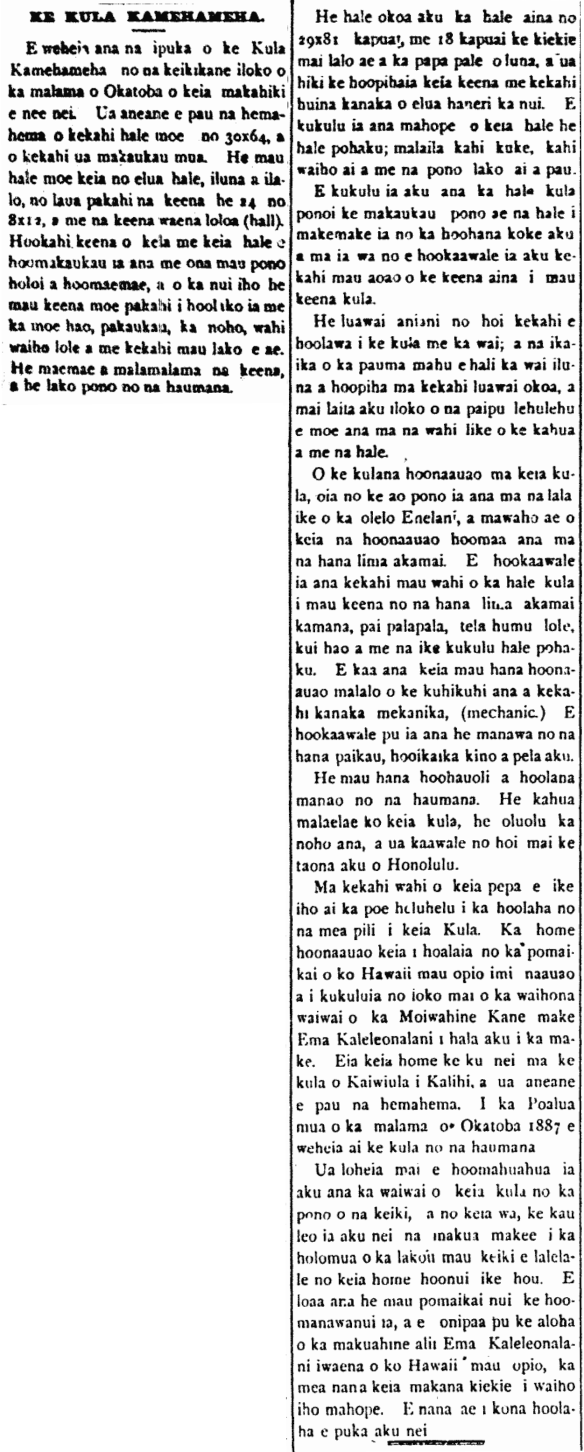
The gates of the Kamehameha School for boys will open in October of this current year. The imperfections of one of the dormitories of 30 x 64 [feet] are almost smoothed out, and another was complete before. These dormitories are two storied, bottom floor and top floor, and each of them have 24 rooms of 8 x 12, and a hallway [keena waena loloa]. One room of each house is furnished with facilities to wash up and clean, and the rest of the rooms are bedrooms, each being supplied with a iron bed, desk, chair, closet, and some other furnishings. The rooms are clean and lighted, and well-furnished for the student.

The dining hall of 29 x 81 feet is a separate building, and it is 18 feet from the bottom to the ceiling, and it will fit two-hundred people. A stone building will be built behind this, which will be the kitchen and and a place to store the food and all cookware and dinnerware.

A proper schoolhouse will be built after the buildings that are desired to be completed quickly are done, and in the meantime, parts of the dining hall will be set aside as school rooms.

A clear spring will supply the school with water and it is by steam pumps that the water will be brought up and filled into a separate water tank, and from there into many pipes laid all over the grounds and buildings.

The curriculum at this school teaches thoroughly the branches of the English language; and outside of that are the teaching of industrial arts. Some rooms of the school house will be set aside as rooms for carpentry, printing, tailoring, blacksmithing, and masonry. The instruction will take place under the direction of a mechanic [mekanika]. Some time will also be set aside for military drilling, physical development, and so forth.

There are fun and cheerful activities for the students. This school sits on a serene site, living there is pleasant, and it is separated from the town of Honolulu.

In a section of this paper, the reader will see the advertisement dealing with this School. This is the educating home established for the benefit of Hawaii’s children who seek education, and built by way of the estate of the late Dowager Queen Ema Kaleleonalani. This home stands in the plain of Kaiwiula in Kalihi, and it is near completion. On the first Tuesday of October 1887, this school will open to students.

It has been heard that the assets of the school will be increased for the good of the children, and for now, parents who want their children to progress forward are being urged to rush to this new home where knowledge is increased. Much benefits will be gained if patient and if the aloha of the royal parent Ema Kaleleonalani is held resolute as well by Hawaii’s children, the one who left this great gift behind. Look at its published notice.

[On this, the day after Queen Emma’s 177th birthday, i thought it would be a good thing  to look back at her role in the establishment of the Kamehameha Schools, a role which she is not recognized often for today.

Notice the difference between the article appearing in the May 24th edition of the Hawaiian Gazette, “The Kamehameha Schools.” (probably what the article is based upon) and this Hawaiian-Language article.]

(Kuokoa, 5/28/1887, p. 2)

KE KULA KAMEHAMEHA.

Ka Nupepa Kuokoa, Buke XXVI, Helu 22, Aoao 2. Mei 28, 1887.

Another mountain-climbing mele for Emalani, 1871.

A mountain-climbing name song for Ema Kaleleonalani.

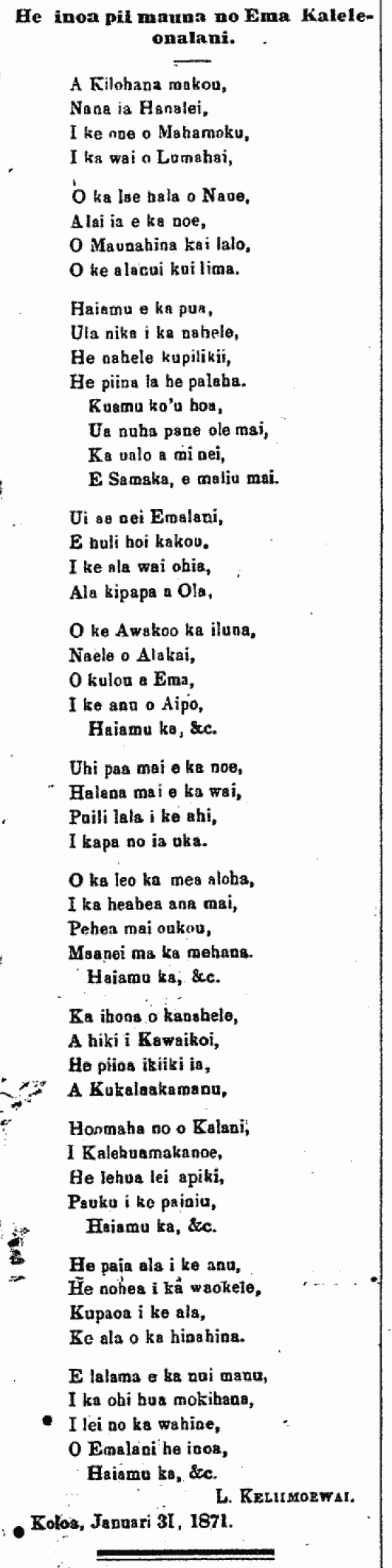
A Kilohana makou,
Nana ia Hanalei,
I ke one o Mahamoku,
I ka wai o Lumahai,

O ka lae hala o Naue,
Alai ia e ka noe,
O Maunahina kai lalo,
O ke alanui kui lima.

Haiamu e ka pua,
Ula nika i ka nahele,
He nahele kupilikii,
He piina la he palaha.
Kuamu ko’u hoa,
Ua nuha pane ole mai,
Ka ualo a mi nei,
E Samaka, e maliu mai.

Ui ae nei Emalani,
E huli hoi kakou,
O ke ala wai ohia,
Ala kipapa a Ola,

O ke Awakoo ka iluna,
Naele o Alakai,
O kulou a Ema,
I ke anu o Aipo,
Haiamu ka, &c.

Uhi paa mai e ka noe,
Halana mai e ka wai,
Puili lala i ke ahi,
I kapa no ia uka.

O ka leo ka mea aloha,
I ka heahea ana mai,
Pehea mai oukou,
Maanei ma ka mehana.
Haiamu ka, &c.

Ka ihona o kanahele,
A hiki i Kawaikoi,
He piina ikiiki ia,
A kukalaakamanu,

Hoomaha no o Kalani,
I Kalehuamakanoe,
He lehua lei apiki,
Pauku i ke painiu,
Haiamu ka, &c.

He paia ala i ke anu,
He nohea i ka waokele,
Kupaoa i ke ala,
Ke ala o ka hinahina.

E lalama e ka nui manu,
I ka ohi hua mokihana,
I lei no ka wahine,
O Emalani he inoa,
Haiamu ka, &c.

L. Keliimoewai.

Koloa, Januari 31, 1871.

[This is another mele honoring Queen Emma and her famous travels through Kauai. It seems the eight lines starting “Haiamu e ka pua” is repeated like a chorus after every two verses.

This seems to be a more “complete” version of the one printed in “He Lei no Emalani,” pp. 90–91.]

(Au Okoa, 2/9/1871, p. 1)

He inoa pii mauna no Ema Kaleleonalani.

Ke Au Okoa, Buke VI, Helu 43, Aoao 1. Feberuari 9, 1871.

Mele for Queen Emma on her mountain-climbing expedition, Kauai, 1871.

He inoa pii kuahiwi no Kaleleonalani.

1.

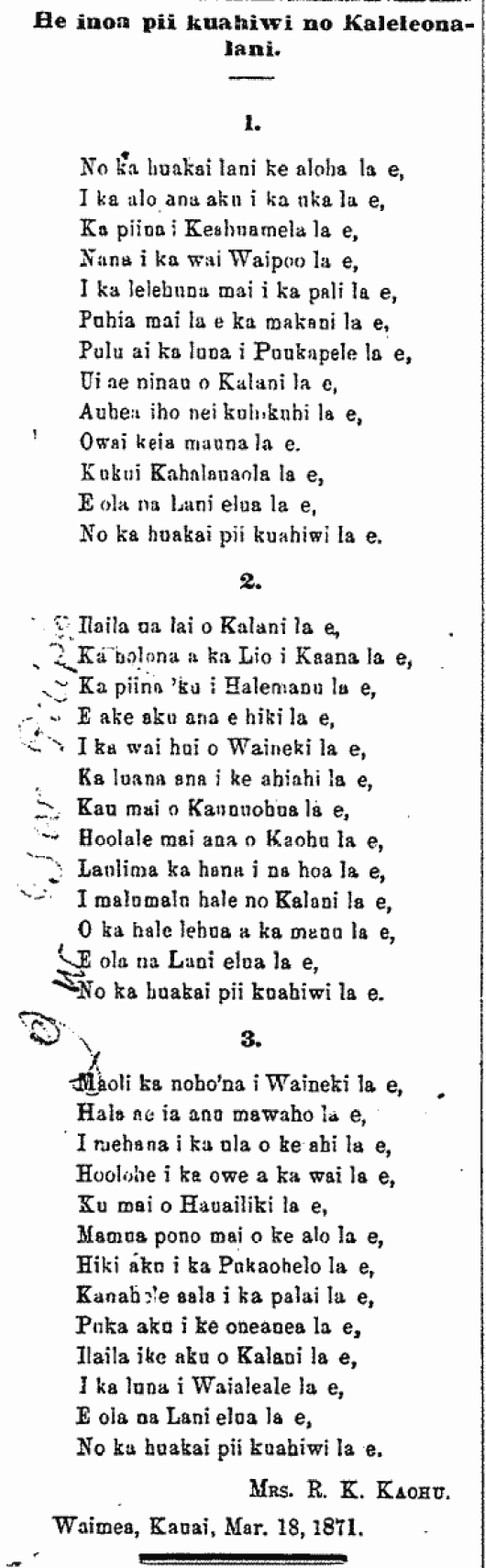
No ka huakai lani ke aloha la e,
I ka alo ana aku i ka uka la e,
Ka piina i Keahuamela la e,
Nana i ka wai Waipoo la e,
I ka lelehuna mai i ka pali la e,
Puhia mai la e ka makani la e,
Pulu ai ka luna i Puukapele la e,
Ui ae ninau o Kalani la e,
Auhea iho nei kuhikuhi la e,
Owai keia mauna la e,
Kukui Kahalauaola la e,
E ola na Lani elua la e,
No ka huakai pii kuahiwi la e.

2.

Ilaila ua lai o Kalani la e,
Ka holona a ka Lio i Kaana la e,
Ka piina ‘ku i Halemanu la e,
E ake aku ana e hiki la e,
I ka wai hui o Waineki la e,
Ka luana ana i ke ahiahi la e,
Kau mai o Kaunuohua la e,
Hoolale mai ana o Kaohu la e,
Laulima ka hana i na hoa la e,
I malumalu hale no Kalani la e,
O ka hale lehua a ka manu la e,
E ola na Lani elua la e,
No ka huakai pii kuahiwi la e.

3.

Maoli ka noho’na i Waineki la e,
Hala ae ia anu mawaho la e,
I mehana i ka ula o ke ahi la e,
Hoolohe i ka owe a ka wai la e,
Ku mai o Hauailiki la e,
Mamua pono mai o ke alo la e,
Hiki aku i Pukaohelo la e,
Kanahele aala i ka palai la e,
Puka aku i ke oneanea la e,
Ilaila ike aku o Kalani la e,
I ka luna o Waialeale la e,
E ola na Lani elua la e,
No ka huakai pii kuahiwi la e.

Mrs. R. K. Kaohu.

Waimea, Kauai, Mar. 18, 1871.

[For more mele in honor of Queen Emma, see “He Lei no Emalani”.]

(Au Okoa, 4/13/1871, p. 1)

He inoa pii kuahiwi no Kaleleonalani.

Ke Au Okoa, Buke VI, Helu 52, Aoao 1. Aperila 13, 1871.

Monument to Kamehameha III planned by Daughters of Hawaii, 1911.

Monument Planned

Daughters of Hawaii Plan to Build Monument to Kamehameha III

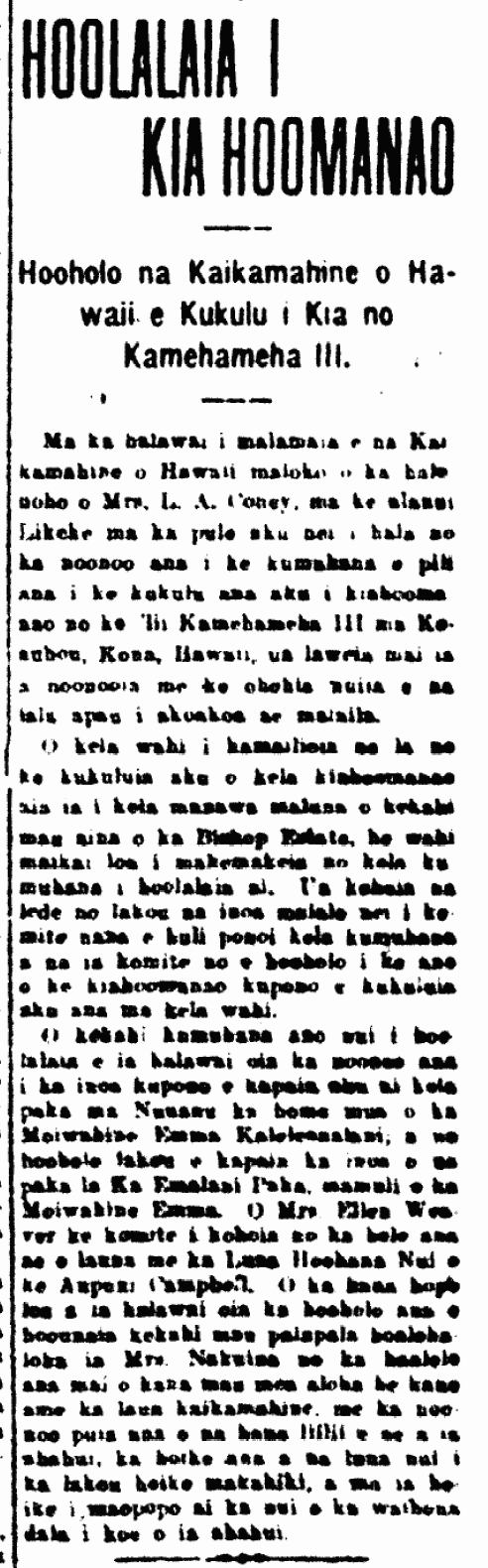
In a meeting held by the Daughters of Hawaii at the residence of Mrs. L. A. Coney, on Richards Street last week, to think over the subject of building a monument to the alii, Kamehameha III, at Keauhou, Kona, Hawaii; it was undertaken and considered with much enthusiasm by all members present.

The place mentioned above for the building of monument is currently upon lands of the Bishop Estate, and is a very good area desired for that planned project. The ladies named below were chosen as a committee to decide the kind of monument that would be appropriate to be built at that place.

Another subject on the agenda of that meeting was the considering of a proper name for the park in Nuuanu, the first home of Queen Emma Kaleleonalani, and they decided that the park would be called “Emalani Park,” after Queen Emma. Mrs. Ellen Weaver was the committee chosen to go to meet with the Chief Executive Officer of the Campbell Estate. The last subject of that meeting was the decision to send letters of sympathy to Mrs. Nakuina for the passing of her loved ones, her husband and their daughter; with consideration of other small organization business—the presentation by the regents of their annual reports, and as a result of these presentations, the remaining funds of the organization was made clear.

(Kuokoa, 10/27/1911, p. 1)

HOOLALAIA I KIA HOOMANAO

Nupepa Kuokoa, Buke XLVII, Helu 43, Aoao 1. Okatoba 27, 1911.