Kamehameha III’s Feather Cape returned to Hawaii, 1927.

THE FEATHER-CAPE OF KAMEHAMEHA IS RETURNED

Ceremony in Respect to the Ahuula is Carried Out in the Crown Room of the Palace Last Monday

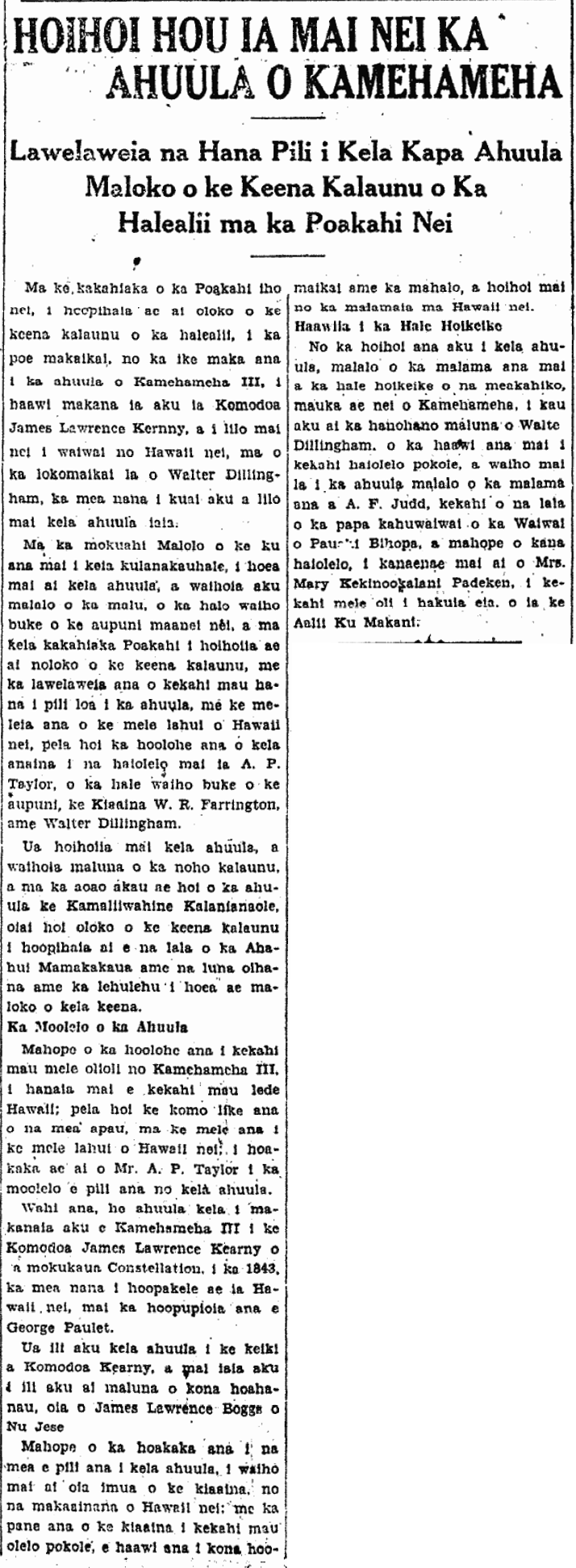
In the morning of last Monday, the throne room of the palace was filled with visitors to see the ahuula of Kamehameha III gifted to Commodore James Lawrence Kernny, and now becoming a treasure for Hawaii nei, through the generosity of Walter Dillingham, the one who purchased the ahuula.

The ahuula arrived aboard the steamer Malolo which arrived in town, and was entrusted to the safekeeping of the national archives, and on that Monday was returned to the throne room with ceremony befitting the ahuula, along with the singing of patriotic songs of Hawaii nei, as well as the hearing by the crowd of speeches given by A. P. Taylor of the national arvhives, Governor W. R. Farrington, and Walter Dillingham.

The ahuula was returned and draped upon the throne, and to the right was the Princess Kalanianaole, while the throne room was filled with members of the Mamakakaua Association and heads of businesses and the multitudes there in that room.

The Story of the Ahuula

After hearing some songs for Kamehameha III, composed by some Hawaiian ladies, the crowd entered while singing the anthem of Hawaii. And Mr. A. P. Taylor explained the history of the ahuula.

According to him, this was an ahuula gifted to Commodore James Lawrence Kearny of the warship Constellation, by Kamehameha III, in the year 1843. He was the one who saved Hawaii from the subjugation by George Paulet.

The ahuula was inherited by the child of Commodore Kearny, and from there to his cousin, James Lawrence Boggs of New Jersey.

After the explanation of its story, the ahuula was presented before the governor for the makaainana of Hawaii nei, whereupon the governor spoke a bit, while giving his thanks and appreciation for it being returned here to be cared for in Hawaii nei.

Given to the Museum

The honor was given to Walter Dillingham for his return of the ahuula for stewardship by the museum up above Kamehameha, and he gave a short speech and placed the ahuula under the care of A. F. Judd, one of the members of the board of the Trust of Pauahi Bishop. After his speech, Mrs. Mary Kekinookalani Padeken presented a chant composed by her, “Aalii Ku Makani.”

[If this sounds familiar, I am reposting it from the old Facebook site. Posts on FB are not easily searched, and so periodically I am thinking of doing reposts of those articles…]

(Kuokoa, 12/1/1927, p. 1)
HOIHOI HOU IA MAI NEI KA AHUULA O KAMEHAMEHA

Ka Nupepa Kuokoa, Buke LXVI, Helu 53, Aoao 1. Dekemaba 1, 1927.
Vital Statistics, 1912.

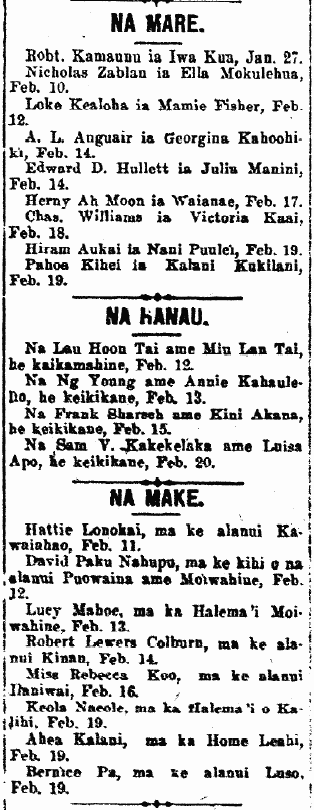
MARRIAGES.

Robert Kamaunu to Iwa Kua, Jan. 27.
Nicholas Zablan to Ella Mokulehua, Feb. 10.
Loke Kealoha to Mamie Fisher, Feb. 12.
A. L. Auguair to Georgina Kahoohiki, Feb. 14.
Edward D. Hullet to Julia Manini, Feb. 14.
Herny [Henry?]  Ah Moon to Waianae, Feb. 17.
Charles Williams to Victoria Kaai, Feb. 18.
Hiram Aukai to Nani Puulei, Feb. 19.
Pahoa Kihei to Kalani Kukilani, Feb. 19.

BIRTHS.

To Lau Hoon Tai and Miu Lan Tai, a daughter, Feb. 12.
To Ng Young and Annie Kahaulelio, a son, Feb. 13.
To Frank Sharech and Kini Akana, a son, Feb. 15.
To Sam V. Kakekelaka and Luisa Apo, a son, Feb. 20.

DEATHS.

Hattie Lonokai, on Kawaiahao Street, Feb. 11.
David Paku Nahupu, on the corner of Punchbowl and Queen Streets, Feb. 12.
Lucy Mahoe, at Queen’s Hospital, Feb. 13.
Robert Lewers Colburn, on Kinau Street, Feb. 14.
Miss Rebecca Koo, on Ilaniwai Street, Feb. 16.
Keola Naeole, at Kalihi Hospital, Feb. 19.
Ahea Kalani, at Leahi Home, Feb. 19.
Bernice Pa, on Luso Street, Feb. 19.

(Kuokoa, 2/23/1912, p. 8)

NA MARE / NA HANAU / NA MAKE.

Ka Nupepa Kuokoa, Buke XLVIII, Helu 8, Aoao 8. Feberuari 23, 1912.

Hawaiian returns home from Pacific Northwest, 1859.

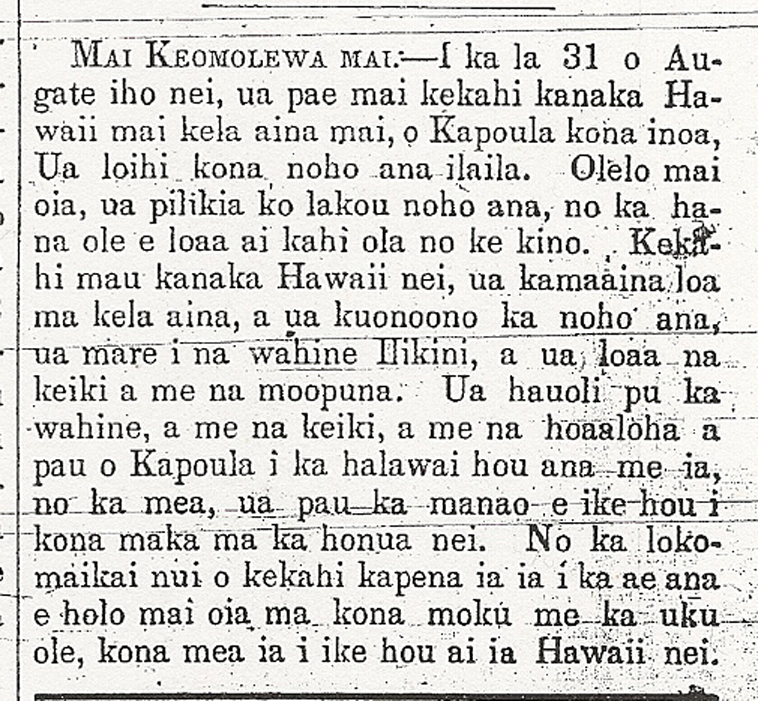
From Keomolewa [Columbia River? Vancouver?]:—On this past 31st of August, a Hawaiian arrived from that land, his name being Kapoula. He lived there for a long time. He stated that their lives were difficult, because they did not have jobs to make a living. Some Hawaiians are long-time residents there, are well off, married Indian women, and had children and grandchildren. The wife, children, and friends of Kapoula are also thrilled at seeing him again, for they thought they’d never see his face again on this earth. It is because of the generosity of a certain captain who allowed him to ride his ship without paying, that he could see Hawaii once again.

[Keomolewa also seen as “Keamolewa”]

(Hoku Loa, 9/1859, p. 12)

Mai Keomolewa mai...

Ka Hoku Loa, Buke I, Helu 3, Aoao 12. Sepatemaba, 1859.

Description of Moku o Lo‘e (Coconut Island) and a lesson on sustainable living. 1859.

FEAST AT MOKUOLOE.

O Hoku Loa:

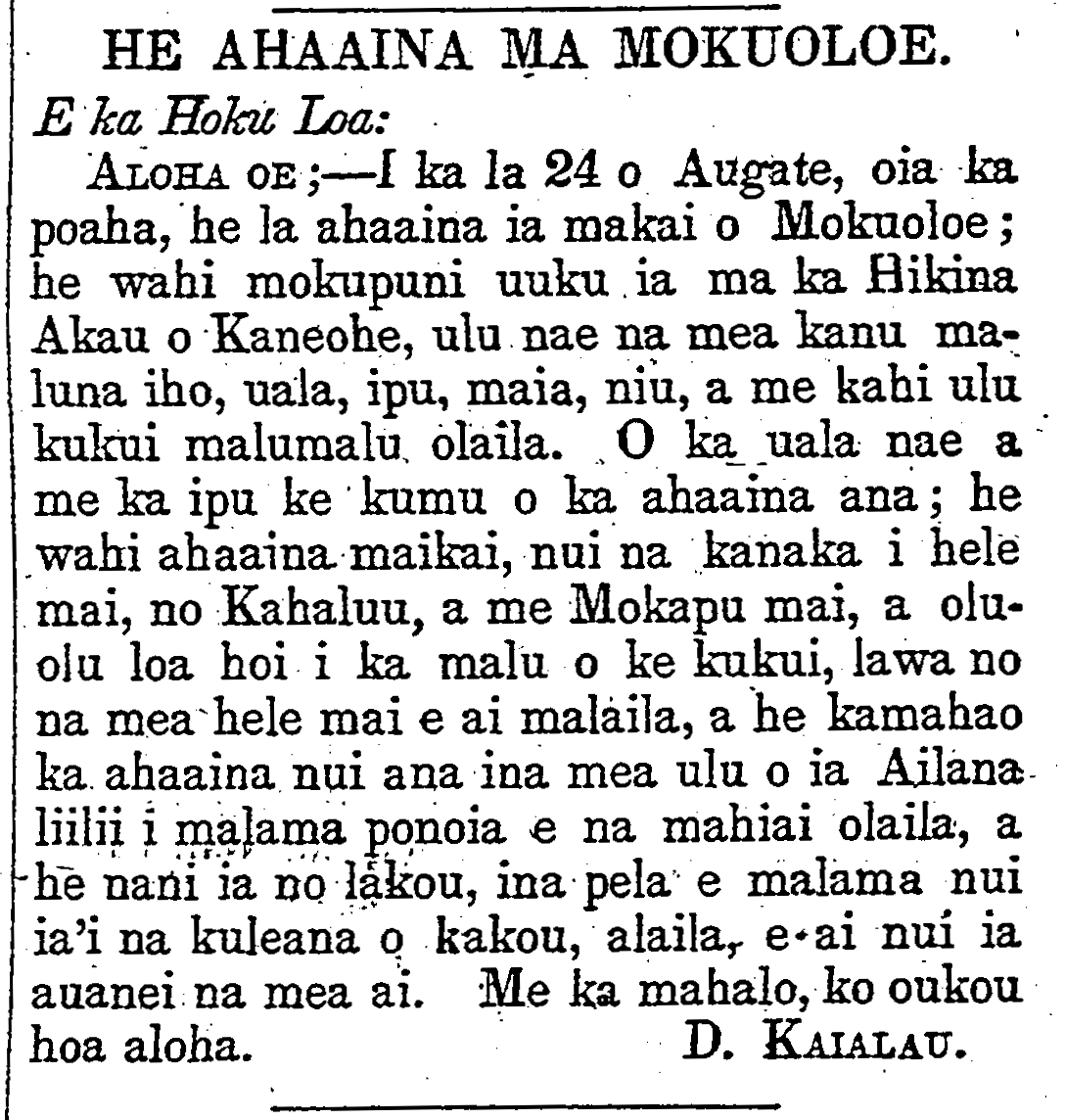
Aloha oe:—The 24th of August, which was a Thursday, was a day of party at the shore of Mokuoloe; it is a small island to the Northeast of Kaneohe, and yet plants grow upon it: sweet potato, gourd, banana, coconut, and its shady kukui grove. The focus of the feast was the sweet potato and gourd; it was a fine party, with many people who came from Kahaluu, and Mokapu, and it was very pleasant in the shade of the kukui, with enough food for all that came; the great spread of produce well-cared for by the farmers of this tiny Island was astonishing, and it would be a good thing if all our own lands were taken care of in the same way, then we’d in time be feasting off of the fruits. With mahalo, your friend.

D. Kaialau.

[For more on Moku o Lo’e, see the recent publication: Moku o Lo’e: A History of Coconut Island.

The images for Hoku Loa will hopefully be put up online soon!]

(Hoku Loa, 9/1859, p. 9)

HE AHAAINA MA MOKUOLOE.

Ka Hoku Loa, Buke I, Helu 3, Aoao 9. Sepatemaba, 1859.

“Kaua i ka Nani o Hilo”. 1892.

A MELE FOR HULA.

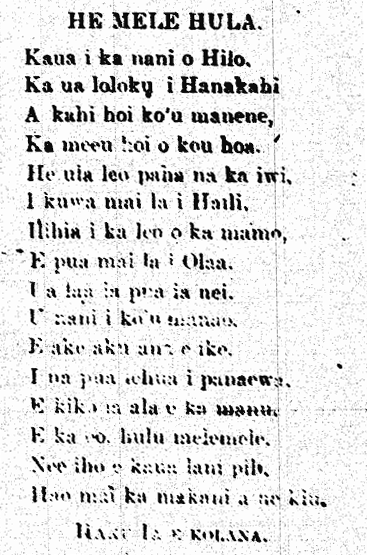
Kaua i ka nani o Hilo
Ka ua loloku i Hanakahi
A kahi hoi ko’u manene,
Ka meeu hoi o kou hoa.
He ula leo paha na ka iwi,
I kuwa mai la i Haili,
Ilihia i ka leo o ka mamo,
E pua mai la i Olaa.
Ua laa ia pua ia nei,
U nani i ko’u manao,
E ake aku ana e ike.
I na pua lehua i panaewa,
E kiko ia ala e ka manu
E ka oo, hulu melemele.
Nee iho e kaua lani pili,
Hao mai ka makani a he kiu.

Composed by Kolana.

[Here is another version of “Kaua i ka Nani o Hilo”, and here it is attributed to Kolana.]

(Leo o ka Lahui, 7/18/1892)

HE MELE HULA.

Ka Leo o ka Lahui, Buke II, Helu 501, Aoao 2. Iulai 18, 1892.

“Kaua i ka Nani o Hilo” and finding things where you might not expect. 1895.

“Kaua i ka Nani o Hilo”

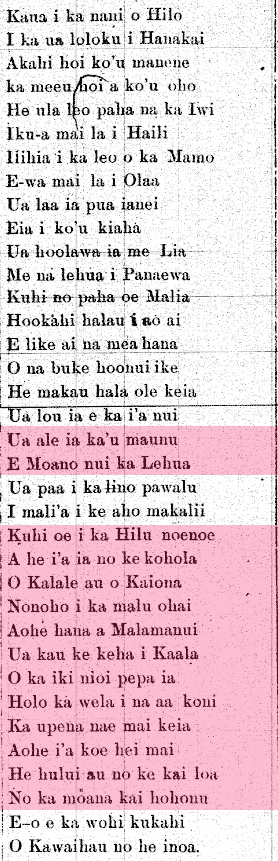
[This mele for Kalakaua is taken from an article entitled “OWAI LA O J. L. KUKAHI, KA IHEPA NUI O KA WAA PAE E PEE NEI?”, which is a scathing criticism by D. M. Punini, Jr. over an ongoing argument concerning the naming of Hawaiian traditional months. But here, I wanted to show once again, that you never know what you will find and where.

The version of “Kaua i ka Nani o Hilo” most widely known today is probably the one from the Roberts Collection at the Bishop Museum, which is quoted here. The Museum’s Mele Index can be searched online here. But notice that the Punini version has additional verses (highlighted in red).

Also note that “Kawaihau” is one of the names for Kalakaua.]

Kaua i ka nani o Hilo

I ka ua loloku i Hanakahi

Akahi hoi ko’u manene

ka meeu hoi a ko’u oho

He ula leo paha na ka Iwi

Iku-a mai la i Haili

Ilihia i ka leo o ka Mamo

E-wa mai la i Olaa

Ua laa ia pua ianei

Eia i ko’u kiaha

Ua hoolawa ia me Lia

Me na lehua i Panaewa

Kuhi no paha oe Malia

Hookahi halau i ao ai

E like ai na mea hana

O na buke hoonui ike

He makau hala ole keia

Ua lou ia e ka i’a nui

Ua ale ia ka’u maunu

E Moano nui ka Lehua

Ua paa i ka lino pawalu

I mali’a i ke aho makalii

Kuhi oe i ka Hilu noenoe

A he i’a ia no ke kohola

O Kalale au o Kaiona

Nonoho i ka malu ohai

Aohe hana a Malamanui

Ua kau ke keha i Kaala

O ka iki nioi pepa ia

Holo ka wela i na aa koni

Ka upena nae mai keia

Aohe i’a koe hei mai

He hului au no ke kai loa

No ka moana kai hohonu

E—o e ka wohi kukahi

O Kawaihau no he inoa.

(Leo o ka Lahui, 4/2/1895, p. 3)

OWAI LA O J. L. KUKAHI, KA IHEPA NUI O KA WAA PAE E PEE NEI?

Ka Leo o ka Lahui, Buke II, Helu 1078, Aoao 3. Aperila 2, 1895.

Hawaiian Ethnological Notes, Bishop Museum.

This is a priceless resource left to us mainly by Mary Kawena Pukui. There are translations (in all stages) of all kinds of material. For more information on the body as well as online search access, see below. (Note that not all of the HEN is listed online.):

http://data.bishopmuseum.org/HEN/index.php

The reason I am bringing this up now is because one of the translations in the collection is of those Moanalua articles! So for a much better translation of the previous article as well as the whole series, check it out at the Museum. Its is available under the call number: HEN Newspapers, 2/17/1922 – 8/31/1922.

One more thing. Although that Moanalua series translation (and those like it) found in HEN does not appear in any publication as a whole, information extracted from it appears in a great number of publications we are all most likely familiar with!

Aina and description in the Hawaiian-Language Newspapers.

There are so many descriptions of land (along with things related to it, like kamaaina who reside there, its wind/rain names, famous stories of the area, etc.) in the Hawaiian-Language Newspapers. They appear in all types of articles: from travelogues (like Thomas K. Maunupau’s “Huakai Makaikai a Kaupo, Maui”), to church meeting descriptions (it seems as if there was a church meeting going on at all times of the year somewhere), to pieces done specifically about a certain place (like the Moanalua one just shown), to random articles not focused on the place but that just happen to mention important information found nowhere else. And something else that is remarkable is that there are descriptions of places through the years, so you can see how they change over time…

All this is in the papers. Once all of the pages of newspaper are shot clearly and word-searchable, so so many awesome things will come to the light of day once more.

Speaking of place, check out the new series “Wahi Ko’iko’i” on Oiwi TV! The story of Queen Emma’s circuit of the islands and her riding horseback up to Waiau is documented beautifully in the newspapers!

Perhaps even the Hawaii Tourism Authority might consider the importance of the Hawaiian-Language Newspapers and all the benefits they could enjoy if all of the information contained in them were easily accessed!

Moanalua, then and now, 1922.

MOANALUA PAST AND MOANALUA PRESENT.

(Written by J. K. Mokumaia)

(Continued)

[This is from a serial column on stories about Moanalua. At the close of the previous installment, Mokumaia is speaking about Waiapuka and evidence of a large population…]

So too a well-built rock platform, it is like a heiau; and so too a huge cave large enough for a hundred people to live; and so too perhaps a small cave enough for a single person to live as a lookout, looking out at Moanalua, where the oncoming enemies would be plain in sight.

In my estimation, its height above sea level is 500 and a half feet, and this valley was an important one to the people, and was called Kamanaiki, and there is the famous hill Puukapu.

It is said that this was a place where the alii and people got together to discuss an important problem, and it will be be clear through your writer, those things integrally related to this hill and why it is famous; being that this hill is very close to where passing travellers were waylaid at night.

Therefore, dear readers of my fond Kilohana (a frequently used appellation for the newspaper Kuokoa, coming from its subtitle “Ke Kilohana Pookela no ka Lahui Hawaii” [The Greatest Prize of the Hawaiian Nation]), I am taking this little entertainment back to the time when Kaleiluhiole was ruling as konohiki, where this story gets its basis.

Kaleiluhiole’s total area of management went all the way to Makua, Waianae and back, when he made his tour, he would start at Moanalua and take a respite at Makua, staying there for some anahulu (a period of 10 days), and then turn back; going along on these tours were his workers as well as those who entertained on the trips so that everyone amongst his travelling companions was filled with the constant promise of merriment.

When the konohiki stayed there, items from the seaside were prepared by the natives, and so too the fruits of the land; being that his word had power, it was necessary to prepare all these things; and the important man during those times as heard by your writer was the one called Kihikihi; this gentleman was lame, but his  mind however was filled with all sorts of ideas that benefited him.

He owned a number of schooners, and from amongst his servants, there is one still alive in Waianae, that being Mr. Hui; they went around with the father of your writer, being that my father was a captain of the vessels belonging to Kihikihi, who was also the grandfather of your writer.

The basis for this discussion was that when the Konohiki stayed in Makua it was a regular thing that entertainment was provided for him; and from amongst these entertainments, was a hula troupe headed by Mahoe; this hula leader was from Kauai,  and when he was joined by the beauty of Makua, that hula performance of his—the hips of that hula leader were pressed by that beauty of Makua; quiet your breathing at the whispering seas of that land, as your eyes will  grow dizzy watching [?].

My father was also one who belonged to this hula troupe, and when the konohiki made his return, until reaching his usual lands, that being Moanalua, it was customary for him, were it extremely long, for everyone to be filled with happiness, and this happiness was what was witnessed when that hula troupe was joined by Moanalua’s, which was headed by Keoni Paakaula, and hula students got together, and thus appeared your writer; from what is known, this travelling was the foundation from which a brought forth its garden and came the year spoken previously of by the writer, when thought first came to him.

Looking at how the konohiki and people lived, it was quite fun; this was a land of people and food aplenty.

(To be continued.)

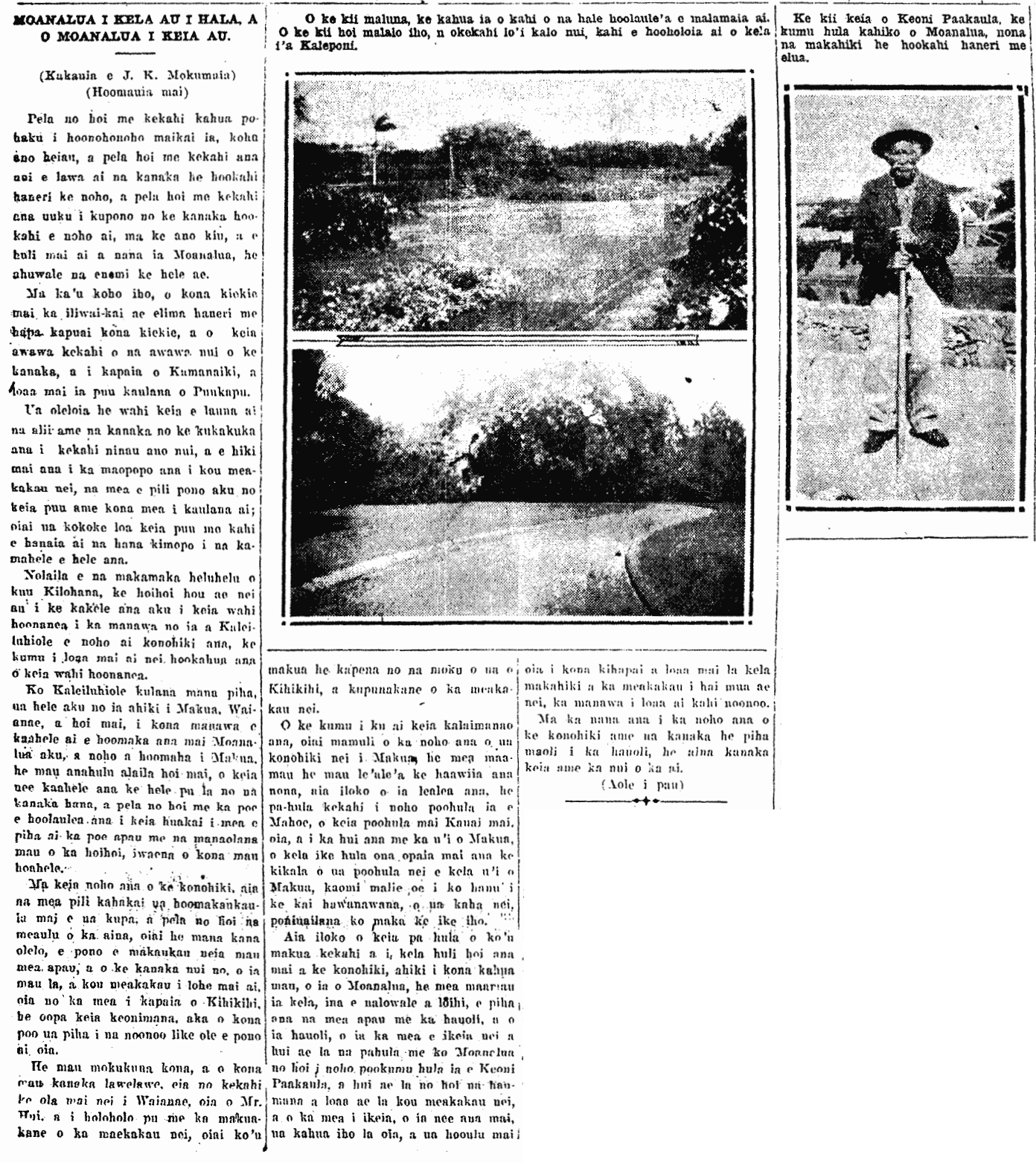
The picture above is the grounds on which was the structure where festivities were held. The picture below is of a great taro patch where the fish from California [i’a Kaleponi?] was set loose.

This is a picture of Keoni Paakaula, the old kumu hula of Moanalua, who is 102 years old.

[This serial by J. K. Mokumaia begins on 2/17/1922 and might end on 8/31/1922 (although there is indication that it is not completed).]

(Kuokoa, 3/10/1922, p. 6)

MOANALUA I KELA AU I HALA, A O MOANALUA I KEIA AU.

Ka Nupepa Kuokoa, Buke LXI, Helu 10, Aoao 6. Maraki 10, 1922.

Bishop Museum Library and Archives accessible by appointment only, 2012.

From the museum website:

“In alignment with Bishop Museum’s new strategic plan, the Library and Archives collections have been identified as an area of priority in the effort to develop increased access to Museum resources for our community. Effective March 1, 2012, the Library and Archives will temporarily suspend public reference hours and provide limited, by-appointment access to its collections. This temporary closure will allow staff the necessary time to support a museum and community effort to plan and implement a new model of operation for this area. ”

see: http://www.bishopmuseum.org/research/library/libarch.html