Lack of payment for Kuokoa subscription, 1918.

PAY YOUR DEBT TO THE KUOKOA NEWSPAPER.

Please show my thoughts about the people who are subscribing to the Kuokoa newspaper, to pay for their subscription from last year and this current year.

I live near Napoopoo nei in center of the land, and what about all of you? Pay all of your debts from the past year and sleep soundly.

And the same for the people who are newly subscribing who said they wanted newspapers, and you received them; and I wrote the editor that I would be sending the money when the ship returns because of what you all told me. And these months went by, you have not brought your money at all.

It isn’t you all that are being called liars, it is me. So here it is, bring your money to me, the agent or it will cause complications later.

Z. P. KALOKUOKAMAILE,

Agent for the Kuokoa Newspaper.

Napoopoo, March 14, 1918.

[The newspapers are constantly asking people to pay their subscriptions, and it seems that lack of payment caused a number of newspapers to fold.]

(Kuokoa, 3/22/1918, p. 3)

E HOOKAA MAI I KA AIE NUPEPA KUOKOA.

Ka Nupepa Kuokoa, Buke LVI, Helu 12, Aoao 3. Maraki 22, 1918.
A. Panui passes away, 1890.

MY LOVED ONE, MY FATHER HAS GONE.

In the evening of Sunday, the 30th of March, the angel of death plucked the life of A. Panui [? Abraham Panui] and took him on the road of no return.

He was born at Kaanapali, Maui, in the year of 1827, and when he was 18, he left his birth land for Kapaa, Kauai, and he married his wife and from their loins were born 4 girls with his first wife, and 10 children with his second wife. Continue reading

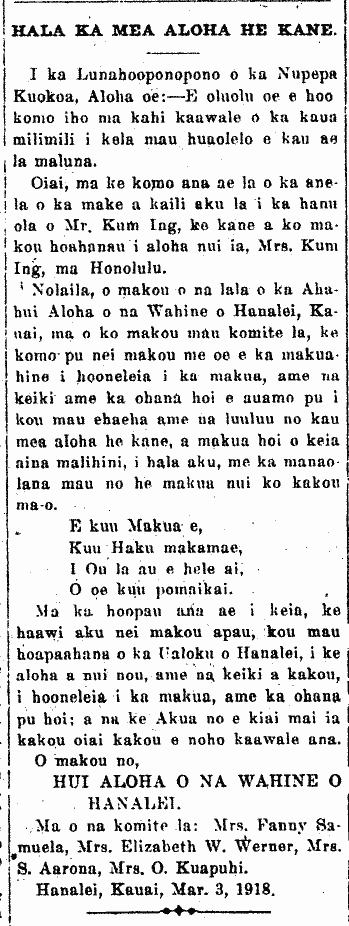
Tam Kum Ing dies, 1918.

HER BELOVED, HER HUSBAND HAS GONE.

To the Editor of the Kuokoa Newspaper, Aloha oe:—Please include in an open space of our favorite, the words placed above.

Being that when the angel of death entered and took the life breath of Mr. Kum Ing, the husband of our much beloved friend, Mrs. Kum Ing, at Honolulu.

Therefore, we, the members of the Ahahui Aloha o na Wahine o Hanalei, Kauai, through our committees, we join with you, oh mother who is left without a father, along with the children and family who carry the pain and sadness for your beloved husband, and father in that unfamiliar land, who has gone; with the constant hope that we have a great father beyond.

O Dear Father,
My precious Lord,
To You I go,
You are my blessing.

At the conclusion of this, all of us, your fellow laborers in the downpouring rain of Hanalei, give our great aloha for you and our children who are without a father, and the ohana as well; and it is God who will watch over us even as we live apart.

We, the

HUI ALOHA O NA WAHINE O HANALEI.

By way of the committee: Mrs. Fanny Samuela, Mrs. Elizabeth W. Werner, Mrs. S. Aarona, Mrs. O. Kuapuhi.

Hanalei, Kauai, Mar. 3, 1918.

(Kuokoa, 3/22/1918, p. 8)

HALA KA MEA ALOHA HE KANE

Ka Nupepa Kuokoa, Buke LVI, Helu 12, Aoao 8. Maraki 22, 1918.

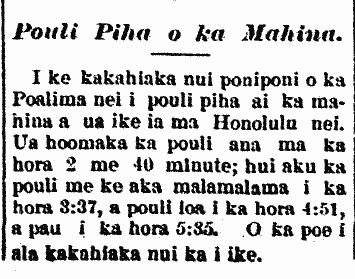
Total Lunar Eclipse, 1892.

The Moon in Total Darkness.

In the dark early morning of this past Friday, the moon went totally dark, and it was seen here in Honolulu. The darkening began at 2 o’clock and 40 minutes; the darkness met with the shadow at 3:37, and total darkness occurred at 4:51, and it was over at 5:35. Those who woke up in the early morning witnessed it.

(Kuokoa, 11/5/1892, p. 3)

Pouli Piha o ka Mahina.

Ka Nupepa Kuokoa, Buke XXXI, Helu 45, Aoao 3. Novemaba 5, 1892.

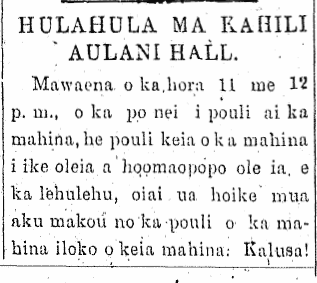
On dancing and an unnoticed eclipse, 1906.

DANCE AT KAHILIAULANI HALL.

Between the hours of 11 and 12 p. m., last night, there was a lunar eclipse; it was an eclipse that was not seen and known by the public, being that we announced the eclipse of the moon this month: Kalusa!

[Has anyone seen the use of the exclamation, “Kalusa!”???]

(Na’i Aupuni, 8/4/1906, p. 2)

HULAHULA MA KAHILIAULANI HALL

Ka Na’i Aupuni, Buke II, Helu 54, Aoao 2. Augate 4, 1906.

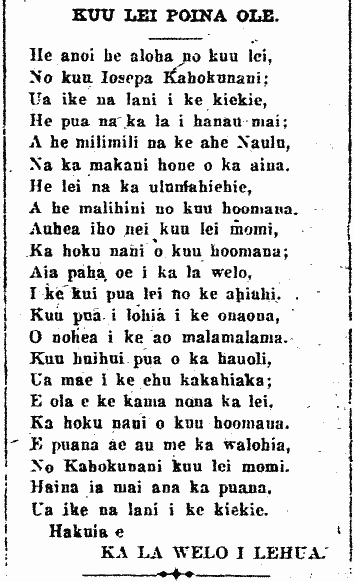
A pretty mele for Joseph Kahokunani, 1918.

KUU LEI POINA OLE.

He anoi he aloha no kuu lei,
No kuu Iosepa Kahokunani;
Ua ike na lani i ke kiekie,
He pua na ka la i hanau mai;
A he milimili na ke ahe Naulu,
Na ka makani hone o ka aina,
He lei na ka ulumahiehie,
A he malihini no kuu hoomana,
Auhea iho nei kuu lei momi,
Ka hoku nani o kuu hoomana;
Aia paha oe i ka la welo,
I ke kui pua lei no ke ahiahi.
Kuu pua i lohia i ke onaona,
O nohea i ke ao malamalama.
Kuu huihui pua o ka hauoli,
Ua mae i ke ehu kakahiaka;
E ola e ke kama nona ka lei.
Ka hoku nani o kuu hoomana,
E puana ae au me ka walohia,
No Kahokunani kuu lei momi.
Haina ia mai ana ka puana,
Ua ike na lani i ke kiekie.

Hakuia e

KA LA WELO I LEHUA.

[Anyone know who Iosepa Kahokunani (Joseph Kahokunani) might be?]

(Kuokoa, 2/1/1918, p. 8)

KUU LEI POINA OLE.

Ka Nupepa Kuokoa, Buke LVI, Helu 5, Aoao 8. Feberuari 1, 1918.

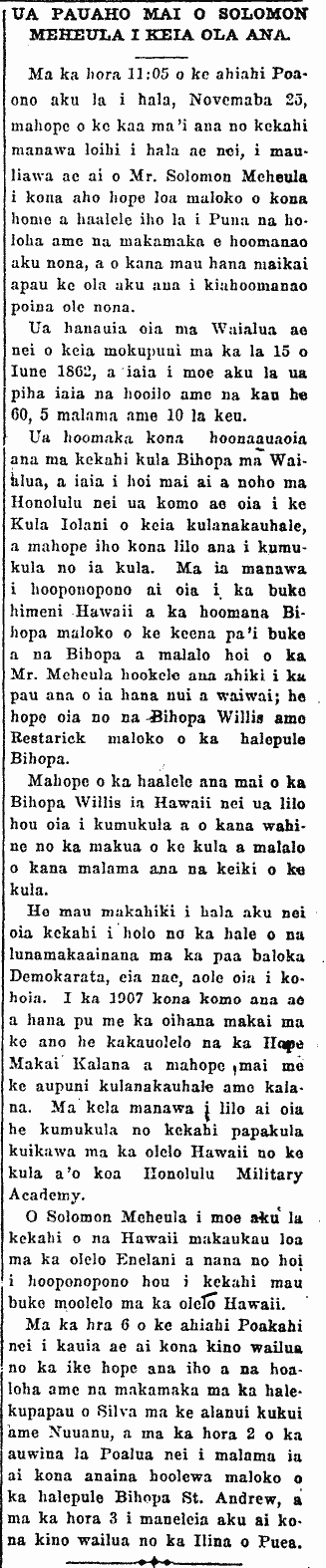
Another Solomon Meheula passes on just three years earlier, 1922.

SOLOMON MEHEULA GROWS WEARY OF THIS LIFE.

At 11:05 in the evening of this past Saturday, November 25, after being sick for a long time, Mr. Solomon Meheula gasped his last breath at his home, and he left in Puna his friends and fellows remembering him and all of his fine works that will live on as a monument to him.

He was born over there in Waialua, on this island, on the 15th of June 1862, and now that he sleeps, he spent 60 winters and summers plus 5 months and 10 days.

His education was began at an Episcopal school in Waialua, and when he returned to live in Honolulu nei, he entered the Iolani School of this town, and after he became a teacher for that school. During this time he edited the Episcopal Hymnal in the press of the Episcopal Church, and it was under Mr. Meheula’s guidance that this great and valuable work was completed; he was an assistant to the Bishops Willis and Restarick in the Episcopal Church.

After Bishop Willis left Hawaii nei, he again became a school teacher, and his wife was the matron of the school, and the children of the school were under her care.

A number of years ago, he was one of those who ran for representative under the Democratic party, however, he was not elected. In 1907 he entered and began working at the police department as a secretary under the County Deputy Sheriff and thereafter with the city and county government. At that time, he became a teacher in a special Hawaiian-language class for the military school, the Honolulu Military Academy.

The late Solomon Meheula was one of the Hawaiians who was fluent in English, and he rearranged a number of story books into Hawaiian.

At 6 o’clock in the evening of this Monday, his remains were placed for the last visitation by his fellows and friends at the Silva Mortuary on Kukui Street and Nuuanu Avenue, and at 2 o’clock in the afternoon of this Tuesday, his funeral was held at the Episcopal church, St. Andrew, and at 3 o’clock his remains were carried to the Puea Cemetery.

(Kuokoa, 11/30/1922, p. 1)

UA PAUAHO MAI O SOLOMON MEHEULA I KEIA OLA ANA.

Ka Nupepa Kuokoa, Buke LXI, Helu 48, Aoao 1. Novemaba 30, 1922.

Solomon W. Meheula passes on, 1925.

S. W. MEHEULA LEAVES THIS LIFE.

In the early morning of Wednesday last week, Solomon W. Meheula, one of the kamaaina of this district of Hanalei, Kauai, left this worldly life, after being sick for a short time, and in the afternoon of that Wednesday, his remains were carried to and buried at Anahola, his birth land.

He was a native and local that faced the showers [aloalo kuaua], that is of Hanalei, and as he now rests, he lived 51 years in this life. He left behind his wife and his four children, three daughters and one son.

He was educated at Kamehameha School for Boys, and he was one who was very enthusiastic in sports and he was often scene in the circle of those who know singing. He strove to do good works. He was ordained in the ministry for Kauai just a little while ago, and it was in this profession that he worked until his death.

He was a member of the local legislature in 1923 from Kauai, and for several years, he lived and worked on the homestead lands in Kapaa, and now that he has gone, he has become an unforgettable memorial for all the good works which he did.

(Kuokoa, 5/28/1925, p. 2)

HAALELE MAI O S. W. MEHEULA I KEIA OLA ANA.

Ka Nupepa Kuokoa, Buke LXIV, Helu 22, Aoao 2. Mei 28, 1925.

New book by Joseph Mokuohai Poepoe, 1891.

[Found under: “NU HOU KULOKO.”]

The new book by J. M. Poepoe called Ki Gula, is 40 pages long; all that is left is for them to swiftly disappear [pahee aku koe i ka welowelo].

[The only book in Forbe’s National Bibliography that resembles this book from 1891 is “Ka Buke Akeakamai a o ke Ki Gula.” However there is nothing about Poepoe, and the total number of pages given is much more than 40...]

(Leo o ka Lahui, 4/9/1891, p. 2)

He 40 ka nui...

Ka Leo o ka Lahui, Buke II, Helu 168, Aoao 2. Aperila 9, 1891.