
No Kalani “Kauikeaouli Kamehameha III.”
“O hanau ka po ia luna,
Hanau ka po i luna nei,
O lani hanee ka po o pinai ke ewe,
O pipili ka po o moe anaanale’a,
O kohi ana le’a ka po o mahianale’a,
O huli e ka po o kaawale ka pili,
O ke keiki po lani keia a “Kea,” i hanau,
Keiki akahi a ka po keiki alua a ka po,
Keiki akolu a ka po,
O ke kuakoko o ka po,
E hanau mai auanei ka po,
Oia hoi, o ka Po, hanau ka po,
O ka po la hoi auanei ko luna nei la,
Owai la hoi auanei ko lalo na,
Owai la, O ka moku, Ai’a, aia hoi ha,
“Palaki,” ka pua i ka ua pala ka hinano,
Kahaha ka nahele o koolau,
Uli e aku la ke poo o Haihala,
He mauna ia iluna o Makaolehua,
He mau lehua na ka wai a koloa,
I kanu i ke kai o Piakalae,
Noeo aku la ke kai i ka akani,
Mehe koko pau mano la i ka moae,
Ka ula o ke kai mai “Nae a Hilia”—e,
E aloha—e.
Kai ka hili hewa o ka lima i ka po nei,
Ua kuhi i kuu kahela he moe hewa—a ha’e,
Moe ka makani o lalo ua ahiahi,
Kau ka malo o ka Ikioe i ka pohu,
Puhala ka ihu nana i ke kaao,
Kuhelahela i ka malie na kaha,
Waiho kaka ke kula o Kaiolohia,
Ka lele maopu i ka wai a ka naulu,
Ka hoo wawa i ka piha a ka manu he lai—e,
E aloha—e.
[Na] AUA.
O hanau ka Moku a kupu,
A lau, a loa, a ao, a muo a lilo,
Ka moku ia luna o Hawaii,
O Hawaii nei no ka moku,
He Pulewa ka aina he Naka Hawaii,
E lewa wale ana no i ka lani lewa,
Hanoa mai e Wakea pa hano ia,
Malia kea a o ka moku me ka honua,
Paa ia lawaalani i ka lima akau o Wakea,
Paa Hawaii, a laa Hawaii la ikea he moku,
O ka moku la hoi auanei kolalo nei la,
Owai la hoi auanei ko luna, owai la?
O ke Ao—aia—aia hoi ha.”
“Hii Puna i ke keiki puu i ke alo o Moikeha,
I na pae puu hala iluna,
Hele Kalalea iho au ana i kai,
He mau maka ka liu na ka makani,
Ike akuu oe ia Aahoaka,
E hemo kahi ana i ke alo o Wailua,
Uu ka pua a ka makani hoolua,
Malua Haupu ke poo o Keolewa—e
E aloha—e.
Aloha wale iho no ia Wailua,
I ka hiolo a ka pua hau i ka wai—a, hae,
Wai Maluaka onio ka laumania,
Kahuli Kapaa ke alo o Kuahiahi,
Haili ana Puna ia’u me ipo la,
Ka wao aku o ka hau o Palehuna,
O ka waikini aku no ka hoi ia,
Aohe wa ua ike aku no hoi—e,
E aloha—e.
Ua ike o ka maka kai halawai,
A o i pa na lima e meheu ai—a hae.”
Na HAUNA.
“O hanau ke Ao, o hiki ae,
O ohi ae ke ao o hiki ae,
O mokupawa ke ao o hiki ae,
O akaula ke ao o hiki ae,
O moakaka ku ke ao mola’e,
O opukupuku ke ao melemele,
O memele ka “opua” he la—i,
O oponiuli ka opua hiwahiwa,
O hiwahiwa ka opua lani ele,
Eleele ka lani hu hulu weo,
Lani ekaeka ha eleele,
Hakona hakuma hakumakuma,
O ke ao nui mai hee ua keia,
E hoowiliwili mai ana e hana-u,
Oia hoi—o ke Ao—hanau ke ao,
O ke ao la hoi auanei ko luna nei la,
Owai la auanei ko lalo la?
Owai la—o ka Mauna—aia—Aia hoi ha.”
“Hoinainau mea ipo ka nahele,
Hookokoe ana ka maka i ka moani,
I ka ike i na pua hoomahie luna,
Ua hihina wale i Moeawakea,
Ka inoa ua poina ia Malio,
Aia ka i pua lei o ha—o,
I Puna no ka waihona a ka makani,
Kaele ka malama ana a ka puulena,
I kahi mea hoalohaloha no—e,
E aloha—e,
O ke aloha ia e pa waa nei,
E hou nui ai ka maka ke ike aku—a,
Hae.”
Ike i na lani ua o mahele ana,
He omaomao ka la kakaia kea,
He la aihaa nui ia no ka ua,
Hele awili ke poo o ka lehua,
Ako Hilo i ka malua a pau ke aho,
Hoi ka i-i akamai a ka malie,
Kohi i kawelewele a ka lai,
O kuu ike wale aku no i ka hala,
Ua hoopapa kai wale i Haena—e,
E aloha—e.
E na ka maka ahiu me he puunoa la,
I ka ike i kana mea i loaa’i—a—hae.
Na PIOPIO.
“O hanau ka mauna a Kea,
Opuu ae ka mauna a Kea,
O Wakea ke kane, o Papa o Welinuu ka wahine,
Hanau Hoohoku he wahine,
Hanau Haloa he alii,
Hanau ka mauna he keiki mauna na Kea,
O ka lili o Wakea o ka hai i ka hala,
O ke ku kuku laau ana me Kane,
I hoouka ai i iloko o Kahikiku,
Hee Wakea ka lewa kona ohua,
Kuamu ia e Kane, kuawa ia e Kane,
Hoi mai Wakea a loko o lani momo—e,
Moe Wakea moe ia Papa,
Hanau ka la na Wakea,
He keiki kapu na Wakea,
O ka uluna o Wakea na Kea no,
Hanau ka mauna he makahiapo kapu na Kea,
Oia hoi—o ka mauna—hana ka mauna,
O ka mauna auanei ko lalo nei la,
Owai la auanei ko luna la?
Owai la, o ka La, aia—aia hoi ha.”
“Hoe Puna i ka waa pola loa a ka ino,
Haukaukai—koo o Kookoolau,
Eha—e—eha—la—eha i ka makili kui a Kaulumano,
Hala’e ka makawalu ihe a Ko-a-e,
Ku iho i ka pahu ku a ka awaawa,
Hanane ke kikala o ko Hilo kini,
Hoi luuluu i ke oe o Hanakahi,
I ka palolo a ua wahine o ka lua—e,
E aloha—e.
No ke aloha no ka’u lalau ana,
Aole au i hewa iho i ke alii—a hae.”
“Nalo ole ka puana o ka moe ua pulelo,
Kupinai aku la a uka o ka pili,
Me he mumuhu na ka mumuhu nalopaka la,
Ka ekeekemu i ka pua o ka laau,
Maalo hookahi wale iho no au i Hilo—e,
E aloha—e.
He aloha kahiko no na’u mai lalo mai—a—hae.
Na HEHENA.
(Kuokoa, 3/24/1866, p. 4)
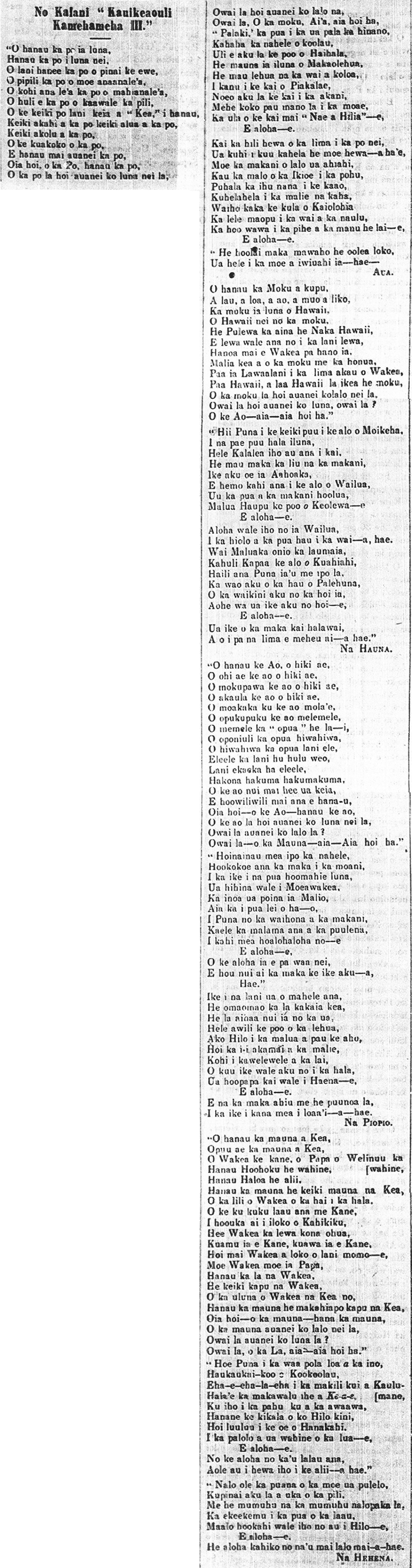
Ka Nupepa Kuokoa, Buke V, Helu 12, Aoao 4. Maraki 24, 1866.
No Kalani “Kauikeaoule Kamehameha III.” [No Kalani “Kauikeaouli Kamehameha III.”]
O hanau ka La o na’u,
O nau ka la o Kupauole,
O Kupauole ka la kohia,
Kohia ka la ia Hina,
O ke kukuna o ka la paa,
O ka pea o hilima o hilinehu,
O ka lala o ke Kamani,
O ka hui o ke Kamani ula,
O ka ehu o Halulu,
Ke haina mai la hai,
Ke haki’a mai la e ka “La,”
E ke keiki hele lani a “Kea,”
O Wakea kai lalo o ka la kai luna,
O ke keiki la a Kea i hookauhua ai,
Oia hoi—o ka La—hanau ka La,
O ka La, hoi auanei ko luna la,
Owai la ua nei ko lalo nei?
Owai la—o ka moana—aia, aia hoi ha,
“Hemo kahili kuhao i ka pohu,
Mehe lala no ka hale loha maikai la,
Ka paia kua a ka makani,
I hoaho i hoa ia e ka lai o Hauola,
Oki ka kahi Lahaina i ka malino,
Honi na hono i ka makani paalaa,
He hanu ia no ke ka Kaalani—e,
E aloha—e.
Aloha aku la i ka lau o ka manao,
Aiwaiwa i ka moe ke pa mai—a,”
Hae.
Pa na lima o ka he Kuawa,
He makemake okoa no i Wailuku,
E like na manao me Kaiaiki,
Kahiko i hoao ai i ka moe e,
O ka momoe aku la ia i Hopukoa,
Hi hininu i ke kula me ka Haakea,
Loaa ka hoa i ke kaha o Kahuaiki—e,
E aloha—e.
O ka hue Kamehai ka inoa e nalo,
Aia no ka hewa o ka lonoia—a,
Hae.
O hanau ka moana a Kea,
O na nalu na Kea, o ke kai na Kea,
O kai kane o kai wahine na Kea,
O koa ku o koa halelo ulu na Kea, hanau ka La,
O hoowiliwili a ka ia iloko o ka moana,
Uliuli eleele nei lae—o ka moana,
O ka moana la hoi auanei ko lalo nei la,
Owai la hoi auanei ko luna, owai la?
O ku, o Lono, o Kane, o Kanalua, o Kaekae,
O Maliu, o ka haku o ka pule, o nuupule,
O Nuukahana, o elieli holo imua kapu,
O elieli holo imua noa, noa ka hanau ana o ke ‘lii,
Hanau “Ku” o ku la hoi auanei ko luna,
Owai la hoi auanei ko lalo nei owai la?
O Haloa, Puka kanaka laha na ‘liii,
Loaa iluna nei o Kalani Mehameha,
A Ekahi ka lani—la—akahi o luna nei,
O Kalani “Kauikaalaneo—la—alua oluna nei,
Pili laua—ua mau paha—oia paha?
O Kalani Nui kua Liholiho akahi,
I ke kapu la—akahi oluna nei,
O Kalani Kauikeaouli—la alua o luna nei,
Pili laua ua mau paha oia paha.”
Here O Friends is the first time we actually have the part of this mele in which is the name of the one whose birthday it is, in the mele called, “O hanau a Hua.” That being “Kapu Puna i ka wahine Ihiihi ka ma,” and after that, I, your “Expert,” will tell you of the day, and the months, and everything pertaining to the birthday of that “Leiopapa.”
[This genealogical mele for Kamehameha III was printed a number of times over the years in various Hawaiian-Language Newspapers. It was important enough back then, and it is just as important for us today, if not more so. The gods gave birth to all above and all below—it is all sacred. Let us treat all our land and ocean with that in mind.
Unfortunately much of the columns in which these appear are not digitized clearly, and are hard to read…]
(Kuokoa, 3/31/1866, p. 4)
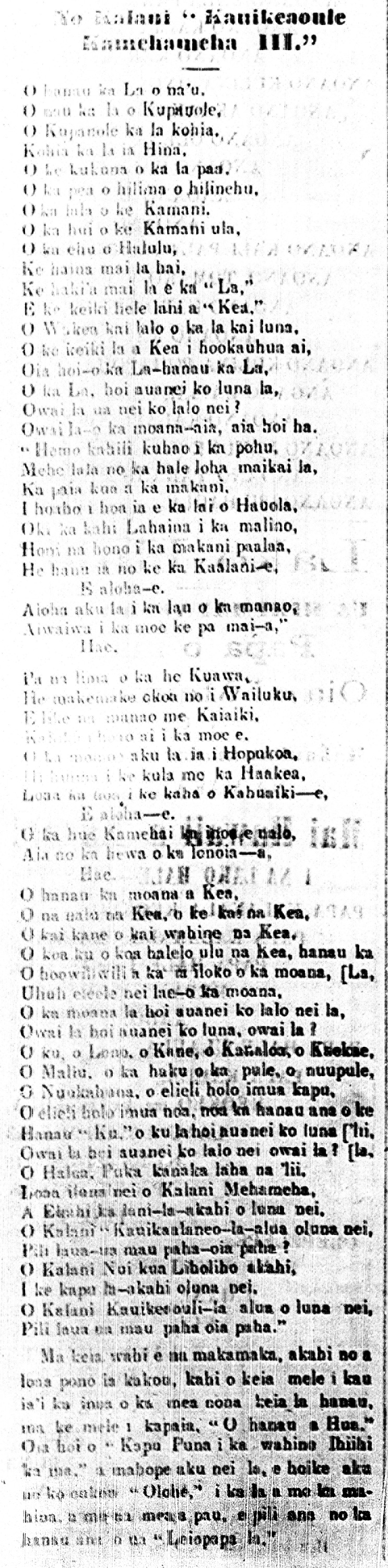
Ka Nupepa Kuokoa, Buke V, Helu 13, Aoao 4. Maraki 31, 1866.


 nupepa