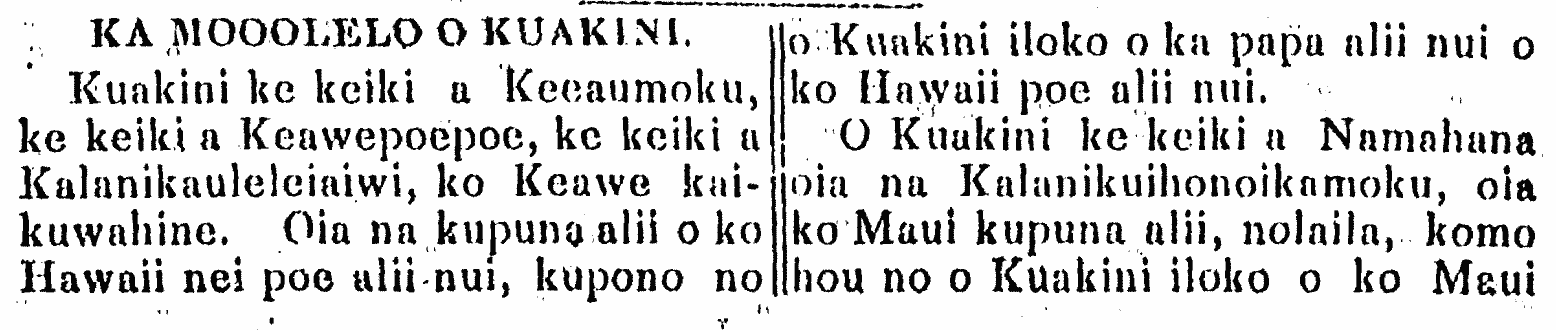
BIOGRAPHY OF KUAKINI.
Kuakini was the son of Keeaumoku, the son of Kalanikauleleiaiwi, the sister of Keawe. They are the royal ancestors of Hawaii Island’s high chiefs, Kuakini was befitting the class of high chiefs amongst Hawaii’s alii nui.
Kuakini was the son of Namahana who was born from Kalanikuihonoikamoku, and they are Maui’s royal ancestors, and therefore, Kuakini is amongst Maui’s…
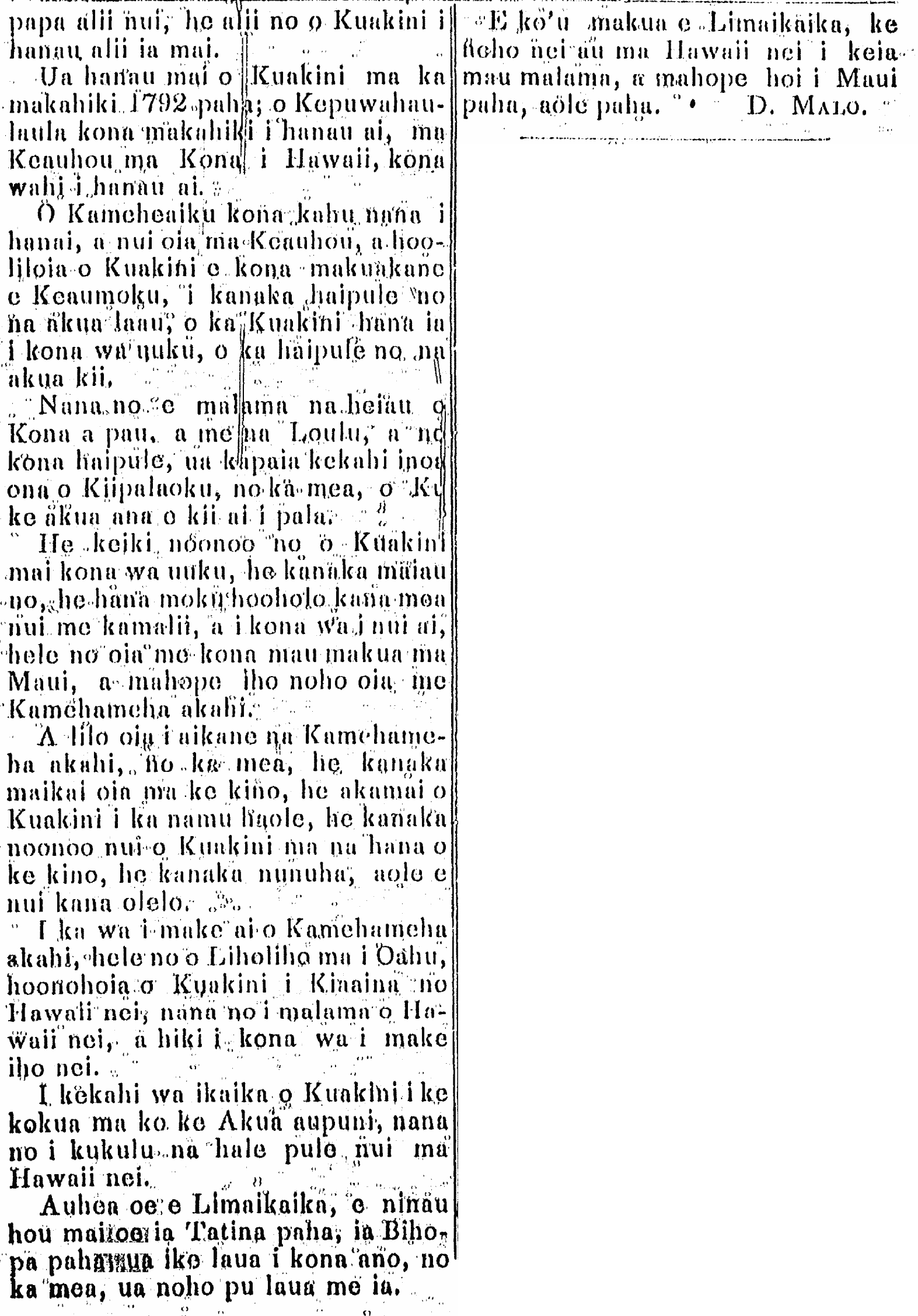
…class of high chiefs; Kuakini was born as an alii.
Kuakini was born in the year 1792 perhaps; he was born in the year of [battle of] Kepuwahaulaula; at Keauhou in Kona in Hawaii was where he was born.
His caretaker [kahu hanai] was Kameheaiku, and Kuakini grew up at Keauhou, and he was made by his father, Keeaumoku, to pray to the wooden gods; this was Kuakini’s duties in his youth, the worship of the wooden gods.
He was the one who cared for all the temples in Kona, along with the Loulu temples, and in regard to his worshiping, one of the names Kuakini was called was Kiipalaoku, for Ku was the god for whom he would fetch pala fern.
Kuakini was a thinker from when he was small; he was meticulous; he often would sail boats with the other children in his youth, and when he grew up, he went with his parents to Maui, and thereafter he lived with Kamehameha I.
He became an aikane of Kamehameha I, because Kuakini possessed a fine body, he was skilled in English, he thought much about the way a body functions, he was sullen, and was a man of few words.
When Kamehameha I died, Liholiho them went to Oahu, and Kuakini was appointed Governor of Hawaii, and it was he that was to care for Hawaii until his recent death.
When Kuakini was assisting intently with the kingdom of God, it was he who built the great churches here on Hawaii Island.
O Armstrong [Limaikaika], please ask of Thurston [Tatina] or Bishop [Bihopa], for they know what he was like for both of them lived with him.
O Father Armstrong, I am living here on Hawaii these months, and will then return to Maui, or perhaps not. D. MALO.
(Nonanona, 1/7/1845, pp. 89–90)
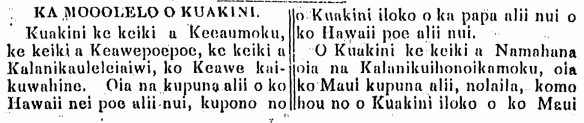
Ka Nonanona, Buke 4, Pepa 19, Aoao 89. Ianuari 7, 1845.
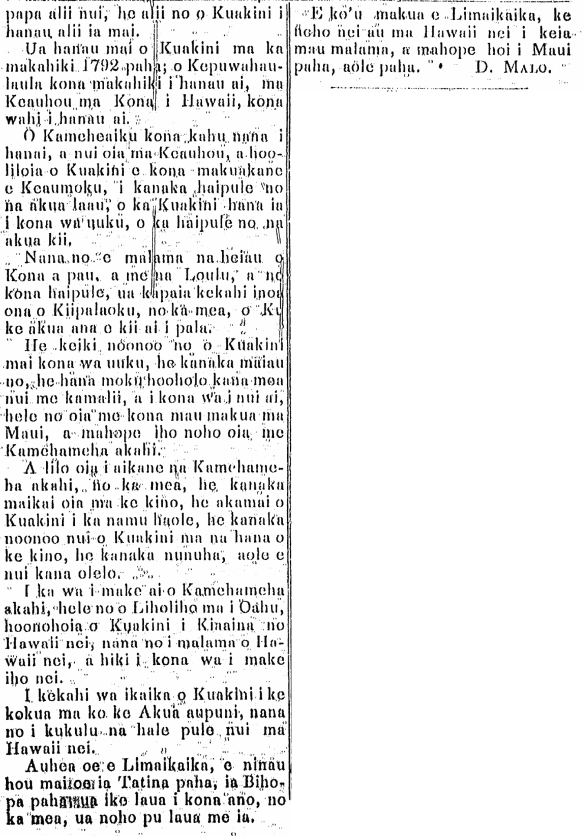
Ka Nonanona, Buke 4, Pepa 19, Aoao 90. Ianuari 7, 1845

 nupepa