Import of Snakes to Hawaii? 1902.

Snakes are Allowed to be Imported to Hawaii.

THIS NEWS WAS REPORTED TO THE HEAD CUSTOMS INSPECTOR OF HAWAII.

It was thoroughly believed that a person or persons could not bring in snakes from foreign lands into Hawaii, but the head custom inspector received a letter telling him that there is no law prohibiting the import of this type of animal into Hawaii, and should it be brought in by a person or persons, he has not right to prevent the bringing of it ashore.

It is right for us to oppose this with what power we have. There are many pests currently brought into Hawaii, and we do not want to bring in others. Before the arrival to Hawaii nei, there were no mosquitoes here, and they could be up at night without their hands tiring out from constantly waving them off. That isn’t all, there is the mongoose that are eating chicks, and eggs, and we hear that a baby left somewhere by its mother while she was washing clothes, died because it was got by a mongoose which sucked all of its blood. There are also mynah birds, fleas, and many, many other pests brought into Hawaii after the arrival of the enlightened races into Hawaii, and here is another thing that is wanted to be open to a person or persons to bring into Hawaii.

If these snakes come into Hawaii nei, and they spread in the forests, we will not be able to let our children go out to those places without facing calamity. Not just the children, but animals will be in danger of being bit by these snakes. If the snakes are allowed, the time will perhaps come when lions and tigers will be imported, and we will be just like most of the lands of the world.

We want the beautiful things of the other lands, but the problems are what we don’t want. If they import beneficial things, we will happily take them let them free in our verdant fields of Hawaii nei for them to run about; however, if they are to bring in pests, we will stand and exterminate them when they step within the borders of this Territory.

[That was a close one! But lately, with all the budget cuts and the resulting lack of inspectors doing inspections, who knows what is being brought into Hawaii nei. Some things are too important to let fall to the side…]

(Kuokoa, 4/11/1902, p. 1)
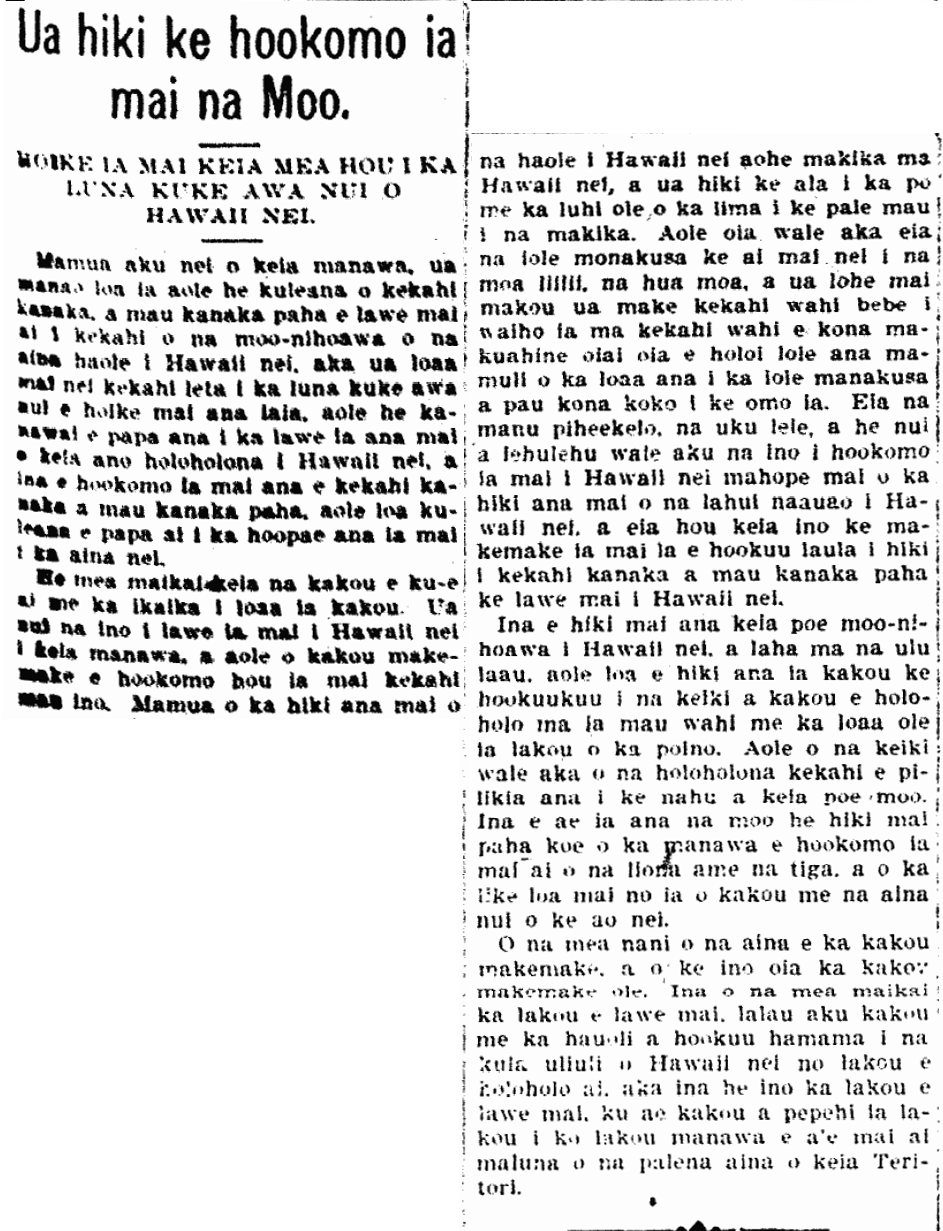
Ua hiki ke hookomo ia mai na Moo.

Ka Nupepa Kuokoa, Buke XL, Helu 15, Aoao 1. Aperila 11, 1902.
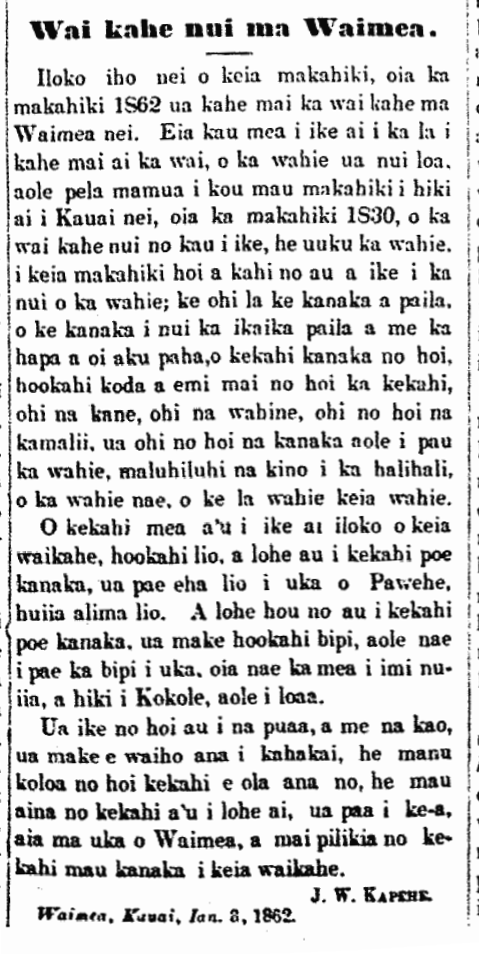
Bad weather on Kauai. 1862.

Great Flooding in Waimea.

During this year, 1862, there was flooding here in Waimea. This is what I saw on the day of the flood, a lot of kindling; it wasn’t like that before in the years since I arrived here to Kauai, that being 1830; in the floods I’ve witnessed, there was only a little kindling. This year is the first time I’ve seen so much wood for fire; people were gathering it up and making piles. A strong man would have a pile and a half or more, and another would have a cord or less. Men would gather, women, and children too; people gathered it up, but there was no end to it; your body would get tired from carrying the wood, and yet the kindling, it would still be remain here and there.

Another thing I witnessed in the flood was a horse, and I hear from some other people that four horses came ashore at Pawehe; all together that makes five horses. And from some other people I hear that a cow died but did not wash up ashore, but was searched carefully for all the way until Kokole, but was not found.

I’ve seen pigs and goats that were dead, laying on the shore, and there are some ducks still alive; there are places which I’ve heard that are obstructed in the uplands of Waimea, and some people almost got in trouble in this flood.

J. W. Kapehe,

Waimea, Kauai, Jan. 3, 1862.

(Kuokoa, 3/22/1862, p. 2)

Wai kahe nui ma Waimea.

Ka Nupepa Kuokoa, Buke I, helu 17, Aoao 2. Maraki 22, 1862.

Ad from the first issue of Kuokoa, 1861.

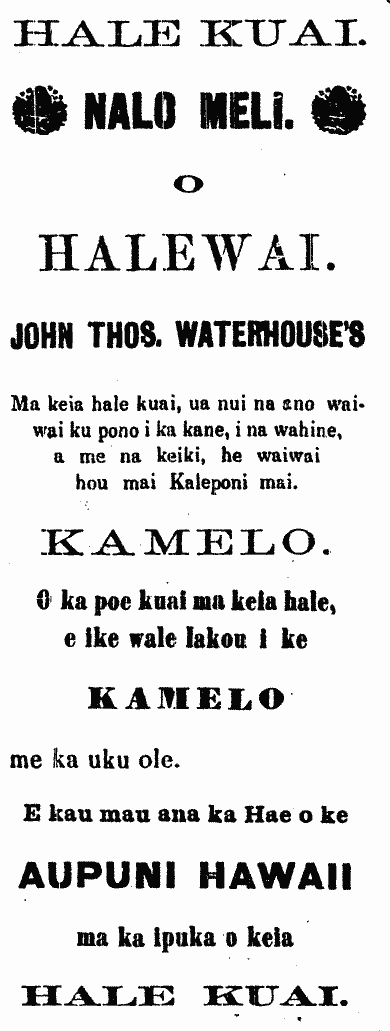
NALO MELI [Bee]

SHOP

of

HALEWAI.

JOHN THOMAS WATERHOUSE’S

At this store, there are many items for men, women, and children; new goods from California.

CAMEL

Those who make purchases from this store will see the

CAMEL

at no cost.

Always flying is the Flag of the

HAWAIIAN NATION

at the entrace of this

STORE.

[Notice how “Halewai” [lit., water house] is what they called John Thomas Waterhouse. Later for Waterhouse you will also see Walakahausi and Walakahauki.

The images to the left and right of “Nalo Meli” are of a bee hive with bees flying above it.

OH, and yes, it seems there was a camel…]

(Kuokoa, 10/1861, p. 3)

HALE KUAI.

Ka Nupepa Kuokoa, Buke I, Helu 1, Aoao 3. Okatoba, 1861.

Honey Bees introduced, 1857.

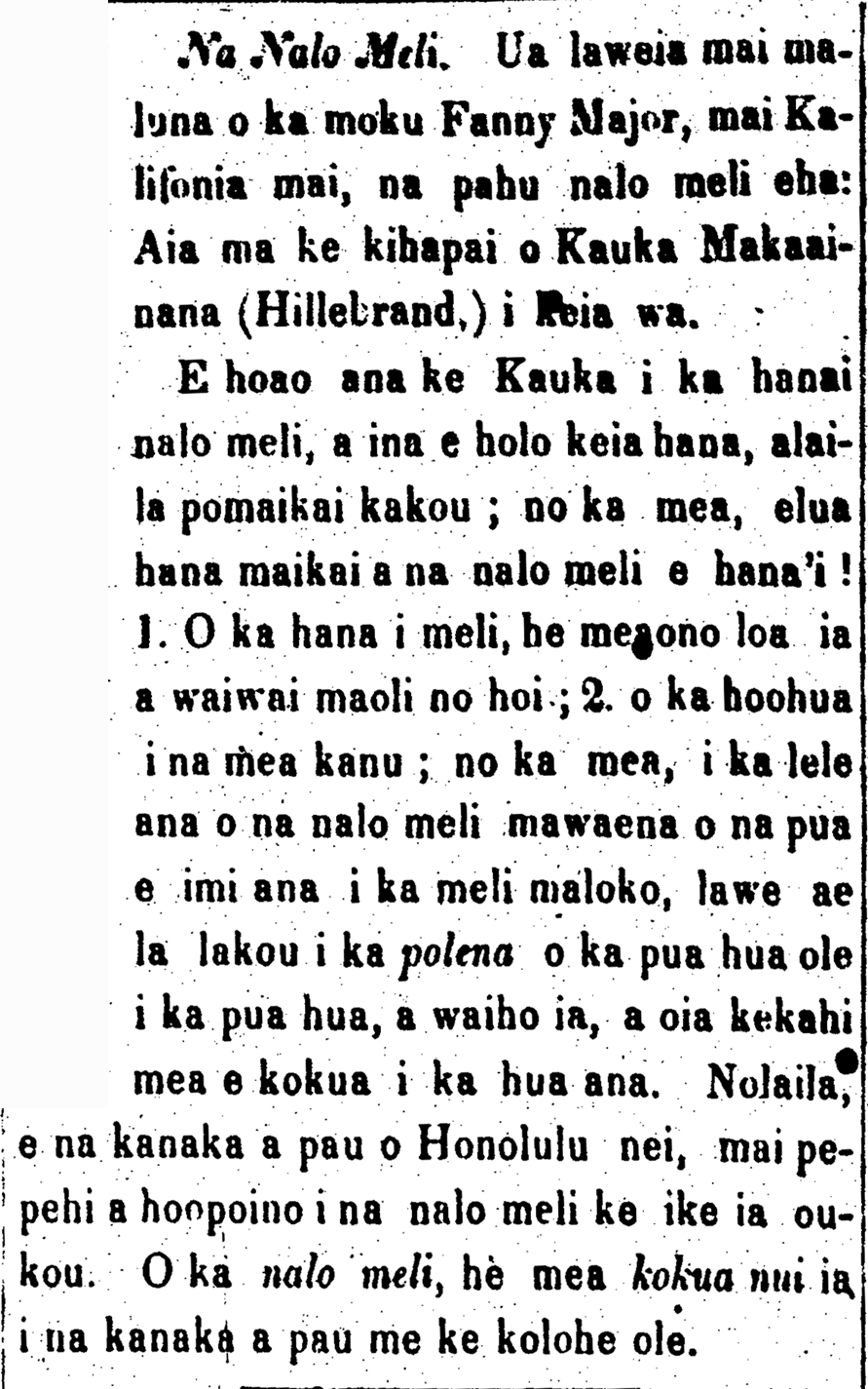
Honey Bees [nalo meli]. Brought upon the ship Fanny Major from California were four boxes of bees. Currently they are in the garden of Dr. Hillebrand [Kauka Makaainana].

The doctor will attempt raising the bees, and should this progress, we will be blessed, because there are two good things done by bees. 1. They make honey, which is very delicious and valuable. 2. They make plants fruit, because when bees fly to flowers in search of the nectar within, it takes with them pollen from non-fruiting flowers to fruiting flowers and deposit it, and that is what helps fruiting. Therefore, all you people of Honolulu nei, do not kill or abuse the bees when you see them. Bees are a great help to all, without any harm.

[According to Senior Scientist and Cultural Advisor at The Nature Conservancy of Hawai’i, Sam Ohu Gon III, “In the big picture, in our modern agricultural world, honeybees are vital, but we should never forget our little-known native bees…”]

(Hae Hawaii, 11/18/1857, p. 134)

Na Nalo Meli.

Ka Hae Hawaii, Buke 2, Ano Hou.----Helu 34, Aoao 134. Novemaba 18, 1857.

Rabbits for the young prince, 1861.

[Found under: “This and That of Hawaii nei”]

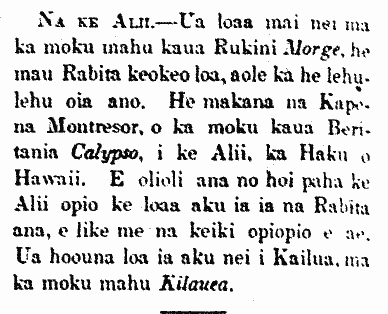
For the Alii.—Aboard the Russian warship, Morge, there were pure white Rabbits which are probably rare. They are a gift from Captain Montresor of the British warship Calypso to the Alii, Ka Haku o Hawaii. They young chief will most certainly be thrilled when receiving his Rabbits, just like other young children. It was sent all the way to Kailua by the steamboat Kilauea.

(Kuokoa, 12/16/1861, p. 2)

Na ke Alii.

Ka Nupepa Kuokoa, Buke I, Helu 5, Aoao 2. Dekemaba 16, 1861.

Deer imported from Japan in 1867

Seven Deer—The Hawaiian Consul in Japan sent to our Benevolent King Kapuaiwa, eight live deer, however one died at sea. These deer were given as a gift to our King. We hear that these deer will be shipped to Molokai and set free; perhaps they will increase should they all live healthily for a long time. We recall that some were taken to Parker Ranch in Waimea, but what became of those deer; maybe they are roaming the cold forests of that mountainous land [aina mauna], and maybe they gave birth to young and are multiplying and becoming abundant on that island.

(Kuokoa, 12/21/1867, p. 2)

He Mau Dia Ehiku

Nupepa Kuokoa, Buke VI, Helu 51, Aoao 2. Dekemaba 21, 1867.