Hawaiians singing on the East Coast, 1908.

A SINGING GROUP OF HAWAIIAN YOUTHS TOURING IN THE EAST

Their Singing was Received with Much Delight

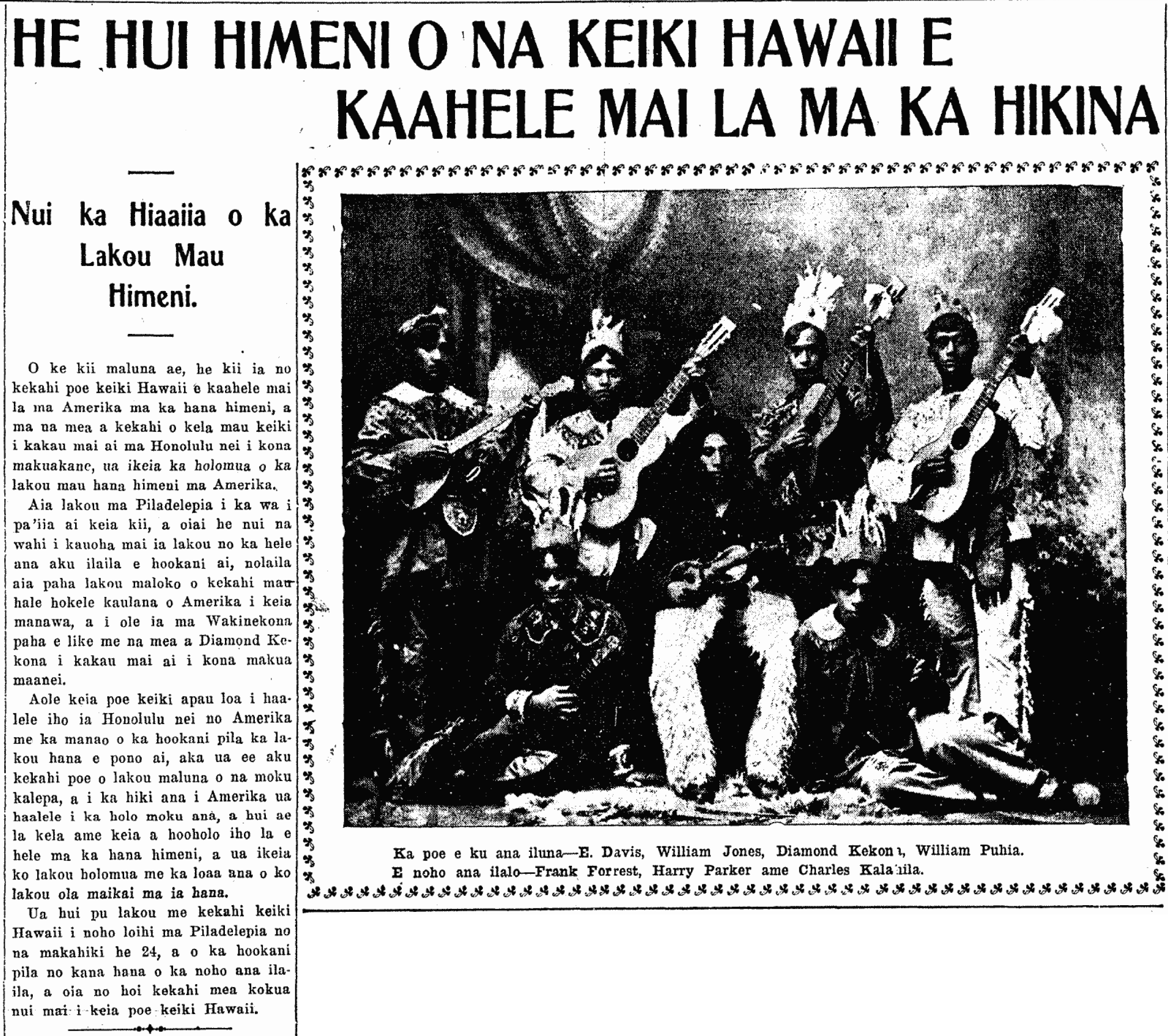
The picture above is a picture of some Hawaiian youths travelling America singing, and from what one of them wrote to Honolulu to his father, we can see they are making progress in their singing in America.

They were in Philadelphia at the time this picture was taken, and being that there are many places where they have been requested to go to perform music, they might be in some famous hotels now in America, or perhaps in Washington according to what Diamond Kekona wrote to his father here.

All of these boys did not leave Honolulu for America thinking that they would be making a living playing music, but some boarded trading ships, and upon arriving at America, they gave up sailing and met up with each other and decided to go around singing, and their progress has been witnessed along with them making a good living.

They met a young Hawaiian who was living in Philadelphia for 24 years, and he was working playing music and he was one who helped these Hawaiian boys immensely.

Those standing—E. Davis, William Jones, Diamond Kekona, William Puhia.

Seated—Frank Forrest, Harry Parker and Charles Kalahila.

(Kuokoa, 11/27/1908, p. 1)
HE HUI HIMENI O NA KEIKI HAWAII E kAAHELE MAI LA MA KA HIKINA

Ka Nupepa Kuokoa, Buke XLIII, Helu 48, Aoao 1. Novemaba 27, 1908.
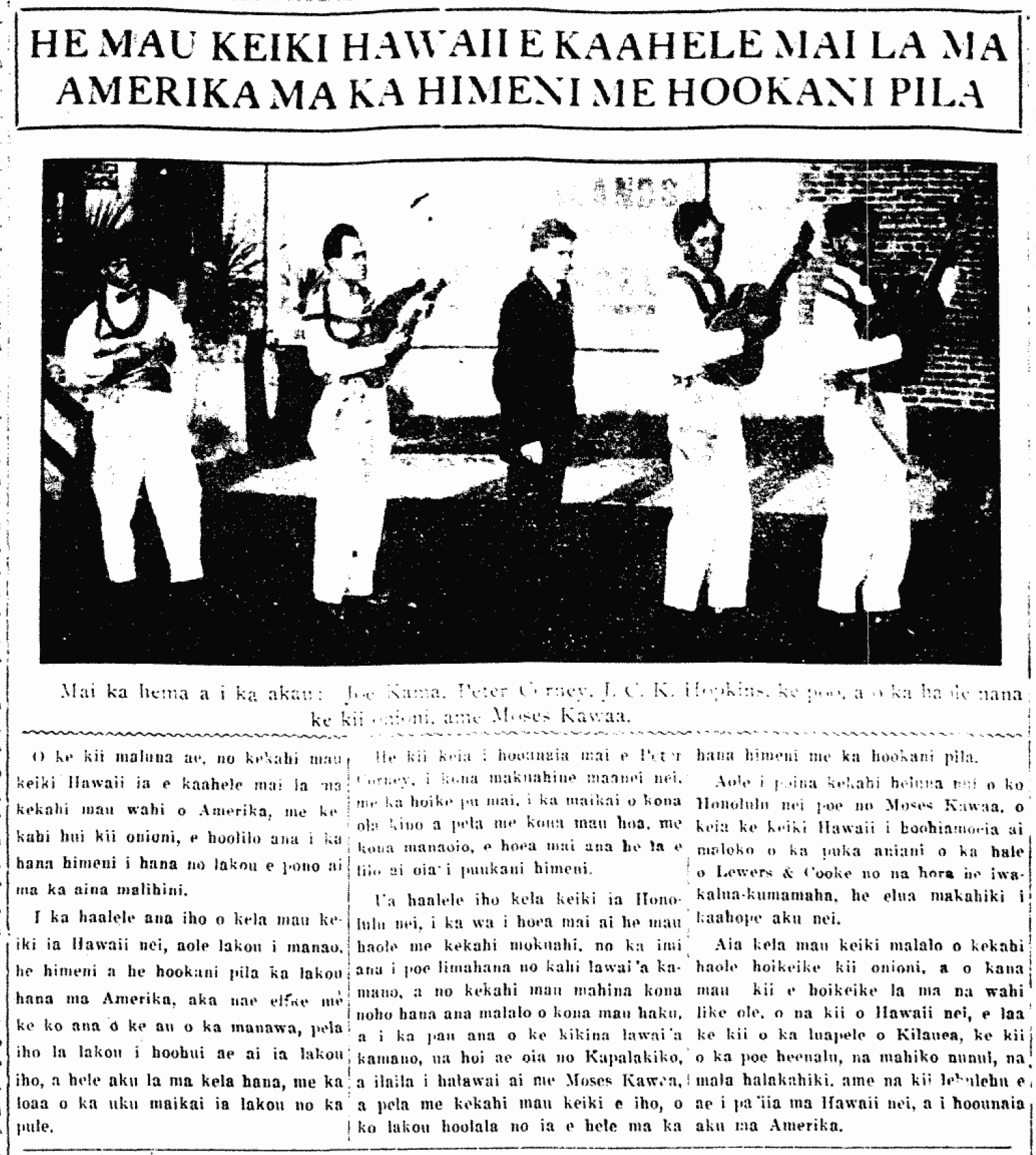
J. C. K. Hopkins and his band travelling around America, 1914.

SOME HAWAIIAN BOYS TRAVELLING AMERICA SINGING AND PLAYING MUSIC

From the left to right: Joe Kama; Peter Corney; J. C. K. Hopkins, the leader; the haole to whom belongs the movies; and Moses Kawaa.

The picture above is of some Hawaiian boys travelling around some places in America, along with a movie company, using music to make a living in the unfamiliar lands.

When the Hawaiian boys left Hawaii nei, they did not imagine that they would be singing and playing music in America, but with the passing of time, they found themselves getting together with each other and started this job, getting paid well by the week.

This picture was sent by Peter Corney to his mother here and he also stated that he was in very good health as well as his friends, and that he believes that the day will come when he will become a singer.

This boy left Honolulu nei when some haole came with a steamship in search of workers for a salmon fishing outfit and he spent several months working under his supervisors, and when the salmon fishing season was over, he returned to San Francisco and there he ran into Moses Kawaa and with some other boys, and they planned to go around singing and playing music.

Many here in Honolulu have not forgotten Moses Kawaa, the Hawaiian boy who was made to sleep in the window of the Lewers & Cooke building for twenty-four hours, two years ago.

These boys work under a haole who shows movies, and the movies that he shows all over the place are of scenes of Hawaii, like shots of the crater of Kilauea, shots of surfers, the expansive sugarcane plantations, pineapple fields, and many, many scenes taken in Hawaii nei and sent to America.

(Kuokoa, 3/13/1914, p. 5)

HE MAU KEIKI HAWAII E KAAHELE MAI LA MA AMERIKA MA KA HIMENI ME HOOKANI PILA

Ka Nupepa Kuokoa, Buke LII, Helu 11, Aoao 5. Maraki 13, 1914.

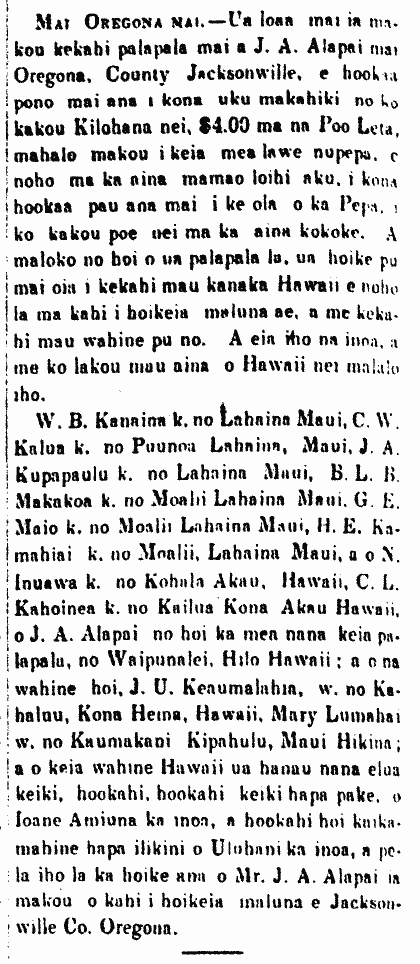
Hawaiians in Jacksonville, Oregon, 1868.

[Found under: “NU HOU KULOKO: Oahu.”]

From Oregon.—We have received a letter from J. A. Alapai from Oregon, County Jacksonwille, paying his year’s subscription for our Kilohana,¹ $4.00 in Stamps; we appreciate this subscriber who lives in lands far, far away, in his paying for the life of the Paper to our people nearby. And in that letter, he spoke of some Hawaiian men living in that place shown above, as well as some women. Here below are their names and their places in Hawaii nei:

W. B. Kanaina (m), from Lahaina, Maui; C. W. Kalua (m), from Puunoa, Lahaina, Maui; J. A. Kupapaulu (m), from Lahaina, Maui; B. L. B. Makakoa (m), from Moalii, Lahaina, Maui; H. E. Kamahiai (m), from Moalii, Lahaina, Maui; N. Inuawa (m), from North Kohala, Hawaii; C. L. Kahoinea (m), from Kailua, North Kona, Hawaii; J. A. Alapai, the one who wrote the letter, from Waipunalei, Hilo, Hawaii; and as for the women, J. U. Keaumalahia (f), from Kahaluu, South Kona, Hawaii; Mary Lumahai (f), from Kaumakani, Kipahulu, East Maui; and these Hawaiian women gave birth to two children, one each; one half Chinese named Ioane Amiuna, and one half Indian named Uluhani; and that is what Mr. J. A. Alapai presented to us of that place shown above, Jackonville County, Oregon.

¹”the Foremost,” is an epithet for the Kuokoa Newspaper.

[Hawaiians were and are to this day travellers. There are letters written by Hawaiians travelling about or living in lands afar written to the Hawaiian-Language Newspapers from early on until the very end. I wonder what became of these people, if they stayed there in Oregon, moved on to somewhere else, or came  back home to Hawaii nei…]

(Kuokoa, 8/29/1868, p. 2)

Mai Oregona mai.

Ka Nupepa Kuokoa, Buke VII, Helu 35, Aoao 2. Augate 29, 1868.

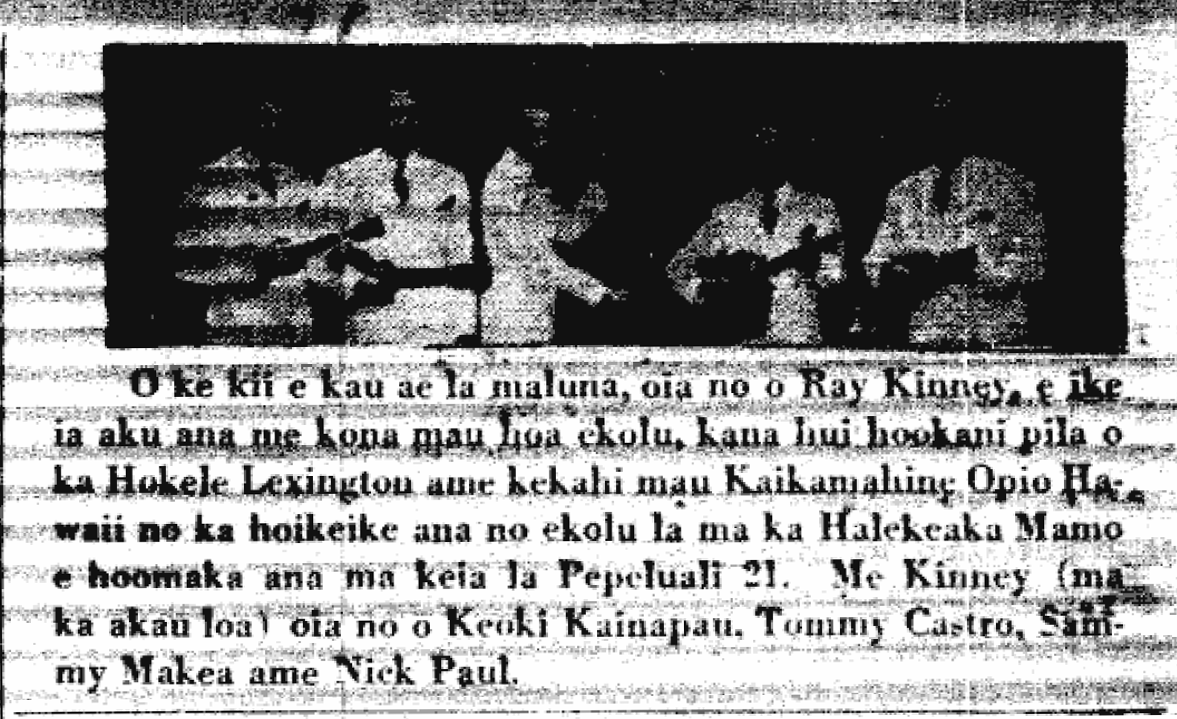
Ray Kinney Band, 1940.

The picture above is of Ray Kinney, and he will be seen with his three friends, who are the band that plays at the Hotel Lexington [in New York], and some Hawaiian Girls; they are here to perform for three days at the Mamo Theater [Halekeaka Mamo], beginning on this day, February 21. With Kinney (on the far right), are Keoki Kainapau, Tommy Castro, Sammy Makea and Nick Paul.

(Hoku o Hawaii, 2/21/1940, p. 3)

O ke kii e kau ae la maluna...

Ka Hoku o Hawaii, Volume XXXIV, Number 43, Aoao 3. Feberuari 21, 1940.

George Freeth gold medal mystery solved, 1910 / 2014.

George Freeth’s Gold Medal Up Close.

[Mystery solved! George Freeth was not presented with a Congressional Gold Medal after all; what he was instead presented with was a Gold Lifesaving Medal.

If you look at the original image in the newspaper, you can at least make out, “….STAT… OF AMERICA.” on the top, and on the bottom, “ACT OF CONGRESS JUNE 20, 187…” With that information, the Lifesaving Medal was easy to find.

This is not the best image, but it is still better than what can be found online or on the microfilms. If the newspapers were rescanned clearly, there are so many mysteries that could be answered!

Does anyone have any idea where this medal might be today? The reverse side should have George Freeth’s name inscribed with the date and description of his heroic rescue.]

KA MEDALA GULA MAKANA.

Ka Nupepa Kuokoa, Buke XLVI, Helu 34, Aoao 10. Augate 26, 1910.

Royal Hawaiian Band headed to America, 1906.

THE ROYAL HAWAIIAN BAND OF THE COUNTY OF OAHU.

The picture below is of the Royal Hawaiian Band [Bana Alii Hawaii], famous here in the Hawaiian Archipelago, but there will be a small change, that being, this band will head to America in the month of June, and will stay there during the months of July and August, and will have two lady singers, which will be the entire band as is desired. Continue reading

Latest news about the heir to the throne, Princess Kaiulani, 1891.

[Found under: “NU HOU HAWAII.”]

On the steamship of this past 28th of April from San Francisco, we have heard once again, the Heir to the Throne of Hawaii is in England where she is continuing her studies in good and robust health. And as an example of Her competence in many languages, she sent her father a letter in French.

[In those days, much of the news from afar came by way of steamship.]

(Kuokoa, 5/2/1891, p. 3)

Ma ka mokuahi o ka la 28...

Ka Nupepa Kuokoa, Buke XXX, Helu 18, Aoao 3. Mei 2, 1891.

More on Mrs. Heleluhe going to take the place of Kahele Nahaolelua, and name variations, 1897.

MRS. HELELUHE HEADED FOR AMERIKA.

Because Mrs. Kahele Nahaolelua has been away from the presence of the Queen due to her illness, Mrs. Vakeki Heleluhe has been ordered to  seek out the Royal One in Washington; she will be leaving the mother land on the Australia of this next Wednesday, May 5th, for the skin-nipping cold of America, and while she is treads through San Francisco, her care will be under the guidance of J. A. Palmer [Pama], the Queen’s secretary. And for you, O Mrs. Vakeki Heleluhe, is our prayer, that your ocean voyage be accompanied by God’s protection and may he put you ashore on dry land in good health, and may he be with you on water and on land. And when you meet with the Heavenly Alii of the lahui, give the royal one our great aloha.

[According to David Forbes, from the new edition of “Hawaii’s Story,” Mrs. Heleluhe was sometimes referred to as “Waikiki”. Here we see her as “Vakeki”.

See another article on Mrs. Heleluhe’s departure here.

Also, to be added to the index of the new edition should be:

Heleluhe, Wakeke Ululani, 106, 258, 338, 385, 391]

(Aloha Aina, 5/1/1897, p. 6)

MRS. HELELUHE NO AMERIKA.

Ke Aloha Aina, Buke III, Helu 18, Aoao 6. Mei 1, 1897.