Monument to Father Damien, 1894.

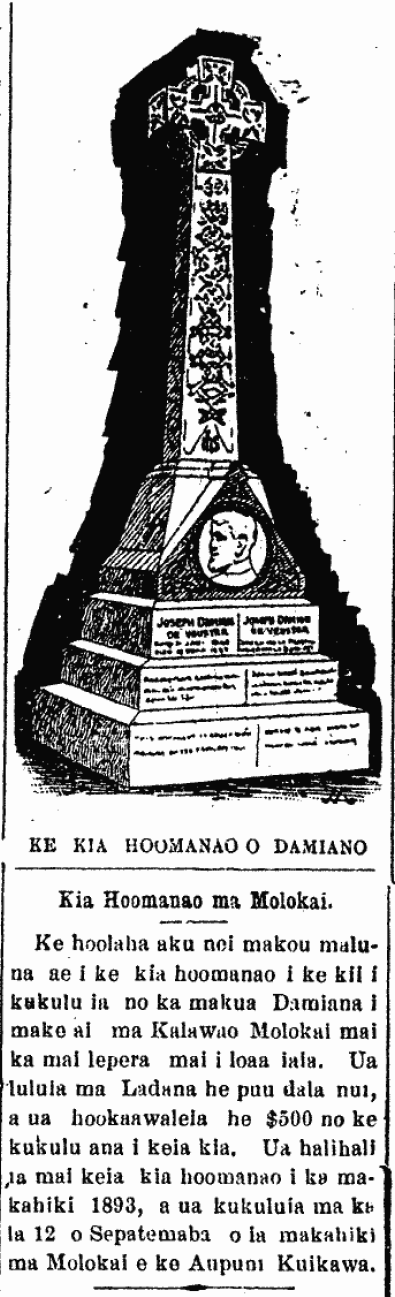
MEMORIAL TO DAMIEN

Monument on Molokai.

We are publishing above the monument; the statue built for father Damiana who died at Kalawao, Molokai, from leprosy which he contracted. A large sum of money was donated at London and $500 was put aside to build this monument was constructed. This memorial was brought here in 1893 and erected on the 12th of September of this year on Molokai by the Provisional Government.

(Kuokoa, 5/19/1894, p. 1)

Kuokoa_5_19_1894_1.png

Ka Nupepa Kuokoa, Buke XXXIII, Helu 20, Aoao 1. Mei 19, 1894.

Death of Kauhane, 1900.

THAT FAMILIAR ONE OF THE TOWN HAS PASSED ON.

At the Hospital was where the life of Kauhane left, one of the Hawaiians that was very familiar amongst the different ethnicities of this town. And this caused his friends around town to be overcome; he was a man that was very familiar as a sounder of the police whistle and an officer on street corners. And as a result of those positions, he had very many friends from the haole to the Hawaiians.

He was one of the Hawaiian boys who stepped foot on the Artic [Alika] in his youth, and he became a kamaaina of those foreign lands.

He was a Hawaiian who was greatly admired while he was travelled the seas¹ as a sailor until he became a Captain for one of the schooners of our seas. And he was one of the diligent servants…

[image] Continue reading

Fun Star-Bulletin feature on paperboys, 1916.

ALERT STAR-BULLETIN NEWSBOYS—No. 1

SHIGETARO SARUHASHI.

Son of Mr. and Mrs. Saruhashi of Kalihi-uka. Shigetaro is 16 years old and a Hawaiian-born Japanese. He attends the Royal school and is in the 8th grade. “Chicken,” as he is familiarly known by his customers and fellow newsboys, is a good hustler, disposing of 125 Star-Bulletins each afternoon. He covers the corner of Hotel and Fort streets and along Hotel to River. He has been selling papers about five years and has built up quite a profitable business by his energetic work. He belongs to the Boy Scouts and is “right there” when duty calls.

(Star-Bulletin, 6/19/1916, p. 14)

StarBulletin_6_19_1916_14

Honolulu Star-Bulletin, Volume XXIII, Number 7456, Page 14. June 19, 1916.

“A Night in Hawaii of Old,” by Kaai Glee Club, 1913.

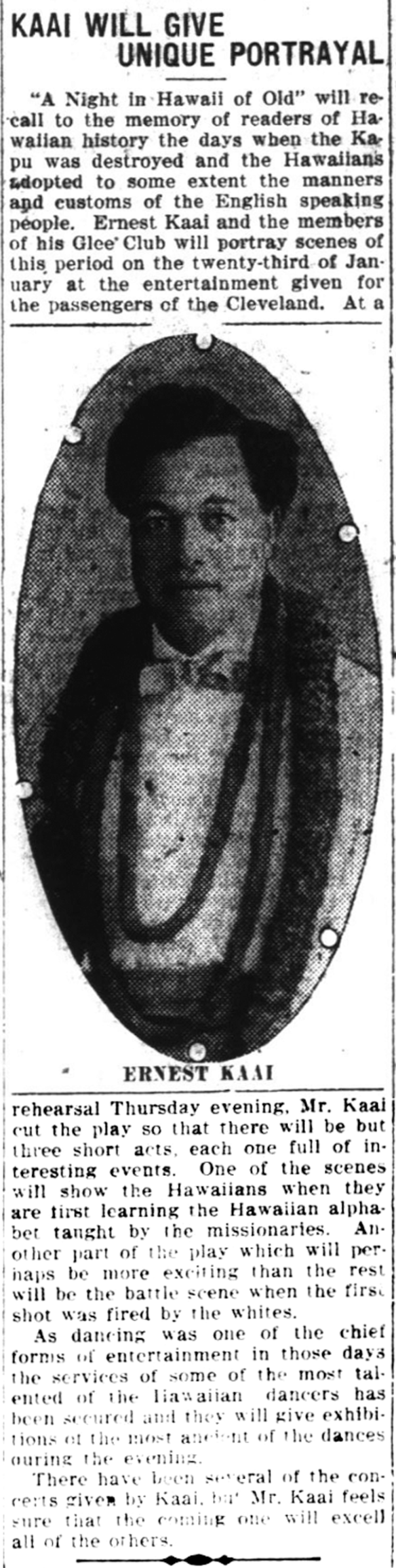
KAAI WILL GIVE UNIQUE PORTRAYAL

“A Night in Hawaii of Old” will recall to the memory of readers of Hawaiian history the days when the Kapu was destroyed and the Hawaiians adopted to some extent the manners and customs of the English speaking people. Ernest Kaai and the members of his Glee Club will portray scenes of this period on the twenty-third of January at the entertainment given for the passengers of the Cleveland. At a…

ERNEST KAAI

…rehearsal Thursday evening, Mr. Kaai cut the play so that there will be but three short acts, each one full of interesting events. One of the scenes will show the Hawaiians alphabet taught by the missionaries. Another part of the play which will perhaps be more exciting than the rest will  be the battle scene when the first shot was fired by the whites.

As dancing was one of the chief forms of entertainment in those days the services of some of the most talented of the Hawaiian dancers has been secured and they will give exhibitions of the most ancient of the dances during the evening.

There have been several of the concerts given by Kaai, but Mr. Kaai feels sure that the coming one will excell all of the others.

(Star-Bulletin, 1/20/1913, p. 12)

StarBulletin_1_20_1913_12.png

Honolulu Star-Bulletin, Volume XX, Number 6489, Page 12. January 20, 1913.

Still Our Museum Today! 1900.

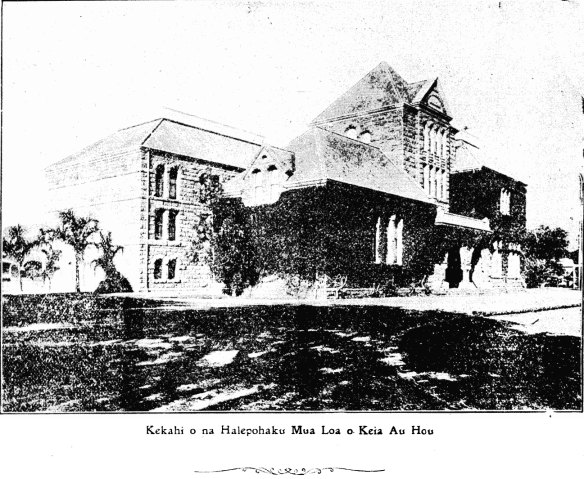
OUR MUSEUM

The Bishop Collection of Curios.

One of the Most Interesting Sights In Honolulu Pleasantly Described.

HONOLULU, Feb. 8.—Above the inner entrance to the Museum of Hawaiian and Polynesian History is a tablet of polished mottled stone, in which is engraved in letters of gold the following inscription:

To the Memory of
BERNICE PAUAHI BISHOP,
FOUNDER OF THE KAMEHA-
MEHA SCHOOLS OF HO-
NOLULU.
A Bright Light Among Her Peo-
ple; Her Usefulness Survives
Her Earthly Life.

A Bernice Pauahi, she was related to the royal family of the Kamehameha dynasty, and the cousin of Queen Emma, two women who have indelibly inscribed their names upon the hearts of…

BERNICE PAUAHI BISHOP.

…all Hawaiians, whether by birth of association. She married the Hon. C. R. Bishop, and with her immense wealth and her kindly deeds through life, created a new life among the Hawaiians. Upon her death she left most of her wealth to endow the Kamehameha Schools, a separate school for boys and a separate one for girls. These schools are kept up entirely from the income of her estates, which have become so vast as to render it necessary to erect other buildings throughout the Islands in order to expend the revenue. In memory of his wife, the Hon. C. R. Bishop dedicated the museum in her name, laying aside a princely endowment. Collectors have scoured the Hawaiian Islands for curios of historical and intrinsic value and have succeeded by the most diligent effort and at great expense, in depositing in the museum an invaluable collection of ancient materials which would warm the cockles of the antiquarian’s heart beyond measure. Calabashes, large and small, ancient and modern, have come into the museum; some were in the possession of families, relics passed from one generation to another; others were found in the caves where in ancient times were buried kings and chiefs. Idols of grotesque shapes, dedicated to all the elements of nature, good and evil; some dedicated to Pele, the Goddess of Volcanoes; others to the poison god and to the fish god; some made of stone, others of the valuable koa and kou woods; one made of the trunk of the poison tree, its wood, upon being steeped in water, being a most powerful, yet undetectable poison which acts upon the heart, and which was used by the kahunas and chiefs. Beautiful feather cloaks of wonderful sheen and delicate texture, worn by Kamehameha the Great during his tour of conquest a century ago. Continue reading

“The Hawaiian Revolution!” 1894.

THE HAWAIIAN REVOLUTION!

DEDICATED BY SPECIAL PERMISSION

TO THE

Provisional Government

A MOST ELABORATE AND EXTENSIVE HISTORY OF
HAWAII FROM JANUARY, 1893, UNTIL
THE PRESENT!

EXQUISITELY ILLUSTRATED BY THE NEW AND

Beautiful “Crisp Photo” Process.

HAWAII.

The Volume Will Contain Half Tone Portraits of All the Leading People Connected With This Memorable Epoch.

Including an Account of the

INDUSTRIAL ÷  ADVANCE ÷ OF ÷ HONOLULU

In Fact an Historical, Statistical and Descriptive Review of the Material Development and Advancement of the Islands.

WITH AN APENDIX CONTAINING A SERIES OF

Comprehensive ÷ Sketches ÷ of ÷ Representative ÷ Citizens

Mr. Wellesley A. Parker, whose success throughout the world in art matters, is well known has been specially employed to superintend the pictorial department of this work. Of the Crisp process, which is to be used, the following extract from a well known paper speaks well for it.

The Albany, N. Y. Evening Journal says:

New Printing Process.—People unacquainted with the wonderful strides that have been made in Australia in printing, and the general depicting of nature in its most beautiful moods, have little idea of the complimentary and deserving success that Messrs. F. W. Niven and Co. of Ballarat, Australia have attained in their new “Crisp Photo” Process. We have been shown by Mr. Wellesley Parker, who is visiting us, samples of this new firm’s beautiful process. The book that has lately run into three editions, of 5000 each, of “Syracuse Illustrated” is beyond compare the most exquisite series of views ever appearing in the direction of printing. Episodes of the old days, and scenes of the beauties of the gardens of the city, are scattered throughout, interented with pictures of well-known citizens, that for fidelity rival any photograph that is at present produced. Every credit is due to Australia, who has taken the lead in this innovation.

Intersperced through the book will be pages devoted to the estaousnments or leading wholesale and retail merchants. Not only will the exteriors of the buildings be shown, but the interiors will come out with great fidelity, showing every branch of the business in actual working order, thus giving to many a glimpse behind the scenes of the various details involved in producing the articles that they purchase in the showroom or at the counter. The first issue of “The Hawaiian Revolution” is to be 5000.

The principal industries and business establishments will be visited by Mr. Parker, who is now in this city, on behalf of the Publishers, and arrangements made by which the actual details of the various branches of the businesses will be represented pictorially. In addition, it is the desire of the Publishers to add to the completeness of the work by prevailing upon citizens who have handsome residences or grounds, to arrange with Mr. Parker for their appearance in its pages.

PUBLISHED BY THE

HAWAIIAN GAZETTE CO.

[Does anyone know if this book ever got published?]

(Pacific Commercial Advertiser, 4/25/1894, p. 3)
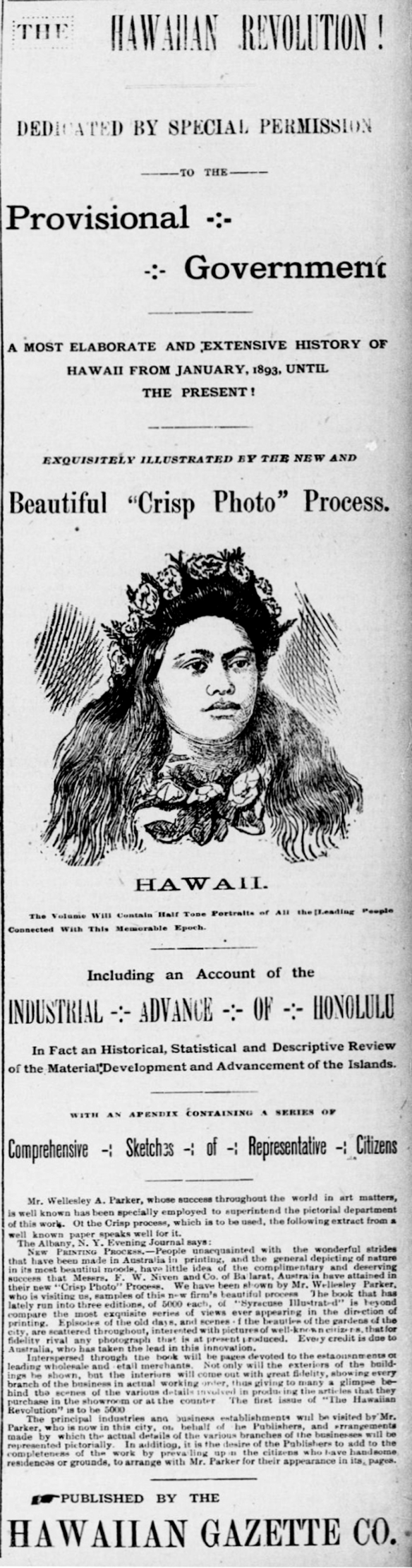
PCA_4_25_1894_3.png

The Pacific Commercial Advertiser, Volume XIX, Number 3671, Page 3. April 25, 1894.