Henry Nalaielua on KHBC, 1940.

Talking on KHBC

HANALE NALAIELUA

The one who will give short announcements when they air from the Naniloa Hotel on Saturday, December 21, during the entertainment in the program given by the Bohlings, and brought to you by the Hoku o Hawaii. Mr. Nalaielua will speak in “gibberish” (English) and the language pleasant to the ear to hear, that being our mother tongue, the Hawaiian language.

(Hoku o Hawaii, 12/18/1940, p. 1)
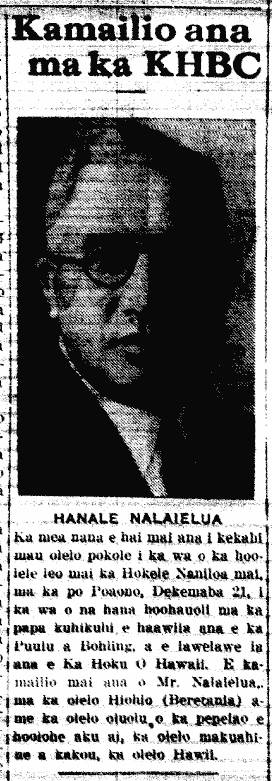
Kamailio ana ma ka KHBC

Ka Hoku o Hawaii, Volume XXXV, Number 34, Aoao 1. Dekemaba 18, 1940.

New Bank of Hawaii opened, 1927.

The New Bank of Hawaii Building Opened

for Business this Monday

[This building stood where the current downtown BOH building is on the corner of King and Bishop Streets. It opened for business on Monday, the 28th of March, 1927.]

Ka Hale Hou o ka Banako Hawaii i Wehe ia

Ka Nupepa Kuokoa, Buke LXVI, Helu 13, Aoao 1. Maraki 31, 1927.

Alsoberry Kaumu Hanchett, 1925.

Here is a photograph of Dr. A. K. Hanchett from The Story of Hawaii and Its Builders, with which is incorporated volume III Men of Hawaii; an historical outline of Hawaii with biographical sketches of its men of note and substantial achievement, past and present, who have contributed to the progress of the Territory, edited by George F. Nellist. Honolulu: Honolulu Star-Bulletin, Ltd., 1925. p. 481!

[It seems that his mother, Julia Palaile Hanchett first married a Crowell, and then following that married the grandson of Hanchett, the whaler. Her Crowell children were raised alongside with her Hanchett children. Thanks to Chris Faye for the information and for pointing out that the picture was there.]

Dr. A. K. Hanchett

Dr. A. K. Hanchett

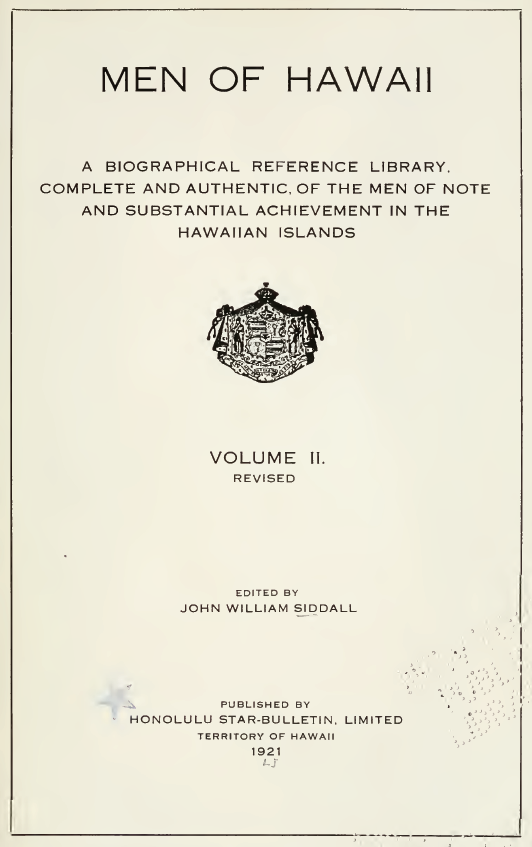
Men of Hawaii, Volume II, 1921.

MEN OF HAWAII

BEING A

BIOGRAPHICAL REFERENCE LIBRARY,

COMPLETE AND AUTHENTIC, OF THE MEN OF NOTE

AND SUBSTANTIAL ACHIEVEMENT IN THE

HAWAIIAN ISLANDS

Volume II.

Revised

Edited by

John William Siddell

Published by

HONOLULU STAR-BULLETIN, LIMITED

Territory of Hawaii

1921.

[Here is a revised version of Men of Hawaii, available online here at the Internet Archive (www.archive.org) that is word searchable!]

Men of Hawaii, Volume II

Men of Hawaii, Volume II

Democratic candidates, 1910.

W. S. EDINGS, For Senator

M. E. SILVA, For Supervisor

E. K. RATHBURN, 4th District

SOLOMON MEHEULA, For Representative, 4th District

W. P. JARRETT, For Sheriff

CHARLES H. ROSE, For Deputy Sheriff of Honolulu

H. H. PLEMER, For Supervisor

WADE WARREN THAYER, For City and County Attorney

F. COSTA BENEVEDES, For Representative, 4th District

J. S. KALAKIELA, For Senator

W. M. McCLELLAN, For Supervisor

E. H. F. WOLTERS, For Representative, 4th District

J. C. ANDERSON, For Auditor

EDWARD HANAPI, For Senator

FRED TURRILL, For Representative, 4th District

M. C. PACHECO, For Supervisor

[This is an interesting group of Democratic candidates for the race in 1910.]

(Democrat, 11/5/1910, p. 4)

PAGE 4

The Democrat, Volume I, Number 11, Page 4. November 5, 1910.

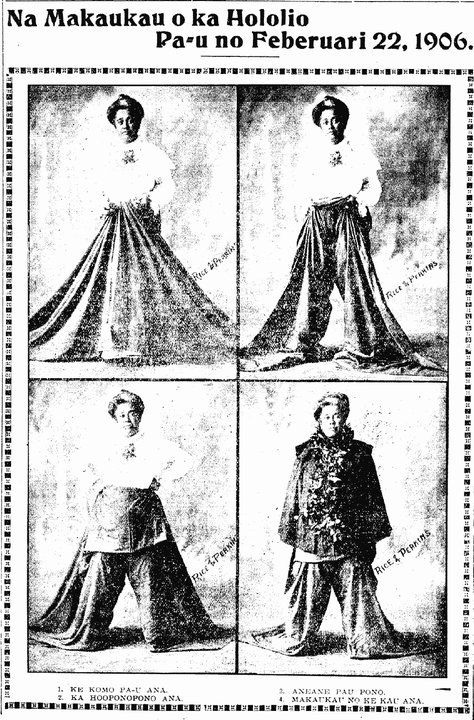
Putting on a Pāʻū, 1906.

Preparations for the Pa-u Riding of February 22, 1906.

1. Putting on a pa-u.
2. The adjusting.
3. Almost done.
4. Ready to ride.

[This was for the parade on Washington’s birthday. An article describing these steps was printed in the 2/4/1906 issue of the Sunday Advertiser.]

(Kuokoa, 2/9/1906, p. 4)

Na Makaukau o ka Hololio Pa-u no Feberuari 22, 1906.

Ka Nupepa Kuokoa, Buke XLIV, Helu 6, Aoao 4. Feberuari 9, 1906.

Mary Mahiai, the original story, in English, 1901.

ROMANTIC HISTORY OF MARY MAHIAI

PROBABLY the most interesting woman in all Hawaii is the white-haired old wahine of four-score and ten, or thereabouts, who answers to the name of Mary Mahiai.

Last week an intricate land case came up in Judge Gear’s court and Mary Mahiai was summoned to appear as a witness, her testimony being relied upon to establish the validity of certain patents to extensive and valuable lands, the ancient boundaries of which were in dispute.

The old lady scorned the services of the interpreter on the witness stand and proceeded with her own story in good English astonishing the court and silencing the lawyers as, with Hawaiian freedom of gesture and animated features, she related the details of a most remarkable career.

It developed that she was born on the Island of Kauai before the coming of the first missionary, the arrival of Rev. Hiram Bingham being distinctly within her memory; at the age of seven years, little Mahiai, whose name (meaning “Working in the taro”) had been given her by her mother, went out in a rowboat with her uncle and five other men, starting for Molokai, to “go look see.” A storm came up and the boat was driven out of sight of land, its occupants having no food or drink with them, and suffering terribly from the pangs of hunger and thirst: for ten days and nights they drifted, becoming crazed and unable to cry out, and at last, when all hopes had been abandoned, and it was certain that the frail boat would go to pieces before the end of another day, a sail appeared upon the horizon and the faint outcries and feeble signals of the seven unfortunates attracted the attention of a sailor on board the ship, which was a sailing vessel bound for China. The six men and the little girl were taken on board and treated kindly. When the little girl was able to be about she was given the task of taking care of the captain’s little daughter, and the men were put to work on the ship; the vessel put in at Ladrone Islands, and by their own desire, the five men who had set out with little Mahiai and her uncle, were put ashore. It was afterwards learned that they were eaten by cannibals. Continue reading

Mary Mahiai, what a story! 1901.

MARY MAHIAI.

The picture above is of Mary Mahiai, a Hawaiian woman who is ninety years old or more. Last week, she was called to court over land that is being fought over. Here, her story was heard. Because of her good story and her long life, one of our writers went once again to ask her about her history. And this is it:

I don’t know when I was born, but I was born before the arrival of the missionaries. I was very small at that time, and maybe I was this tall. One day, we boarded a canoe, her Uncle and five others; they wanted to visit Molokai. They were caught up in a storm in the middle of the ocean, and blown outward; they did not eat for ten days and nights. Because I was so young, I cried a lot. I wanted to eat, and I was thirsty. We had nothing to eat, and had no water left. Water came in the waa, and some of us drank the bilge water. We were near crazy with hunger and thirst. We lost hope that we would live. One day we spotted a ship. We tried to get noticed. We were fetched and taken aboard the ship. My duty aboard the ship was to care for the children. The captain and his wife were kind. We landed at Lardone [??]. Five of them got off with the intent of living there. We heard that they were eaten after that by the people this place. My uncle and I went all the way to China. I cared for the baby some missionaries, Mr. and Mrs. Brown. Thereafter, my uncle died and I was left alone with those haole. I was the caretaker of the baby. I lived for perhaps six whole years in China. I travelled around many places. Later, Mrs. Brown died. I lived with Mr. and Mrs. Bates. After that he wanted to go to California to prospect for gold. We accompanied him on a boat, and saw Cape Horn [Kepahoni], that place famous for rough seas. I saw many lands. I lived for three months in the gold fields. I wanted very much to return to Hawaii. Afterwards, these haole agreed and we all left for Hawaii nei. When we arrived, I immediately wrote to my parents and younger siblings. They came to Honolulu at once. They believed that I had died earlier. My father died without me knowing him.

Continue reading

Custom House, 1895.

Custom House of Honolulu.

We are adorning these columns of the Kuokoa with a picture of the grand Hale Oihana Dute of Honolulu nei, at the corner of Fort [Papu] and Allen [Alani] Streets. this building was built during the reign of Kamehameha IV., and it was added to at various times when it was found that it was not adequate for the incoming goods to be stored, so it has become very long and wide. This is the entrance [makaha] into the nation, where goods from foreign lands are stored, and duty is collected on taxable items, and not only that, the owners pay a fee for care of their goods in this building by the government. There is a big force of government employees in this bureau under the Department of Finance [Oihana Waiwai], starting with the collector-general and the deputy-collector, and down to the secretary and the storekeeper, guards, and so forth. The money expended to rebuild or perhaps extend this entrance comes from the revenues of the growing public funds due to the duties charged by this entity.

(Kuokoa, 3/16/1895, p. 2)

Ka Hale Oihana Dute o Honolulu.

Ka Nupepa Kuokoa, Buke XXXIV, Helu 11, Aoao 2. Maraki 16, 1895.