Yes to Hawaiian language. No to Dole, 1903.

DOLE’S VETOES TURNED DOWN

SENATE UNANIMOUSLY SAYS HIS LANGUAGE RESOLUTION VETO IS ALL RIGHT BUT IT WON’T DO.

The Senate played football with Governor Dole’s vetoes this morning. The language veto was thrown into the scrap heap first. This veto disapproved the joint resolution asking Congress to make the Hawaiian the official language the same as English. Continue reading

Dole vetoes Hawaiian language, 1903.

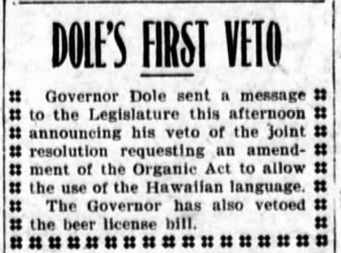
DOLE’S FIRST VETO

Governor Dole sent a message to the Legislature this afternoon announcing his veto of the joint resolution requesting an amendment of the Organic Act to allow the use of the Hawaiian language.

The Governor has also vetoed the beer license bill.

(Evening Bulletin, 4/8/1903, p. 1)

EveningBulletin_4_8_1903_1.png

Evening Bulletin, Volume XIII, Number 2425, Page 1. April 8, 1903.

Hawaiian language was even the official language of the Territory? 1903.

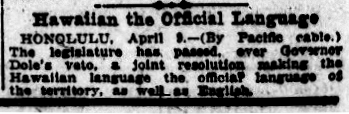
Hawaiian the Official Language

HONOLULU, April 9.—(By Pacific cable.) The legislature has passed, over Governor Dole’s veto, a joint resolution making the Hawaiian language the official language of the territory, as well as English.

(Los Angeles Herald, 4/10/1903, p. 2)

LAHerald_4_10_1903_2.png

Los Angeles Herald, Volume XXX, Number 185, Page 2. April 10, 1903.

William Panui talks about fishing, 1989.

[Found under: “Storytelling now a respected art”]

William Panui: Fish tales

Pacific Islands: Reef fishing on the Big Island

William Panui was adopted by his grandparents and grew up on land the family owned at remote Keei Beach on the South Kona coast.

His grandfather—Lui Kauanoe Panui—only spoke Hawaiian and taught him the old ways of fishing. “The old techniques depended on what was available,” he said. “Now you can just go to the store and buy everything you need.” Continue reading

J. H. Kanepuu the traditionalist, 1970.

Hawaiian Math

By Russell and Peg Apple

BY THE MID 1800s, the Hawaiian people were betwixt and between two cultures. There was the pull and the momentum of the old—the traditional Hawaiian; and the lure and exhortations of the new—a New England brand of Western.

And the Hawaiians were aware of the situation. They were not above pointing out to each other the conflicts they met in their everyday life.

One who did so was a man from Palolo, a Mr. J. H. Kanepuu. He wrote in the Hawaiian language newspaper Ke Au Okoa, and on Jan. 21, 1867, saw the need to call attention to two counting systems that existed side by side.

KANEPUU NOTED the conflict in the markets where Hawaiians bought and sold. There was a generation gap in methods of enumeration. Most of the fishermen and farmers who sold in the markets were old men who counted by the Hawaiian method. Those who bought were younger folks who counted by the haole system. Few knew both well.

The momentum and practices of the past fixed the habit patterns of the fishermen who caught flying fish, mullet, mackerel and milkfish for the Honolulu markets. They either sold their catch themselves, or it was sold by family members of the same generation. They counted Hawaiian style.

Those who bought counted haole style. They had been to the mission and public schools. They knew how to count by tens, from one on up into the tens of thousands. Each had ten fingers, including thumbs, to help.

BUT THE Hawaiian system was based on the numeral four, not the decimal system. Hawaiians had four fingers on each hand to help in counting.

Both the old timers and the younger Hawaiians spoke Hawaiian fluently. But the haole terms had been translated into Hawaiian and taught to the people who went to school, along with the counting-by-tens method. It was the same sort of confusion which occurs today when a nation switches from pounds-shillings-and-pence to a coinage based on the decimal system. Or when a student who learned his work in inches, feet, yards and miles tries to deal with millimeters, centimeters, meters kilometers. Misunderstandings and confusion result.

LOT KAMEHAMEHA, later to rule as Kamehameha V, was educated by Christian missionaries and was versed in the Western system. Kanepuu wrote that when he was still Prince Lot, he received a gift of fish at his house in Honolulu. This was sometime in the early 1800s, before Lot Kamehameha was crowned.

The men who brought the fish used the old system, the Prince only understood the new.

“How much fish?” asked the prince.

“One lau and nine kaau,” answered the Hawaiian servant who delivered the fish, a gift from chief Kuhia.

THIS ANSWER distressed Lot Kamehameha and he alsmost became angry. On seeing this, the Hawaiian switched to the new system. Continue reading

Unexpected language questions from so long ago, 1867.

Some Questions.

O Friends of the Kuokoa; Aloha no:

May it please you, O Mr. Editor, to insert in an open pace of our columns, these questions, so that those who understand our Hawaiian language will see; and these are they:

  1. What is the nature of the word “Kuauhau?”
  2. What is the nature of the word “Mamo?”
  3. What is the nature of the word “Hoka?”

Continue reading

Let Hawaiian be taught in the schools, 1939.

Something that Should be Done

Senator James Kealoha of Hawaii introduced a law into the Legislature to teach Hawaiian language in the government schools, and in schools that stand on land under the care of the Hawaiian Homes Commission [Komisina o na Home Hawaii].

The senator believes that by teaching children Hawaiian in the places shown above, for only Hawaiians live on Hawaiian Homes land, and it is right to teach them the mother tongue. This idea of the young senator is a fine one indeed. But in the mind of some people they do not believe that this is a very good bill to be supported by the other members of the senate as well as the house of representatives.

Thoughts expressed by some who are not Hawaiian is that this bill should be amended to whereby it is opened up widely and Hawaiian is taught at all government schools in the Archipelago.

If this young senator did not submit this bill, the thoughts of others would not have been known. Continue reading

Hawaiian language not economical, 1939.

Unfair to Hawaiians

Territorial Secretary Charles M. Hite wants to have a bill put through the legislature eliminating the publication of the session laws in the Hawaiian language, claiming this is an “economy” measure.

Mr. Hite seems to be starting his so-called economy program in the wrong place. He probably doesn’t realize that there are still thousands of old time Hawaiians in the territory who cannot read English and who depend on the reports from the legislature through their own Hawaiian language newspaper, otherwise they won’t know what has been done by our law makers. Continue reading