Welo Hou and the Helen H. Roberts Collection at the Bishop Museum, 2018.

It seems the Welo Hou blog has been up since November of 2017, with posts every Monday. If you are a mele person, or a history person, or are from Hawaii nei, you should check it out and start a dialogue! This is its opening post from last year [click anywhere below to link to the blog]:

Welo Hou: Building Connections to the Helen Roberts Mele Collection

 How has mele informed your understanding of a Hawaiian worldview?

As I ponder this question framed within the context of the above quote, my mind begins to churn with examples stemming from my own life and learning experiences. I recall my early childhood years in keiki hula class where I proudly chanted “Kūnihi ka mauna” while oblivious to the meaning of the words that were resonating from my mouth. Yet even in my naivety, I understood the function and purpose of that oli kahea. Though my mind was too young to comprehend the arbitrary words formed by my lips, I was fully aware that I had to be focused and present-minded in order to be granted permission into the hālau. This is a small example of how, even at 5 years old, mele/oli had already begun to shape my perspective to be one that reflects a Hawaiian way of thinking and behaving. “Kūnihi ka mauna” followed me into the academic arena where I eventually learned how to dissect the mele word for word, structure by structure, phrase by phrase, and sound by sound. I learned about the different places referenced in the mele and discovered the kaona behind words. I came to know the story by which the mele was inspired and I internalized the knowledge gained through the deconstruction and reconstruction of this mele. I share these thoughts with the hope that we can collectively become even more conscious of the way in which mele is able to shed light on aspects that are often considered obscure in research and Hawaiian knowledge acquisition.

                As we meet here weekly for Mele Monday, I invite you to ponder deeply on the pieces we will discuss from the Roberts’ Mele Collection over the next two years. The purpose of this blog is to cultivate a community of mele enthusiasts who would like to dialogue about the gems uncovered from within the mele we will explore over the coming weeks. Please feel free to ask questions, share manaʻo, and post comments that will contribute to the facilitation of thoughtful and respectful discourse.

                If you feel so inclined, I invite you to leave a comment expressing your thoughts on the quote and question posed above. 

E hea i ke kanaka e komo ma loko…..

At Waimanalo, Mololani, and Mokumanu are your mats of feathers, 1886.

HE INOA NU’A HULU NO KA MOIWAHINE KAPIOLANI.

(Hakuia e Mrs. A. L. K.)

A i Waimanalo ko Nua Hulu,
I hakuia mai e Mololani,
Noho o Kalani hano i ka nani,
I ka lawe hoolai a ka mokuahi,
Hoohihi ka manao e ike aku,
E kilohi i ka nani o ka Mokumanu,
O ka pohai a ka manu i ka lewa,
Kikahakaha lua i ka ilikai,
Welo haaheo ko Hae Kalaunu,
Ua ike mai o Malei ke kupua,
Oia kai kapu la ua noa,
Ua hehiku aku nei o Kalani,
Nau i olali hoohie aku,
Oia mau ale hanupanupa,
Ka iniki welawela a ke ehukai,
Lamalama ua i ka nani alii,
Liilii na hana a ke Telefone,
Haihai olelo me ka huapala,
Kulia ka anuu la e o mai,
Ka wahine nona ka Lei Hooheno. Continue reading

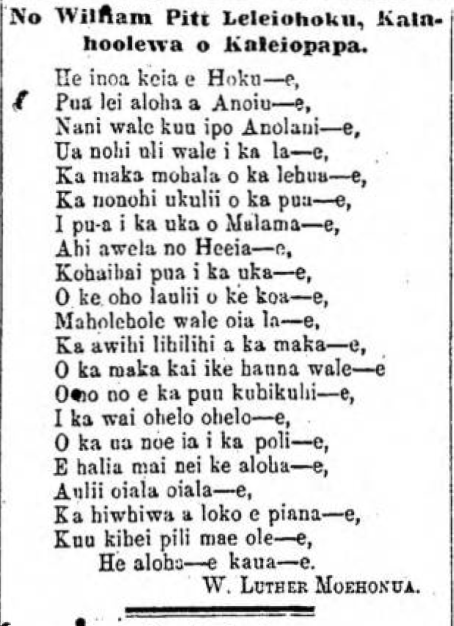
Mele inoa for Kalahoolewa by W. L. Moehonua, 1867.

No William Pitt Leleiohoku, Kalahoolewa o Kaleiopapa.

He inoa keia e Hoku—e,
Pua lei aloha a Anoiu—e,
Nani wale kuu ipo Anolani—e,
Ua nohi uli wale i ka la—e,
Ka maka mohala o ka lehua—e,
Ka nonohi ukulii o ka pua—e,
I pu-a i ka uka o Malama—e,
Ahi awela no Heeia—e,
Kohaihai pua i ka uka—e,
O ke oho laulii o ke koa—e,
Maholehole wale oia la—e,
Ka awihi lihilihi a ka maka—e,
O ka maka kai ike hauna wale—e,
O no no e ka puu kuhikuhi—e,
I ka wai ohelo ohelo—e,
O ka ua noe ia i ka poli—e,
E halia mai nei ke aloha—e,
Aulii oiala oiala—e,
Ka hiwahiwa a loko e piana—e,
Kuu kihei pili mae ole—e,
He aloha—e kaua—e.

W. Luther Moehonua.

(Au Okoa, 5/30/1867, p. 4)

AuOkoa_5_30_1867_4.png

Ke Au Okoa, Buke III, Helu 6, Aoao 4. Mei 30, 1867.

Mele hua inoa for the new year! 1869.

Olioli Makahiki Hou.

O—li—O—li makahiki h—O—u:
L—a e—L—u ai na manawa—L—ea,
I—ho—I—ke no ko kakou hil—I—nai,
O—k—O—kakou la makahiki hO—u,
L—ae—L—oaa ole ai kona—L—ike
I—na—I—waena o ka makah—I—ki;
M—ai—Mua mai a hiki i ka—M—uli,
A—ole—A—u mea e hoohalike—A—i,
K—e —K—eu hookahi i ka ma—K—ahiki,
A— k—A—mua no hoi i ka makA—hiki,
H—ea—H—a ke kumu o ka—H—auoli
I—ke—I—a la i hoomanao nu—I—ia?
K—a—K—aou anei ia e a—K—e nei?
I—h—I—aai nui ai hoi e—I—ke?
H—ea—H—a! 365 na la me 6—H—ora
O—k—O—ka honua ho—Opuni ana,
U—a p—U—ni ka La: Lamak—U o ke ao.

[Happy New Year
Happy new year:
Day to give donations,
To prove our beliefs,
Of our new year,
A day like no other,
In the year;
From beginning to end,
I have nothing to compare it to
It is the greatest in the year,
And the first in the year,
For what is the joy
On this day that is greatly celebrated?
Is it what we desire?
What we delight in seeing?
What! 365 days and 6 hours
The earth goes around,
The sun is circumnavigated: the torch of the world.

Usually an acrostic only uses the first letter of the lines of poetry to form a word or phrase, but the composer of this mele was very ambitious.]

(Au Okoa, 1/7/1869, p. 2)
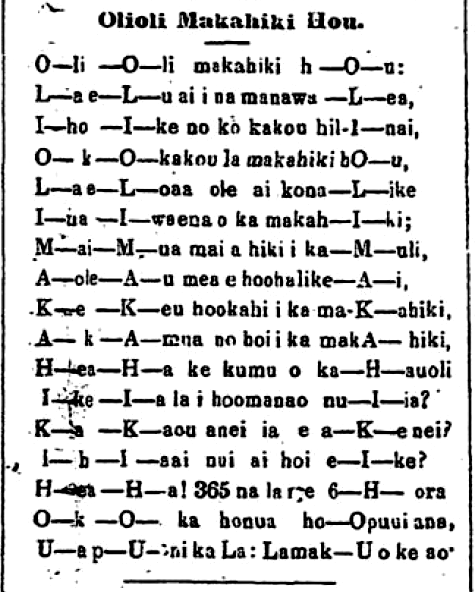
AuOkoa_1_7_1869_2.png

Ke Au Okoa, Buke IV, Helu 38, Aoao 2. Ianuari 7, 1869.

Another mele for La Kuokoa, 1871.

No ka La Kuokoa.

Leo.—A Victory, Happy Hours. p 144.

1. Ke kani nei na pahu e,
Ma keia la maikai;
E ala mai a oli ae,
La Kuokoa nei.
Ke kani nei na mele e
Mauka, a makai;
Maanei, ma o, a ma na puu,
Nani ke kani mai.

Cho—Hooho pu na kini nei,
Huza, huza, e oli e,
Huza, huza, huza, e oli e,
Huza, huza, huza, e oli e. Continue reading