Death of Maraea Pomaikai Kamakahiki, 1870.

[Found under: “NU HOU KULOKO: Maui.”]

Plucked by death.—We received news that on the 18th of March, at Keanae, Mrs. Maraea Pomaikai Kamakahiki left this life, and was taken by the cruel-handed messenger of death, in her old age living in this unfamiliar world. She was a Christian woman, and died as a good and proper servant for the Lord in which she had faith. Here is a short story about her. In the year 1855, the two of them left their land of birth and sailed to the small islands of Micronesia where they served as Missionaries for the Almighty, Continue reading

J. E. Chamberlain, collector for the Hawaiian National Museum, 1876.

Curios for the Government Museum.

The Morning Star brought up for the Hawaiian Government the following curios, corals, &c. Two sets Gilbert Island armor complete with helmets; also shark teeth sword and spear, mats and native dresses; eel basket; common fish basket; umbrella coral, three feet six inches in diameter, perfect, from Apian by Mr. Randolph.

From Marshall Island: Spears, Male fringe petticoats and woman’s mat dress; carved figure-head; model of canoe fully rigged; paddles; red coral; black coral; platter coral, bone adzes from Strong’s Island. Continue reading

Mangrove for Hawaii? 1876.

[Found under: “Ka Moolelo o ka Huakai aku nei a Hoku Ao i Maikonisia.”]

Ualana.

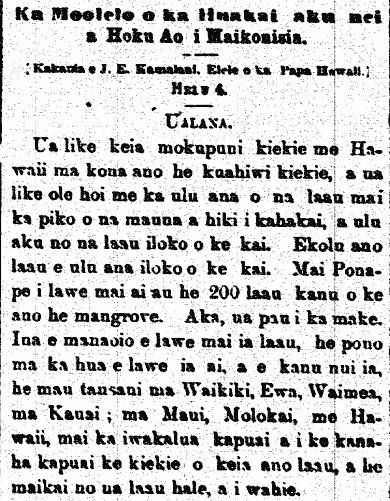
This high island is similar to Hawaii being that it is a high mountain, but it is different in that there are trees that grow from the mountain peaks all the way to the ocean, and there are trees that grow in the ocean. There are three kinds of trees growing in the ocean. I brought from Ponape 200 mangrove plants. But they all died. If we really want to bring in that plant, it should be brought in by seed, and planted extensively; thousands in Waikiki, Ewa, Waimea on Kauai, on Maui, Molokai, and Hawaii; this tree reaches from twenty to forty feet high, and is good as lumber for house building and for firewood.

[This appears in a description of travels of the Morning Star to Micronesia, written by Jeremiah E. Chamberlain, the representative of the Board of Hawaiian Missions.]

(Lahui Hawaii, 4/6/1876, p. 2)

LahuiHawaii_4_6_1876_2.png

Ka Lahui Hawaii, Buke II, Helu 15, Aoao 2. Aperila 6, 1876.

Death of Stephen William Kekuewa, 1920.

THE REV. S. W. KEKUEWA PASSES ON

After being worn away by a debilitating illness for some time, the Rev. Stephen William Kekuewa grew weary of this life, at the home of his daughter, Mrs. John P. Kapua, on School Street, at four o’clock in the afternoon, on Wednesday of this past week; and in the afternoon of this past Sunday, his remains were carried to the Maemae Cemetery.

The Rev. S. W. Kekuewa was born at Luakaha, Nuuanu, on the 25th of February, 1842, therefore when he died he was over seventy-eight years old.

During his youth, he was educated at Lahainaluna School, under his teachers, S. E. Bishop and C. B. Andrews; and for some years he lived on the island of Micronesia on a mission he was sent on by the Hawaiian Evangelical Board [Papa Hawaii].

Because the health of his wife was not good, they returned to Hawaii nei, and he served as the kahu of the chruch at  Iole, Kohala, Hawaii for many years.

Because of the letter of the members of the church of Waianae which called for him to be the kahu of that church, he left the church of Kohala and went to live at Waianae; at that church he lived and worked until he was called by his Lord, and he went to his permanent home beyond. Continue reading

Hōkūleʻa, 1980 / 2015.

HOKULEʻA RETURNS

by Wayne Washburn

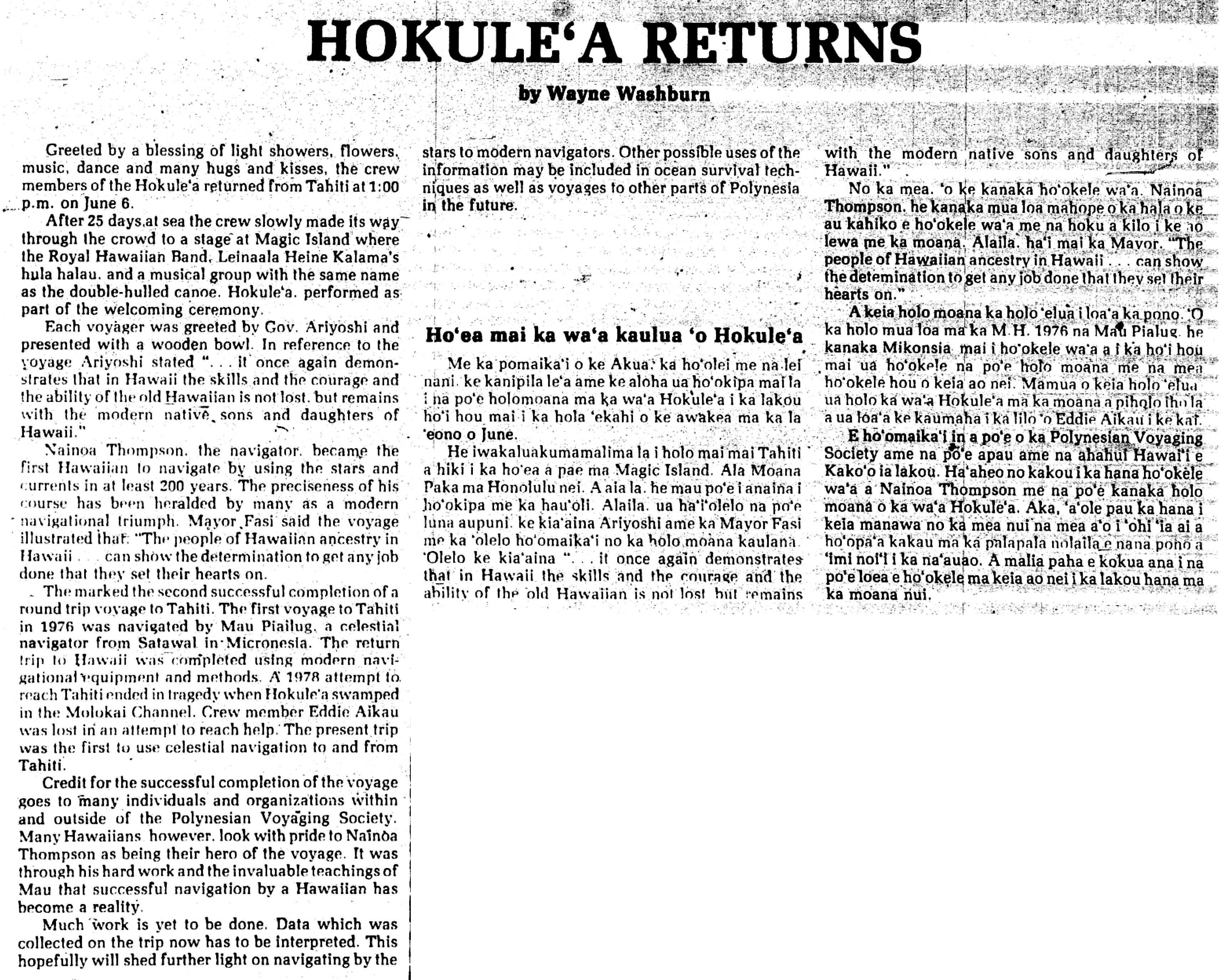
Greeted by a blessing of light showers, flowers, music, dance and many hugs and kisses, the crew members of the Hokuleʻa returned from Tahiti at 1:00 p.m. on June 6.

After 25 days at sea the crew slowly made its way through the crowd to a stage at Magic Island where the Royal Hawaiian Band, Leinaala Heine Kalama’s hula halau, and a musical group with the same name as the double-hulled canoe. Hokuleʻa, performed as part of the welcoming ceremony.

Each voyager was greeted by Gov. Ariyoshi and presented with a wooden bowl. In reference to the voyage Ariyoshi stated “…It once again demonstrates that in Hawaii the skills and the courage and the ability of the old Hawaiian is not lost, but remains with the modern native sons and daughters of Hawaii.”

Nainoa Thompson, the navigator, became the first Hawaiian to navigate by using the stars and currents in at least 200 years. The preciseness of his course has been heralded by many as a modern navigational triumph. Mayor Fasi said the voyage illustrated that: “The people of Hawaiian ancestry in Hawaii…can show the determination to get any job done that they set their hearts on.

This marked the second successful completion of a round trip voyage to Tahiti. The first voyage to Tahiti in 1976 was navigated by Mau Piailug, a celestial navigator from Satawal in Micronesia. The return trip to Hawaii was completed using modern navigational equipment and methods. A 1978 attempt to reach Tahiti ended in tragedy when Hokuleʻa swamped in the Molokai Channel. Crew member Eddie Aikau was lost in an attempt to reach help. The present trip was the first to use celestial navigation to and from Tahiti.

Credit for the successful completion of the voyage goes to many individuals and organizations within and outside of the Polynesian Voyaging Society. Many Hawaiians however, look with pride to Nainoa Thompson as being their hero through his hard work and the invaluable teachings of Mau that successful navigation by a Hawaiian has become a reality.

Much work is yet to be done. Data which was collected on the trip now has to be interpreted. This hopefully will shed further light on navigating by the stars to modern navigators. Other possible uses of the information may be included in ocean survival techniques as well as voyages to other parts of Polynesia in the future.

Hōʻea mai ka waʻa kaulua ʻo Hōkūleʻa

Me ka pōmaikaʻi o ke Akua ka hoʻolei me nā lei nani ke kanipila leʻa a me ke aloha ua hoʻokipa maila i na poʻe holomoana ma ka waʻa Hōkūleʻa i kā lākou hoʻi hou mai i ka hola ʻekahi o ke awakea ma ka lā ʻeono o June.

He ʻiwakāluakūmālima lā i holo mai ma Tahiti a hiki i ka hōʻea a pae ma Magic Island. Ala Moana Pāka ma Honolulu nei. A aia lā, he mau poʻe i anaina i hoʻokipa me ka hauʻoli. A laila, ua haʻiʻōlelo nā poʻe luna aupuni, ke kiaʻāina Ariyoshi a me ka Mayor Fasi me ka ʻōlelo hoʻomaikaʻi no ka holo moana kaulana. ʻŌlelo ke kiaʻāina, “…it once again demonstrates that in Hawaii the skills and the courage and the ability of the old Hawaiian is not lost but remains with the modern native sons and daughters of Hawaii.”

No ka mea, ʻo ke kanaka hoʻokele waʻa, Nāinoa Thompson, he kanaka mua loa ma hope o ka hala o ke au kahiko e hoʻokele waʻa me nā hōkū a kilo i ke ao lewa me ka moana. A laila, haʻi mai ka Mayor, “The people of Hawaiian ancestry in Hawaii…can show the determination to get any job done that they set their hearts on.”

A kēia holo moana ka holo ʻelua i loaʻa ka pono. ʻO ka holo mua loa ma ka M. H. 1976 na Mau Pialug, he kanaka Maikonia mai i hoike mai i hoʻokele waʻa a i ka hoʻi hou mai ua hoʻokele nā poʻe holo moana me nā mea hoʻokele hou o kēia ao nei. Ma mua o kēia holo ʻelua ua holo ka waʻa Hōkūleʻa ma ka moana a piholo ihola a ua loaʻa ke kaumaha i ka lilo ʻo Eddie Aikau i ke kai.

E hoʻomaikaʻi i nā poʻe o ka Polynesian Voyaging Society a me nā poʻe a pau a me na ʻahahui Hawaiʻi e kākoʻo iā lākou. Haʻaheo nō kākou i ka hana hoʻokele waʻa a Nāinoa Thompson me nā poʻe kānaka holo moana o ka waʻa Hōkūleʻa. Akā, ʻaʻole pau ka hana i kēia manawa no ka mea nui nā mea aʻo i ʻohi ʻia ai a hoʻopaʻa kākau ma ka palapala no laila e nānā pono a ʻimi noiʻi i ka naʻauao. A malia paha e kokua ana i nā poʻe loea e hoʻokele ma kēia ao nei i kā lākou hana ma ka moana nui.

[Now on their worldwide voyage, Mālama Honua!]

(Alahou, 5/1/1980, p. 7)

HOKULEʻA RETURNS

Ke Alahou, Helu 6 & 7, Aoao 7. May-June 1980.

Introduction to the reminiscences of Hawaiian missionary James Kekela, 1901.

THE LIGHT IN MICRONESIA.¹

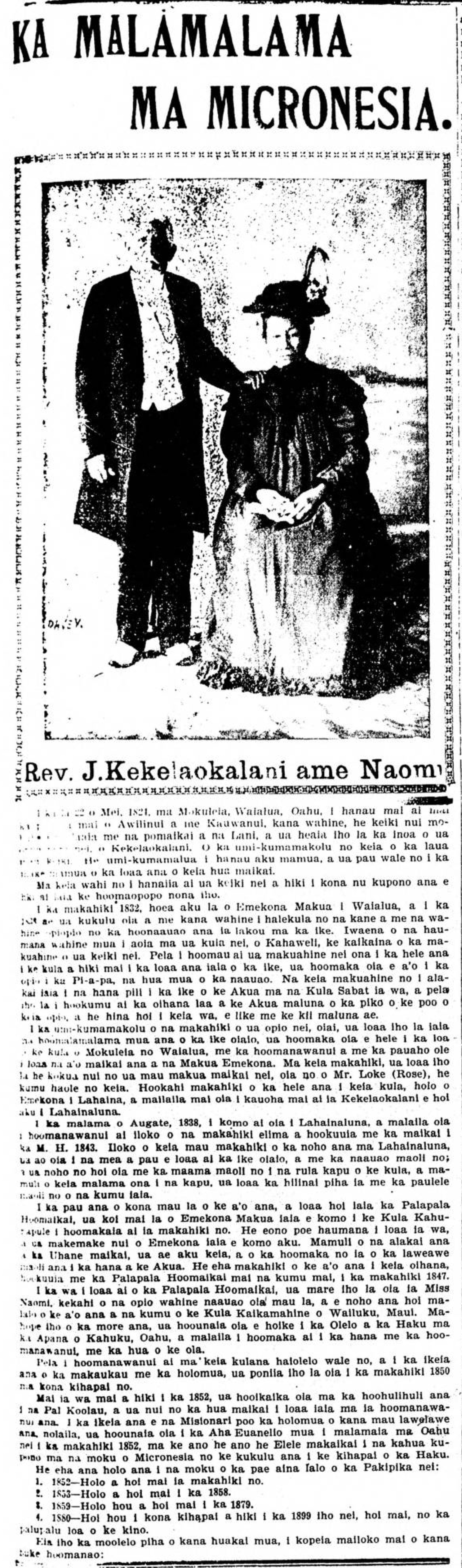
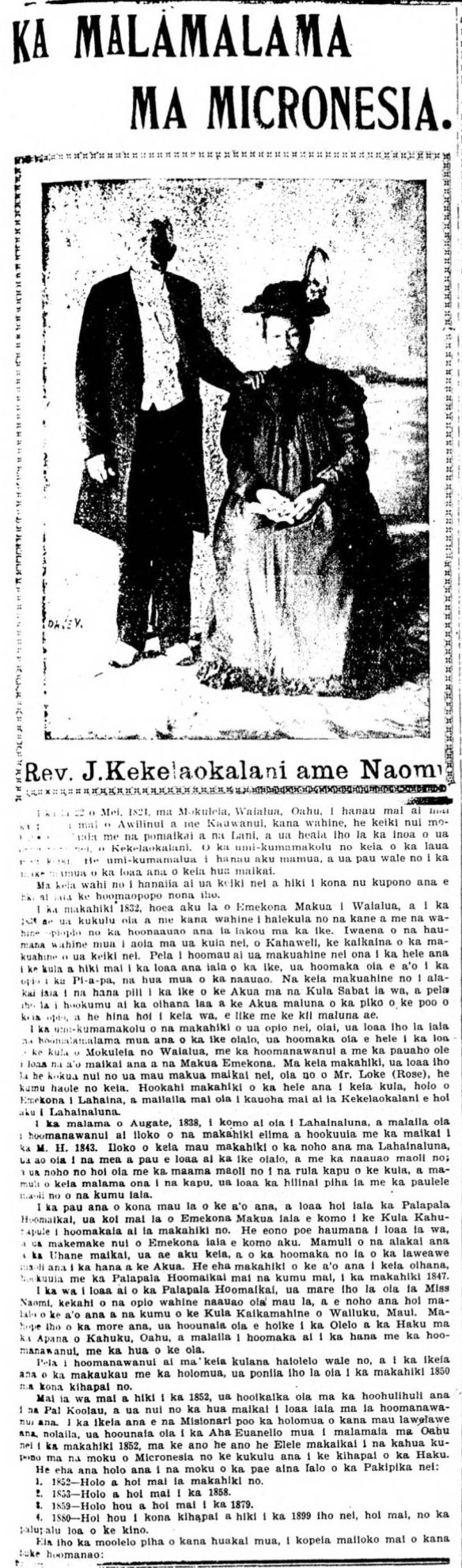
Rev. J. Kekelaokalani and Naomi

On the 22nd of May, 1821, at Mokuleia, Waialua Oahu, born of Awilinui and Kauwanui, his wife, was a big well filled-out baby with the blessings of the Heavens, and child was called by the name Kekelaokalani. This was the thirteenth of their children. Twelve were born prior, and with the [unclear phrase] of that fine offspring.

It was here that that child was raised until he was capable of understanding things for himself.

In the year 1832, Emerson, Sr. [Emekona Makua] arrived in Waialua, and in the following 1833 [unclear] he built a schoolhouse with his wife for the young men and women to enlighten them with knowledge. From among the first women to be taught there at that school was Kahaweli, the younger sister of the mother of that child. And following her, his mother as well attended the school until she was educated; and she began teaching the children the alphabet [Pi-a-pa], the beginnings of knowledge. It was this mother who guided him at that time in the knowledge about God and Sunday School, and it was thus that the sacred work of God was instilled a top the fontanel of the head [piko o ke poo] of this child, which is silver now, as in the picture above.

When that child was thirteen years old, being that he had received the beginnings of the light of true knowledge, he began to travel the width of the plain of Mokuleia for Waialua, with patience and without exhaustion, to receive the good teachings of the elder Emersons. In this year, those fine elders got great help in the form of Mr. Rose (Loke), a haole teacher. After one year of attending this school, Emerson went to Lahaina, and from there he told Kekelaokalani to come to Lahainaluna.

In August 1838, he entered Lahainaluna, and there he patiently remained for five years and he graduated in the year 1843. During those years at Lahainaluna, he learned everything about the true knowledge, as well as actual knowledge; and he remained, following the rules of the school, and as a result of his following the rules, he gained the full trust and total faith of the teachers.

After his days of learning were over, and he received his Diploma [Palapala Hoomaikai], Emerson, Sr. encouraged him to join the school for the clergy [Kula Kahunapule] that was started that very year. There were six students at the time, and Emerson wanted greatly for him to join. And because of the guidance of the righteous Spirit, he agreed, and so began his actual performing of the work of God. He spent four years at this work, and graduated with a Diploma from the teachers, in the year 1847.

When he received his Diploma, he married Miss Naomi, one of the educated young women of the time, and was living under the instruction of the teachers of the Girls’ School of Wailuku, Maui. After they were wed, he was sent to teach the Word of the Lord in the District of Kahuku, Oahu, and there he began his work with patience, with the word of life.

And he thus patiently continued as but a preacher; and when his readiness and progress was seen, he was ordained at his own parish.

From then until 1852, he strove to convert the Koolau Cliffs, and the fruits of his patience were many. When the head Missionaries saw his progress of his work, he was sent by the first Evangelical Convention held here on Oahu in the year 1852 as a Representative to travel to the places suitable to build parishes of the Lord in the Micronesian Islands.

He went to the islands of the South Pacific four times:

1. 1852—Went and returned that same year.

2. 1853—Went and returned in 1858.

3. 1859—Went again and returned in 1879.

4. 1880—Returned to his parish until this past year 1899, and came back, in feeble health.

Here is the entire story of his first excursion, copied from his journal:

[A long account follows. Perhaps i will post it here one of these days…]

¹Kekela was based in the Marquesas Islands, and not the Micronesian Islands.

(Kuokoa, 1/18/1901, p. 5)
KA MALAMALAMA MA MICRONESIA.

Ka Nupepa Kuokoa, Buke XXXIX, Helu 3, Aoao 5. Ianuari 18, 1901.