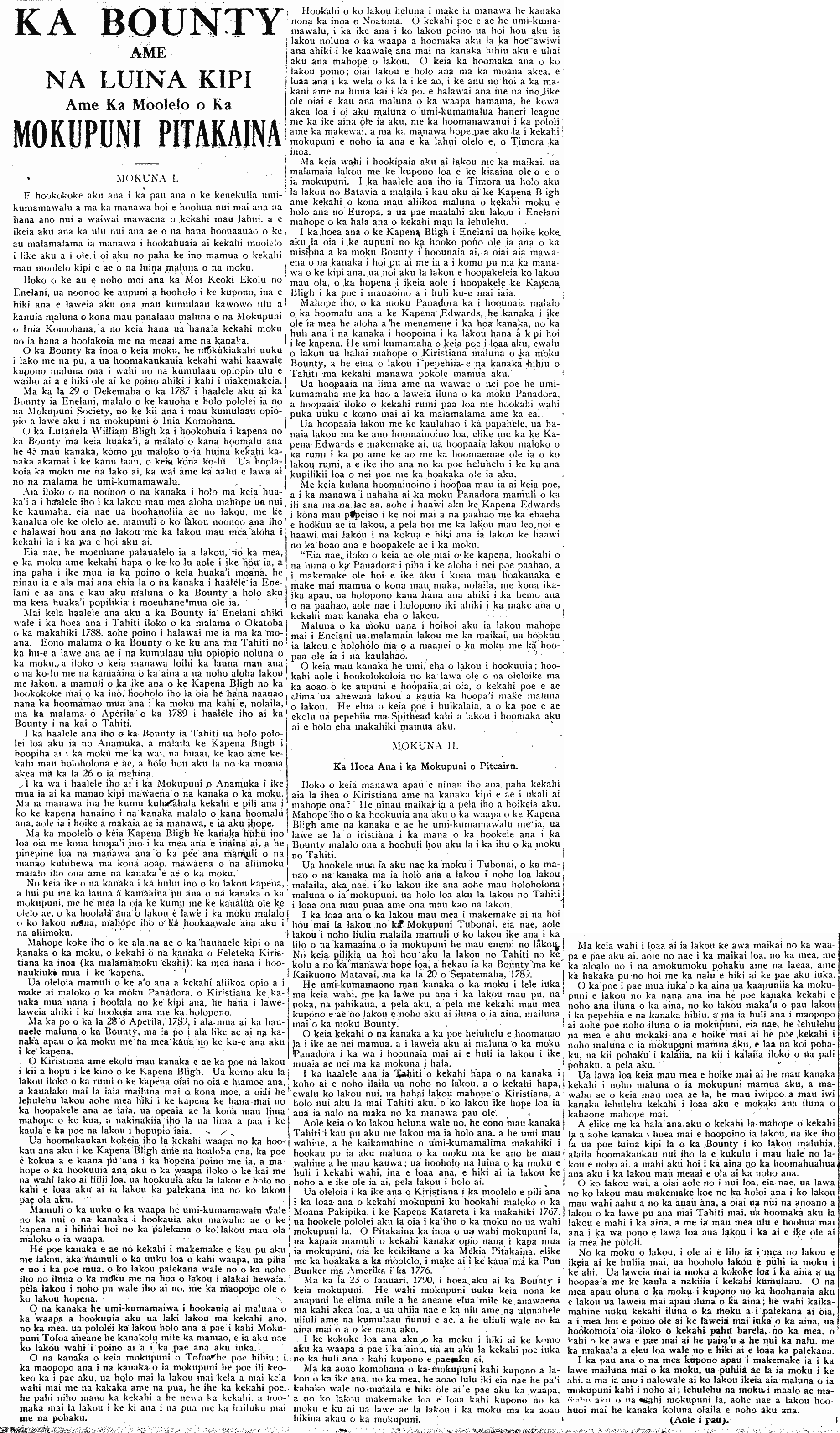
The magazine “Ke Au Hou.” 1912.

[Found under, “Local News”]

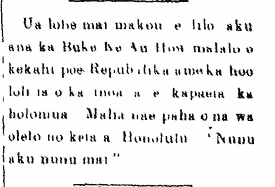
We have heard that the Book, “Ke Au Hou,” will be taken over by some Republicans and its name will change to “Ka Holomua.” Perhaps that is just gossip here in Honolulu: groaning this way and that.

[See Papakilo Database for online issues: “Ke Au Hou” and “Hawaii Holomua”. I am not sure what changes were made with the name change, but the heads of the paper seem to stay the same: John H. Wise, Gulstan K. Poepoe, and Daniel K. Hoolapa…

These publications are more like literary magazines than newspapers. There are many more extant issues of “Hawaii Holomua” neither microfilmed nor available online to this day!]

(Kuokoa Home Rula, 2/16/1912, p. 2)

Ua lohe mai makou...

Kuokoa Home Rula, Buke X, Helu 7, Aoao 2. Feberuari 16, 1912.

Mahalo to Kamaoli Kuwada for kindly allowing us to repost this! 1905/2012.

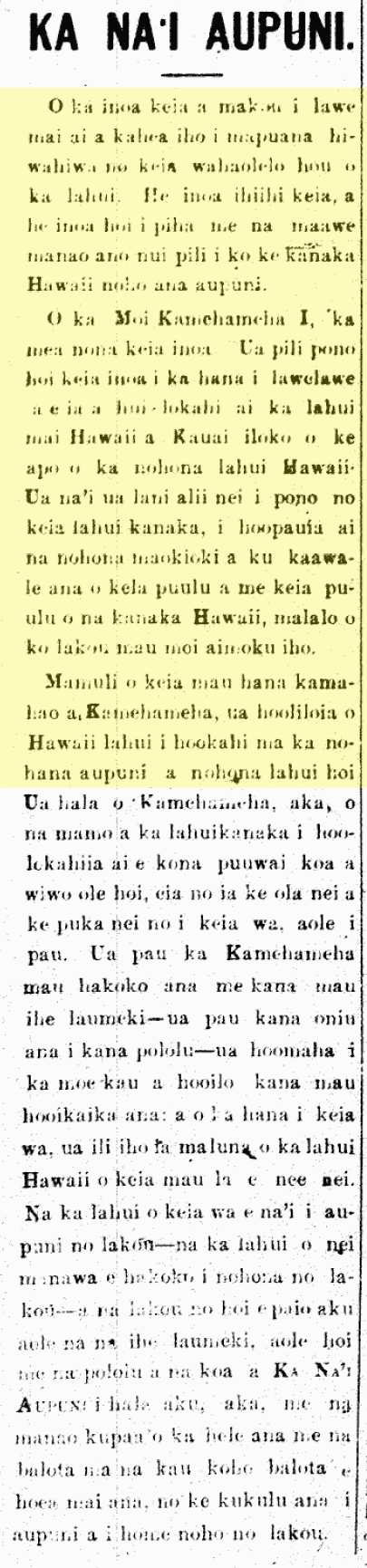
KA NA’I AUPUNI.

[Today is not only a day to mourn the events of 1893, but also to celebrate the courage, tenacity, and deep aloha of the lāhui Hawai’i for persisting and growing these past 119 years.

As the editors of the newspaper Ka Nai Aupuni said in an editorial published alongside Ka Moolelo o Kamehameha I:]

. . .

Kamehameha has passed on, but as for the descendants of the race of people united by his brave and fearless heart, they still live on and emerge in this time; they are not gone. Kamehameha’s fighting with his ihe, his barbed spears, is finished; the whirling of his pololū, his long spears, is ended; his struggles have retired to the sleep of ages; and the work of this time has been inherited by the Hawaiian nation of this progressive era. It is the people of this era who shall conquer a nation for themselves; it is the people of this era who will wrestle for a lifestyle of their own; it is they who will fight, not with barbed ihe, not with the long spears of the warriors of the Conqueror who has passed on, but with the firm conviction to go with ballots to the coming elections in order to build a government and a home for themselves.

(Na’i Aupuni, 11/27/1905, p. 2)

KA NA'I AUPUNI

Ka Na'i Aupuni, Buke I, Helu 1, Aoao 2. Novemaba 27, 1905.

More on traditional stories, and variation within, 1862.

About Kaao and Moolelo.

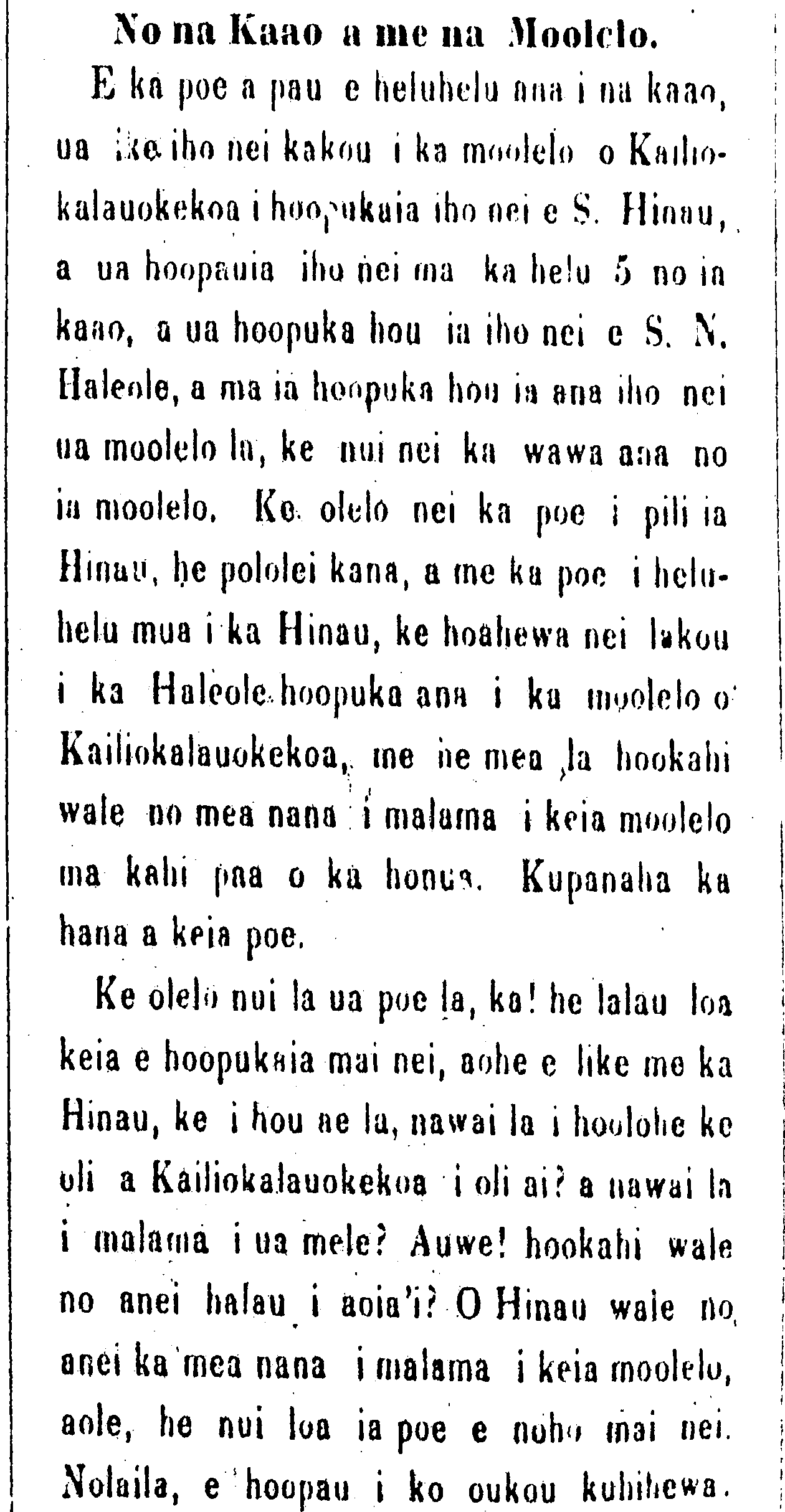
O Readers of kaao, we have seen the story of Kailiokalauokekoa that was published by S. Hinau, and it was just completed with the 5th installment [this series, “He Moolelo no Kailiokalauokekoa,” probably started on 10/24/1861 (which is missing) and S. Hinau closes his telling on 12/5/1861]; S. N. Haleole has just started that story again [which begins with genealogy, on 12/12/1861, restarts with installment 6 on 12/19/1861, and probably ended with installment 10, on 1/30/1862 (which sadly is also missing)], and with that retelling of the story, there has been quite the uproar. Those who are with Hinau say that his is correct, and those that read Hinau’s first fault Haleole’s publishing of Kailiokalauokekoa, as if there is but one person who retained this story on this solid earth. The actions of these people are unbelievable.

Those people go on and on saying, “oh please! this series is so misguided and not like Hinau’s”; further more, “Who has heard those oli which were chanted by Kailiokalauokekoa? and who kept those mele?” Auwe! Is there only one school where it was taught? Is it only Hinau who has kept this story? No, there are many people today. So stop with your unfounded ideas.

(Hoku o ka Pakipika, 1/16/1862)

No na Kaao a me na Moolelo.

Ka Hoku o ka Pakipika, Buke 1, Helu 17, Aoao 4. Ianuari 16, 1862.

On traditional stories and finishing properly what you begin, 1862.

Words of Advice.

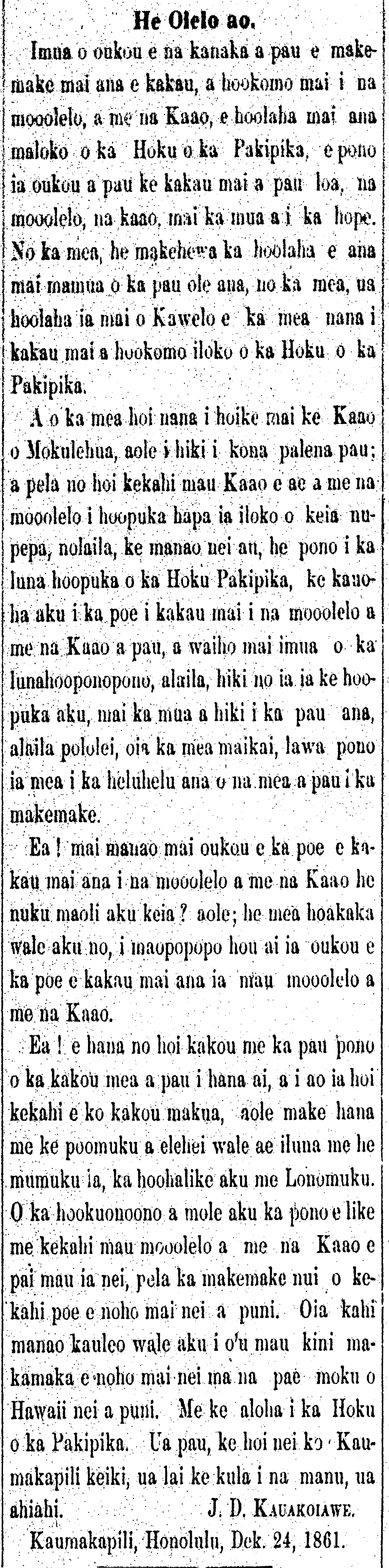
Before you, all those who want to write and publish stories (mooolelo and kaao) in the Hoku o ka Pakipika: you must all write the whole story from the beginning all the way until the end. Because it will be a waste of time to start printing before it is completed, as Kawelo by the person who submitted it, was printed in the Hoku o ka Pakipika [“Mooolelo no Kawelo” by S. K. Kawailiula from 9/26/1861 to 12/5/1861—5 helu total].

And as for the person who submitted the story of Mokulehua, he did not get to the end [“He wahi Kaao no Mokulehua” begins on 11/28/1861, and in the Helu 2 (12/5/1861), there is a note from the editor at the bottom, “Send in more of the story of Mokulehua; make it quick lest the Hoku o ka Pakipika give you a kick.” Helu 3 in the next issue (12/12/1861) is very short, and there is a long hiatus until well after this letter is published. It finally reappears as “He Moolelo no Mokulehua on 3/13/1862 to 3/27/1862, 6 Helu in total, by B. K. H.**.]; and so too of some other kaao and mooolelo that were published partially in this newspaper; therefore, i feel that it is necessary for the editor of the Hoku o ka Pakipika to require that those who write in mooolelo and kaao to complete it and then to put it before the editor, and then it can be printed from beginning to end, and it is right and good, and everyone who reads it will be satisfied.

Now then! all you people who write in mooolelo and kaao, don’t take this as a critique; no, it is just clarification, so that you all know.

Now then! let’s all finish everything we start properly, as some of us were taught by our parents: don’t do things leaving off the beginning, cutting off the top like a maimed one, imitating Lonomuku. What is necessary is to make it well-rooted, as are some of the mooolelo and kaao that are being published, and that is what what people all over really want. This is just encouragement to all my friends living throughout these Hawaiian islands. With aloha to the Hoku o ka Pakipika. I am done, Kaumakapili’s child returns, as the fields are tranquil with birds and it is eventide.  J. D. KAUAKOIAWE.

Kaumakapili, Honolulu, Dec. 24, 1861.

(Hoku o ka Pakipika, 1/2/1862, p. 4)
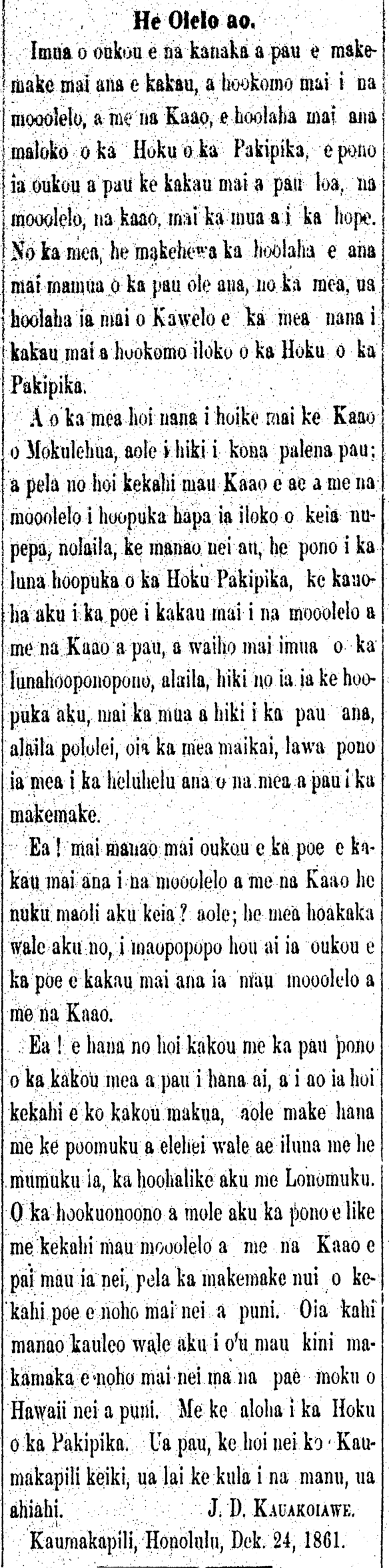
He Olelo ao.

Ka Hoku o ka Pakipika, Buke 1, Helu 15, Aoao 4. Ianuari 2, 1862.

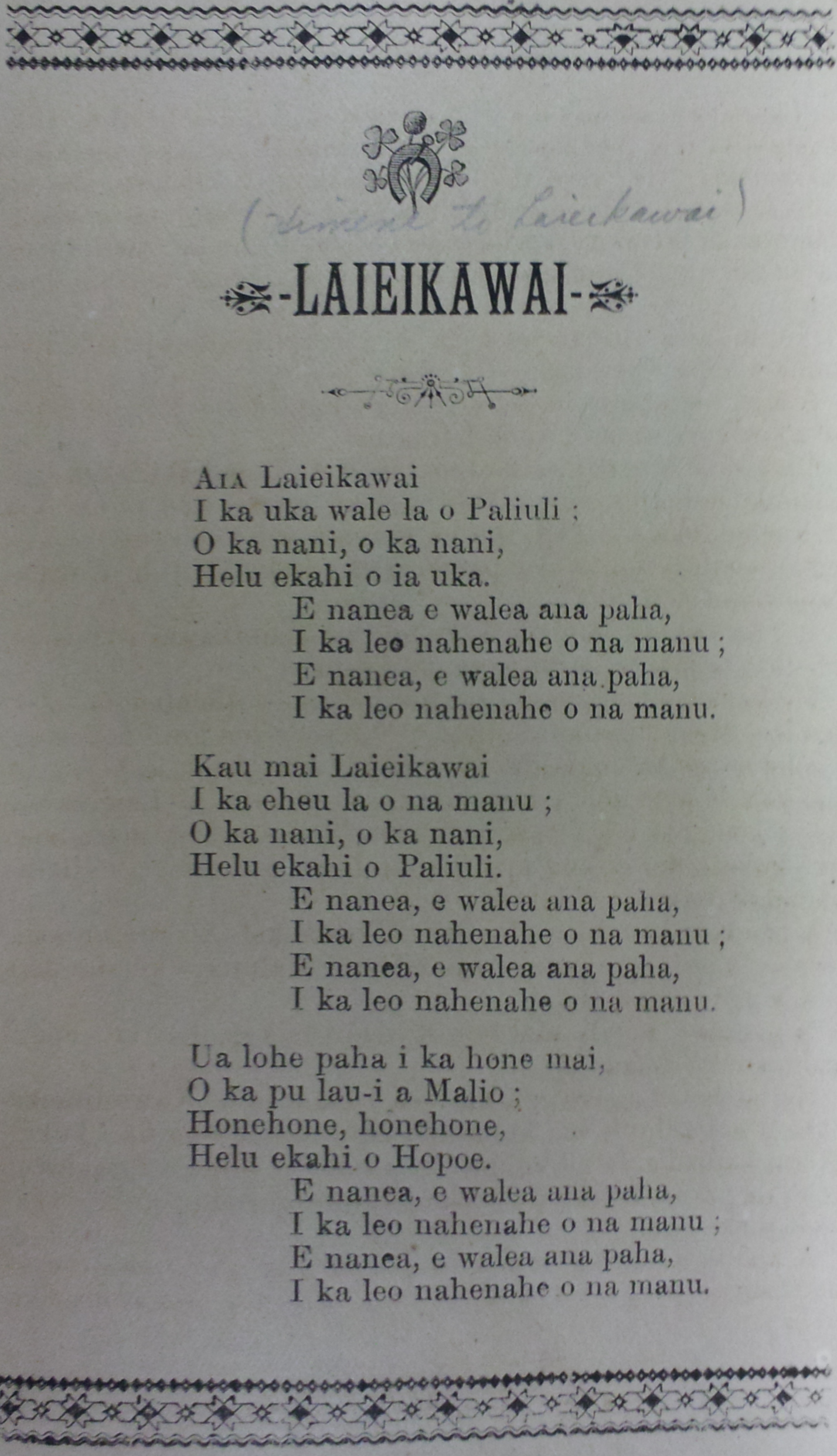
Laieikawai, 1888.

In 1888, “Ka Moolelo o Laieikawai, a o ka mea i kapa ia Kawahineikaliula [The Story of Laieikawai, the one that was called The Woman of the Twilight],” was edited and republished by Sol. Meheula and Jas. Henry Bolster, “For the benefit and the progress of the new generations of the Hawaiian People.”

On page 131 of this book appears this mele called “Laieikawai” which may look familiar to many of you.

Laieikawai

"Ka Moolelo o Laieikawai: a o ka mea i kapa ia Kawahineikaliula," Sol. Meheula & Jas. Henry Bolster, ed., Honolulu: Papa Pai Mahu "Bulletin," 1888. p. 131 (Courtesy of Bernice Pauahi Bishop Museum)