A new Portuguese newspaper, 1885.

O Luso Hawaiiano.

The unfamiliar words placed above is the name of a new newspaper published in town in the Portuguese language. We got a hold of the first issue of the new serie of this newspaper. This paper was published earlier, but it was not long lived before it went to sleep. After being revived these days, it was called a new serie, like it is a new ano [new series]. We hope this newspaper O Luso Hawaiiano will live forever. The number of Portuguese living with us lately has increased, and it would not be good to just have them be without means to gain knowledge. And they will probably be happy to regularly acquire news in their own language. Mr. A. Marques is the editor of this newspaper. He is a haole that has not lived long amongst us, but his is a kamaaina nonetheless.

He has had editorials printed in haole newspapers of this town, speaking of subjects pertaining to the progress and prosperity of our archipelago. He is a man who speaks his mind without being ingratiating [hoopilimeaai]. In this age of much ingratiation and prejudice, our readers will be happy to hear of this new newspaper established for the good of the people.

[Hamilton Library put up online the Portuguese language newspapers from Hawaii. CLick here to be taken to O Luso Hawaiiano.]

(Kuokoa, 8/22/1885, p. 2)
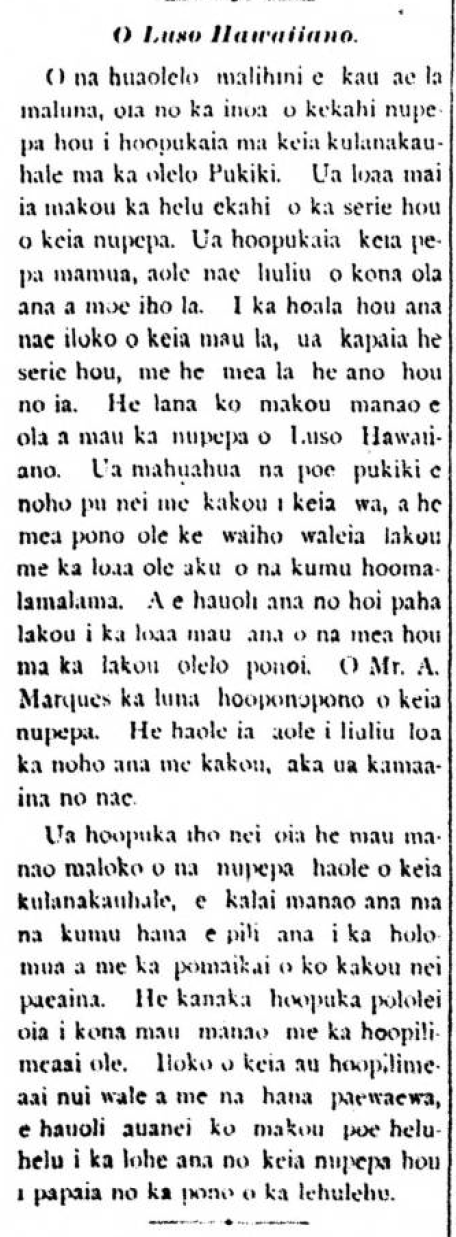
Ka Nupepa Kuokoa, Buke XXIV, Helu 34, Aoao 2. Augate 22, 1885.

Pleas for So Hin Wong, 1923.

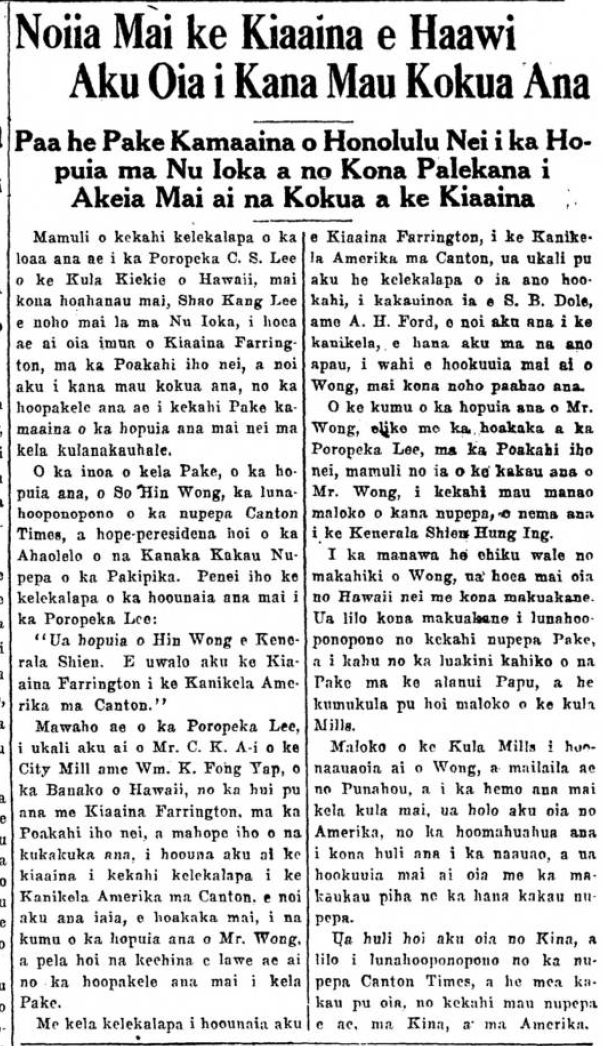
The Governor is Asked to Give Assistance
A Chinese Kamaaina of Honolulu is Arrested in New York, and to Save Him, Assistance of the Governor is Wanted

Because of a telegraph received by Professor C. S. Lee of the University of Hawaii, from his brother, Shao Kang Lee, living in New York, he went before Governor Farrington this past Monday and asked for his assistance to save a Chinese kamaaina who was arrested in that city.

The name of that Chinese that was arrested is So Hin Wong, the editor of the newspaper Canton Times, and vice president of the Pan Pacific Press Congress [ka Ahaolelo o na Kanaka Kakau Nupepa o ka Pakipika]. This is how the telegraph went which was sent to Professor Lee:

“Hin Wong was arrested by General Shien. Have Governor Farrington call for help from the American consulate in Canton.”

Other than Professor Lee, he was accompanied by Mr. C. K. A-i of City Mill and William K. Fong Yap of the Bank of Hawaii, to meet with Governor Farrington, on this past Monday. And after their meeting, the governor sent a telegraph to the American consul in Canton asking him to explain the reasons that Mr. Wong was arrested. And those were the steps to save that Chinese.

Along with the telegraph sent by Governor Farrington to the American Consul in Canton, another similar telegraph was sent by S. B. Dole and A. H. Ford, asking the consul to do all that he can to get Wong released from his imprisonment.

The reason that Mr. Wong was arrested, as explained by Professor Lee, last Monday, because Mr. Wong wrote editorials in his newspaper criticizing General Shien Hung Ing.

When Wong was but seven years old, he arrived here in Hawaii with his father [Shu King Wong]. His father became the editor of a Chinese newspaper [Sun Chung Kwok Bo] and pastor for the old Chinese church on Fort Street, and a teacher as well at Mills School.

Wong was educated at Mills School, and then at Punahou, and after graduating he went to America to further his education, and he graduated, prepared to be a newspaper writer.

He returned to China, and because the editor for the newspaper Canton Times, and he is also a writer for a number of other newspapers in China and America.

(Kuokoa, 2/15/1923, p. 1)

Ka Nupepa Kuokoa, Buke LXII, Helu 7, Aoao 1. Feberuari 15, 1923.

Japanese Newspapers, 1895.

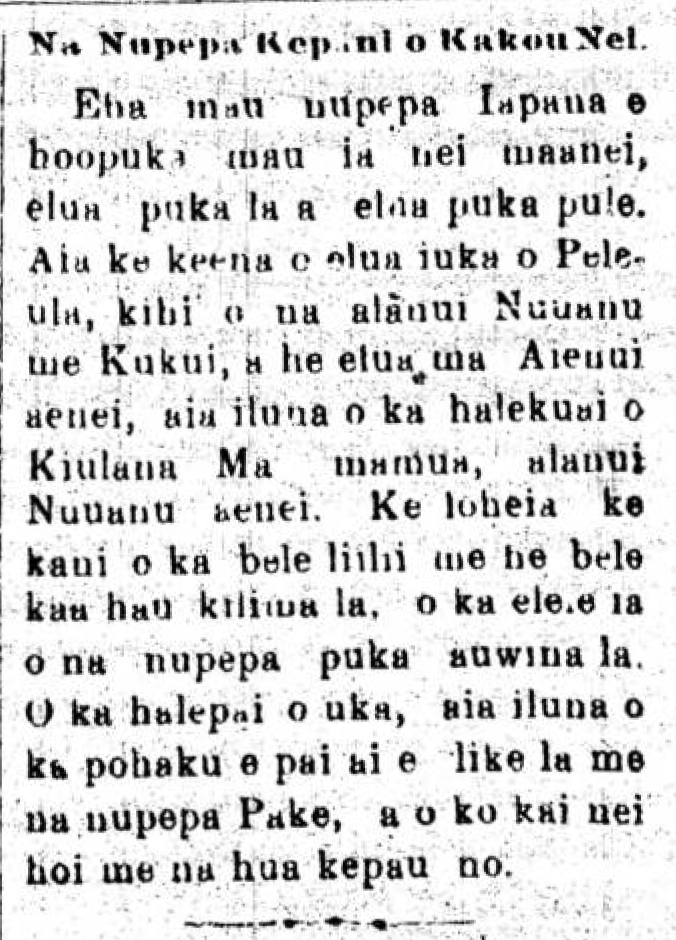
Our Japanese Newspapers.

There are four Japanese newspapers being published regularly here, two dailies and two weeklies. Two of their offices are in the uplands of Peleula at the corner of Nuuanu and Kukui Streets; and two are at Aienui, above what was the shop of Chulan & Co. [Kiulana Ma], on Nuuanu Street. When we hear the little bell that sounds like the ice cream cart bell, it is the messenger of the afternoon newspaper. The press in the uplands does its printing using stone [lithograph] like the Chinese, and the lowland press uses movable type.

(Makaainana, 4/29/1895, p. 2)

Ka Makaainana, Buke III—-Ano Hou, Helu 8, Aoao 2. Aperila 29, 1895.

Maori newspaper, 1875.

[Found under: “Nu Hou Kuloko.”]

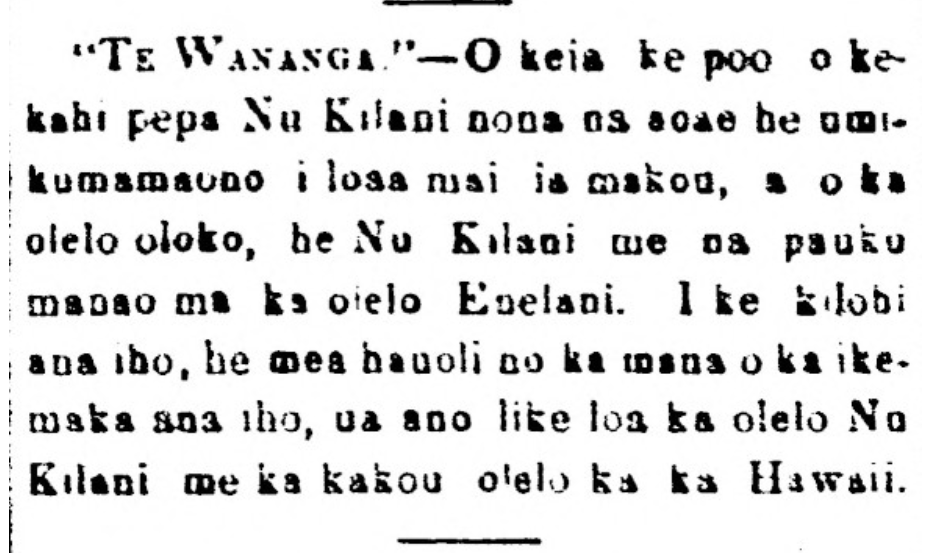
Te Wananga.–This is the title of a New Zealand newspaper of sixteen pages which we obtained. The words within are of New Zealand [Maori] with some paragraphs in English. Taking a look, it was joyful to see firsthand that the New Zealand language is very similar to our language, the Hawaiians.

(Kuokoa, 10/23/1875, p. 2)

Ka Nupepa Kuokoa, Buke XIV, Helu 43, Aoao 2. Okatoba 23, 1875.

Newspaper out of Makawao? 1865

[Found under: “HUNAHUNA MEA HOU O HAWAII NEI.”]

A Printer at Makawao.—A paper printed at the press of the girls’ school at Makawao arrived at our business office. And being that we see it is a new thing being done there, we therefore extend our great praise for the girls who perhaps set the type and printed it on their press. And here are the words printed by them in Hawaiian [olelo kanaka]: May the parents, friends, and neighbors know that Thursday, the 28th of Dec., will be the examination of Makawao College at the protestant church in Makawao. Come all who wish.” It is published in Hawaiian and in English.

(Kuokoa, 12/23/1865, 2)

Ka Nupepa Kuokoa, Buke IV, Helu 51, Aoao 2. Dekemaba 23, 1865.

What are you doing tomorrow at 2:00?

Papakilo Database on Hawaiian language newspapers!

If you are free tomorrow afternoon, check out the webinar on Hawaiian language newspapers put on by Papakilo Database and Awaiaulu. Click the image below to be taken to the registration page!

https://zoom.us/webinar/register/WN_fOxuRC5_QcyXB5Yex40Gkg

Edwin M. Desha fights for Ka Hoku o Hawaii, 1938.

Eddie Desha is Trying All Means to Save “Ka Hoku o Hawaii”

An effort to perpetuate the Hawaiian language and a Newspaper published in that language is being made in Hilo.

Eddie Desha, the nephew of the late Senator Stephen L. Desha Sr., is making this determined effort, with the courage and persistence which characterized his uncle, one of Hawaii’s noted orators and legislators.

Besides a small monthly magazine published by the Hawaiian Board of Missions [Ka Hoaloha], there now remains only one weekly newspaper printed in the native Hawaiian language of Hawaii. It is Ka Hoku o Hawaii (Star of Hawaii), published in Hilo by the Star of Hawaii Publishing Co., Ltd., of which W. H. Beers, Hilo attorney, is president, and Edwin M. Desha is treasurer and manager. Continue reading