Jules Tavernier, 1885

[Found under: “NA NU HOU HAWAII”]

Illustrations by Tavernier were sent, a great many of his drawings of the storied places [wahi pana] of Hawaii nei, to the illustrated newspaper Harper’s of New York, with the hopes that they will be engraved in stone and arranged in the newspaper.

[Jules Tavernier not only did these illustrations for Harper’s Magazine, but he did spectacular paintings as well. Click here for the latest post from Nanea Armstrong-Wassel on a painting by Tavernier.]

(Ko Hawaii Paeaina, 3/21/1885, p. 2)

KHPA_3_21_1885_2.png

Ko Hawaii Paeaina, Buke VIII, Helu 12, Aoao 2. Maraki 21, 1885.

More on paintings of Joseph Nawahi, 1888.

A TALENTED PAINTER.

We went in person to see the just completed paintings of Joseph Nawahi, Esq. of Hilo; a painting of the crater of Kilauea and Waikiki seen from Leahi; we have but one word to say,—he is a Hawaiian well versed at painting self taught to a very high level. It is something that baffles the malihini, that Mr. Nawahi possesses this amazing talent like that of the haole who were actually schooled in this field of knowledge. His paintings are being shown at the bookstore of A. M. Hewett [Huita] where malihini have words of praise for this Hawaiian skilled at handling his paintbrush deftly utilizing all the colors of ink. Way-up.

(Kuokoa, 12/8/1888, p. 2)

Kuokoa_12_8_1888_2.png

Ka Nupepa Kuokoa, Buke XXVII, Helu 49, Aoao 2. Dekemaba 8, 1888.

More on prolific Charles Furneaux, 1881.

Mr. Furneaux’s Paintings.

A very interesting series of oil paintings by Mr. Furneaux is to be seen in the tower room of the Government Building [Aliiolani Hale]. These are chiefly sketches of the volcanic phenomena which have been displayed on Hawaii since November last. Having been on the spot from the beginning of the eruption, and taking a great interest in it, Mr. Furneaux has been able to secure illustrations of all its phases during the progress of the flow, from its source to the immediate proximity of the sea. The first of the series is a view taken from Kawaihae, in November last, after the flow had divided into two or more streams; one the Kau stream, which, after threatening the Kapapala Plantation, has long since ceased to flow; another the flow towards the plateau between Maunaloa and Maunakea, which, after many windings and doublings, is now threatening the town and harbor of Hilo. The next view was taken from Hilo Bay, and shows the three streams which were so conspicuous on the face of the mountain in November last. Immediately after his arrival Mr. Furneaux paid a visit to the crater of eruption, which is situated at an elevation of about 12,000 feet, or about 2,000 feet below the summit of the mountain. Three of the paintings depict this crater, one being from a point which gives a view of its interior. Another picture gives a near view of the blow-hole, or secondary crater, from which a discharge of lava was noticed on December 3rd. The next group of paintings gives us vivid illustrations of the conditions of things near Hilo in April and May last. In the former month Mr. Furneaux obtained a fine view of the main flow, as it appeared in the woods about eight miles from Hilo, at the time when its whole width of two to two and a half miles was in a molten and very active state, just at a point where the Puna, Waiakea and Hilo flows were being separately developed from it. In this picture we have a fine illustration of the “volcano cloud” with its deep red tinge looking more fiery than the very lava whose glow it reflects. The next of the series shows the curious phenomena of a waterspout on the lava flow, a sight frequently witnessed when the front face of the stream was lingering in the woods. Another picture also taken in April at the same distance from Hilo, shows the black and broken surface of the flow of 1856 and this new and greater flow creeping up to and over it. The next series of sketches were of the Waiakea flow taken two months before the sudden outburst by which it has threatened the sugar mill. One is of the artist’s camp in a dense growth of ohias, tree-ferns and wild bananas close to the edge of the flow. Another sketch from the tent door pictures some bananas, ferns and creepers with the red glare from the lava as a background. A third is a daylight view of the flow showing the havoc made in the lovely forest thus cruelly invaded. This sketch was taken when one tall ohia remained still erect with lava all round it. John Hall, whose place has since been destroyed, was Mr. Furneaux’s guide, and the latter made a sketch of his house before its fate was anticipated. This view was taken in May; a companion picture shows everything overwhelmed except a tree and part of the fence, with an extraordinary pit in the foreground, revealing the liquid lava flowing beneath the cooled crust. Later in May Mr. Furneaux paid a visit to what is known as the Hilo flow. Among the group of sketches then taken is one of the advanced part of the flow, with a group of Hawaiians getting specimens in the foreground; a sketch of Hale Laumaia, with the volcanic cloud hanging over the wooded scenery of the background; a sketch of the flow at the moment of one of the gas explosions, which are common when the lava is passing over the surface of previous flows, and penetrating into the caverns which about in the dead lava. Then comes a sketch in which we have a cascade of lava falling over a ledge of bare rock, and by way of contrast to its lurid fire, the flame of burning timber and undergrowth on the right hand of the picture. Following this series is a picture of the Waiakea flow as seen from a distance before its sudden advance; also a sketch of H. H. Ruth Keelikolani’s place, where that flow will probably reach the sea. The last group are from sketches taken late in July, after the Waiakea flow had pushed forward with so much violence. One of John Hall’s property has already been alluded to; another shows the lava flowing over a precipice about 60 feet wide, and 14 or 15 feet high, into a great pool of water—a scene already familiar to us through Mr. Dickson’s photographs; and a third shows the Waiakea mill, and the position of the flow on 25th July, with the intervening land. One interesting picture shows the way in which the lava at times pushes its way forward, throwing out snake-like tongues of fire from the black front of the stream.

Besides these paintings, there are some pictures of Halemaumau, and some views of forest and mountain scenery. Mr. Furneaux has also a number of other pictures, which he has not at present opened out for the public view, as he intends to return at once to Hilo to increase his store of sketches, and to catch, if possible, the lava stream in the very act of precipitating itself into the sea.

(Pacific Commercial Advertiser, 8/13/1881, p. 3)

PCA_8_13_1881_3.png

The Pacific Commercial Advertiser, Volume XXVI, Number 7, Page 3. August 13, 1881.

Mauna Loa eruption and Furneaux, 1881.

From Our Hilo Correspondent.

Editor Saturday Press:—A large column of smoke stills issues from Mauna Loa and the end of the three flows, which are seen very distinctly from here, prove that there is great activity at the source of the flows. Large numbers of the people of this place have visited them, and there is someone going almost daily, as it only takes about two hours to reach the flows nearest Hilo. It is generally conceded that the flow or flows must come to the sea unless it should change its present course) somewhere near Waiakea. Mr. Furneaux, the artist, has been making some fine views of the flows as seen at night. His pictures are very correct always. We may consider ourselves fortunate in having an artist on the spot. He will also visit old Kilauea which is quite active, as I was told this morning. We had a report a few days ago that there was nine cases of small-pox at Kona, but it was found to be not so. We have not had a single case in the district. No place in the islands, or perhaps in creation, is more healthy than this district.  J. A. M.

(Saturday Press, 5/21/1881, p. 2)

SaturdayPress_5_21_1881_2.png

Saturday Press, Volume I, Number 38, Page 2. May 21, 1881.

Charles Furneaux and the Sublime, 1882 / 2016.

[Found under: “NU HOU KULOKO.”]

Our master painter Mr. Furneaux hung his paintings of the volcanic crater at his office in Aliiolani Hale to show it to the public. This Wednesday, he has invited the Members of the Legislature to go and see his work. They are just so beautiful.

[Don’t forget to go and check out the Furneaux exhibition going on now at the Honolulu Museum of Art!]

(Kuokoa, 6/3/1882, p. 3)

Kuokoa_6_3_1882_3.png

Ka Nupepa Kuokoa, Buke XXI, Helu 22, Aoao 3. Iune 3, 1882.

More from the Deshas, 1944.

Our Day

THE CALM SEAS OF KONA

Kealakekua, Thursday, April 27, 1944. This morning the Rev. Desha went down to Kailua, to the Kona Inn, to fetch his namesake grandchild, Winona Beamer. She had a friend with her. The Rev. Desha went with our first child, Stephen Desha III, to take Winona Beamer and her friend to Hale o Keawe at Honaunau. They saw the Stone of Keoua [Pohaku a Keoua], the stone konane board, the stone with holes to bury the umbilical cord of babies of those days, the stone that Kaahumanu used to hide from Kamehameha with, and the stone god figures.

After their tour was over they returned to Napoopoo and saw the Monument to Opukahaia and the bay of Kealakekua. And after that was done, they came back to our home to eat lunch. After lunch, we had an enjoyable time with Winona Beamer with the piano and all of us singing.

At 2:00 p. m., a haole arrived, Mr. Lester, a friend of these girls, and we all went to Huehue, to the home of those friends, Mr. and Mrs. Theodore Vredenberg [Vredenburg]. We spent a pleasant time with Mrs. Vredenberg and saw her drawings of all sorts of flowers. One of her pictures was of the flower of the Hawaiian ape. These drawings were not small, they were big indeed. The length of this drawing is around three feet while the width is about two feet and a half. If you look at this drawing, it looks as if it is growing in the picture. After enjoying our time, we turned back and the visitors returned to the Kona Inn.

Friday, April 28, 1944. At 9:00 this morning, the two of us went to the Dentist [Hale Kauka huki niho] and had a checkup. My tooth was chipped from eating the charred skin from a kalua pig. I ate it because it was tasty, and alas my tooth became chipped. I was so lucky, the doctor said it was not a big thing to insert a new tooth, and that is what he will do.

[This was a fun account, perhaps mostly because I know the awesome daughter of Theodore and Beatrice Vredenburg!]

(Hoku o Hawaii, 5/10/1944, p. 1)

Ko Maua La

Ka Hoku o Hawaii, Volume XXXIX, Number 3, Aoao 1. Mei 10, 1944.

Painting of lying in state of Queen Liliuokalani by Lionel Walden? 1917.

LIONEL WALDEN TO PUT CHURCH SCENE INTO COLOR

Lionel Walden, noted artist, whose representations of Hawaiian scenes met with great favor here and elsewhere, was occupied yesterday in making a sketch of the interior of Kawaiahao church. The painting on which Mr. Walden will be at work again this morning will give to posterity a vivid and realistic picture of the lying in state of the last of Hawaii’s monarchs. The somber background, setting off in brilliant contrast the many beautiful flowers that are being sent to the dead queen, the tall kahilis, the graceful palms, the waiting people, will have proper place in the picture, and dominating all will be the royal casket, with its covering of feather cape, its tabu sticks guarding the queen in death as her proud station guarded her in life, while surrounding her stand the faithful kahili-bearers, keeping the last vigil over the last ruler of a vanished kingdom.

[Wow. Does anyone know if this painting was completed and if so, where it is now?]

(Honolulu Star-Bulletin, 11/15/1917, p. 2)

LIONEL WALDEN TO PUT CHURCH SCENE INTO COLOR

Honolulu Star-Bulletin, Volume XXV, Number 7985, Page 2. November 15, 1917.

Enoch Wood Perry Jr. arrives, 1864.

An Artist.—Among the passengers by the Comet last week, was Mr. E. W. Perry, Jr., a portrait and landscape painter. A specimen of his work can be seen in the bookstore—being a portrait of Rev. Mr. Corwin. A glance at the picture is sufficient to satisfy any one that it is a perfect copy of the original, and that the person who executed it, has the skill of a true artist. Mr. Perry visits our islands to take views and paintings af our principal landscape scenery, and starts for Kilauea on Monday next in the steamer, via Kealakekua and Kau, intending to sketch the crater, Hilo and other scenery of that island worthy of being copied. We commend him to the attention of our friends wherever he may visit. While travelling through California, Mr. Perry was in company with Messrs. Williams and Bierstadt. The former will arrive here shortly. The latter having sold his fine painting of Yosemite Falls and Valley to a New York publishing house for $15,000, has gone East on business connected with the same. It was the intention of the three artists to visit our group in company. Messrs. Perry and Williams will undoubtedly succeed in taking some views that will be very valuable. Now while they are here, let us suggest that the Government secure their services to paint correct full-size portraits of the late King and His Majesty the present King, as also, perhaps, Queen Emma and Gov. Kekuanaoa, to be preserved as national property to adorn the Palace. It is so seldom genuine artists visit the islands that this opportunity should not be lost.

[Perry is the artist who painted the famous portrait of Ka Haku o Hawaii with his dog. He also seems to have painted a portrait of Levi Haalelea!

I am not sure who the Williams mentioned in the article is, but the other painter is most likely Albert Bierstadt.]

(Pacific Commercial Advertiser, 10/1/1864, p. 2)

An Artist.

The Pacific Commercial Advertiser, Volume IX, Number 14, Page 2. October 1, 1864.

Portrait of Levi Haalelea, 1864.

[Found under: “NA MEA HOU O HAWAII NEI.”]

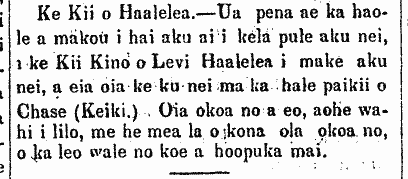
Portrait of Haalelea.—The haole which we spoke of the other week has painted a Portrait of Levi Haalelea who has passed, and it is now in the photography studio of Chase (Keiki). It remains victorious, and has not lessened at all, as if he is still living, it is just missing his voice coming forth.

[Here is the article mentioning the artist’s name. And here is another found in the Pacific Commercial Advertiser with more data.

Does anyone know the whereabouts of this painting by famous painter Enoch Wood Perry Jr.? I would appreciate it if you all might repost this article wherever you think an answer could be found!]

(Kuokoa, 12/24/1864, p. 2)

Ke Kii o Haalelea

Ka Nupepa Kuokoa, Buke III, Helu 52, Aoao 2. Dekemaba 24, 1864.