Committee of Thirteen and the Calvinists, 1893.

NATION OVERTHROWING COMMITTEE OF MISSIONARIES.

What are the each of the Names of this Nation Overthrowing Committee of Missionaries?

There will come a time when each of their names are made known.

What are the thoughts and aims of this Missionary Committee? Continue reading

Defense of Bishop Alfred Willis, and perhaps why Royalist Campbell was baptized at St. Andrews and not at Kawaiahao. 1893.

POSITION OF THE BISHOP.

Bishop Willis in his Diocesan Church Magazine takes the ground that Christian missions to heathen nations and peoples throughout the world will be injured by the news that will go everywhere of the prominent part taken by the sons and descendants of Christian missionaries in  Hawaii in overthrowing the ancient monarchy of the country. Whether the Bishop can maintain this ground or not is not a question that we are going to discuss. Continue reading

Speaking of Bishop Willis, 1893.

AN IMPLACABLE BISHOP.

The Diocesan Magazine is a purely religious publication—not like the Christian Union in New York, or our own Friend, partially secular in its character. It is, therefore, with some surprise, that one finds half the March issue given over to a rabid attack on the Government, the Revolution, and indeed upon almost everything civilized, progressive and Christian in sight. Those who are acquainted with the career of the present head of the Anglican Church in Hawaii, will find nothing unexpected in his sentiments, but will be surprised only at the manner and occasion of their expression. Continue reading

Blind no more, 1894.

THE TIME IS OVER WHEN HAWAIIAN PEOPLE ARE BLINDED.

In 1820, the missionaries came to Hawaii nei and taught the good of God and they instructed—do not accumulate wealth on earth or it will be destroyed by bugs and by rot, but instead accumulate your wealth in heaven, where thieves cannot steal it; therefore, look to the heavens, there is God.

It is a true, this lahui heeded the teachings of the missionaries from Boston, and their voices became something important to this lahui for 66 years without dissent. Continue reading

On neutrality, 1865.

Hawaiian Neutrality.

Our “Query” of last week has received a response from one of the Government organs, a reply however by no means satisfactory.

The fling is entirely amiss, that we are not acting the part of Hawaiians, but of Americans, in speaking of this nation as weak, and its acts as having no great effect abroad.It is because we love Hawaii, weak as she is, that wewould have her for her own sake avoid following the bad example of other nations, and would also have her prompt in following their good examples. Continue reading

Why did Dr. Matthew Makalua not return? 1894.

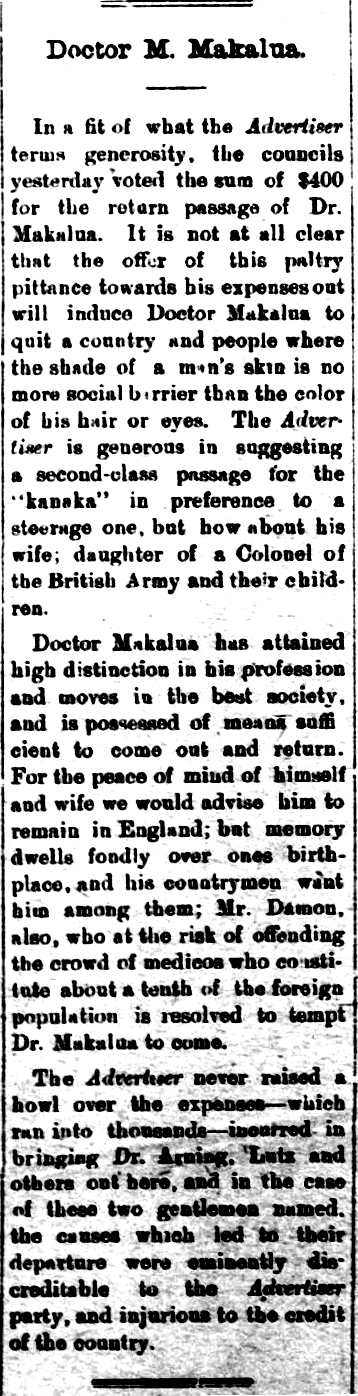
Doctor M. Makalua.

In a fit of what the Advertiser terms generosity, the councils yesterday voted the sum of $400 for the return passage of Dr. Makalua. It is not at all clear that the offer of this paltry pittance towards his expenses out will induce Doctor Makalua to quit a country and people where the shade of a man’s skin is no more social barrier than the color of his hair or eyes. The Advertiser is generous in suggesting a second-class passage for the “kanaka” in perference to a steerage one, but how about his wife; daughter of a Colonel of the British Army and their children.

Doctor Makalua has attained high distinction in his profession and moves in the best society, and is possessed of means sufficient to come out and return. For the peace of mind of himself and wife we would advise him to remain in England; but memory dwells fondly over ones birthplace, and his countrymen want him among them; Mr. Damon, also, who at the risk of offending the crowd of medicos who constitute about a tenth of the foreign population is resolved to tempt Dr. Makalua to come.

The Advertiser never raised a howl over the expenses—which ran into thousands—incurred in bringing Dr. Arning, Lutz and others out here, and in the case of these two gentlemen named, the causes which led to their departure were eminently discreditable to the Advertiser party, and injurious to the credit of the country.

[Click here. Find out about why Dr. Matthew Makalua said he did not come home to Hawaii nei.]

(Hawaii Holomua, 6/1/1894, p. 2)
HawaiiHolomua_6_1_1894_2.png

Hawaii Holomua, Volume III, Number 128, Page 2. June 1, 1894.
Aloha Aina, 1923 / Today.

The obituary of Frank Pahia made me remember a post I saw from Kanaeokana a few days ago. Lately we have been seeing so much corruption and abuse of government positions. Where are the Frank Pahias of today?

Another tool in our aloha ‘āina arsenal

An interesting political movement is underway, and many of us haven’t noticed it even though it is happening right here, close to home. Kānaka Hawaiʻi are turning out in greater and greater numbers to run for their neighborhood boards.

On Oʻahu, neighborhood boards have become one of the latest frontiers of mālama ʻāina. It’s easy to feel like your lone voice can’t change how things are going, but neighborhood boards give you a say in dealing with localized issues taking place right where you live. Your area’s legislators often attend in person, giving you more direct access to them. Even the Governor, Mayor, and the state’s federal delegation in Washington D.C. send representatives to local board meetings.

[For the entire article, click here.]

Dissatisfaction with the new king, 1887.

The Native Hawaiian
HEARD FROM.

The Natives of Kaneohe Show Their Feeling Towards the Present Government.

Ua paneia e W. M. Kipikona na mea i hoikeike ia iho nei, e pili ana i ke aupuni e ku nei, o ka poe ma ke poo ke hilinai nei lakou ma o na haole la o ka aina, o na kamaaina hoi, aole o lakou hilinai iki i ka Moi a me kona mau Kuhina, i ko lakou hooponopono ana i ke aupuni. Ua ike ia ka hemahema o ko Kipikona mau alakai ana i ka manao o ka lehulehu, a e ike ia ka manao o na kamaaina o ka aina e like me na mea i kakauia malalo iho. (Ua kakauia keia ma ka olelo Hawaii e like me ka mea i ike maka ia a i lohe ia mai ka poe nona na inoa malalo iho o keia, a i kakau inoa ia e lakou me ka maopopo pono.)

Ua makemake makou i aupuni maemae, i aupuni e hooponopono noeau ia ana, a e malama ia ana na loaa a pau no kou homealoha, kou aina makuahine—”ua pau loa na alii oiaio ia Lunalilo i hala e aku nei.” O D. Kalakaua aole oia he Alii io; aole makou i noi i na Lunamakaainana e koho iaia; aole no hoi o makou makemake iaia, e like me na kahoaka i ike ia i kona la i koho ia ai. Continue reading