Kamehameha School graduation a hundred years ago, 1916.

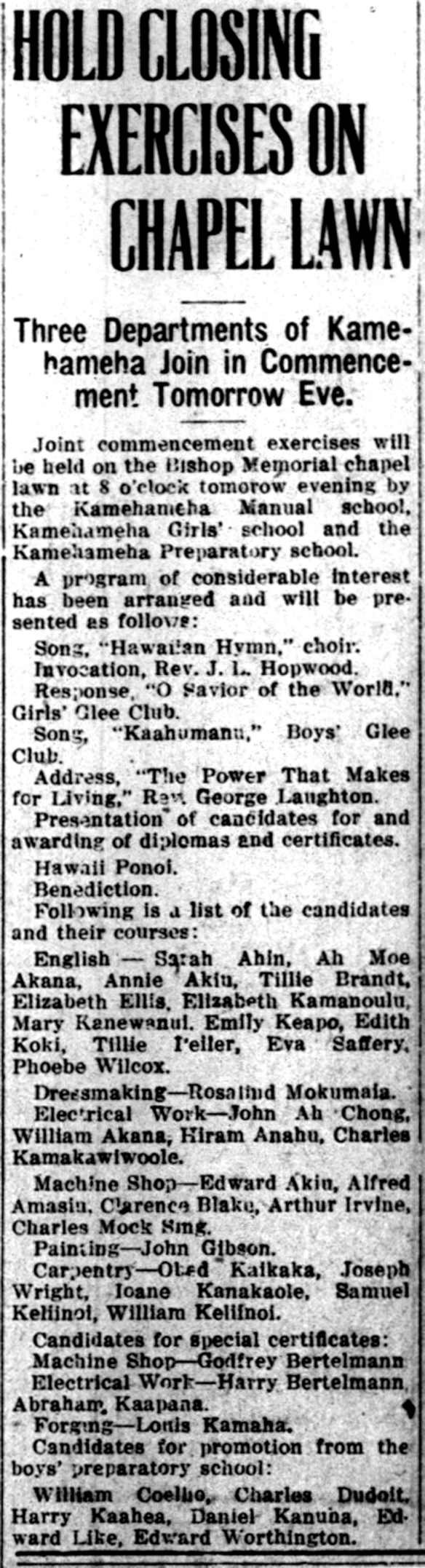
HOLD  CLOSING EXERCISES ON CHAPEL LAWN

Three Departments of Kamehameha Join in Commencement Tomorrow Eve.

Joint commencement exercises will be held on the Bishop Memorial chapel lawn at 8 o’clock tomorrow evening by the Kamehameha Manual school, Kamehameha Girls’ school and the Kamehameha Preparatory school.

Song, “Hawaiian Hymn,” choir.
Invocation, Rev. J. L. Hopwood.
Response, “O Savior of the World,” Girls’ Glee Club.
Song, “Kaahumanu,” Boys’ Glee Club.
Address, “The Power That Makes for Living,” Rev. George Laughton.
Presentation of candidates for and awarding of diplomas and certificates.
Hawaii Ponoi.
Benediction.

Following is a list of the candidates and their courses:

English—Sarah Ahin, Ah Moe Akana, Annie Akiu, Tillie Brandt, Elizabeth Ellis, Elizabeth Kamanoulu, Mary Kanewanui, Emily Keapo, Edith Koki, Tillie Peller, Eva Saffery, Phoebe Wilcox.

Dressmaking—Rosalind Mokumaia.

Electrical Work—John Ah Chong, William Akana, Hiram Anahu, Charles Kamakawiwoole.

 Machine Shop—Edward Akiu, Alfred Amasiu, Clarence Blake, Arthur Irvine, Charles Mock Sing.

Painting—John Gibson.

Carpentry—Obed Kaikaka, Joseph Wright, Ioane Kanakaole, Samuel Keliinoi, William Keliinoi.

Candidates for special certificates:

Machine Shop—Godfrey Bertelmann.

Electrical Work—Harry Bertelmann, Abraham Kaapana.

Forging—Louis Kamaha.

Candidates for promotion from the boys’ preparatory school:

William Coelho, Charles Dudoit, Harry Kaahea, Daniel Kanuha, Edward Like, Edward Worthington.

[Congratulations to the class of 2016! Make Pauahi proud!!]

(Star-Bulletin, 6/8/1916, p. 8)
HOLD CLOSING EXERCISES ON CHAPEL LAWN

Honolulu Star-Bulletin, Volume XXIII, Number 7537, Page 8. June 8, 1916.
Long live the Bernice Pauahi Bishop Museum! 1892.

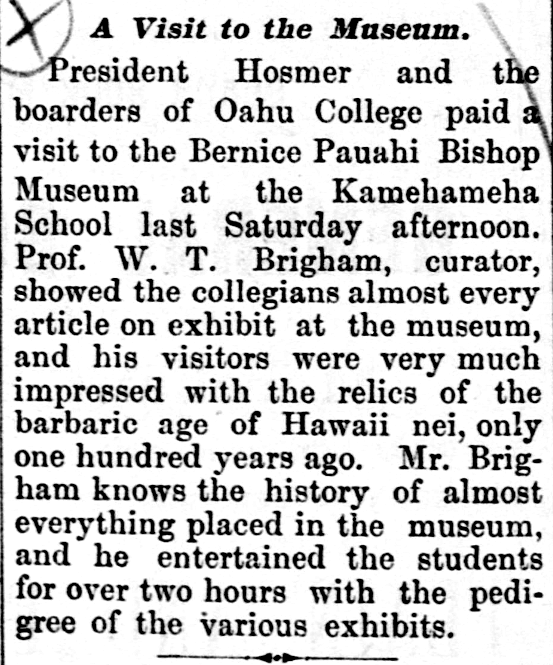
A Visit to the Museum.

President Hosmer and the boarders of Oahu College paid a visit to the Bernice Pauahi Bishop Museum at the Kamehameha School last Saturday afternoon. Prof. W. T. Brigham, curator, showed the collegians almost every article on exhibit at the museum, and his visitors were very much impressed with the relics of the barbaric age of Hawaii nei, only one hundred years ago. Mr. Brigham knows the history of almost everything placed in the museum, and he entertained the students for over two hours with the pedigree of the various exhibits.

[I wonder if the students of Punahou are still visiting the museum today!]

(Advertiser, 10/17/1892, p. 3)

PCA_10_17_1892_3

The Pacific Commercial Advertiser, Volume XVI, Number 3203, Page 3. October 17, 1892.

Kamehameha School for Boys’ 24th annual song contest, 1945.

[Found under: “News From Boys, Girls Kamehameha School”]

BOY’S SONG CONTEST

Kamehameha School for Boys will present its 24 annual song contest on March 4 at the school auditorium with the eighth and ninth graders competing in the junior division at the tenth, eleventh and twelfth grade boys in the senior division.

The eighth graders have as their choice song “Beautiful Kahana” and the ninth graders choice is “Ka Anoi.” The juniors have selected “Wai Lana” and the tenth grade boys a medley of “Kuu Lei Pikake,” “Lei Awapuhi” and “Roselani.” A medley of “Na Lei O Hawaii” and “Aloha Oe” is the seniors choice. Continue reading

Ahuimanu College exam information, 1871.

Ahuimanu College.

We had the pleasure of attending the public examination of Ahuimanu College last Wednesday, July 5. The location of the College is healthy and romantic, being situated on a plain at the foot of the mountains, and commanding a fine view of the ocean to the north and of the mountain range east and west.

The institution is under the charge of the Rev. Father Lievin, who is distinguished for his affability and kindness as much as for his many scholarly attainments. He has made improvements in the grounds and buildings during the past year: notably, in the students’ dormitory, each one having to himself a latticed apartment opening on a long corridor, all freely ventilated. The students are, even during the night, under his immediate supervision.

We were much pleased with the correct spelling and distinct reading of the primary classes. Young native boys who, a year ago, could not speak a word of English, read fluently and with a very good pronunciation. It occurred to us to ask ourselves how we could read French or German, after only one year’s study.

The examination of the classes in Grammar, Geography, Arithmetic, History, and Elementary Astronomy, was conducted by the President, and after him by the visitors. The questions asked by the latter were not the routine ones of textbooks. They were intended to draw forth the real knowledge of the students. This rather severe examination showed a proficiency in the various branches that is truly commendable. Our expectations were surpassed at the knowledge of English Grammar and Analysis evinced by that class. The study of Music and Oratory seems to be pursued con amore. The spcimens of Penmanship showed a marked improvement—those of the last and present year being side by side. It is only just to mention the Joseph Poepoe, Victor Kapule, Eddy Morgan, John K. Loio, Zachariah Kapule, and John Spencer, were the most distinguished in their several departments.

We learned that the school year commences on the 20th of August, and ends about the 4th of July. The fees for board, lodging and tuition are from $60 to $100 per year; some poor boys are received gratis. These figures are so low that the institution can not be self-sustaining. Bishop Maigret gives $300 a year towards its support. We hope that it will prosper, and continue to extend its usefulness.

(Hawaiian Gazette, 7/12/1871, p. 2)

HawaiianGazette_7_12_1871_2.png

Hawaiian Gazette, Volume VII, Number 26, Page 2. July 12, 1871.

Ahuimanu College Examinations, 1871.

Ahuimanu College.

Ahuimanu College is under the administration of the Roman Catholics; the students had their examinations last week Wednesday. We very much wanted to see firsthand the progress made by this school, but we did not know ahead of time, and its examination date was not advertised. And therefore, we perhaps can take word of their progress from people who were there and who weighed for themselves. This school, many years ago, was under the leadership of Rev. Walsh, and these days, it is being taught and lead by Rev. Father Lievin, the one who is known for his abilities, kindness, and some other good traits for the proper administering in the advancement of the school.

We were informed that the visitors enjoyed the spelling and clear reading of the students of the lower classes. The young students who could not speak English they ear before, could now pronounce clearly what they were reading. This was a testament to the strength and competence of their teaching and their guidance; giving hope that if they continue to progress in that fashion, they will not fail to make advancements in the future. The teaching and making clear to the students about reading clearly is very important in the knowledge of reading that is to be ingrained in our youngsters; whereas studying hurriedly will be worthless in the end; that kind of learning is nothing more than a horse race. Continue reading

Ahuimanu College and St. Louis College, 1882.

ST. LOUIS COLLEGE

Is our leading Roman Catholic educational institution for boys. It is an old institution called by a new name and located in a new place. The same institution long existed and prosecuted its mission at Koolau, on the other side of this island, and was there and then known as Ahuimanu College. Although delightfully situated, and having many advantages in its favor, it was felt to be too far from the centre of population, to answer fully the purpose of its existence. Consequently, it was decided, a short time ago, to remove the institution to the neighborhood of Honolulu.

For this purpose the church authorities purchased a splendid piece of property from Mr. Roth, at the north end of Beretania street, not far from Smith’s bridge, where they have erected suitable buildings, and established the old Ahuimanu College under the new name of St. Louis College.

The College grounds measure about two acres, allowing abundance of space for recreative exercise, and are planted with all kinds of tropical trees, some of which are fruit-producing, while others simply afford shade and ornamentation. It is truly a lovely spot, and being free from noisy surroundings, is peculiarly adapted to the purpose for which it is now used.

The College building is a substantial two storey brick structure, 60×20 feet in the clear. The ground floor is divided into three class rooms of equal size, by wooden partitions. Each of these rooms is nicely furnished with new school furniture of the most approved modern style. They are also well lighted and ventillated, ventillation being greatly assisted by the wooden partitions not extending the whole way to the ceiling, which latter is fourteen feet from the floor. Continue reading

The beginnings of Kamehameha Schools, 1884.

Kamehameha School.

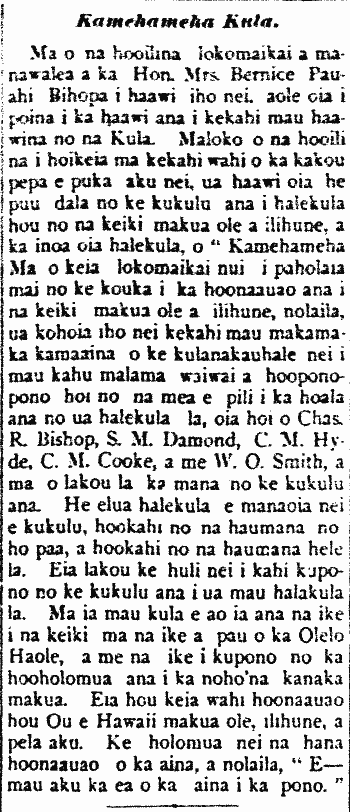
By way of the kind and generous endowment given by the Hon. Mrs. Bernice Pauahi Bishop, she did not forget to make contributions for Schools. Amongst the heirs shown in one of our papers published earlier, she gave a sum of money to build a new schoolhouse for children with no parents or who are indigent, and the name of the school is to be Kamehameha. By this great kindness extended to help in the education of orphan and indigent children, several familiar friends of this town were recently selected as trustees and administrators pertaining to the establishing of said school, that being Charles R. Bishop, S. M. Damon, C. M. Hyde, C. M. Cooke, and W. O. Smith; and with them lies the power to build. Two schools houses are being considered to be built: one for the boarders, and one for the day school students. They are now searching for a suitable place to build the buildings. In those schools, knowledge will be taught to the children in all facets of the English language, as well as learning that will be helpful for advancement in their adult life. Here is your new place of learning, O Hawaiians who are without parents, who are indigent, and so forth. Education in this land is progressing, and therefore, “Let the life of the land live on in righteousness.”

(Kuokoa, 11/8/1884, p. 2)

Kuokoa_11_8_1884_2.png

Ka Nupepa Kuokoa, Buke XXIII, Helu 45, Aoao 2. Novemaba 8, 1884.


Chorus at Kamehameha, 1889.

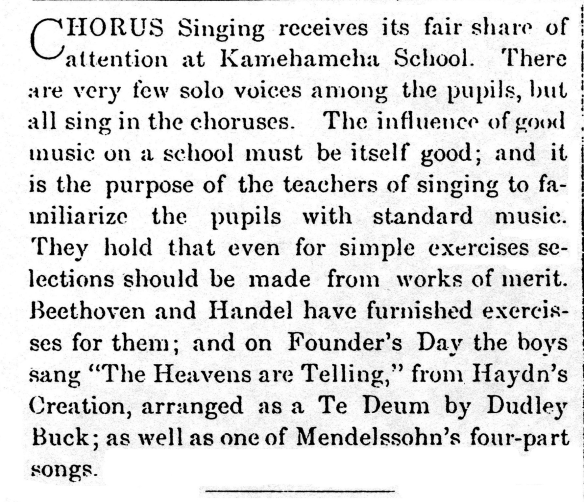
Chorus Singing receives its fair share of attention at Kamehameha School. There are very few solo voices among the pupils, but all sing in the choruses. The influence of good music on a school must be itself good; and it is the purpose of the teachers of singing to familiarize the pupils with standard music. They hold that even for simple exercises selections should be made from works of merit. Beethoven and Handel have furnished exercises for them; and on Founder’s Day the boys sand “The Heavens are Telling,” from Hayden’s Creation, arranged as a Te Deum by Dudley Buck; as well as one of Mendelssohn’s four-part songs.

(Handicraft, 1/1883, p. 3)

Handicraft_1_1889_3.png

Handicraft, Volume 1, Number 1, Page 3. January 1889.

Kamehameha School’s “Handicraft,” 1889.

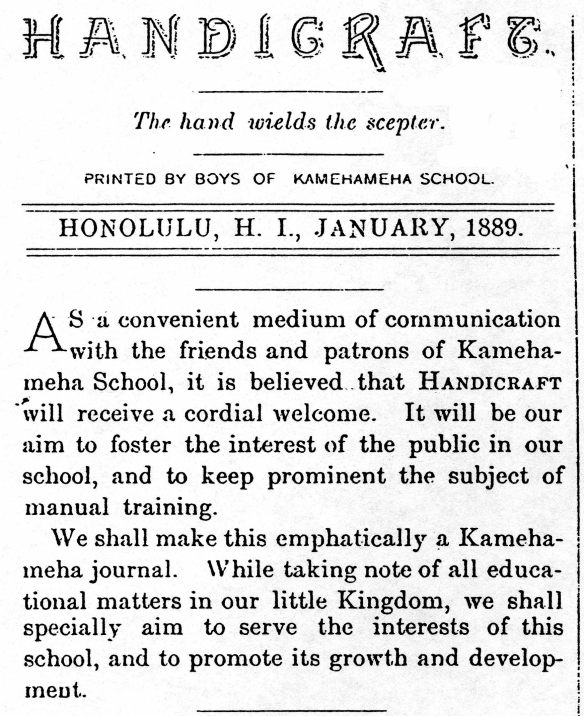
HANDICRAFT.

The hand wields the scepter.

PRINTED BY BOYS OF KAMEHAMEHA SCHOOL.

HONOLULU, H. I., JANUARY , 1889.

As a convenient medium of communication with the friends and patrons of Kamehameha School, it is believed that Handicraft will receive a cordial welcome. It will be our aim to foster the interest of the public in our school, and to keep prominent the subject of manual training.

We shall make this emphatically a Kamehameha journal. While taking note of all educational matters in our little Kingdom, we shall specially aim to serve the interests of this school, and to promote its growth and development.

[The priceless issues of the Handicraft are just one of the many cool items from Kamehameha Schools’ history found on their Archives page.]

(Handicraft, 1/1889, p. 2)

Handicraft_1_1889_2.png

Handicraft, Volume I, Number 1, Page 2. January 1889.

Kalihi fire, 1889.

The glowing fire on the Kalihi mountains Thursday night Feb. 21, was caused by workmen burning off the grass on the site of the new reservoir in the upper Nuuanu Valley. The fire could easily have been controlled in the first instance. As it was, it was allowed to run up a narrow ridge, and thence to spread along the flanks of the mountain until it became an extensive conflagration, destroying many vigorous young koa trees and persistently working itself down into the valley. On Friday morning, two teachers and about twenty of the largest boys in the Kamehameha School went up to the fire and after a vigorous battling with the dense smoke succeeded in hemming in the fire, and finally subdued it. The utmost care in such a dry season should be used in preventing the setting, much more the spreading, of fire in the grass and bushes above Honolulu. A few such fires would make it unnecessary to build extra reservoirs.

(Handicraft, 2/1889, p. 3)

Handicraft_2_1889_3.png

Handicraft, Volume I, Number 2, Page 3. February 1889.