More on language, 2015.

LANGUAGE MATTERS

Language Matters asks what we lose when languages die and how we can save them. It was filmed around the world: on a remote island off the coast of Australia, where 400 Aboriginal people speak 10 different languages, all at risk; in Wales, where Welsh, once in danger, is today making a comeback; and in Hawaii, where a group of Hawaiian activists is fighting to save the native tongue.

Language Matters is a co-production of David Grubin Productions and Pacific Islanders in Communications. Major funding provided by the National Endowment for the Humanities with additional funding provided by the Corporation for Public Broadcasting, the Arthur Vining Davis Foundations, the National Endowment for the Arts.

[This showed on PBS on 1/19/2015. It might be a long show, but don’t skip to the back, it is well worth watching from the beginning! Click the picture below.]
Language Matters
Language Matters

Cornerstone of the new Kaumakapili Church, 1881.

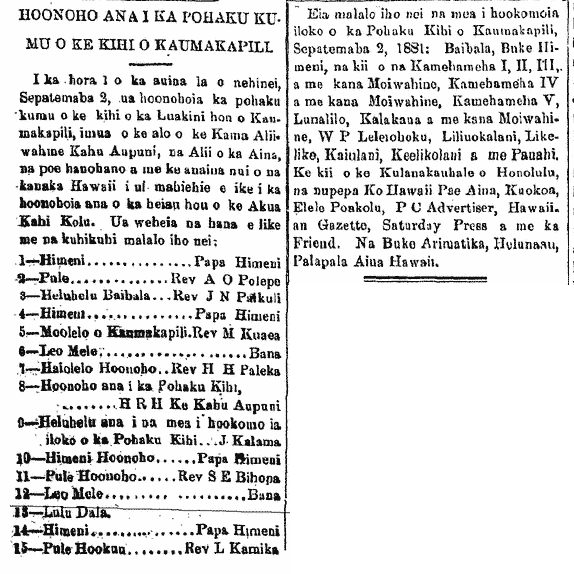
LAYING OF THE CORNERSTONE OF KAUMAKAPILI.

At 1 o’clock yesterday afternoon, September 2, the cornerstone [pohaku kumu o ke kihi] of Kaumakapili Church was laid, before the Princess Regent [Liliuokalani], the Alii of the Land, dignitaries, along with a huge contingent of Hawaiian people who were finely dressed to see the laying out of the new heiau of the Trinity. The ceremony opened like the program below:

1—Hymn . . . . . Choir
2—Prayer . . . . . Rev. Anderson Oliver Forbes [A. O. Polepe]
3—Bible Reading . . . . . Rev. J. N. Paikuli
4—Hymn . . . . . Choir
5—History of Kaumakapili . . . . . Rev. M. Kuaea
6—Song . . . . . Band
7—Speech for the Laying of the Cornerstone . . . . . Rev. H. H. Parker [H. H. Paleka]
8—Laying of the Cornerstone . . . . . Her Royal Highness, The Princess Regent
9—Reading of the contents of the Cornerstone . . . . . J. Kalama
10—Hymn for the Laying of the Cornerstone . . . . . Choir
11—Prayer for the Laying of the Cornerstone . . . . . Rev. S. E. Bishop [S. E. Bihopa]
12—Song . . . . . Band
13—Monetary Donations
14—Hymn . . . . . Choir
15—Closing Prayer . . . . . Rev. L. Smith [L. Kamika]

Here below are the things put inside of the Cornerstone of Kaumakapili on September 2, 1881: Baibala, Buke Himeni, pictures of Kamehameha I, II, III and his Queen, Kamehameha IV and his Queen, Kamehameha V, Lunalilo, Kalakaua and his Queen, W. P. Leleiohoku, Liliuokalani, Likelike, Kaiulani, Keelikolani and Pauahi. A picture of the Town of Honolulu, the newspapers, Ko Hawaii Pae Aina, Kuokoa, Elele Poakolu, P. C. Advertiser, Hawaiian Gazette, Saturday Press, and the Friend. The books, Arimatika, Helunaau, Palapala Aina Hawaii.

(Ko Hawaii Pae Aina, 9/3/1881, p. 2)

HOONOHO ANA I KA POHAKU KUMU O KE KIHI O KAUMAKAPILI.

Ko Hawaii Pae Aina, Buke IV, Helu 36, Aoao 2. Sepatemaba 3, 1881.

Flooding on Molokai, 1883.

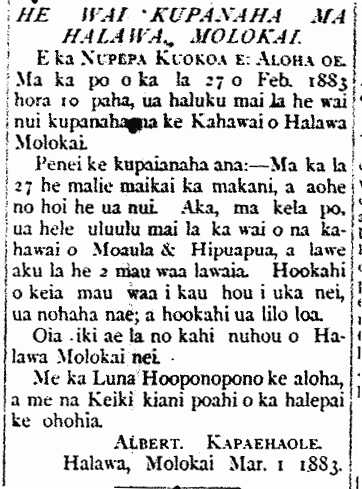
ASTONISHING WATERS AT HALAWA, MOLOKAI.

O Kuokoa Newspaper: Aloha oe.

On the night of February 27, 1883, at perhaps 10 o’clock, a shockingly huge amount of water rushed down the river of Halawa, Molokai.

Here is what was shocking:—On the 27th, the wind was perfectly calm, and there was no big rain. However, that night, the waters of the rivers of Moaula and Hipuapua came violently down and swept away 2 fishing canoes. One of these canoes was brought back on land but was broken up; the other is gone.

That is just some small news from here in Halawa, Molokai.

Aloha to the Editor and to the typesetting Boys of the press my delight.

Albert Kapaehaole

(Kuokoa, 3/10/1883, p. 3)

HE WAI KUPANAHA MA HALAWA, MOLOKAI.

Ka Nupepa Kuokoa, Buke XXII, Helu 10, Aoao 3. Maraki 10, 1883.

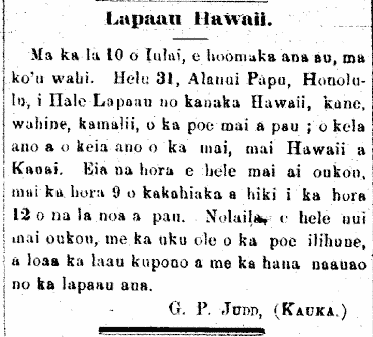
Kauka Judd opens a clinic for Hawaiians, 1871.

Treatment for Hawaiians.

On the 10th of July, I will commence at my place. Number 31, Fort Street, Honolulu, a Clinic for Hawaiian, men, women, children, everyone; with any illness, from Hawaii to Kauai. These are the hours for you all to come by, from 9 o’clock in the morning until 12 on weekdays [la noa]. Therefore, come all; there is no pay for the indigent, and you will get proper medicine with enlightened treatment.

G. P. Judd, (Kauka.)

[Although the title of this advertisement, “Lapaau Hawaii,” can be seen as “Treatment for Hawaiians,” I think the first idea that comes to mind would be “Hawaiian Medicine.” I wonder if that was done on purpose…]

(Au Okoa, 7/20/1871, p. 2)

Lapaau Hawaii.

Ke Au Okoa, Buke VII, Helu 14, Aoao 2. Iulai 20, 1871.

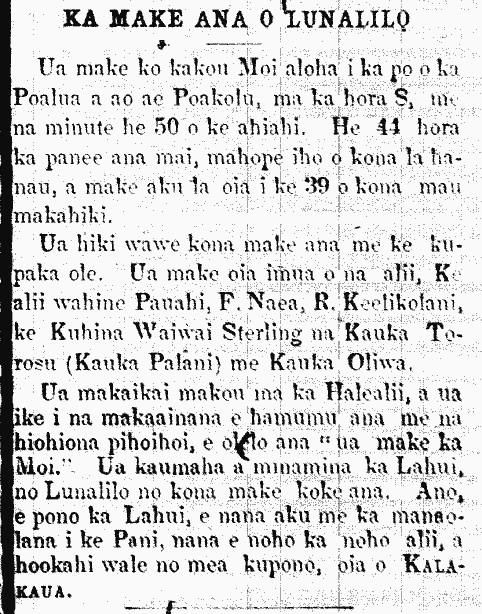
King Lunalilo passes, 1874.

THE DEATH OF LUNALILO

Our beloved King died from the night of Tuesday to the day of Wednesday [February 3, 1874], at 8 o’clock and 50 minutes in the evening. 44 hours went by after his birthday, and he died at 39 years old.

His death was quick without a struggle. He died before the alii, Ke alii Pauahai, F. Naea, R. Keelikolani, the Minister of Finance Sterling, Dr. Trousseau (Kauka Palani), and Dr. Oliver.

We visited the Palace and saw the makaainana murmuring about with worried faces, saying, “The King is dead.” The Lahui are sad and grieve over the quick passing of Lunalilo. The Lahui must at once look with hope to his Replacement, the one who will occupy the throne, and there is but one who is fitting, that is Kalakaua.

(Nuhou Hawaii, 2/10/1874, p. 3)

KA MAKE ANA O LUNALILO.

Ka Nuhou Hawaii, Buke I, Helu 15, Aoao 3. Feberuari 10, 1874.

Aloha Aina calls for submissions, 1915.

Listen to This.

The columns of the Aloha Aina are open to publishing ideas and letters from friends on all sorts of topics, however it should be based on intelligent and proper subjects. We do not believe in personal criticisms and reviling. We do not take responsibility for the letters and editorials from friends, but this falls under their own names. We want all letters and editorials to come in Monday evenings. Write clearly.

(Aloha Aina, 2/13/1915, p. 2)

E Hoolohe i Keia.

Ke Aloha Aina, Buke XIX, Helu 72, Aoao 2. Feberuari 13, 1915.

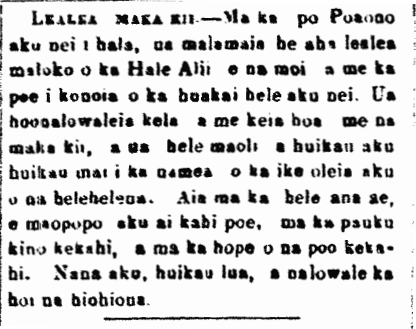
Masquerade party at the palace, 1874.

[Found under: “Nu Hou Kuloko.”]

Masked Entertainment.—In the evening of this past Saturday, a party was held in the Palace by the monarchs and those who were invited to go there. Each person was hidden behind a mask [maka kii], and everyone was befuddled because the features of people could not be seen. You went up to someone to figure out who it was, maybe by their figure, or the back of the head. You turned away, and you were confused once again, as people’s features were hidden.

(Kuokoa, 5/2/1874, p. 2)

Lealea maka kii.

Ka Nupepa Kuokoa, Buke XIII, Helu 18, Aoao 2. Mei 2, 1874.

More the celebrating the better? 1915.

[Found under: “Na Kuhinia o ka Manawa.”]

The celebration [hi’uwai] of the people of China [Aina Pua] is approaching, but perhaps there will only be a few because New Years was celebrated by some Chinese on this past New Years Day.

[Konohi is the lunar calendar new year. It probably comes from the Hawaiianization of the Chinese Kung Hei as in Kun Hei Fat Choi (恭喜發財).]

(Aloha Aina, 2/6/1915, p. 3

Ke hookokoke mai nei...

Ke Aloha Aina, Buke XIX, Helu 71, Aoao 3. Feberuari 6, 1915.

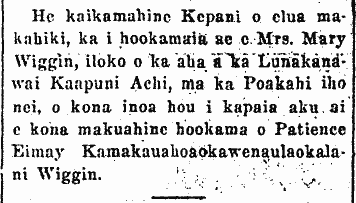
E o, e Namaka! 1921.

[Found under: “Nuhou Kuloko”]

A Japanese girl of two years old was adopted by Mrs. Mary Wiggin, in the court of the Circuit Court Judge Achi, on this past Monday; her new name that she is being called by her adopted mother is Patience Eimay Kamakauahoaokawenaulaokalani [Namakauahoaokawenaulaokalaniikiikikalaninui] Wiggin.

See much more in Nanea Armstrong Wassel’s Instagram post!

[Hauoli la hanau, e Aunty!]

(Kuokoa, 8/19/1921, p. 4)

He kaikamahine Kepani...

Ka Nupepa Kuokoa, Buke LIX, Helu 33, Aoao 4. Augate 19, 1921.

First birthday celebration of Keelikolani’s birthday, 1871.

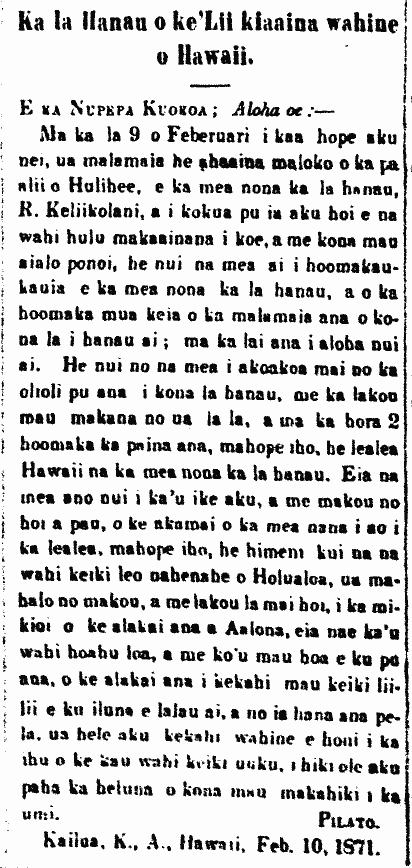
Birthday of the Alii, the governess of Hawaii.

O Nupepa Kuokoa; Aloha oe:—

On the 9th of February past, a banquet was held on the estate of Hulihee by the person whose birthday it was, R. Keelikolani, assisted by her dear makaainana remaining, and her personal attendants; there was much food prepared by the one whose birthday it was, this being the very first celebration of her birthday; and it was appreciated for the calmness of the day. There were many gathered to celebrate her day of birth, with their gifts for that day, and at 2 o’clock, the feast began, followed by Hawaiian entertainment [lealea Hawaii] furnished by the one whose birthday it was. Here are is the main thing which I saw and all of us as well, that being the skill of the person who instructed the entertainment [o ke akamai o ka mea nana i ao i ka lealea], and this was followed by a joint choir of the sweet-voiced children of Holualoa; we and they give praise to the excellent leadership of Aalona; but this is what I did not like the most, along with my friends who stood with me, that being the guiding of some children to stand up and go astray [eia nae ka’u wahi hoahu loa, a me ko’u mau hoa e ku pu ana, o ke alakai ana i kekahi mau keiki liilii e ku iluna e lalau ai], and for that some women went and “kissed the nose” [honi i ka ihu] of the small children who were probably no more than ten years old.

Pilato.

Kailua, Kona Akau, Hawaii, Feb. 10, 1871.

[Many times people will be referred to by their position and not by their actual name. When doing searches for Keelikolani for instance, she is often referred to as the governor of the island of Hawaii, ke kiaaina o ka mokupuni o Hawaii (1855–1874).]

(Kuokoa, 2/25/1871, p. 2)

Ka la Hanau o Ke'lii kiaaina wahine o Hawaii.

Ka Nupepa Kuokoa, Buke X, Helu 8, Aoao 2. Feberuari 25, 1871.