[Found under: “NA MEA HOU O NAWAIEHA.”]
Pertaining to the Daily Newspaper.
A daily newspaper called, “O Hawaii Imi Loa,” was published by a number of wealthy youths of Waihee nei; Continue reading

Pertaining to the Daily Newspaper.
A daily newspaper called, “O Hawaii Imi Loa,” was published by a number of wealthy youths of Waihee nei; Continue reading
E ala ka makani kololio
E hui me ka malu o ke ao
Na pali kapu o Kakae
Wai huihui o Iao
—Hui—
Pa mai ka makani kaulana
Kilioopu o Waihee
Ko mai ke ala hu’ihu’i
Hoihoi lau-i o Eleile. Continue reading
He aloha e ka ua Kanilehua
I loku hala ole i ka waokele
Hookele akamai no hoi oe
Helu ekahi o ka mikioi
Na’u i pailaka pololei
Ike ia ka nalu hai o Kawili
Neenee mai oe e ke aloha
Ua anu ka lehua i ka nahele
I ka pehi mau ia e ka ua noe
Noeau ka hana a ka uwila
Ka anapa ma na rumi liilii
He liilii ka hana a ke akamai
A he niih [nihi] ka hele’na o ka nahele
Ua ako hewa oe i ka lehua
I lawa no a hoolale iho
Holu ana e ka malua kiiwai
Haina ka puana i lohe ia
No Hilo ko’u lei e lei ai
[E nihi ka hele’na o ka nahele.]
(Ka Lei Momi, 7/24/1893, p. 4)

Ka Lei Momi, Buke I, Helu 27, Aoao 4. Iulai 24, 1893.
In the afternoon of Sunday, June 3, the Hula Studio of Albert Nahale-a [Pa Hula a Albert Nahale-a] arrived at the Puumaile Hospital to entertain the patients at that home.
It was heard that a Hula Studio would come to entertain the patients, and it was questioned, who was coming down, and in the afternoon of Saturday it was clear, the Hula Studio that was coming down.
A little before the clock struck 3:00 P. M., the bell to rise rang. The people got up and made ready for the arrival of the Hula Studio. Nahale-a’s people arrived, and a little bit after 3:00 P. M. the emcee announced that they were ready to start the activities. Continue reading
Auhea wale ana oe,
Hinahina ku i ka pali,
Kulolou pili i ke anu la,
Anu wale a ka rain paupili.
CHORUS.
Ko mai ana e ke anu,
Huihui i ka puuwai,
O sweet flower i ka uka la,
Lei aloha no ke kuini. Continue reading
By MARY COOKE
Mary Kawena Pukui, dean of Hawaiian scholars, has two reasons to celebrate today.
It’s her 69th birthday, and the English-Hawaiian Dictionary, part of a project for which she started the research 30 years ago, is just out.
It is a companion volume of the Hawaiian-English Dictionary published in 1957. On both works her collaborator was Dr. Samuel H. Elbert of the University of Hawaii who studied the language with her. Both were published by the University Press.
“IT IS such a relief,” Kawena began in the light, unhurried conversational tones of a Hawaiian tutu, “to have the dictionaries finished.”
But her dark eyes sparkled with the intensity of the scholar as she added, “now I can go ahead with the Kamakau.”
She explained that some years ago she translated the writings on Hawaiian religion, arts and crafts by the early Hawaiian author, Samuel Kamakau. Now she is reviewing the work for publication with Dorothy Barrere of the Bishop Museum.
“AND THERE are lots of other things I want to do, too,” she said with characteristic forward-looking zeal.
Kawena is modest about looking backward. But the record shows 40 years of persistent, scholarly accomplishment as researcher, translator, compiler and writer of authentic Hawaiiana.
Thirty-seven titles in Bishop Museum listings covering ethnology, sociology, natural history and linguistics are the work of Mary Pukui alone or in collaboration with scientists and other writers.
HER MOTIVATION is the urgency she feels to research and record all possible knowledge of the indigenous culture of Hawaii.
When she began writing and translating years ago she started a card file of Hawaiian words “for whoever would do a new Hawaiian dictionary… I never thought I was going to be the one to do it,” she said.
Her source material was Hawaiian newspapers and magazines, the Hawaiian Bible, catechisms and religious writings of all denominations, legends, folk lore, chants and writings of early native scholars.
Legal terms and land law terms were translated, and from the modern Hawaiian vocabulary, such contemporary words as “air raid” and “blackout” were also included.
KAWENA, with Eleanor Williamson of the Bishop Museum, also traveled remote areas of the Islands with a tape recorder to garner all she could from living memories about pronunciation and meanings of words.
She says the Hawaiian language frequently is complicated by multiple meanings.
Advertiser Photo by Charles Okamura
MARY KAWENA PUKUI Continue reading
Kaulana mai nei a o Naope,
Ka uwila i anapu ma ke kapitala,
Na ke kelekalapa i ha’i mai,
Lawe oe i ka hae o ka lanakila;
Kilakila no oe i ka’u ike,
Ka moho kaulana puni Hawaii. Continue reading
Splendid was the uniki activities that were held at the armory [halekoa] of Hilo on the night of this past Saturday, April 24th. Continue reading
For all of you lucky people in Hilo of the famous Kanilehua rain!
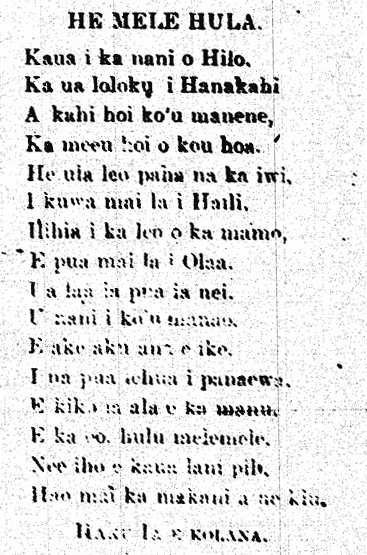
Ka Leo o ka Lahui, Buke II, Helu 501, Aoao 2. Iuali 18, 1892.
THIS IS THE MARBLE SCULPTURE THAT WAS UNVEILED THIS TUESDAY, A MEMORIAL PUT UP BY THE PEOPLE OF HONOLULU NEI TO COMMEMORATE THE TRULY MAJESTIC AND OUTSTANDING WORKS DONE BY MRS. CHERILLA A. LOWREY IN HER EFFORTS TO INCREASE THE BEAUTY AND ELEGANCE OF HONOLULU NEI. THIS IS A GIFT OF THE OUTDOOR CIRCLE, THE ORGANIZATION THAT WAS PRESIDED OVER BY MRS. CHERILLA A. LOWREY FOR MANY YEARS.
Because of her many good works, the works that cannot be forgotten by a great portion of the citizens of this town, a memorial was built for Mrs. Cherilla A. Lowrey, by the Outdoor Circle of Honolulu and friends, and on the past Tuesday the memorial was unveiled before a large number of visitors who arrived, before the Mission Memorial Hall. Continue reading
 nupepa