Unknown's avatar

About nupepa

Just another place that posts random articles from the Hawaiian Newspapers! It would be awesome if this should become a space where open discussions happen on all topics written about in those papers!! And please note that these are definitely not polished translations, but are just drafts!!! [This blog is not affiliated with any organization and receives no funding. Statements made here should in now way be seen as a reflection on other organizations or people. All errors in interpretation are my own.]

Lauhala weaving revival, 1936.

ANCIENT HAWAII ART REVIVAL

Kona District to Supply Lauhala Articles to Hawaiian Village At Waikiki

George P. Mossman, of the Hawaiian Village at Waikiki, who has been spending some time on the Big Island, has succeeded in making arrangements through which the Kona districts will supply the village with lauhala, mats and other articles.

Mr. Mossman reported that he found three grades of lauhala articles produced. the First grade, which is the cheaper grade, is turned out as a medium of exchange for which the family obtains clothing, groceries and other articles for home use. Continue reading

Tourism and the revival of lauhala, 1936.

Tourist Business In Hawaii Booms As Result Of Publicity

An influx of visitors to the Hawaiian islands during the past few years has revived many of the interesting traditions and practices of Old Hawaii.

This paradox was recently pointed out by Percy A. Swift, manager of the merchandise department of American Factors, Ltd., in a discussion of Hawaii’s tourist industry.

“An interesting sidelight of the travel business here has been the way it has encouraged Island customs and activities,” he said. “The nourishing influence of tourist interest has given added impetus to the lei tradition, for example; and it has revived native sports such as surfing and outrigger canoe riding, which were on the point of dying out 15 years ago.” Continue reading

Lauhala anyone? 1916.

ANNOUNCEMENT

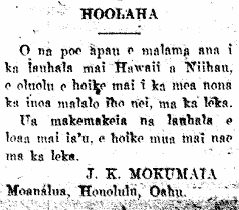
To everyone who is holding on to lauhala from Hawaii to Niihau; please tell the person whose name appears below by letter.

I want lauhala, but give me notice by letter.

J. K. MOKUMAIA

Moanalua, Honolulu, Oahu.

(Aloha Aina, 4/15/1916, p. 4)

HOOLAHA

Ke Aloha Aina, Buke XXI, Helu 27, Aoao 4. Aperila 15, 1916.

Far reaching influence of Hawaiian lauhala, 1911.

[Found in: M. McInerny, Ltd. advertisement]

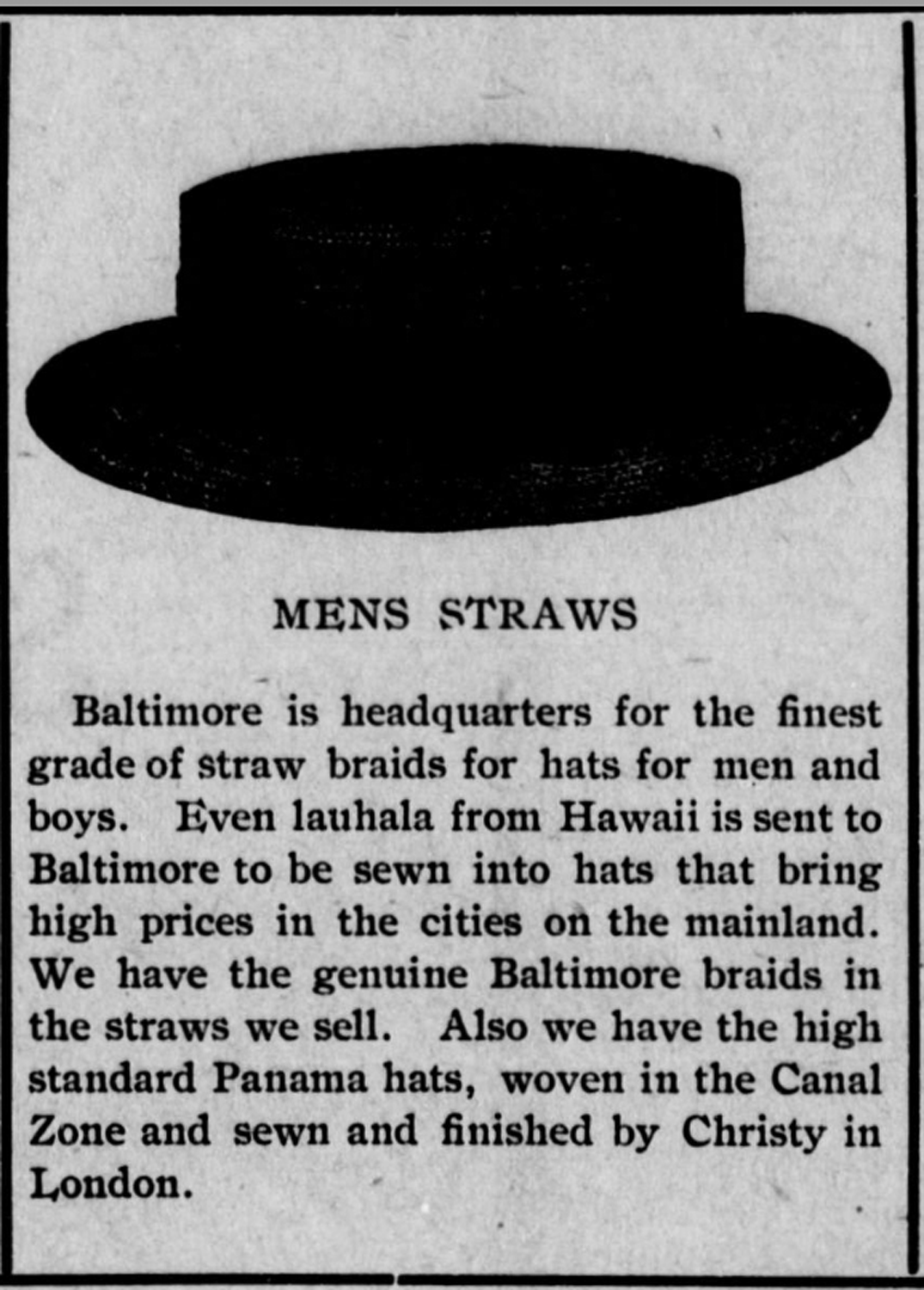
MENS STRAWS

Baltimore is headquarters for the finest grade of straw braids for hats for men and boys. Even lauhala from Hawaii is sent to Baltimore to be sewn into hats that bring high prices in the cities on the mainland. We have the genuine Baltimore braids in the straws we sell. Also we have the gigh standard Panama hats, woven in the Canal Zone and sewn and finished by Christy in London.

(Maui News, 12/2/1911, p. 7)

MENS STAWS

Maui News, Volume XVIII, Number 41, Page 7. December 2, 1911.

Hala exhibit coming to the Bishop Museum, 2015.

It seems that the Museum is having an exhibit on weaving starting the end of this week. Maybe go check it out if you are on Oahu.

The beauty and significance of hala is woven throughout our history and throughout this exhibit. In ancient times, the sails of voyaging canoes were plaited of hala, and utilitarian hala baskets and mats were commonplace. The introduction of foreign items that replaced Hawaiʻi-made mats and baskets encouraged weavers to further their creativity, leading to a distinctive and truly exquisite Hawaiian style of lau hala hats that are coveted and treasured as fine art.

Nani i ka Hala

Carl Nakuina’s shark attack news spreads far to Utah, 1917.

SHARK IN AUTO BITES CAPTOR

HONOLULU, T. H., Aug. 30 (by mail).—Honolulu has probably the only man who was ever bitten by a shark in an automobile. If the sentence appears confused, it is nevertheless correct, for both the man and the shark were in the automobile at the time.

Carl Nakuina, an employee of a local poi factory, went to Nanakuli, on the shores of this island, last Sunday to fish. He had bigger luck than he anticipated in, for he hooked a twelve-foot shark. Continue reading

Hōkūleʻa, 1980 / 2015.

HOKULEʻA RETURNS

by Wayne Washburn

Greeted by a blessing of light showers, flowers, music, dance and many hugs and kisses, the crew members of the Hokuleʻa returned from Tahiti at 1:00 p.m. on June 6.

After 25 days at sea the crew slowly made its way through the crowd to a stage at Magic Island where the Royal Hawaiian Band, Leinaala Heine Kalama’s hula halau, and a musical group with the same name as the double-hulled canoe. Hokuleʻa, performed as part of the welcoming ceremony.

Each voyager was greeted by Gov. Ariyoshi and presented with a wooden bowl. In reference to the voyage Ariyoshi stated “…It once again demonstrates that in Hawaii the skills and the courage and the ability of the old Hawaiian is not lost, but remains with the modern native sons and daughters of Hawaii.”

Nainoa Thompson, the navigator, became the first Hawaiian to navigate by using the stars and currents in at least 200 years. The preciseness of his course has been heralded by many as a modern navigational triumph. Mayor Fasi said the voyage illustrated that: “The people of Hawaiian ancestry in Hawaii…can show the determination to get any job done that they set their hearts on.

This marked the second successful completion of a round trip voyage to Tahiti. The first voyage to Tahiti in 1976 was navigated by Mau Piailug, a celestial navigator from Satawal in Micronesia. The return trip to Hawaii was completed using modern navigational equipment and methods. A 1978 attempt to reach Tahiti ended in tragedy when Hokuleʻa swamped in the Molokai Channel. Crew member Eddie Aikau was lost in an attempt to reach help. The present trip was the first to use celestial navigation to and from Tahiti.

Credit for the successful completion of the voyage goes to many individuals and organizations within and outside of the Polynesian Voyaging Society. Many Hawaiians however, look with pride to Nainoa Thompson as being their hero through his hard work and the invaluable teachings of Mau that successful navigation by a Hawaiian has become a reality.

Much work is yet to be done. Data which was collected on the trip now has to be interpreted. This hopefully will shed further light on navigating by the stars to modern navigators. Other possible uses of the information may be included in ocean survival techniques as well as voyages to other parts of Polynesia in the future.

Hōʻea mai ka waʻa kaulua ʻo Hōkūleʻa

Me ka pōmaikaʻi o ke Akua ka hoʻolei me nā lei nani ke kanipila leʻa a me ke aloha ua hoʻokipa maila i na poʻe holomoana ma ka waʻa Hōkūleʻa i kā lākou hoʻi hou mai i ka hola ʻekahi o ke awakea ma ka lā ʻeono o June.

He ʻiwakāluakūmālima lā i holo mai ma Tahiti a hiki i ka hōʻea a pae ma Magic Island. Ala Moana Pāka ma Honolulu nei. A aia lā, he mau poʻe i anaina i hoʻokipa me ka hauʻoli. A laila, ua haʻiʻōlelo nā poʻe luna aupuni, ke kiaʻāina Ariyoshi a me ka Mayor Fasi me ka ʻōlelo hoʻomaikaʻi no ka holo moana kaulana. ʻŌlelo ke kiaʻāina, “…it once again demonstrates that in Hawaii the skills and the courage and the ability of the old Hawaiian is not lost but remains with the modern native sons and daughters of Hawaii.”

No ka mea, ʻo ke kanaka hoʻokele waʻa, Nāinoa Thompson, he kanaka mua loa ma hope o ka hala o ke au kahiko e hoʻokele waʻa me nā hōkū a kilo i ke ao lewa me ka moana. A laila, haʻi mai ka Mayor, “The people of Hawaiian ancestry in Hawaii…can show the determination to get any job done that they set their hearts on.”

A kēia holo moana ka holo ʻelua i loaʻa ka pono. ʻO ka holo mua loa ma ka M. H. 1976 na Mau Pialug, he kanaka Maikonia mai i hoike mai i hoʻokele waʻa a i ka hoʻi hou mai ua hoʻokele nā poʻe holo moana me nā mea hoʻokele hou o kēia ao nei. Ma mua o kēia holo ʻelua ua holo ka waʻa Hōkūleʻa ma ka moana a piholo ihola a ua loaʻa ke kaumaha i ka lilo ʻo Eddie Aikau i ke kai.

E hoʻomaikaʻi i nā poʻe o ka Polynesian Voyaging Society a me nā poʻe a pau a me na ʻahahui Hawaiʻi e kākoʻo iā lākou. Haʻaheo nō kākou i ka hana hoʻokele waʻa a Nāinoa Thompson me nā poʻe kānaka holo moana o ka waʻa Hōkūleʻa. Akā, ʻaʻole pau ka hana i kēia manawa no ka mea nui nā mea aʻo i ʻohi ʻia ai a hoʻopaʻa kākau ma ka palapala no laila e nānā pono a ʻimi noiʻi i ka naʻauao. A malia paha e kokua ana i nā poʻe loea e hoʻokele ma kēia ao nei i kā lākou hana ma ka moana nui.

[Now on their worldwide voyage, Mālama Honua!]

(Alahou, 5/1/1980, p. 7)

HOKULEʻA RETURNS

Ke Alahou, Helu 6 & 7, Aoao 7. May-June 1980.

Albert Kunuiakea baptized, 1862.

[Found under: “NA MEA HOU O HAWAII NEI.”]

Baptized.—The Honorable Kunuiakea was baptized in the Anglican faith, by the Lord Bishop of Honolulu, at the Church at Peleula, and his name he was baptized with is Albert Fredrick Kunuiakea Oiwiaulani Koenaokalani. Present was his hanai mother, the dowager Queen K. Hakaleleponi, and the Honorable Col. Peter Young Kekuaokalani, and Col. D. Kalakaua.

(Kuokoa, 11/22/1862, p. 2)

Bapetisoia.

Ka Nupepa Kuokoa, Buke I, Helu 52, Aoao 2. Novemaba 22, 1862.

Prince Albert baptized, 1862.

[Found under: “NA MEA HOU O HAWAII NEI.”]

Ka Haku o Hawaii Baptized.—His Highness, ka Prince of Hawaii was baptized at 10 oʻclock on Saturday, the 23rd of this month at the Palace [Hale Alii], by Rev. E. W. Clark [E. W. Kalaka], in the Anglican faith, before his Royal Parents, the Alii, and the Ministers, and his was named Albert Edward Kauikeaouli Leiopapa a Kamehameha. The wife of the British Commissioner stood in for Queen Victoria of England, the godmother [makuahine Papatema] of the young chief, and Mr. Synge, the British Commissioner, stood in for the Prince of Wales, the Heir to the Throne of England. It was intended for the Bishope to do the baptismal, but because he has not arrived, and the Alii is in distress, therefore, he was baptized before the Commissioner of England who is among the Royal court here.

(Kuokoa, 8/30/1862, p. 2)

Babetisoia ka Haku o Hawaii.

Ka Nupepa Kuokoa, Buke 1, Helu 40, Aoao 2. Augate 30, 1862.