Drive with caution! 1917–Today.

A GIRL OF FIVE YEARS OLD DIED FROM BEING HIT BY AN AUTOMOBILE.

On the morning of this past Wednesday, a girl of five years old, by the name of Leimomi Kekaha, who lived on Auld Lane in Kapalama, was hit on King Street near Desha Lane.

The one to whom belonged the car which hit [the girl] is Charles Hubert, the person who owns an automobile stand in Iwilei.

Right after the girl was hit, she was taken to the emergency hospital [haukapila o na poe ulia], but she died soon after because of a skull fracture. Continue reading

William Huddy, one lucky man, 1916.

SAVED

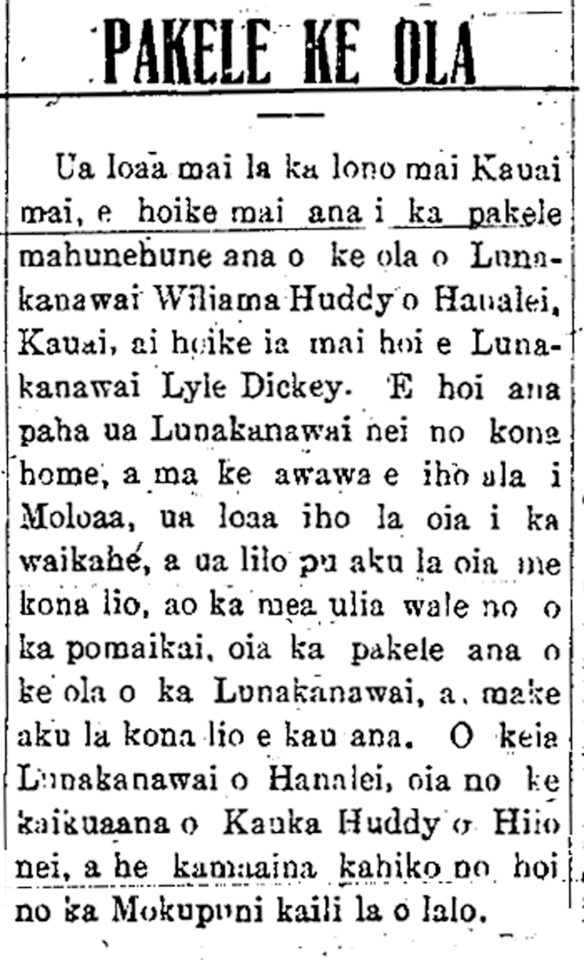
We received news from Kauai telling how the life of Judge William Huddy [Wiliama Huddy] of Hanalei, Kauai was barely saved, as told by Judge Lyle Dickey. Perhaps that Judge was heading home, and in the valley going down into Moloaa, he came up against an overflowing stream, and he and his horse got caught up in it; and only by sheer luck was the life of the Judge saved, but the horse he was on died. This Judge of Hanalei is the older brother of Dr. Huddy of Hilo nei, and a old-timer of the Island in the west that snatches the sun.

(Hoku o Hawaii, 2/17/1916, p. 2)

HokuoHawaii_2_17_1916_2

Ka Hoku o Hawaii, Buke 10, Helu 37, Aoao 2. Feberuari 17, 1916.

Cars collide a hundred and fifty years ago? 1866.

[Found under: “HUNAHUNA MEA O HAWAII NEI.”]

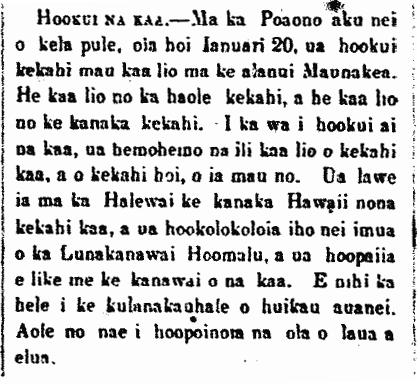
Cars Collide.—On Wednesday Saturday last week, that being the 20th of January, some horse carts collided on Maunakea Street. One was a horse cart belonging to a haole, the other horse cart belonged to a Hawaiian. When the cars collided, the harness [ili kaa lio] of one of the cars came off, and the other remained as always. The Hawaiian to whom belonged one of the cars was taken to Jail [Halewai] and he was tried in front of the Police Justice [Lunakanawai Hoomalu], and he was penalized as per the laws dealing with vehicles. Proceed with caution in this town lest there be confusion. The lives of the two of them however were not harmed.

(Kuokoa, 1/27/1866, p. 2)

Kuokoa_1_27_1866_2

Ka Nupepa Kuokoa, Buke V, Helu 4, Aoao 2. Ianuari 27, 1866.

Timeless words to drivers from a hundred years ago, 1915 / 2015.

BE VIGILANT

Following the three casualties on Volcano Road [Alanui Kaluaopele] near Glenwood, because of the overturning of the automobile of the Volcano Stables Company [Hui Kaa Kaluaopele]; it is necessary to somewhat decrease the numbers of cars so the road isn’t disorderly [kipalale] as we know it is narrow. It is also important for the drivers [hookelekaa] to be cautious when driving, lest there be more casualties like these. When one driver wants to overtake another, that is stupid; be very careful in every way, whether the road is wide or narrow; because that is how this Hawaiian met with disaster, and took two haole women as victims. Think, O Drivers, and drive appropriately on narrow portions of the road so that you don’t get into accidents and lives are lost. This will be a reason world travellers will not often come here to Hilo, because of this kind of dreadful happenings that are heard of, and it is the very first in the history of Hilo.

[Not only Volcano—be careful anytime you are behind the wheel!]

(Hoku o Hawaii, 3/4/1915, p. 2)

E MAKAALA

Ka Hoku o Hawaii, Buke 9, Helu 38, Aoao 2. Maraki 4, 1915.

Pedestrians and Drivers need to be vigilant! 1917.

[Found under: “Nuhou Kuloko”]

One must be very careful when crossing from one side of the street to the other, because the automobiles speed by without paying attention to the people on the street.

[It seems like there are more and more accidents out lately. Please be careful out there!!]

(Aloha Aina, 12/14/1917, p. 4)

He mea pono e akahele...

Ke Aloha Aina, Buke, XXII, Helu 50, Aoao 4. Dekemaba 14, 1917.

Mikahala collides into the Mary E. Foster, 1894.

A SCHOONER WRECKED AT SEA.

The Steamer Mikahala Cuts Off the Stern of an Island Vessel.

THE MARY E. FOSTER OUT OF SIGHT.

The Vessels Meet At Midnight In the Channel—The Disaster Is Said to be Due to a Mates Negligence—No Lives Lost By the Unfortunate Accident.

On last Tuesday, about midnight, the steamer Mikahala and the schooner Mary E. Foster collided in the channel between Kauai and this island. The bow of the steamer struck the port side of the schooner, near the stern, and cut off the end as neatly as if it had been done by a saw. The schooner began to settle at once, and at the end of three-quarters of an hour she sank completely out of sight. Captain Hipa and the crew of the Mary E. Foster were taken on board of the Mikahala and carried as far as Koloa, where they were picked up by the Iwalani and returned to this port.

The particulars of the disaster are about as follows: The Mikahala left this port for Kauai and Niihau. The…

THE I. I. S. N. CO.’s STEAMER MIKAHALA.
(From a Photograph.)

…weather was favorable, and the moon was shining. At midnight Captain Haglund came on deck, as it was the hour for changing the watch. He went aft first, and when returned forward he noticed a sail right ahead of the steamer. He jumped into the wheel-house and turned the helm in order to avoid a collision, but the vessel did not answer her helm quickly enough, and the bow of the steamer crashed into the vessel. The second mate was on watch at the time, and it will be a difficult matter for him to prove that the collision was not his fault. His excuse is said to be that the foresail was up and interfered with his sight. Then another story is, that he thought the vessel which was bearing down on him was the James Makee or some other island steamer, and he did not think it was necessary to shift the helm. As soon as the schooner was struck, her cabin and hold rapidly filled with water, and it was but the work of a few moments to drop a boat into which the crew bundled and pulled for the Mikahala. Captain Hipa remained on his vessel until the last moment, and did not leave until Captain Haglund assured him that his schooner would go to the bottom of the sea.

Captain Hipa made an effort to get out of the way of the steamer but the wind was not heavy enough at the time, and while his vessel was sailing at an angle with the steamer she was struck. If he…

THE MARY E. FOSTER.
(The cross marks the place where the bow of the Mikahala struck the illfated schooner.)

…had had thirty seconds more time he would have cleared himself and the collision would not have occurred. The schooner had 1400 bags of sugar on board which is said to be insured.

The Mary E. Foster was built in 1877 at Port Ludlow. She was ninety tons register and was valued at $5000. For years she has been running between here and Kauai taking coal to different plantations on that island and returning with sugar. Her captain is considered a good seaman and no blame is attached to him for the disaster, as a sailing vessel has the right of way on the high seas, and it was the duty of the second mate in charge of the steamer to steer clear of the schooner. Captain Haglund will return to port tomorrow morning when a full account of the collision will be obtained.

(Pacific Commercial Advertiser, 5/26/1894, p. 3)

A SCHOONER WRECKED AT SEA.

The Pacific Commercial Advertiser, Volume XIX, Number 3698, Page 3. May 26, 1894.

Tragedy shaping Duke Kahanamoku, 1910.

DROWNED WITHOUT RECEIVING HELP.

In the afternoon of this past Sunday at perhaps 4 or so, while a group of young children were swimming ocean side of the Moana Hotel, there was a youngster swimming with them by the name of John A. Aguiar, a 12 years old Portuguese child. While this crowd of children were surfing and playing in the ocean, a group of them swam out to a bunch of boards floating in the ocean, and when they reached this heap of boards, the boy was with them, the one amongst them who was tired out from being buffeted and overwhelmed by the waves. After resting and regaining their breath, they all returned back to the shore, and the Aguiar boy amongst them swam all the way to Seaside Hotel; he had not swam very far when he called out for help.  His swimming friends thought that this was him joking, so they paid him no attention.

When these children came ashore, one of their fellow children asked about Aguiar, and this is what some of them said. “He was calling for help. Why didn’t you help him?” They said, “It was probably Aguiar’s fooling around.” But because Aguiar’s clothes were found laying out, it was realized that this boy was lost.

This Monday morning, the body of this child was found in the shallows near the Moana Hotel by Duke Kahanamoku, Jr. There were no bruises on his body except for the ears where it was nibbled and nipped at by the small fish of the shore.

In Monday evening, his funeral was performed with sadness, regret, and aloha of the his family and friends.

[Perhaps this is one of the reasons why Duke was so involved in water safety and rescue. And if anyone is motioning or calling for help in the water, don’t assume that they are playing around!]

(Kuokoa Home Rula, 8/12/1910, p. 3)

PIHOLO A MAKE ME KE KOKUA OLE IA.

Kuokoa Home Rula, Buke VIII, Helu 32, Aoao 3. Augate 12, 1910.


Keelikolani’s house and valuables destroyed by fire, 1873.

Destruction by Fire of the Residence of the Governess of Hawaii.

The tedium of this dull town, was relieved a little on last Wednesday night by a rousing fire. About one quarter to eight o’clock, the dwellers on Emma street, and in the immediate neighborhood, were suddenly aroused by the shouts and cries of kanakas, the screams of wahines, and the barking of dogs; and were first led to suppose that a big fight was on hand,—that perhaps the police had mutinied and the rifles were called out; but as each anxious individual peered into the street, they soon discovered by the column of flame that was leaping up into the dark sky, that a conflagration was on hand, and farther observation showed that it was taking place at the town mansion of Her Excellency, R. Keelikolani, the Governess of Hawaii.

The fire evidently had a good start, and as soon as discovered, was beyond the control of blankets or buckets of water; but not beyond the control of a good head of water from a fire plug, if spouting on it there and then. But the hydrant for public safety was not ready till the roaring devourer was licking the roof tree of Ruth. And when it was ready, the quenching stream served only to raise an impotent fizzle of stream. And oh! had the wind been up, and this fire had been in the close built part of the town, then we would have had a dance of destruction, that would have been equal to the cost of forty reservoirs.

But we must not complain, as the Ministers were out to see the fire burn, and lend a hand if needed. Emma street was lively with the jostling of Ministers and milkmen, diplomats and deacons, judges and jews, and editors and elderly ladies. Everybody turned out,—even some of the churches turned out. These were in the midst of the regular Wednesday evening service, when the uproar began. One pastor affected by the outside outcry, and the evident anxiety of his people, “sung it short,” and he and his flock, joined the throng in the street, to see the sight; but another one, while addressing his faithful, although he saw them speak out one by one, until he was left with only two to listen, yet he stood firm like the Roman sentinel at Pompeii, while the sparks of the conflagration were falling in his vestibule, and gave the two faithful witnesses the full benefit without halt or abbreviation of good orthodox sermon.

The cause of the fire is unknown, but as there had been on hand lately, a fierce litigation about this and other property, the circumstances afford occasion for a good deal of suspicion. Much that was curious and valuable in relation to ancient Hawaiian habits and costumes were unfortunately destroyed. There was some of the famed featherwork, worn by the old chiefs, many of the old feather insignia of office, the great kahilis of Hawaiian pageants, shell and hair ornaments, tappas and fine mats, and some royal bones—all of which were a considerable loss, excepting the bones.

The residence as a property, will not be much of a loss to the wealthy Governess of Hawaii. If the trades had been blowing fresh, several houses makai of this building, would have gone with it but as it was dead calm, and a light shower had fallen a few minutes before the fire broke out, it was easy to defend the roofs of neighboring houses.

On account of the absence of mail, we give this long report of an ordinary fire.

(Hoku o Hawaii, 1o/17/1873, p. 3)

Destruction by Fire of the Residence of the Governess of Hawaii.

Nuhou, Volume II, Number 24, Page 3. October 17, 1873.

Excursion of the Princess Regent Liliuokalani, 1881.

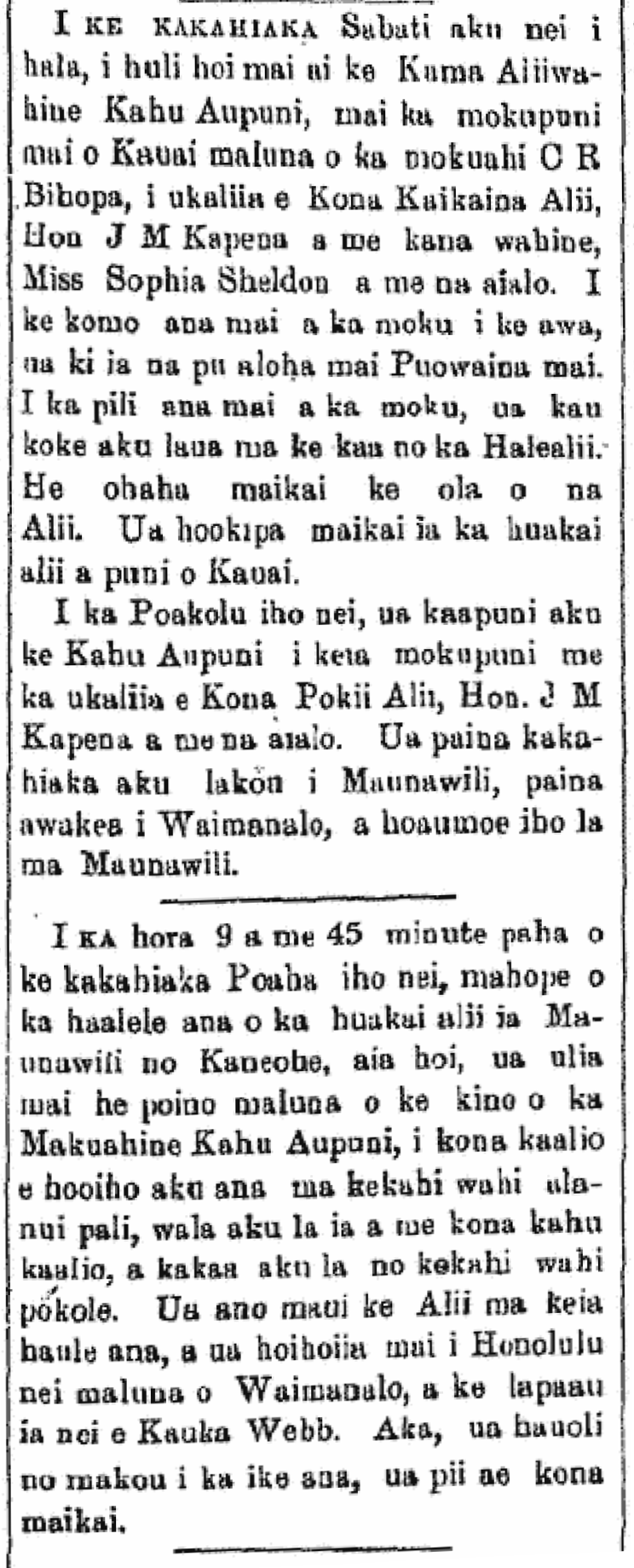
On the morning of this past Sunday, the Princess Regent [Kahu Aupuni] returned from the island of Kauai aboard the steamship C. R. Bishop, accompanied by Her Royal Younger Sister [Likelike], Miss Sophia Sheldon, and her attendants. When the ship entered the harbor, guns of salute were shot from Puowaina. When the ship landed, the two of them immediately boarded a car for the Palace. The Alii was in fine health. The royal excursion was welcomed warmly all around Kauai.

This past Wednesday, the Regent did a circuit of this island accompanied by Her Royal Younger Sibling, Hon. J. M. Kapena, and her attendants. They had breakfast in Maunawili, had lunch at Waimanalo, and spent the night in Maunawili.

———————

At perhaps 45 minutes past the hour of 9 on the morning of this past Thursday, after the royal excursion left Maunawili for Kaneohe, an accident befell the Mother Regent, when her carriage was descending a cliff road, she was thrown backwards along with her driver, and tumbled for a short time. The Alii was somewhat bruised in the fall, and was brought back to Honolulu aboard the Waimanalo, and she is being treated by Doctor Webb. But we are happy to see that she is improving.

[Perhaps the newspaper is playing down the severity of Liliuokalani’s injuries. In “Hawaii’s Story,” she sounds like she is in quite a lot of pain.]

(Ko Hawaii Pae Aina, 10/8/1881, p. 2)

I ke kakahiaka Sabati aku nei...

Ko Hawaii Pae Aina, Buke IV, Helu 41, Aoao 2. Okatoba 8, 1881.

Near tragedy on the way from Kauai to Niihau, 1864.

Barely survived at sea

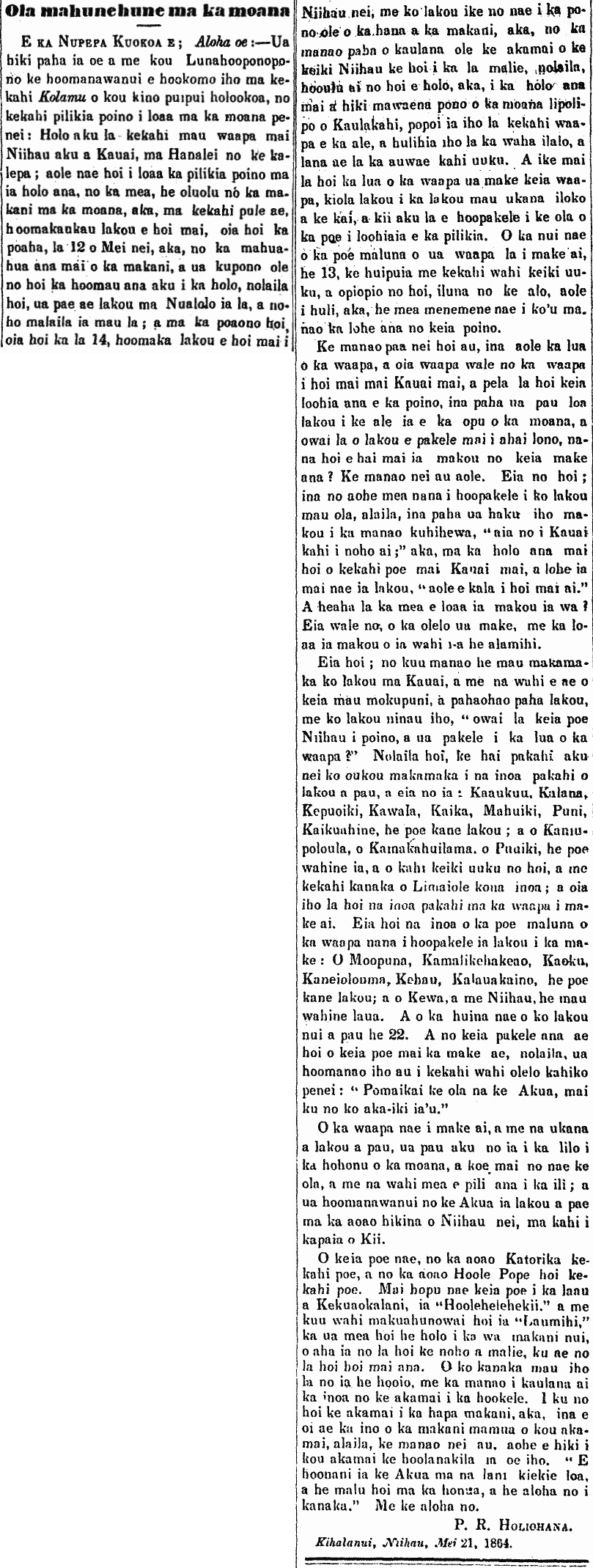
O Kuokoa Newspaper; Aloha oe:—Perhaps you and your Editor can be tolerant and include this in a Column of your entire stout body, about a crisis at sea, like this: Several skiffs left Niihau for Kauai, in Hanalei, to peddle goods; they did not face the crisis during this trip because the winds were calm on the sea, however, the next week they made ready to return, that being Thursday, the 12th of May, but because the wind was growing stronger, it wasn’t appropriate to continue the travels, therefore they landed at Nualolo that day, and stayed there for those days; and on Saturday, the 14th, they made to return here to Niihau while knowing the activity of the wind was bad; perhaps it was because they felt that the skill of the Niihau youth would not be acclaimed should they return in the calm, so they were worked up to sail, but after leaving and reaching the middle of the deep seas of Kaulakahi, one of the skiffs was pounded by a billow, and it overturned, and they were in dire straits. And when the second skiff noticed that this one had sunk, they threw their belongings into the sea and went to save the lives of the people overcome by calamity. The number of people aboard that vessel that had sunk was 13 including a small, young child who wasn’t yet crawling; I felt sorrow when I heard of this tragedy.

I strongly believe that if it wasn’t for the second skiff, and there was but just one skiff returning from Kauai, and they ran into this trouble, then they would be all gone, being swallowed by the belly of the ocean, and which of them would have escaped to be the messenger, the one to tell us of this sinking? I don’t think any one of them. And here is another thing; should none of them have lived, then we would have imagined something that was not true: “They are there living on Kauai;” but when some people from Kauai came and heard of them: “They left a long time ago.” Then what would we have then? Just this, the word that they had died, while accepting that fish, an alamihi.”¹

Here is another thing; being that I believe they have relatives on Kauai, along with other places of these islands, who are full of wonder, asking, “who are these Niihau people who were in trouble, and were they saved by the second skiff” So your friend will give each of their names, and here they are: Kaaukuu, Kalana, Kepuoiki, Kawala, Kaika, Mahuiki, Puni, and Kaikuahine, who are men; and Kamupoloula, Kamakahuilama, and Puuiki, who are women; and the small children and a man named Limaiole; those are the names of each of them in the skiff that sank. These are the names of the people aboard the skiff which saved them: Moopuna, Kamalikehakeao, Kaoku, Kaneiolouma, Kehau, and Kalauakaino, who are men; and Kewa and Niihau, who are women. The total number of them all was 22. And with this saving of these people from death, I recall an old saying: “Life is blessed through God, your snicker was almost fitting for me. [?? “Pomaikai ke ola na ke Akua, mai ku no ko aka-iki ia’u.”

As for the skiff that sunk and all of their cargo, it is all gone into the depths of the ocean, and all that was left are their lives, and what they had on; and God was patient with them and they landed on the east side of Niihau nei, in the place called Kii.

These people, some of them were of the Catholic faith, and some were Protestants. These people nearly grabbed onto the club of Kekuaokalani, “Hoolehelehekii,”² along with my father-in-law, “Laumihi,”³ as they set off in strong winds; what’s wrong with staying put until it is calm and then get up and come back. It is in man’s nature to show off, thinking that he will be famous for his prowess at sailing. You are competent facing a fraction of the wind, but should the ferocity of the wind be greater than your skill, then I believe that your intelligence would not leave you victorious. “Praise god in the high heavens, peace on earth, and good will towards men.” With aloha,

P. R. Holiohana.⁴

Kihalanui, Niihau, May 21, 1864.

¹A play on alamihi crab which can also sound like “path to repentance”.

²A play on the name “Hoolehelehekii,” meaning to be all talk.

³A play on the name “Laumihi,” perhaps meaning much remorse.

⁴P. R. Holiohana is most likely also known as P. R. Holi.

[On a related note, please don’t drive if you have been drinking. It isn’t worth the risk you are putting yourself and others on the road in.]

(Kuokoa, 6/18/1864, p. 4)
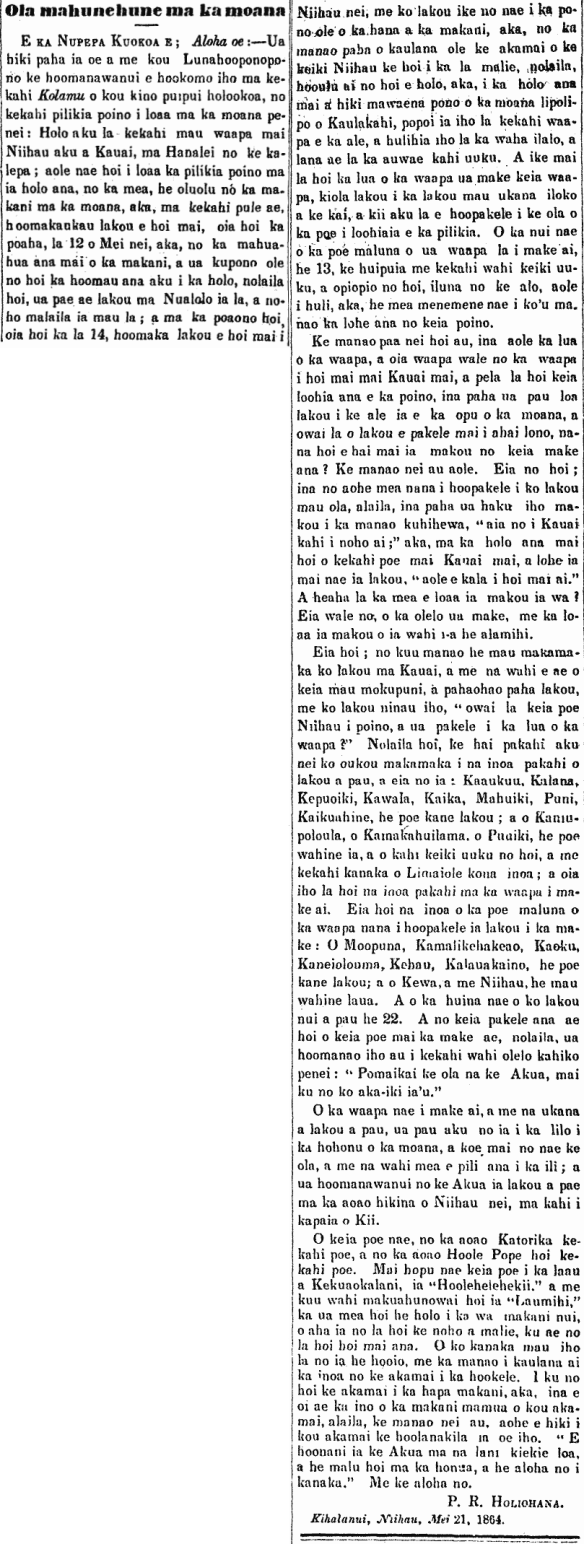
Ola mahunehune ma ka moana

Ka Nupepa Kuokoa, Buke III, Helu 25, Aoao 4. Iune 18, 1864.