The birthday of Pauahi, 1901.

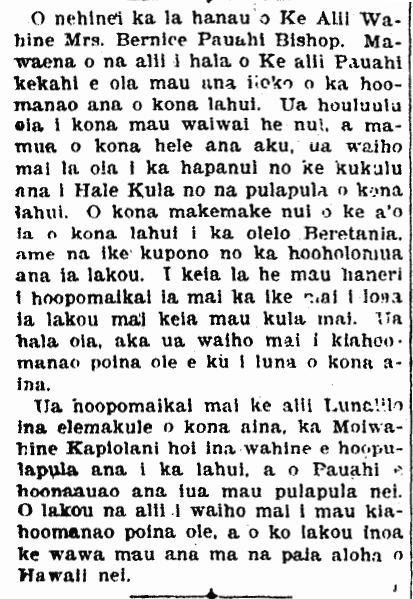
Yesterday was the birthday of The Chiefess Mrs. Bernice Pauahi Bishop. Amongst the alii who passed on, Ke alii Pauahi is one who lives on in the minds of her lahui. She accumulated her great wealth and before her passing, she left most of it to build a School for the children of her people. Her strong desire was that her lahui be taught English and the proper knowledge for them to progress. Today there has been hundreds who have benefited from the knowledge they gained from these schools. She has gone on but left an unforgettable monument standing upon her land.

Lunalilo blessed the old people of his aina; Queen Kapiolani, the women who are increasing the race; Pauahi, educates those children. Those are the alii who left enduring monuments; and their names shall forever reverberate against the beloved walls of Hawaii nei.

(Kuokoa, 12/20/1901, p. 2)

O nehinei ka la hanau o Ke Alii Wahine Mrs. Bernice Pauahi Bishop...

Ka Nupepa Kuokoa, Buke XXXIX, Helu 25, Aoao 2. Dekemaba 20, 1901.

Birthday of Mrs. A. Pauahi Bishop, 1869.

[Found under: “NU HOU KULOKO: Oahu.”]

Birthday of the Alii Pauahi.—On the 20th of December, a party was held at Koholaloa, to celebrate the birthday of one of our young chiefs, that being the Honorable Mrs. A. Pauahi Bishop, recognizing her reaching thirty-eight years old. This past 19th was a Sunday and was her actual birthday, but because it fell on a Sunday, it was not observed. It was left until the following Monday. The lanai where the party was held was honored by the arrival of the Governess of Hawaii [Keelikolani], the Hon. Mrs. L. Kamakaeha, Mrs. L. Kaaniau [Kekaaniau], and the other dignitary women of this town. Later that night, the chiefess whose birthday it was was entertained at her home, relying on Pauli, Malo, Kapoli, and Wakeki, who sang some name songs for that alii. They were appreciated for their singing.

(Kuokoa, 12/25/1869, p. 2)

La Hanau o Pauahi Alii.

Ka Nupepa Kuokoa, Buke VIII, Helu 51, Aoao 2. Dekemaba 25, 1869.

Death of Abner Kuhooheiheipahu Paki, 1855.

The death of A. Paki, on the 13th of this June.

The chief A. Paki. He appears in the genealogy of the Chiefs of this Nation, from ancient times, and he is a high Chief of this land descended from Haloa, that being the one father of the children living in this world, and the father of our people.

Part of his genealogy is taken from the High Chiefs of the land, and he is part of Kamehameha’s, and he is part of Kiwalao’s, and he is a hereditary chief of a single line from ancient times; and he was a father who rescued from trouble his people of this nation from Hawaii to Kauai.

His accomplishments during his life. When he promised to stop drinking and to become a Christian, from that time on he did not drink alcohol again until the day he died.

He was a Chief who was steadfast in his work for the nation, and he was an Alii who would be furious when he heard his deceased child being spoken ill of, as well as of his children who survive him.

From what I have seen of this Alii while he was alive. In the year 1837, he began his governmental work, and at one point he was appointed Chief Justice [L. K. Kiekie] of the country, and at another point he served as Governor, and another time he was included in the Privy Council, and still another time he was the steward for his child, this during his lifetime. Continue reading

Konia’s kanikau for Paki, 1855.

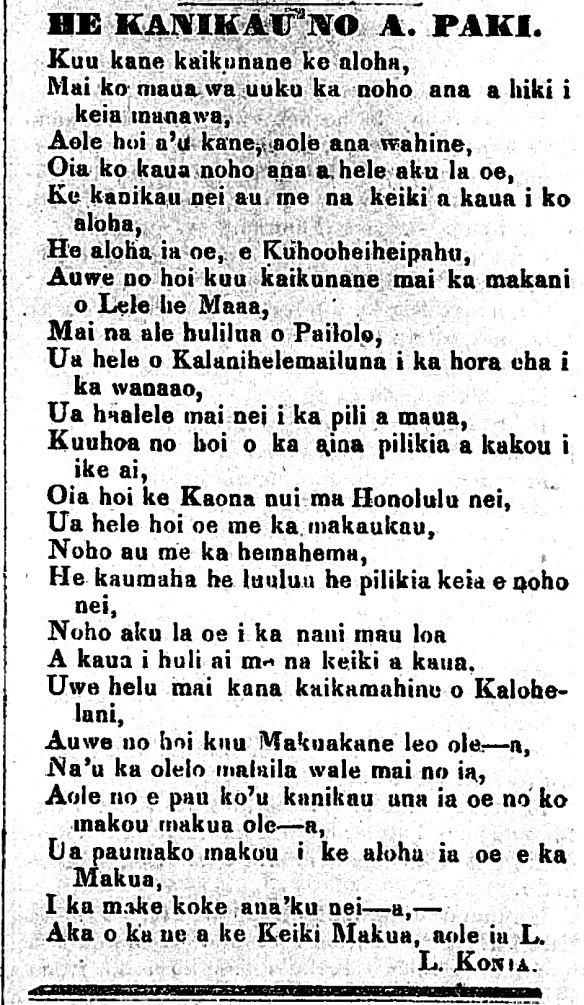
HE KANIKAU NO A. PAKI.

Kuu kane kaikunane ke aloha,
Mai ko maua wa uuku ka noho ana a hiki i keia manawa,
Aole hoi a’u kane, aole ana wahine,
Oia ko kaua noho ana a hele aku la oe,
Ke kanikau nei au me na keiki a kaua i ko aloha,
He aloha ia oe, e Kuhooheiheipahu,
Auwe no hoi kuu kaikunane mai ka makani o Lele he Maaa,
Mai na ale hulilua o Pailolo,
Ua hele o Kalanihelemailuna i ka hora eha i ka wanaao,
Ua haalele mai nei i ka pili a maua,
Kuu hoa no hoi o ka aina pilikia a kakou i ike ai,
Oia hoi ke Kaona nui ma Honolulu nei,
Ua hele hoi oe me ka makaukau,
Noho au me ka hemahema,
He kaumaha he luuluu he pilikia keia e noho nei,
Noho aku la oe i ka nani mau loa,
A kaua i huli ai me na keiki a kaua,
Uwe helu mai kana kaikamahine o Kalohelani,
Auwe no hoi kuu Makuakane leo ole—a,
Na’u ka olelo malaila wale mai no ia,
Aole no e pau ko’u kanikau ana ia oe no ko makou makua ole—a,
Ua paumako makou i ke aloha ia oe e ka Makua,
I ka make koke ana’ku nei—a,—
Aka o ka ne a ke Keiki Makua, aole ia L.

L. Konia.

(Elele E, 6/16/1855, p. 20)

HE KANIKAU NO A. PAKI.

Ka Elele E, Buke 10, Aoao 20. Iune 16, 1855.

Funeral of Konia, 1857.

The Funeral of Konia.

The obsequies of the late chiefess Konia were performed on Tuesday, and notwithstanding the sickness which has been so general prevented numbers of persons from attending, the aggregate of those collected to show their respect on the occasion was very large, whilst the crowd that thronged both sides of the streets, as the procession moved along, was so great as to require a strong force to preserve the line of march from the late residence of the deceased lady to the Royal cemetery, in which the coffin was placed. The religious services were performed by the Rev. Mr. Clark, and the ceremony was conducted throughout with a decorum and feeling which was remarked by all present.

(Polynesian, 8/8/1857, p. 108)

The Funeral of Konia.

The Polynesian, Volume XIV, Number 14, Page 108. August 8, 1857.

Death of Laura Kanaholo Konia, 1857.

On this past 2nd, L. Konia, the widow of A. Paki, died at 50 years of age. She was an alii nui, and was a child of Kaoleioku, and Kalaniopuu was the father of Kaoleioku, an actual cousin of the father of Kamehameha I. Konia was a loving chiefess, and her friends and all the people of this archipelago are very saddened for there is no high chiefess in this land remaining; they have all gone. Her friends weep with greatly pained hearts.

(Hae Hawaii, 7/15/1857, p. 62)

I ka la 2 iho nei...

Ka Hae Hawaii, Buke 2, Ano Hou—-Helu 16, Aoao 62. Iulai 15, 1857.

On the moving of the Na-ha Stone to Hilo Library 100 years ago, and its history (4 of 6), 1915.

As soon as Ululani heard these words of her children, she exited the house, and soon saw Kamehameha approaching, and that is when Ululani began a wailing call of love [uwe helu] and then she also called out the name song for Kamehameha with these words:

Au—we hoi—e, he mai hoi paha,
O oe ka ia e Kalaninuilanimehameha—a,
E hea aku ana i ka Iwa kiloulou moku la,
E komo e kuu Laninui hoi—a,
Ao i wehewehena ao i waihona—e,
Kona po o ka hoa keia—la,
A’u lei o ka ua haao hoi—e,
E lele ae la mauka o Auaulele—a,
E komo hoi paha i ka hale o Kealohalani—e,
Auau i ke kiowai kapu o Ponahakeone,
Ae inu hoi i ka awa a Kane i kanu ai i Hawaii,
A ola hoi ke kini o ke akua ia oe,
He mai hoi e kuu Laninuimehameha—a.

[Ah indeed, do come,
Might it be you, O Kalaninuilanimehameha?
I call out to the island-hooking Frigate bird,
Come in, my Heavenly Chief,
The day opens, the day closes,
In his night, this is the companion,
My lei of the Haao rains,
Soaring in the uplands of Auaulele,
Entering the home of Kealohalani,
Bathing in the sacred pool of Ponahakeone,
Drinking the awa which Kane planted in Hawaii,
The multitudes of the gods will live through you,
Come, my dear Laninuimehameha.] Continue reading

Name chant for Kamehameha V, 1868.

HE INOA NO KAMEHAMEHA V.

Kalaninui Kapuaiwa i ke kapu he inoa,
He kua kapu oe no Waialii kukai kapu na Lono,
O Lono o ke kai maeleha kapu ka leo i Kolea la,
Ka Ewauli o Laakona ke’lii nona ia kua—e,
Hanohano Lahaina i ka ua Nalina,
Ke kipu mai la i na kahawai,
O ka omaka o ka wai ke iho la i kai,
Ilina opala aku la kai o Hauola,
I ka hoonuua ia e ka makani Malanai,
He noe ke kino oia makani ke pa mai,
Ulu iho la maha pepe ka lau o ka maia,
Ana ole i ka hookinaia e ke kaao—e,
Ua—i—I aku la oe iaia nei—e.

Ike iho la oe he mea pono ia,
Heaha ka mea i lawelawe ole iho ai ka lima,
I koho kau nana iaia—e,
Ua i—I aku la oe iaia nei—e.

Kau ka hae o Lele i ka pohu,
Me he ia moku i ka malie,
Kauilani i ka makani Ma—aa,
E honi ana i ke Kakaalani,
Kii Kaunuloa powa i ka pohu,
Nana’ku oe o na lehua o Lihau,
Ua maeele i ka ua ia e ka ua,
Opili Kahili maeele i ke anu—e,
Ua i—I aku la oe iaia nei—e.

He anu no ko’u noho nei,
Ina e mehana moe iho la hoi,
Ua i—I aku la oe iaia nei—e,
Ua i—I aku la oe iaia nei—e.

S. KANAE.

Kalaninui Kapuaiwa i ke kapu he inoa,
Ke kua e o i ko olua kua no,
Opu no oukou a i ekolu,
Ka ihea lepo iluna o Iolani,
O ka lani koe iluna lilo,
Ke ‘lii nona ia kua—e,
Hana i ka lani ke kiowai,
He kiowai ua no Kulanihakoi,
I hanini mai pulu ke kahawai,
Helelei piha ke kahawai o ka honua,
E hana ino ana i ka lai o Lele,
Hone ka Maaa a pepehi i ke Kaomi,
Hoi e moe i Kauamakaupili—e,
Ua i—I aku la oe iaia nei—e.

Oia nei ke hoa he alapahi ke ano,
He nolunolu olelo i kahi alii,
I hewa mai ai ke kahu o ka moe—e,
Ua i—I aku la oe iaia nei—e.

Moe e no Puna lolii i ka makani,
Hooio i na lei lehua a Kamoani,
Hukihuki hele i ke kai o Punahoa,
Hahihahi ku i ke one o Paikaka,
Kaka kahela na lima o Mokaulele,
E apo ana i paa Omaolala,
O lilo e aku i ka ua nahunahu,
O Konohiki lau aku i ka Luaopele—e,
Ua i—I aku la oe iaia nei—e.

He pele ia nei he mea a loa,
Hookahi no mea i pio ai o Kamapuaa,
I ka haunuu haulani a Kama i ka eku—e,
Ua i—I aku la oe iaia nei—e,
Ua i—I aku la oe iaia nei—e.

KAPOLI HAWANAWANA.

[There is one oki of this mele found in the 5/28/1868 issue of Au Okoa by Kekuanaoa, one in the 6/18/1868 issue without an attribution, one in the 7/23/1868 issue by Kamehameha III; three in the 7/30/1868 issue, one by Kalama, one by Kaomi, and the other by Liliha. There are also many issues that are missing for this newspaper, and who knows what treasures might be found once copies of those issues are found!]

(Au Okoa, 9/24/1868, p. 1)
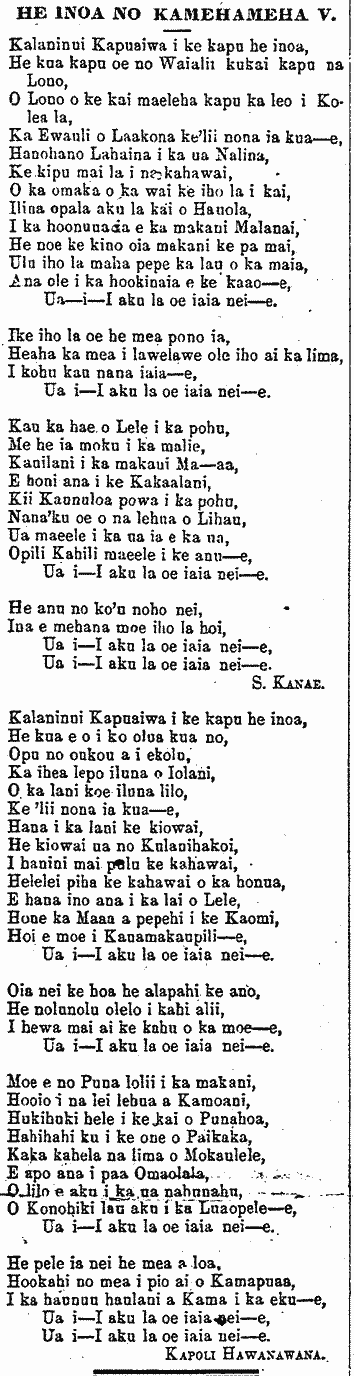
HE INOA NO KAMEHAMEHA V.

Ke Au Okoa, Buke IV, Helu 23, Aoao 1. Sepatemaba 24, 1868.

A Kauai procreation chant for Princess Kaiulani, 1899.

[Found under: “KANIKAU NO KAIULANI.”]

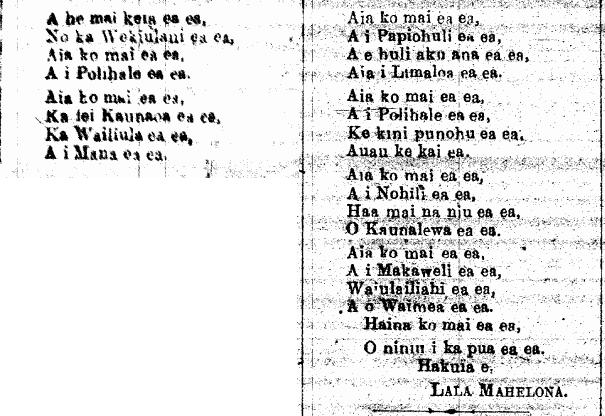
A he mai keia ea ea,
No ka Wekiulani ea ea,
Aia ko mai ea ea,
A i Polihale ea ea.

Aia ko mai ea ea,
Ka lei Kaunaoa ea ea,
Ka Wailiula ea ea,
A i Mana ea ea.

Aia ko mai ea ea,
A i Papiohuli ea ea,
A e huli aku ana ea ea,
Aia i Limaloa ea ea.

Aia ko mai ea ea,
A i Polihale ea ea,
Ke kini punohu ea ea,
Auau ke kai ea [ea].

Aia ko mai ea ea,
A i Nohili ea ea,
Haa mai na niu ea ea,
O Kaunalewa ea ea.

Aia ko mai ea ea,
A i Makaweli ea ea,
Waiulailiahi ea ea,
A o Waimea ea ea.

Haina ko mai ea ea,

O niniu i ka pua ea ea.

Composed by,

Lala Mahelona.

(Aloha Aina, 3/18/1899, p. 6)

A he mai keia ea ea,

Ke Aloha Aina, Buke V, Helu 11, Aoao 6. Maraki 18, 1899.

Hauoli La Hanau, e Kaleiohawaii! 1877.

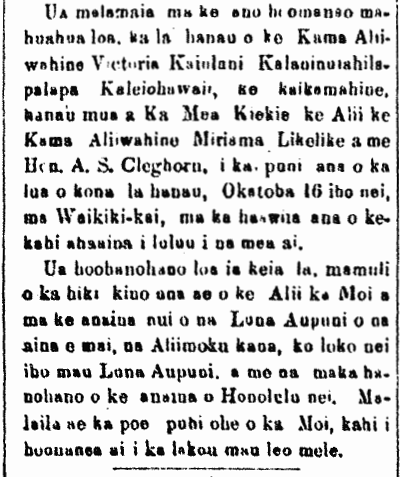
Held with much celebration was the birthday of the Princess Victoria Kaiulani Kalaninuiahilapalapa Kaleiohawaii, the first-born daughter of Her Highness the Alii the Princess Miriam Likelike and Hon. A. S. Cleghorn, on her second birthday, on this past October 16th, at Waikiki Kai, by way of the holding of a banquet laden with much food.

This day was greatly honored by the arrival of the Alii, the King, and by the great attendance of the Officers from foreign nations, the Captains of the warships, the domestic Officers, and the prominent ones of Honolulu nei. Also present was the band of the King, which entertained folks with their songs.

(Kuokoa, 10/20/1877, p. 2)

Ua malamaia ma ke ano hoomanao mahuahua loa...

Ka Nupepa Kuokoa, Buke XVI, Helu 42, Aoao 2. Okatoba 20, 1877.