On Liliuokalani’s composition of “Mele Lahui Hawaii,” 1898.

“In the early years of the reign of Kamehameha V, he brought to my notice the fact that the Hawaiian people had no national air. Each nation, he said, but ours had its expression of patriotism and love of country in its own music; but we were using for the purpose on state occasions the time-honored British anthem, “God save the Queen.” This he desired me to supplant by one of my own composition. In one week’s time I notified the king that I had completed my task. The Princess Victoria had been the leader of the choir of the Kawaiahao church; but upon her death, May 29, 1866, I assumed the leadership. It was in this building and by that choir that I first introduced the “Hawaiian National Anthem.” The king was present for the purpose of criticising my new composition of both words and music, and was liberal in his commendations to me on my success. He admired not only the beauty of the music, but spoke enthusiastically of the appropriate words, so well adapted to the air and to the purpose of which they were written.”

(from Hawaii’s Story by Hawaii’s Queen, pp. 31–32.)

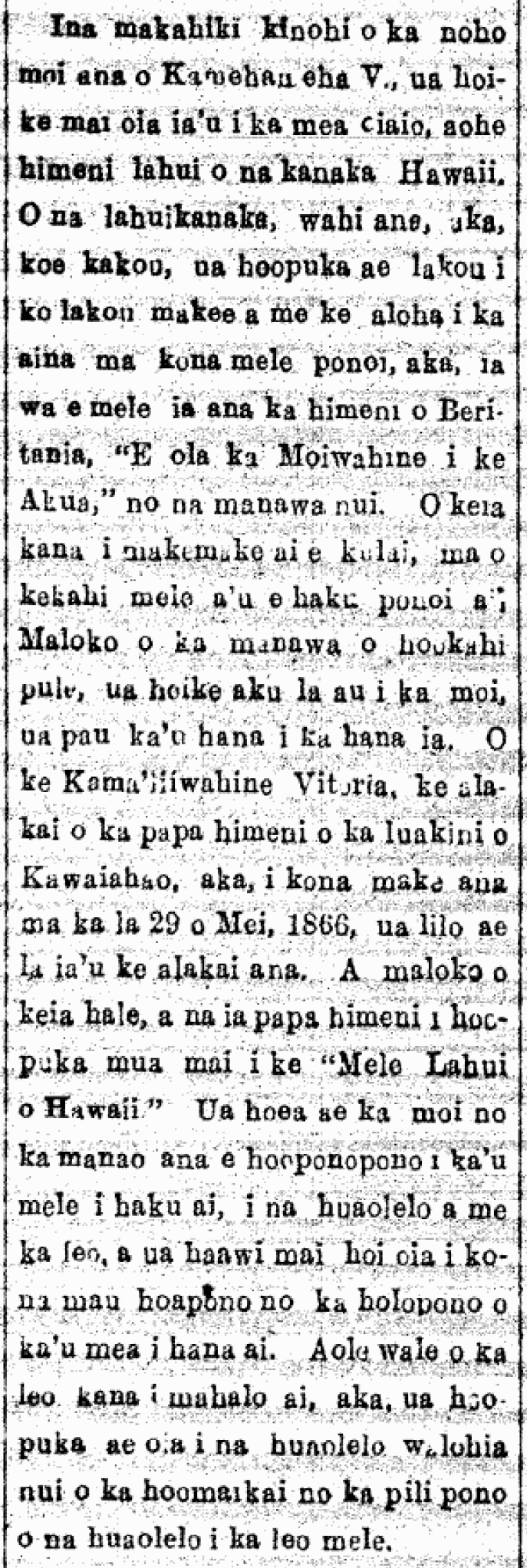
“Ina makahiki kinohi o ka noho moi ana o Kamehameha V., ua hoike mai oia ia’u i ka mea oiaio, aohe himeni lahui o na kanaka Hawaii. O na lahuikanaka, wahi ana, aka, koe kakou, ua hoopuka ae lakou i ko lakou makee a me ke aloha i ka aina ma kona mele ponoi, aka, ia wa e mele ia ana ka himeni o Beritania, “E ola ka Moiwahine i ke Akua,” no na manawa nui. O keia kana i makemake ai e kulai, ma o kekahi mele a’u e haku ponoi ai. Maloko o ka manawa o hookahi pule, ua hoike aku la au i ka moi, ua pau ka’u hana i ka hana ia. O ke Kama’liiwahine Vitoria, ke alakai o ka papa himeni o ka luakini o Kawaiahao, aka, i kona make ana ma ka la 29 o Mei, 1866, ua lilo ae la ia’u ke alakai ana. A maloko o keia hale, a na ia papa himeni i hoopuka mua mai i ke “Mele Lahui o Hawaii.” Ua hoea ae ka moi no ka manao ana e hooponopono i ka’u mele i haku ai, i na huaolelo a me ka leo, a ua haawi mai hoi oia i kona mau hoapono no ka holopono o ka’u mea i hana ai. Aole wale o ka leo kana i mahalo ai, aka, ua hoopuka ae oia i na huaolelo walohia nui o ka hoomaikai no ka pili pono o na huaolelo i ka leo mele.”

(Aloha Aina, 5/14/1898, p. 7)
KA BUKE MOOLELO HAWAII I HAKUIA E KA Moiwahine Liliuokalani...

Ke Aloha Aina, Buke IV, Helu 20, Aoao 7. Mei 14, 1898.
Kaluaikoolau, the book. 1912.

[Found under: “Local News”]

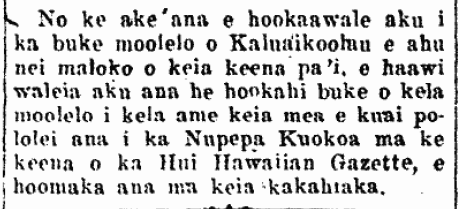
Because of the desire to liquidate the story book of Kaluaikoolau which are stacked up in the publishing office, one of those books will be given away for free to each person who buys the Kuokoa directly from the office of the Hawaiian Gazette Company, beginning this morning.

[Up until this time, the books were going for 10 cents each, if you picked them up at the Hawaiian Gazette Co. office, or 15 cents if you wanted them sent to the country. See ad below.]

(Kuokoa, 3/29/1912, p. 8)

No ke ake ana e hookaawale...

Ka Nupepa Kuokoa, Buke XLVIII, Helu 13, Aoao 8. Maraki 29, 1912.

THE STORY BOOK

Kaluaikoolau

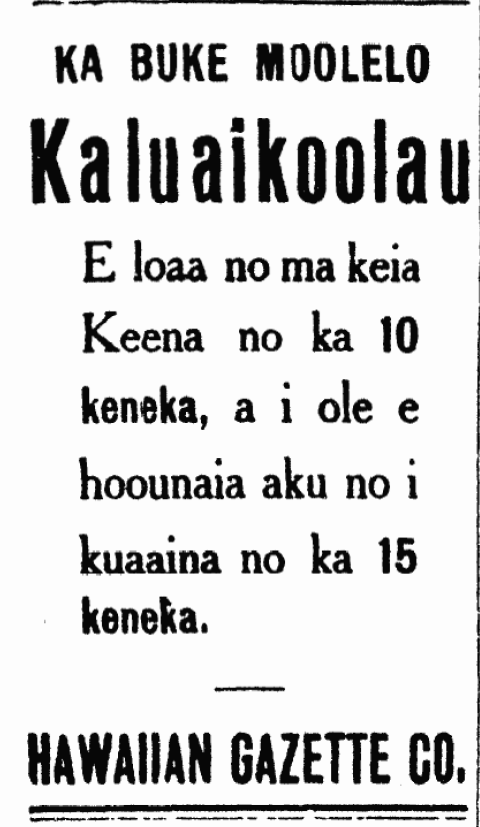
Can be picked up at this Office for 10 cents, or they will be sent to the country for 15 cents.

HAWAIIAN GAZETTE CO.

(Kuokoa, 3/22/1912, p. 6)

KA BUKE MOOLELO

Ka Nupepa Kuokoa, Buke XLVIII, Helu 12, Aoao 6. Maraki 22, 1912.

On the trail of the Japanese New Testament gifted to Kalakaua, 2011.

[So i am still looking for that Bible given at the Yokohama Union Church to King Kalakaua, when he visited there in 1881. Check out these other articles found in The Friend]

HIS MAJESTY IN JAPAN.

And the other article referred to therein,

Cast Thy Bread upon the Waters and Thou Shalt find it after Many Days.

Hawaiian Dictionary, 1913.

Hawaiian Word Dictionary

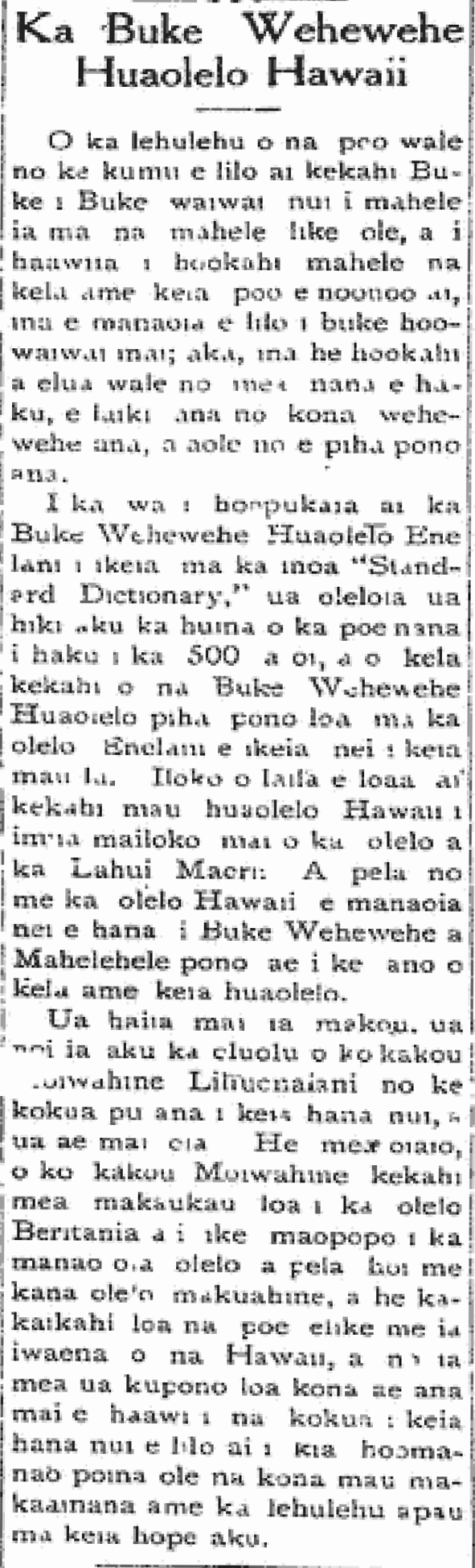
A great number of experts makes a Book a highly valuable Book, divided into many categories, each of which is given to a certain leader to think over, should it be intended to become a useful book; however, if it is composed by just one or two, the explanations will be limited and not complete.

When the English Dictionary, known as the “Standard Dictionary,” was published, it is said that the number of people who produced it is 500 or more, and that is one of the most complete dictionaries of the English language known these days. Within it, there are some Hawaiian words found within the language of the Maoris. And so too with the Hawaiian language, the producing of a Dictionary which clearly defines each word, is now being considered.

We have been told that our Queen Liliuokalani has been asked to help in this great endeavor, and she agreed. It is true, our Queen is very adept at English and understands that language, as well as her own mother tongue, and it is rare to find a person like her amongst the Hawaiians; therefore, it is proper that she agreed to give her assistance to this big project which will become an unforgettable monument for her people and for all people in the future.

(Holomua, 10/4/1913, p. 4)

Ka Buke Wehewehe Huaolelo Hawaii

Holomua, Buke I, Helu 1, Aoao 4. Okatoba 4, 1913