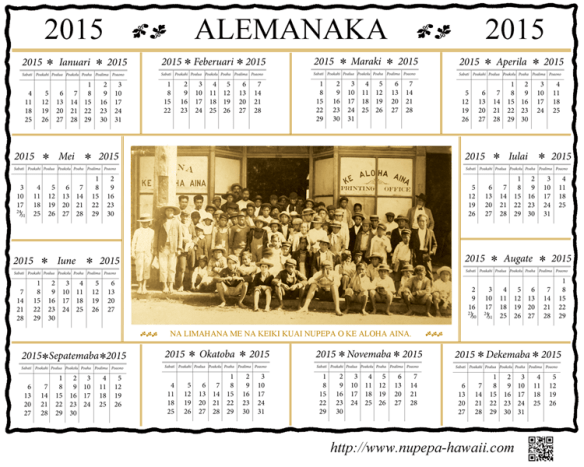
Here is a small makana to everyone who checks in on this blog every once in a while. Just like last year, this is a calendar fashioned after one given by the newspaper Aloha Aina in 1906 to its subscribers. Click on the image and download the pdf file. You should be able to enlarge it to print even on poster-size paper if you want. Feel free to make copies and give it out to anyone you think will appreciate it!
Category Archives: commentary from this blog
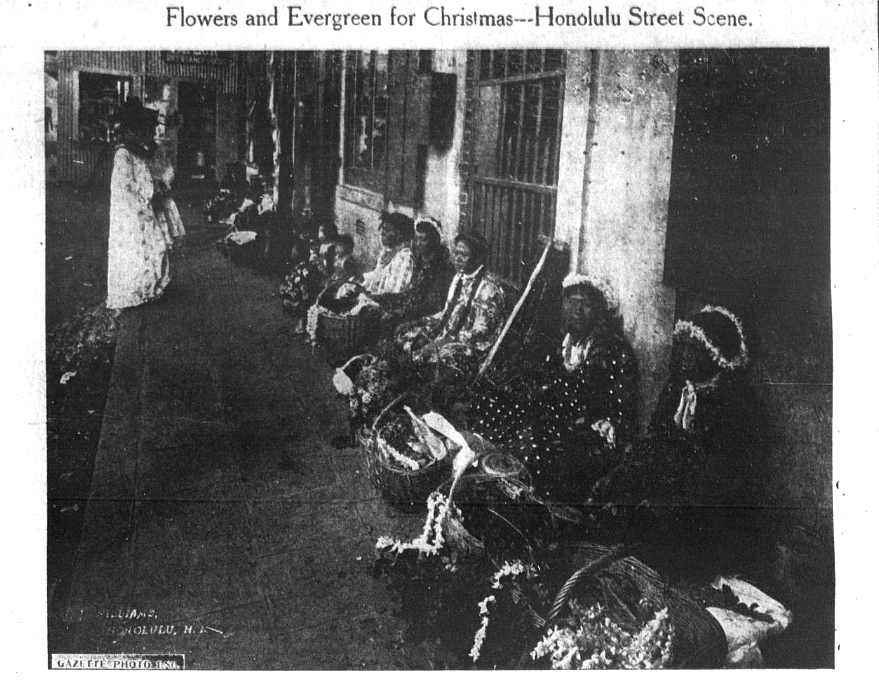
One more Christmas scene from Honolulu nei, 1910.
Flowers and Evergreen for Christmas—Honolulu Street Scene.
J. J. WILLIAMS
HONOLULU, H. I.
GAZETTE PHOTO ENG.
[I just realized now that this is a reused picture. It appears earlier in Kuokoa, 3/11/1904, p. 4! The reuse of stock photos is not unusual (even today)…]
(Hawaiian Gazette, 12/27/1910, p. 3)
More images from the Christmas tree at Iolani Palace, 1910.
THE MALIHINI CHRISTMAS TREE.
New exhibit at Bishop Museum, 2014.
Check out the new exhibit at the Museum commemorating the very beginnings of the Bernice Pauahi Bishop Museum in 1889.¹ Take your parents, and aunties and uncles, and your children, and take a walk with them into the past. Perhaps it will help in bringing back to life family stories! History is cool.
.
In this exhibit, explore how everyday life in Hawai‘i has changed since Bishop Museum was founded in 1889. Some changes have been for the worse and some for the better, and the future holds still more changes that will inevitably transform this place and the people who call it home. [For more, see here at the Bishop Museum page.]
¹The Museum however did not open to the public until 1891.
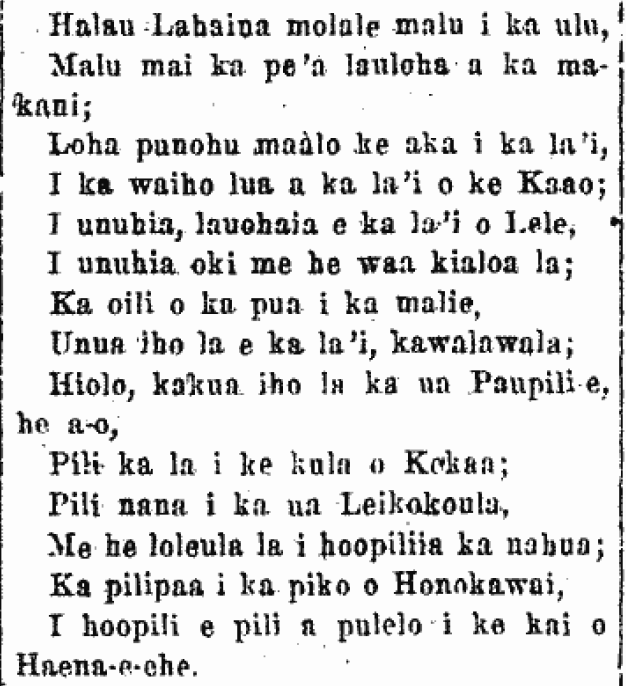
Mele found in moolelo, 1920.
[Found in the story: “Ka Moolelo o He’ma, ke Koaie Ku Pali o ka Makani Kaili Aloha o Kipahulu, Maui.”]
Halau Lahaina molale malu i ka ulu,
Malu mai ka pe’a lauloha a ka makani;
Loha punohu maalo ke aka i ka la’i,
I ka waiho lua a ka la’i o ke Kaao;
I unuhia, lauohaia e ka la’i o Lele,
I unuhia, oki me he waa kialoa la;
Ka oili o ka pua i ka malie,
Unua iho la e ka la’io, kawalawala;
Hiolo, kakua iho la ka ua Paupili e, he a-o,
Pili ka la i ke kula o Kekaa;
Pili nana i ka ua Leikokoula,
Me he loleula la i hoopiliia ka nahua;
Ka pilipaa i ka piko o Honokawai,
I hoopili e pili a pulelo i ke kai o Haena-e-ehe.
[Many times you will find the writer of a story will insert lines of a mele mid-story to evoke a shared memory or emotion with the audience. This writer says these lines of mele were well memorized by those like his grandparents folk.]
(Kuokoa, 10/1/1920, p. 7)
Princess Kaiulani returns home, 1897.
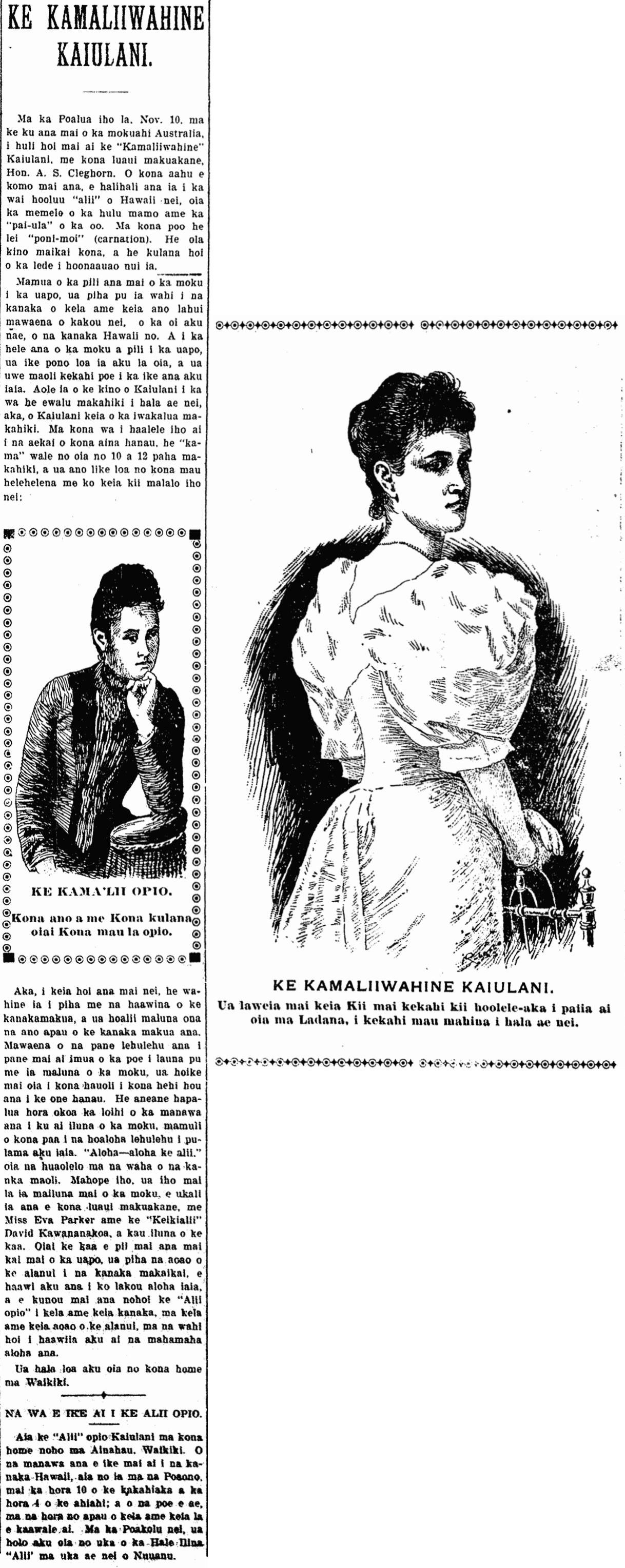
PRINCESS KAIULANI.
This past Tuesday, the 10th of Nov., with the arrival of the steamship Australia, the “Princess” Kaiulani, and her birth father [luaui makuakane], Hon. A. S. Cleghorn returned. Her attire carried the “alii” colors of Hawaii nei, that being the yellow of mamo feathers and the red [“pai-ula”] of the oo. Upon her head was a lei of carnation “poni-moi” [coronation]. She was in fine health, and has the stature of a well-educated lady.
Before the ship docked, the wharf was filled with people of all of the different lahui among us; the most however were Hawaiians. And when the ship came of to the dock, she was clearly seen, and some sobbed at her sight. This was not the body of Kaiulani eight years ago, but this was Kaiulani at twenty years old. When she left the shores of her land of birth, she was bight a child [“kama”] of 10 or 12 years of age, and she looked very much like the picture below:
THE YOUNG PRINCESS.
Her features and Her demeanor in the days of Her youth.
But upon this return, she is a woman that is a full-grown adult, and invested upon her are all the qualities of an adult. Among the words she gave to the people who met with her aboard the ship, she expressed her joy in stepping once again on the sands of her birth. She stood on the ship for almost a half an hour being detained by the many friends who hugged her. “Aloha—aloha to the alii,” are the words from the mouths of the kanaka maoli. Thereafter, she stepped of of the ship, accompanied by her birth father, along with Miss Eva Parker and the “Prince” David Kawananakoa, and she stepped into the car. While the car headed up from the dock, the sides of the street were filled with spectators who gave their aloha to her, and the “young Alii” nodded to each one on both sides of the road at the places which expressed their aloha.
She left for her home in Waikiki.
TIMES TO SEE THE YOUNG ALII.
The young “Alii” Kaiulani is at her residence in Ainahau, Waikiki. She will have audience with the Hawaiians on Saturdays from 10 in the morning until 4 in the afternoon; and the others on each day at the hours set aside. On this Wednesday, she went into the uplands to the Crypt of the “Alii” up in Nuuanu.
THE PRINCESS KAIULANI
This Picture is taken from a lime-light picture [? kii hoolele aka] taken of her in London, a few months ago.
[It is good to be wary of the loyalties of the newspaper (just as it is today) when reading coverage of events. The Kuokoa seems to be at this time pro-annexation and anti-monarchy. This is reflected in their use of quotation marks around words like “Princess” and “Alii”.]
(Kuokoa, 11/12/1897, p. 1)
Two gifts in one, 2014.
Are you looking for the special gift for someone near or far? When you pick up calendars from the Hawaiian Historical Society, you are giving two gifts in one—a calendar for your loved one, and a donation to the Historical Society as well!
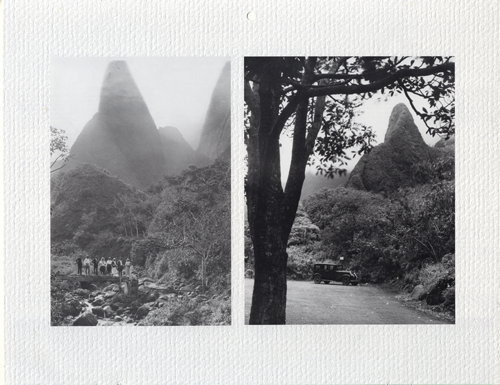
The Hawaiian Historical Society’s Hawaiian history calendar for 2015 is now available. The new calendar features historical photographs of outstanding sites in Hawaiʻi state parks on Kauaʻi, Oʻahu, Maui, and Hawaiʻi Island. Many of the places that are now part of the park system have long attracted residents and visitors alike. The photographs chosen for the calendar exemplify the scenic beauty and unique natural features that have made these locales favored destinations for many decades.
The photographs in the calendar were gleaned from the collections of the Hawaiian Historical Society, the Hawaiʻi State Archives, the Bernice Pauahi Bishop Museum, the Kauaʻi Historical Society and the Hawaiian Mission Children’s Society Library. They date from the1860s through the late 1930s.
As always, the calendar’s pages are filled with notes about significant dates and interesting facts in Island history as well as the phases of the moon. They are great solutions for seasonal gift-giving quandaries.
Society members can purchase copies of the calendar for $8.00 each (plus $3.00 postage when mailed to you). The retail price is $10 per calendar. Bulk rates are available. The calendars can be obtained directly from the Hawaiian Historical Society office at 560 Kawaiahaʻo Street, Honolulu, HI 96813. Telephone (808) 537-6271. Look for them at the annual HHS open house and book sale December 11.
The 2015 Hawaiian history calendar is also available at the following book and gift shops: Native Books at Ward Warehouse; the Mission Houses Gift Shop; the Hawaii State Art Museum Gift Shop; and Kailua General Store.
For more information, see the Hawaiian Historical Society web page!
Language, 2014.
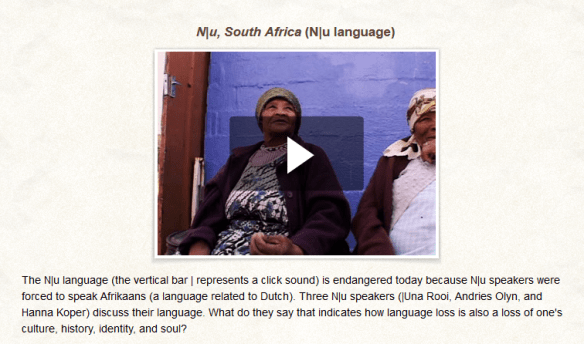
Here is something to think about. The olelo noeau is indeed true, “Make ke kalo a ola i ka palili.” (The oldsters die, but they live on through their offspring.)* Language however is something that needs to be consciously worked at, for if we let it disappear, “when you cover him with dirt, language is not like a plant that grows again…”

N|u, South Africa (N|u language)
http://www.pbs.org/thelinguists/For-Educators/Video-Extras.html
*The old taro stalk dies, but lives on through the shoots. Also seen as “Make ke kalo, ola i ka naio.”
What’s in a name? 2014.
In the recent posts there were examples of many names and variants thereof. If you are doing any sort of research into Hawaii’s past, whether it be genealogical, political, or what have you, it is important to consider that names are complicated and people, places, and things in general can be referred to by any number of different names. It would be a great resource if some entity hosted a site that allowed for adding to a list of this sort. Just in the past few days we had:
G. K. Keawehaku = Gabriel K. Keawehaku = Gaberiela K. Keawehaku = Gabriela K. Keawehaku = Ka Anela o Mekiko
Boston (ship) = Bosetona
Inter-Island Steam Navigation Company = I. I. S. N. Co. = Hui Hooholo Mokuahi Pili Aina
Planter (ship) = Paeli
W. G. Hall (ship) = Malulani
Foster (surname) = Poka
James Robinson = Kimo o Pakaka
Hui Makaainana o Makana and fishing rights, 2014.
Check out this story from one of the Hui Makaainana of today on Kauai! It is awesome to see we are thinking of not only today, but of yesterday and tomorrow as well!
Here is the link to coverage of the story found in the Garden Island¹ of today.
Hook, Line and Sinker
by Chirs D’Angelo, 10/25/2014.
¹We have posted much older stories from this Kauai newspaper which began a hundred and ten years ago (1904); it was nice to link to a story from today!